
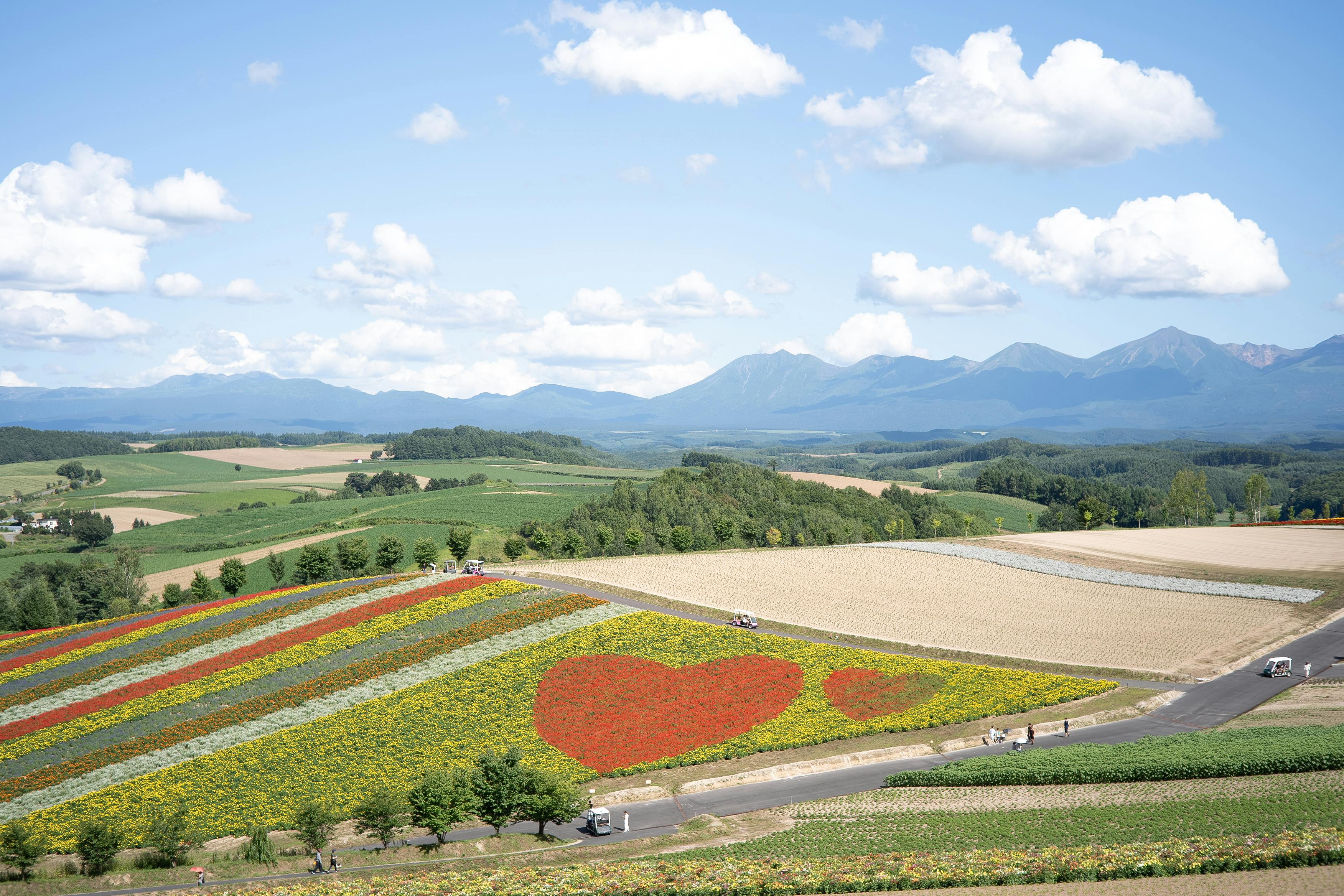
Image Description: Vast purple lavender fields stretching toward the Tokachi mountain range under bright blue summer sky in Furano
Furano Lavender Fields: Where Purple Waves Meet Hokkaido's Horizon
The sweet, herbaceous scent hits you before the color does—a calming aroma that somehow carries both the warmth of summer sun and the coolness of Mount Tokachidake's shadow. At 9:15 AM on a mid-July morning, the bees begin their methodical work, humming through rows of Okamurasaki lavender planted with precision across fields that seem to climb toward the Tenryu Hills. You stand at the crest of this 15-meter slope, looking down at approximately 230 hectares of cultivation—the legacy of a single family's refusal to abandon tradition when synthetic perfumes threatened their livelihood in the 1970s . This is Farm Tomita, Japan's largest lavender farm, where stripes of purple, white, and pink flower across 29 hectares like a living quilt . Below you lies the town of Nakafurano, and beyond it, the volcanic peaks of the Tokachi mountain range—a backdrop that transforms floral agriculture into fine art.
Why the Furano Lavender Fields Embody Agricultural Perseverance
In 1903, Tokuma Tomita first sank his plow into this wilderness, beginning a family legacy that would weather economic collapse and industry-wide transformation . The true test arrived in 1958, when his grandson Tadao began cultivating lavender for essential oils—just as the industry faced crushing competition from cheaper synthetic alternatives. While neighboring farms abandoned their fragrant crops, the Tomita family persisted, developing their own distillation equipment and refusing to compromise on quality. By 1970, lavender cultivation in Furano had peaked at 230 hectares before declining precipitously . But in 1976, an unexpected savior appeared: the Japan Railways calendar featured Farm Tomita's lavender fields, sending photographers and curious travelers flocking to this formerly industrial landscape. Today, the Tomitas produce original perfume from 1984 , and won first prize at France's Lavender Perfume Fair in 1990—proof that authenticity eventually triumphs over imitation. The farm's essential oil, extracted via Tadao's own distillation design, produces about 50 cubic centimeters per batch, each drop representing decades of stubborn devotion to craft .
The Best Time to Experience the Furano Lavender Fields
Timing your visit to Furano demands precision—arrive too early and the buds remain stubbornly green; too late and you'll witness harvested rows stripped of their glory. Outdoor lavender begins blooming around June 20 annually , with early-blooming varieties reaching peak from end of June through mid-July. The classic purple spectacle peaks between July 10 and July 25 , when temperatures hover at a pleasant 20°C–25°C (68°F–77°F)—a miraculous escape from Tokyo's oppressive summer humidity . Late-flowering varieties extend viewing through end of July, but harvesting begins in early August, rendering fields dramatically reduced by mid-August . For sunrise photographers, arrive between 4:30–5:30 AM (July only) to capture the "purple carpet" before tour buses arrive at 10:00 AM. Avoid weekends and July 15–25 if crowd anxiety troubles you; during peak bloom, Farm Tomita's parking lot becomes "a disaster zone" by 10:00 AM . For those willing to trade some purple intensity for solitude, late September offers other flowers at Kanno Farm, where mixed blooms continue until mid-October . Official resources: www.furanotourism.com and www.farm-tomita.co.jp .
Approximate Budget for a 7-Day Furano Trip
This budget assumes mid-range travel during peak lavender season (mid-July). Prices in Japanese Yen (¥) with USD equivalents at ¥150 = $1.
- Accommodation: ¥12,000–¥20,000 per night ($80–$133) — Mid-range pension with breakfast and dinner included ; book by March for July dates
- Food: ¥3,500–¥6,500 per day ($23–$43) — Breakfast at pension (included), Lunch ¥1,000–¥1,800 (ramen at Furano Ramen Alley or Furano Marche ), Dinner ¥2,000–¥4,000 (local izakaya featuring Furano wine and cheese)
- Transportation: ¥2,500–¥5,000 per day — Rental car recommended: ¥5,000–¥8,000/day including insurance; JR Furano Line from Asahikawa: ¥1,070 one-way; bike rental: ¥1,000/day
- Attractions: Farm Tomita: free entry ; Lavender East: free; Hinode Lavender Garden: free ; Furano Winery: free with tastings ; Cheese Factory workshop: ¥1,000–¥1,700; Ningle Terrace: free entry (shopping extra)
- Miscellaneous: Lavender soft serve ¥400 ; DIY lavender sachet workshop ¥800 ; Farm Tomita essential oil (15ml) ¥1,500–¥2,500; Furano melon from roadside stand ¥800–¥1,200
Total estimated for 7 days: ¥95,000–¥160,000 ($630–$1,070) excluding international flights
7 Essential Furano Lavender Field Experiences
- Farm Tomita's "Traditional Lavender Field": The most photographed slope in Hokkaido—and for good reason. Arrive at 8:00 AM (when gates open) to claim your spot before the tour buses descend. Walk to the top of the 15-meter incline and face the Tokachi mountain range. The Okamurasaki variety planted here produces the deepest purple hue; its peak typically occurs July 15–20 .
- Lavender East Expansion: Opened in 2008, this 25-hectare addition to Farm Tomita sits approximately 4 kilometers east of the main property, accessible via free shuttle (10-minute ride, every 20 minutes). Fewer crowds, longer sightlines, and the same free admission. The "Lavender Batake" here slopes toward the mountains rather than away from them—better light for afternoon photography .
- Hinode Lavender Garden's Secret Sunset Point: Located in Kamifurano, approximately 15 minutes by taxi from Furano Station (¥3,000) . This free admission garden offers what Farm Tomita cannot: solitude. The "Secret Sunset Point" overlooks the Tokachi Mountains, turning the peaks pink as the sun drops behind them. Early July offers peak purple with sunset near 7:15 PM. Bring a picnic; benches are minimal but the grassy slope itself serves as seating .
- Choei Lavender Farm Ski Lift Ride: For ¥500 round-trip, ride the old ski lift up the hill above Nakafurano's lavender fields. The 10-minute ascent offers a perspective no ground-level visit can match—looking down into the purple rows rather than across them . Operates only during peak bloom (approximately July 10–31). The lift stops automatically at the top; enjoy the valley panorama before riding back down or hiking the 25-minute trail through adjacent flower fields.
- Furano Winery Lavender Fields: Japan's northernmost municipally-operated winery offers a spectacular免費 pairing: lavender fields planted intentionally alongside terraced grapevines. The contrast between purple flowers and green vines creates unique photographic compositions unavailable elsewhere. Free tastings of Furano wines (produced from local grapes including Kerner and Zweigelt varieties) are available 9:00 AM–4:30 PM . The winery's observation deck faces Shimizu Mountain and fills with yellow flowers in late July after lavender fades.
- Kanno Farm's Rolling Landscape (Late Season): When Farm Tomita's lavender harvest begins in early August, drive 15 minutes from JR Bibaushi Station to Kanno Farm . This hillside farm features lavender alongside mixed annuals planted in sweeping curves that follow the terrain's natural contours—less manicured than Tomita, more organic. Open 9:00 AM until sunset from June through October, with the last lavender typically visible until mid-August. From the farm's crest, you'll see the "rolling landscape of Biei and Furano" that calendars have captured for decades .
- Farm Tomita's Distillery and Dried Flower House: Most visitors photograph fields and rush away, missing the interior experiences that explain why this place matters. The distillery demonstration (hourly, 10:00 AM–3:00 PM) shows Tadao Tomita's original copper equipment extracting essential oil. The Dried Flower House, opened in 2003, preserves 80+ flower varieties in humidity-controlled cases, allowing off-season visitors to experience the farm's full palette. The Greenhouse, blooming year-round, offers lavender viewing even in December .
3 Hidden Gems Most Travelers Miss
- Ningle Terrace After Dark (Not Lavender, But Essential): Located in New Furano Prince Hotel's forest, this village of 15 log cabins opens until 8:45 PM . Most day-trippers from Sapporo leave by 5:00 PM, missing the transformation when artisans light candles inside handcrafted wooden workshops. The "snowrain" effect in winter is well-documented, but summer brings fireflies to the forest edges. Watch glassblowers and woodworkers create pieces available nowhere else. Cash recommended; cards are not accepted at smaller cabins .
- Furano Cheese Factory's Herbal Garden: While the cheese workshops (¥1,700) draw crowds, the herb garden behind the factory sits nearly empty even in July. Over 50 varieties—including six types of lavender not grown at Farm Tomita—are labeled in Japanese and Latin. The "aromatherapy path" invites visitors to crush leaves between fingers and identify scents blindfolded. Open 9:00 AM–5:00 PM; herb garden access is free even if the factory requires payment for workshops.
- Former Tomita Family Residence (Unmarked): On the road between Farm Tomita's main parking area and Lavender East, look for a weathered wooden house set back from the road behind persimmon trees. This was Tokuma Tomita's original 1903 homestead, still owned by the family but unmarked and unpublicized. No tours, no signs—just a quiet historic structure that proves the farm's agricultural roots predate tourism by seven decades. Photograph from the public road; do not enter private property .
Cultural & Practical Tips
- Peak season survival strategy: The parking lot at Farm Tomita fills by 9:30 AM and remains gridlocked until 4:00 PM . Arrive at 8:00 AM (opening) or after 4:00 PM. Better yet, stay in Nakafurano or Furano proper and take the farm's shuttle, which bypasses traffic using employee access roads.
- Lavender variety awareness: Four main lavender varieties bloom at different times . Okamurasaki (deep purple, earliest, late June–mid-July). Hanamoiwa (pinkish-purple, mid-July). Excellent Blue (lighter, late July). Graves (pale purple, early August). If you arrive in early July but see pale lavender, you're simply early for the darker varieties—not at the wrong farm.
- Local phrase: "Oishii desu ne" (美味しいですね) means "It's delicious" and applies equally to lavender soft serve, Furano melon, and locally-brewed beer. Pronounced oh-ee-shee des-kay neh. For farm workers: "Otsukaresama desu" acknowledges hard work with deep cultural respect.
- What to wear: July temperatures reach 25°C (77°F) but drop to 14°C (57°F) after sunset. Layers are essential. The lavender fields have no shade; bring a wide-brimmed hat and sunscreen. Rain turns farm paths to mud—waterproof boots, not sandals.
- Photography etiquette: Drones are prohibited at all major lavender farms. Tripods are allowed at Farm Tomita before 10:00 AM only. Some farmers permit walking between rows; others (marked with rope) do not. The purple exists because of these plants' health—stepping on roots kills future blooms. Stay in designated paths.
- Bee warning: Lavender fields host thousands of non-aggressive honeybees during July. They will not sting unless provoked. Do not swat; do not wear heavy floral perfumes (confuses bees). If one lands on you, remain still until it departs. The farm keeps epinephrine injectors on site but has never needed them in recorded history.
Conclusion: Travel with Wonder, Not Just the Shot
The lavender fields of Furano tempt us to reduce them to a single photograph—that purple slope, that mountain backdrop, that perfect square for a social media grid. But stand here long enough, and you'll realize what persists beyond the frame. Those bees have worked these rows since before you were born. That soil accepted plows in 1903 from a man who crossed Japan seeking opportunity. That family—the Tomitas—watched neighbors abandon lavender, watched synthetic oils threaten their livelihood, and chose to continue anyway. When you visit, you're not consuming a landscape; you're witnessing a living contract between people and place, renewed each July. The flowers will fade, the crowds will disperse, and next year's bloom will arrive without remembering you. That's the gift: not ownership of a moment, but gratitude for being included in something much larger than any single visit could contain.