
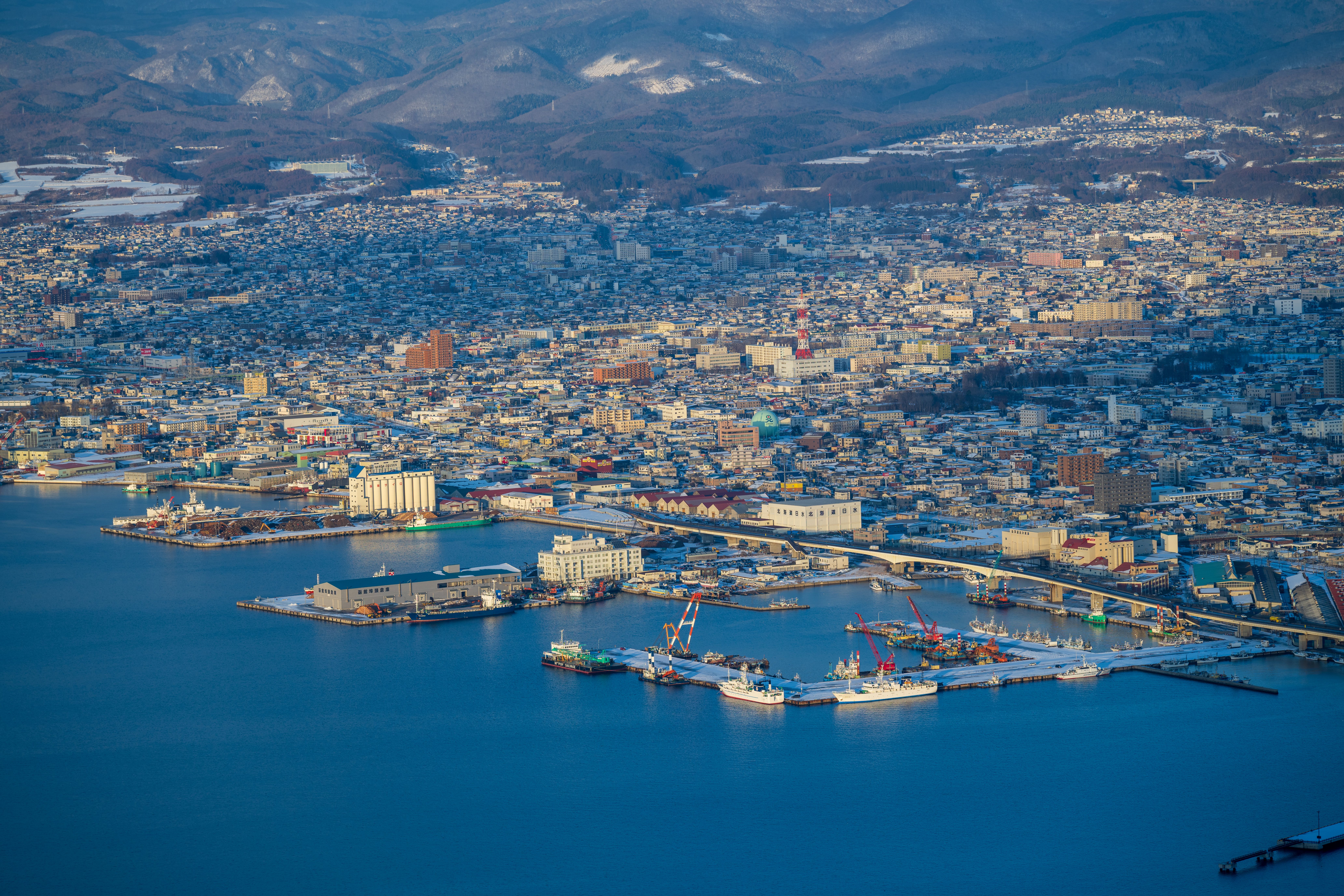
Mount Hakodate: Where City Lights Dance with the Tsugaru Strait
The ropeway cabin rises through evening mist at precisely 6:47 PM—three minutes that feel like a suspended breath. Below you, the isthmus narrows to a mere 800 meters, squeezing two oceans against the city's waist. This is the hour photographers call the "magic hour" (19:00–20:00), when the sky shifts from burnt orange to indigo and the first lights flicker on across Hakodate's fan-shaped bowl . At 334 meters above sea level, the summit observatory delivers a view that Japan's Michelin Green Guide awarded three stars: the double-belted waistline of city lights curving between Hakodate Bay on your left and Tsugaru Strait on your right . You hear the soft whir of the ropeway's steel cables behind you and the distant whisper of waves from two sides simultaneously—a geographic rarity found almost nowhere else on Earth.
Why Mount Hakodate Embodies the World's Top Three Night Views
When Hakodate opened its port to international trade in 1859—becoming one of Japan's first three treaty ports—few could have predicted that this strategic location would birth a visual phenomenon . The city's narrow isthmus creates a natural hourglass shape: lights spill down from the mountainside, constrict through the 800-meter-wide neck, then spread again toward the peninsula's tip. By 2021, the Mount Hakodate Observatory had secured its place among the "World's Top 3 Night Views"—alongside Hong Kong and Naples—a distinction earned not through scale but through this unique geography . From late June through December, you'll witness an additional spectacle: the floating lights of squid fishing boats dotting the strait like fallen stars, their powerful LED arrays visible from the summit . The observatory's two-level deck wraps 360 degrees around the mountain's peak, but the southern face—where the waistline curves most dramatically—draws the largest crowds. Arrive early, claim your spot, and watch as darkness transforms the city into a living constellation.
The Best Time to Experience Mount Hakodate's Magic
Timing separates a good photograph from an unforgettable memory. For the classic "magic hour," arrive 30 minutes before sunset and stay for at least 30 minutes after—this is when the city lights fully activate against deep blue sky . Golden viewing windows: May 20–June 10 (temperatures 12°C–22°C / 54°F–72°F) offers the clearest skies; September 1–October 15 (10°C–20°C / 50°F–68°F) combines crisp autumn air with distant mountain visibility. Winter visits between December 20 and February 20 (-7°C–0°C / 19°F–32°F) reward patience with snow-dusted rooftops reflecting city light. Avoid mid-July through August—frequent summer fog can completely obscure the view, though some photographers chase the mystical "sea of clouds" effect when lights peek through gaps . The ropeway operates 10:00 AM–10:00 PM (until 9:00 PM mid-October to mid-April) with departures every ten minutes, but evening congestion means waits of 30–60 minutes between 6:00–8:00 PM . Official resources: www.visit-hokkaido.jp and ropeway: 334.co.jp/en/ .
Approximate Budget for a 7-Day Hakodate Trip
This budget assumes mid-range travel during October (shoulder season) excluding international flights. Prices in Japanese Yen (¥) with USD equivalents at ¥150 = $1.
- Accommodation: ¥9,000–¥18,000 per night ($60–$120) — Motomachi or near Hakodate Station. Hotel Paco Hakodate (¥12,000) or Dormy Inn Express (¥10,500)
- Food: ¥4,000–¥7,500 per day ($27–$50) — Breakfast ¥600–¥1,200 (Hakodate Morning Market squid), Lunch ¥1,500–¥2,500 (Lucky Pierrot Chinese Chicken Burger set), Dinner ¥2,000–¥4,000 (Izakaya in Daimon Yokocho)
- Transportation: ¥1,500–¥2,800 per day — JR Limited Express from Sapporo to Hakodate: ¥8,830 one-way (3.5 hours). Local tram day pass: ¥600–¥800. Hakodate Special Ticket (includes ropeway round-trip + tram pass + attraction points): ¥3,500–¥4,000 ($23–$27) — excellent value
- Attractions: Mount Hakodate Ropeway round-trip: ¥1,800 ($12) ; Goryokaku Tower: ¥900; Hakodate Hachimangu Shrine: free; Kanemori Red Brick Warehouse: free entry; Bay Area walking tour: self-guided
- Miscellaneous: Squid ink soft serve ¥500; Hakodate glassware workshop ¥2,500–¥4,000; "Hakodate Special Ticket" coupon booklet for souvenirs; Hand towel from waterfront shrine ¥800
Total estimated for 7 days: ¥78,500–¥168,500 ($525–$1,125) excluding international flights
6 Essential Mount Hakodate Experiences
- The Golden 30-Minute Transition: Arrive at the summit observatory 45 minutes before sunset. Watch the city transform from afternoon sprawl to scattered diamonds. The moment when the final traces of orange vanish and the lights fully take over happens in under two minutes—stay off your phone, keep your eyes on the waistline's curve, and witness why this view earned three Michelin stars .
- Ropeway Cabin Seaward Position: On the ascent, position yourself at the back of the cabin (the side facing Hakodate Bay). As the cable car climbs, you'll witness the "double arc" of the coastline unfolding beneath you—a composition impossible to capture from the summit alone . The large cabins accommodate 125 passengers, so move toward the glass immediately upon boarding.
- September Squid Fishing Boat Lights: Return between June and December and look toward the Tsugaru Strait. The distant twinkling row of lights belongs to the squid fishing fleet—each vessel using powerful LEDs to attract catch. The sight of hundreds of lights floating on black water, separate from the city's glow, creates an otherworldly second horizon .
- Battery Ruins Historical Walk: Before sunset, explore the Goten-yama and Senjojiki gun battery ruins—remnants of Hakodate's 19th-century fortifications. This 20-minute walk from the ropeway's summit station passes former military positions with their own dramatic views of the strait. History and panorama combine without the crowds .
- Observation Deck Night Photography: The best spot for the waistline shot is the lower deck's southern railing—arrive at least 60 minutes before sunset on weekends to claim space. Settings: ISO 800–1600, aperture f/8–f/11, shutter 15–30 seconds on a tripod. No tripods allowed in the top-level indoor observatory, but the outdoor deck welcomes them .
- Daimon Yokocho Post-Viewing Dinner: After descending (avoid the 8:00–9:00 PM rush by staying late), walk 15 minutes to this food stall village of 26 stalls. Experience hashigozake (bar hopping)—visit two or three stalls, order grilled squid at one, ramen at another, and finish with Genghis Khan lamb. Each stall seats 8–10 people, creating intimate encounters with local chefs .
3 Hidden Gems Most Travelers Miss
- Hachimanzaka Slope at Blue Hour: Most photographers chase the slope during daytime, but the true magic unfolds 20 minutes after sunset. From this cobblestone street, the view frames Hakodate Bay between Western-style buildings. The lights of docked fishing boats reflect in puddles after rain, creating mirror images overlooked by those who only climb the mountain. Access: 10-minute walk from Jujigai tram stop, just below the Motomachi churches .
- Yachigashira Onsen After Sunset: While tourists rush back to central hotels, locals head to this neighborhood hot spring district. The public bathhouse (¥450) has been operating for over 80 years, its mineral waters heated naturally from beneath the mountain you just descended. Open until 10:00 PM—perfect for warming winter-chilled bones. From Jujigai tram, take the line toward Yachigashira (9 minutes, ¥240) .
- Mount Hakodate Hiking Trail Evening Descent: Everyone takes the ropeway down, but the 60-minute hiking trail offers a entirely different experience. Starting from the summit's rear exit (follow signs for "hiking course"), the path is well-marked with small reflectors. Bring a headlamp. You'll descend through dense forest hearing only wind and your own footsteps, emerging at Jujigai. The trail closes at 8:00 PM in winter, but summer evenings (until 7:00 PM) provide a meditative alternative to waiting in ropeway queues .
Cultural & Practical Tips
- Sunset timing calculator: Hakodate's sunset shifts dramatically: December 15–January 15 (4:05–4:20 PM), June 15–July 15 (7:05–7:15 PM). Check the official ropeway website's daily sunset forecast—their timing is accurate to within two minutes .
- Winter clothing warning: The summit's temperature is consistently 5°C–8°C (9°F–14°F) colder than the base. February nights average -10°C (14°F) with wind chill. Hand warmers (kairo, ¥200 at any convenience store) and insulated gloves are not optional—they're survival gear.
- Private vehicle restrictions: From mid-April through November, private cars are banned from the mountain road between 5:00 PM and 10:00 PM. From December through March, the road closes entirely. Taxis can ascend only before 5:00 PM. The ropeway is your only reliable evening option .
- Local phrase for ordering seafood: "Ika wa ikaga desu ka?" (イカはいかがですか) — "How about some squid?" Pronounced ee-kah wah ee-kah-gah dehss kah? Use at Morning Market stalls to initiate bartering. The pun (ika means both "squid" and "how about") charms vendors.
- Hakodate Special Ticket strategy: Purchase this ¥3,500–¥4,000 booklet at Hakodate Station or online. It includes one ropeway round-trip ticket (worth ¥1,800) plus 12 point tickets redeemable at Goryokaku Tower, the Northern Peoples Museum, and even for takeout yakitori bento boxes. The tram day pass alone covers transportation between all major sights .
- Photography peak hour crowds: The summit platform holds approximately 500 people, but during Golden Week (April 29–May 5) and Obon (August 13–16), visitors exceed capacity. If traveling during these periods, arrive 90 minutes before sunset or visit after 9:00 PM—the view remains spectacular, but crowds thin by 20–30% .
Conclusion: Travel with Awe, Not Just Ambition
The million-dollar night view—that's what locals call it, though no one remembers who first assigned the price tag. But standing at Mount Hakodate's summit, watching the waistline glow against two oceans, you realize money cannot measure what unfolds before you. This view exists because of geography's accident: an isthmus so narrow that two seas nearly touch, a mountain so perfectly positioned that it frames humanity's lights against nature's darkness. But it also exists because Hakodate's residents preserved their waterfront, their historical buildings, their low-rise skyline—choices that kept the view uncluttered for generations yet unborn. When you descend that ropeway, take something home beyond photographs: the understanding that some places ask not for your checklist, but for your stillness. The mountain will be here tomorrow, next year, a decade from now—if we remember to look up.