
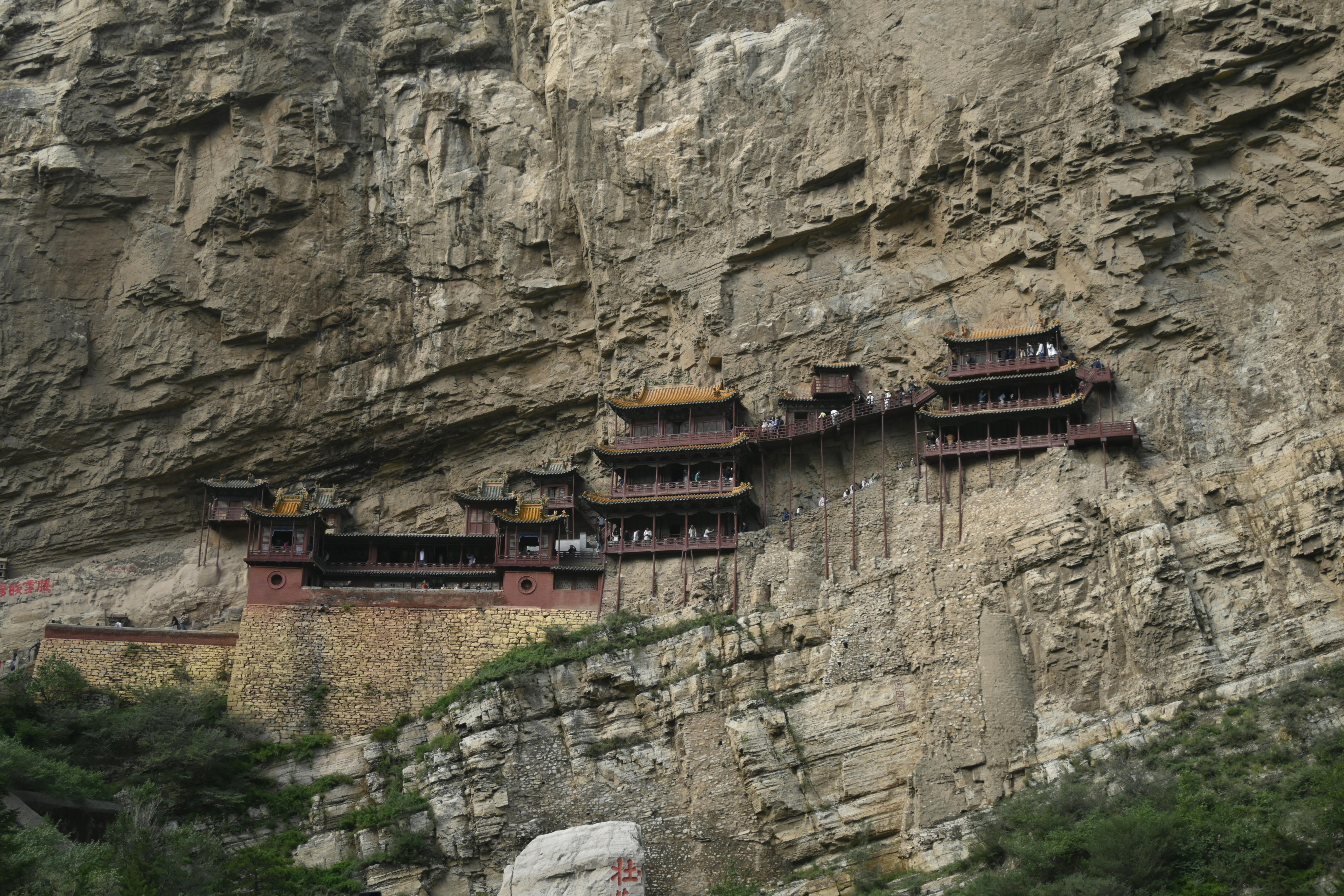
Hanging Monastery Datong: Where Cliffside Faith Meets Triune Harmony
Dawn breaks over Mount Heng—75 meters (246 feet) above the Jinlong Gorge—where the Hanging Monastery clings to the sandstone cliff like a swallow's nest woven from faith and timber. You stand on the narrow wooden walkway, feeling the subtle sway of 27 oak beams inserted deep into the rock face in 491 CE, while the first rays of sun gild the temple's upturned eaves and the distant chime of bells echoes through the misty valley. Below, the Hengshan River glints silver; above, prayer flags snap in the crisp mountain air, carrying whispers of Buddhist sutras, Taoist chants, and Confucian verses—the only temple in China where three philosophies share one sacred space. This is not merely architecture; it is a testament to human ingenuity suspended between earth and sky, where every creaking plank and weathered statue binds the Northern Wei Dynasty to the present. The Hanging Monastery matters because it embodies a profound truth: that harmony among differences is not just possible, but breathtakingly beautiful.
Why Hanging Monastery Datong Embodies Architectural Ingenuity
Built in 491 CE by the monk Liaoran during the Northern Wei Dynasty, the Hanging Monastery (Xuankong Si) solved a profound engineering challenge: how to create a stable spiritual sanctuary on a near-vertical cliff face while protecting it from floods, erosion, and invaders. The complex spans 90 meters (295 feet) horizontally across the cliff, with 40 halls and pavilions connected by winding corridors, staircases, and stone-cut passages. Its structural genius lies in the "inserted beam" technique: 27 fly-cantilevered oak beams, each 10–12 centimeters in diameter, are driven 1.5 meters into pre-drilled rock holes, then layered with crossbeams and planks to form a flexible yet resilient framework that absorbs seismic activity. The temple's triune dedication—to Buddhism (Sakyamuni), Taoism (Laozi), and Confucianism (Confucius)—reflects the Northern Wei's political strategy of unifying diverse belief systems under imperial patronage. UNESCO added Xuankong Si to its Tentative List in 2008, recognizing its unique fusion of religious architecture and cliff-side engineering. Today, conservation teams monitor humidity and wood integrity with laser scanners, ensuring this "miracle of suspension" endures for another 1,500 years. This is ingenuity written in timber and stone—a dialogue between human ambition and geological permanence.
The Best Time to Experience Hanging Monastery Datong
For optimal conditions, target two precise windows: April 20–May 31 or September 15–October 25. During spring, daytime temperatures at Mount Heng range from 10°C to 22°C (50°F to 72°F), with nights averaging 2°C to 10°C (36°F to 50°F); autumn offers crisp days (8°C–20°C / 46°F–68°F) and cooler nights (–2°C to 7°C / 28°F–45°F). Aim to arrive at the monastery between 7:30–9:00 AM for the softest light on cliff facades and minimal crowds on the narrow walkways. Avoid November 1–March 31 (extreme cold, –20°C/–4°F nights, icy pathways, and potential site closures due to snow) and June 1–August 31 (peak heat up to 32°C/90°F, high humidity, and dense tour groups that limit access to upper halls).. Note: Since 2021, visitor flow is managed via 30-minute entry slots—book online 72 hours in advance to secure access during peak hours.
Approximate Budget for a 7-Day Trip
Pricing reflects mid-range independent travel with local guide services, based on 2026 rates from Datong-based operators and hotel associations. Costs assume shared accommodation, three daily meals, and standard attraction fees; private tours or luxury upgrades increase expenses by 40–70%.
-
• Accommodation: ¥300–¥700 per night (boutique guesthouse in Datong's Pingcheng District; prices rise for courtyard-style hotels near the Old City)
• Food: ¥120 per day (breakfast ¥30: congee, steamed buns, soy milk; lunch ¥45: hand-pulled noodles, dumplings, stir-fried mountain vegetables; dinner ¥45: Shanxi braised lamb, knife-cut noodles, hawthorn dessert)
• Transportation: Datong Airport–city taxi ¥65; city–Hanging Monastery private transfer ¥180 round-trip; high-speed train to Beijing ¥180 one-way
• Attractions: Hanging Monastery entry ¥150; Mount Heng Scenic Area pass ¥55; Huayan Temple ¥50; guided architecture tour add-on ¥90
• Miscellaneous: Portable oxygen canister ¥25; souvenir woodblock print ¥45–130; thermal gloves ¥40
Total estimated budget: ¥3,680–¥5,420 CNY ($510–$750 USD)
7 Essential Hanging Monastery Datong Experiences
- Walk the cliffside corridor at sunrise: Arrive by 7:30 AM; the narrow wooden walkway offers breathtaking views of the Jinlong Gorge—bring a wide-angle lens and hold the handrail firmly as the structure gently sways.
- Contemplate the triune altar: Inside the central hall, observe the rare side-by-side statues of Sakyamuni, Laozi, and Confucius; the harmonious arrangement reflects centuries of philosophical synthesis—allow 15 minutes for quiet reflection.
- Photograph the inserted beams: From the lower viewpoint at 8:30 AM, capture the 27 oak beams protruding from the cliff; use a 70–200mm lens to highlight the engineering detail without flash.
- Climb to the highest pavilion: Ascend the 40-step stone staircase to the Taoist shrine; the panoramic vista of Mount Heng's forested slopes rewards the effort—ideal for golden-hour photography.
- Attend a morning chant: If visiting on a Buddhist holiday, witness monks reciting sutras in the main hall; the resonant voices echoing through the cliff chamber create a transcendent atmosphere.
- Explore the stone-cut passages: Follow the narrow tunnels carved directly into the sandstone; the cool, mineral-scented air and ancient tool marks offer a tactile connection to 5th-century craftsmen.
- Watch sunset over Jinlong Gorge: From the eastern terrace at 6:00 PM; the cliff face glows amber as shadows deepen the temple recesses—perfect for silhouette shots with a tripod.
3 Hidden Gems Most Travelers Miss
-
• Mount Heng's Taoist Hermitage Trail: A quiet 2-km path leading to a secluded meditation cave used by Taoist monks since the Tang Dynasty. Access: Start from the monastery's eastern exit; follow blue trail markers. Best visited 10:00 AM–12:00 PM for dappled forest light. Insider tip: Bring a small offering of fruit; locals believe it invites blessings for safe passage, and the cave's acoustics amplify whispered mantras.
• Hunyuan County's Ancient Rammed-Earth Village: A 30-minute drive southeast, featuring 400-year-old courtyard homes built with traditional hangtu (compacted earth) techniques. Access: Hire a local driver in Datong; request "Hunyuan Tucheng." Insider tip: Visit Tuesday mornings when artisans demonstrate wall-repair methods; purchase handmade clay pottery to support heritage crafts.
• Jinlong Gorge Riverside Walk: A peaceful trail along the riverbank below the monastery, offering unique upward views of the suspended temple. Access: Descend via the southern path from the parking lot; allow 45 minutes round-trip. Insider tip: Go at low tide (early morning) to photograph the monastery's reflection in calm water—bring a polarizing filter to reduce glare on the sandstone.
Cultural & Practical Tips
-
• Greet locals with "Nǐ hǎo" (nee how), meaning "hello"; a slight bow conveys added respect, especially with elders.
• Photography etiquette: Flash is prohibited inside temple halls to protect ancient pigments; use natural light or a fast lens (f/1.8 or wider).
• Dress modestly: Cover shoulders and knees when entering sacred spaces; remove hats and sunglasses indoors as a sign of reverence.
• Safety first: The walkways are narrow and can be slippery; wear non-slip shoes and hold handrails—children under 1.2 meters (4 feet) require adult supervision.
• Altitude awareness: Mount Heng sits at 1,800 meters (5,906 feet); stay hydrated and pace yourself during climbs.
• Language tip: Learn "Xièxie" (shyeh-shyeh) for "thank you"; carrying a translation app helps navigate menus and directions.
• Leave no trace: Pack out all non-biodegradable waste; use designated site toilets, and avoid touching statues to preserve delicate surfaces.
Conclusion: Travel with Reverence, Not Just Records
The Hanging Monastery is not a checklist of photo ops—it is a living dialogue between cliff and creed. When you stand where 1,500 years of devotion echo through timbered halls and sunlight illuminates the hands of ancient builders, the impulse to rush dissolves; what remains is the quiet discipline of presence. Choose to tread lightly: support local guesthouses, hire Datong-based guides, and carry out more than you bring in. Let your footprints be temporary, but your respect enduring. For in the silence between swaying beam and whispered prayer, you discover that the greatest journey is not measured in temples visited, but in moments of humility, connection, and awe. Slow down. Trace the grain of an ancient oak beam. Let the cliff change you.