
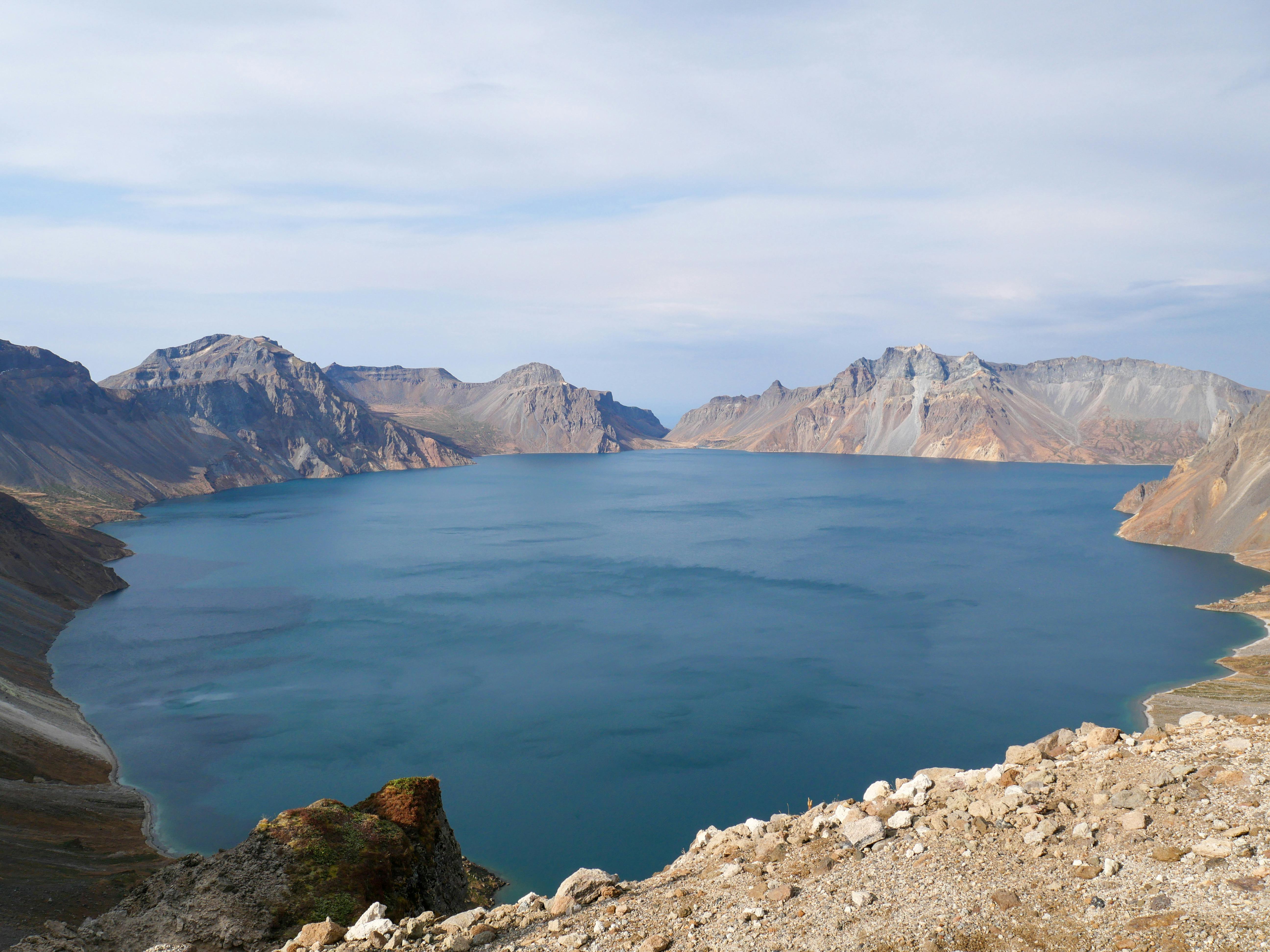
Heavenly Lake Tianchi: Where Volcanic Depths Meet Celestial Serenity
Mist curls across the obsidian surface of Tianchi—Heavenly Lake—as the first light of dawn ignites the sixteen peaks encircling this sacred caldera. You stand at 2,189 meters (7,182 feet) above sea level, where the air tastes of pine and volcanic minerals, and the silence is broken only by the whisper of wind through dwarf birch forests. This crystalline lake, spanning 9.82 square kilometers with a maximum depth of 373 meters (1,224 feet), was born from the cataclysmic "Millennium Eruption" of Mount Paektu in 946 AD—one of Earth's most powerful volcanic events in recorded history. For the Manchu people, this is not merely a lake but a spiritual portal: legend holds that the sky goddess Bukūri Yongšon descended here to give birth to the founding ancestor of the Qing Dynasty. Today, as you trace the rugged rim where China meets North Korea, you witness more than geological wonder—you encounter a living symbol of cultural reverence, ecological fragility, and the profound beauty that emerges when fire yields to water.
Why Heavenly Lake Tianchi Embodies Volcanic Spirituality
Heavenly Lake Tianchi represents a rare convergence of geological power and spiritual significance. Formed by the colossal 946 AD eruption of Mount Paektu—a VEI-7 event that ejected over 100 cubic kilometers of tephra—the lake fills a caldera 4.5 kilometers wide and 3.5 kilometers long. Its waters, among the purest on Earth, maintain a pH of 6.8 and temperatures rarely exceeding 10°C (50°F) even in summer, fed solely by precipitation and snowmelt. This extreme environment solved a fundamental human need: providing a sacred, untouched space for contemplation amid the chaos of earthly life.
The lake's cultural resonance spans centuries. For the Manchu emperors of the Qing Dynasty (1644–1912), Tianchi was gioro—a holy site protected by imperial decree. Pilgrims undertook arduous journeys to its shores, believing the lake's waters granted longevity and wisdom. The sixteen surrounding peaks, each named for distinctive shapes (Cloud-Crowning Peak, Jade-Column Peak), form a natural mandala that aligns with traditional Chinese cosmology. Modern conservation efforts, initiated in 1960 with the establishment of Changbai Mountain National Nature Reserve, protect over 2,000 plant species and endangered fauna like the Siberian tiger and Korean goral.
Engineering marvels facilitate access without compromising sanctity: a 72-kilometer mountain road with 108 hairpin turns ascends from Erdaobaihe Town, while eco-friendly electric shuttles transport visitors the final 12 kilometers to the viewing platform. The observation deck, constructed with reinforced glass and steel to withstand -40°C winters and 200 km/h winds, positions you precisely above the lake's deepest point—where legend says a mythical creature guards ancient secrets. This careful balance between accessibility and preservation embodies Tianchi's enduring lesson: that humanity's greatest achievements honor, rather than dominate, the natural world.
The Best Time to Experience Heavenly Lake Tianchi
Timing transforms your Tianchi encounter from challenging to transcendent. The optimal window spans June 15 through September 20, when daytime temperatures range 10–20°C (50–68°F) and the mountain roads remain snow-free. For photographers chasing the legendary "sea of clouds" phenomenon—where mist pools below the rim while peaks pierce blue sky—arrive between 5:30–7:30 AM when atmospheric conditions most frequently align.
Summer (July–August) offers wildflower meadows in full bloom and the highest probability of clear lake views, though afternoon fog rolls in 60% of days. September delivers crisp air, golden larch forests, and fewer crowds, with temperatures cooling to 5–15°C (41–59°F). Winter access (November–March) is extremely limited: the north slope road closes during heavy snow, and temperatures plummet to -25 to -35°C (-13 to -31°F), though the frozen lake creates an otherworldly landscape for experienced adventurers with proper gear.
Avoid the first week of October (China's National Day holiday) when visitor numbers surge 300%, creating long shuttle queues and obscured viewpoints. The lake is visible only 80–100 days annually due to weather; check the Changbai Mountain weather forecast before ascending. The scenic area opens daily from 7:30 AM to 4:00 PM (June–September) and 8:30 AM to 3:00 PM (October–May), with last shuttle departure 90 minutes before closing.
Approximate Budget for a 7-Day Trip
Pricing for Heavenly Lake Tianchi reflects Northeast China's regional economy—moderate costs with excellent value for nature-focused travelers. The following breakdown assumes mid-range preferences with comfortable lodging in Erdaobaihe Town and authentic local dining. Prices quoted in Chinese Yuan (¥) with approximate USD equivalents. • Accommodation: ¥280–¥550 ($39–$77) per night for mid-range hotels in Erdaobaihe Town; budget guesthouses ¥120–¥220 ($17–$31); eco-lodges near park entrance ¥600–¥900 ($84–$126) • Food: ¥150–¥250 ($21–$35) per day (breakfast ¥25–¥40 for congee and pickles, lunch ¥50–¥80 for Korean-style cold noodles, dinner ¥75–¥130 for Changbai Mountain mushroom hotpot) • Transportation: High-speed rail from Changchun to Dunhua ¥95 ($13) one-way; shuttle bus to Erdaobaihe ¥45 ($6); park entrance shuttle ¥85 ($12); eco-bus to summit ¥35 ($5) • Attractions: Changbai Mountain North Slope combo ticket ¥125 ($17) includes park entry, shuttle, and eco-bus; Waterfall viewpoint ¥30 ($4); Underground Forest trail ¥25 ($3.50); hot springs access ¥60 ($8.50) • Miscellaneous: Thermal jacket rental ¥80/day ($11) for winter visits; local ginseng tea ¥45 ($6.50); hand-carved wooden souvenirs ¥100–¥400 ($14–$56); travel insurance recommended ¥50–¥120 ($7–$17) Total estimated cost for 7 days: ¥5,200–¥7,800 ($730–$1,090)6 Essential Heavenly Lake Tianchi Experiences
- Summit at Sunrise for the "Sea of Clouds": Depart Erdaobaihe by 4:30 AM to reach the north slope viewing platform by 5:45 AM. The 20-minute walk from the eco-bus terminal follows a wooden boardwalk with 328 steps. When conditions align, mist pools 200 meters below the rim while the lake's surface mirrors the first light—a phenomenon locals call yunhai. Bring a thermal layer; summit temperatures average 8°C cooler than the base.
- Hike the Underground Forest Loop: This 2.3-kilometer boardwalk trail descends 45 meters into a volcanic fissure forest where ancient spruce and birch grow in mineral-rich soil. The 90-minute walk reveals moss-draped cliffs, hidden streams, and the rare Changbai Mountain viper. Best visited between 9:00–11:00 AM when dappled light illuminates the canopy. Trailhead located 15 km from main entrance; shuttle stops every 30 minutes.
- Soak in Changbai Mountain Hot Springs: At the Juexian Resort area, natural geothermal pools maintain 42°C (108°F) year-round, rich in sulfur and silica. The outdoor "Sky Pool" overlooks the valley with mountain views. Visit between 4:00–6:00 PM for optimal light and fewer crowds. Entrance ¥60 ($8.50); private pool rentals ¥200 ($28) for 60 minutes. Shower facilities provided; remove jewelry to prevent sulfur damage.
- Photograph Changbai Waterfall: This 68-meter cascade plunges from the lake's northern outlet, creating a permanent rainbow in morning mist. The viewing platform sits 150 meters from the falls—close enough to feel the spray, far enough to capture the full arc. Arrive by 8:00 AM for side-lighting that highlights the water's texture. Use a polarizing filter to reduce glare; shutter speed 1/125s freezes motion, while 1/15s creates silky flow.
- Explore the Manchu Cultural Exhibition Hall: Located at the park's base camp, this museum houses artifacts from Qing Dynasty pilgrimages, including ceremonial robes, ritual drums, and historical maps of the sacred mountain. The 45-minute self-guided tour includes a 10-minute documentary on Tianchi's geological formation. Open 8:00 AM–4:00 PM; audio guides available in English for ¥25. Don't miss the replica of the 1712 imperial survey marker that defined the China-Korea border.
- Stargaze from the Alpine Meadow: After sunset, the high-altitude air (low humidity, minimal light pollution) reveals the Milky Way with stunning clarity. Join the park's optional evening program (June–August, 8:30 PM, ¥40/$5.50) where rangers share Manchu star legends while you observe through telescopes. Dress in layers—temperatures drop rapidly after dark. The meadow is accessible via the same shuttle route; last return bus departs at 9:30 PM.
3 Hidden Gems Most Travelers Miss
- West Slope Alpine Garden (Xipo Gaoshan Huayuan): While 95% of visitors flock to the north slope, the west slope offers wildflower meadows blooming with rare species like Changbai rhododendron and Siberian iris from late June to mid-July. Access requires a separate ¥105 ($15) ticket and a 1,442-step climb to the viewing platform—but rewards with panoramic lake views and near-solitude. Shuttle departs Erdaobaihe at 7:00 AM and 1:00 PM; allow 4 hours round-trip. Bring binoculars for spotting golden eagles nesting on western cliffs.
- Jinjiang Canyon Hot Spring Valley: Located 28 km southeast of Erdaobaihe, this geothermal valley features 12 natural pools nestled among birch forests, with water temperatures ranging 38–45°C (100–113°F). Unlike the resort pools, these are undeveloped—just wooden changing huts and stone basins. Entry ¥30 ($4); open 8:00 AM–5:00 PM. Visit on weekday mornings to avoid small tour groups. Local tip: Mix cold mountain stream water with hot spring water for a refreshing contrast therapy.
- Erdaobaihe Forest Observatory: This little-known research station 5 km north of town offers guided dawn walks with ecologists studying Changbai's biodiversity. The 2-hour experience includes tracking wildlife signs, identifying medicinal plants, and learning about reforestation efforts. Advance booking required via the Jilin Forestry Bureau (phone: +86-433-571-0088); cost ¥180 ($25) includes transport and equipment. Limited to eight participants per session; departures at 5:00 AM May–September. A rare chance to contribute to citizen science while experiencing the mountain's ecological richness.
Cultural & Practical Tips
- Respect Sacred Boundaries: Tianchi remains spiritually significant to Manchu and Korean communities. Never throw objects into the lake, remove stones, or speak loudly at the summit—these actions violate local customs and park regulations. Photography is permitted everywhere except inside cultural exhibition halls (marked with signs).
- Essential Mandarin Phrases: Master these pronunciations: Nǐ hǎo (nee how) = Hello; Zhèlǐ yǒu cèsuǒ ma? (jer-lee yo tsuh-swuh mah) = Is there a bathroom here?; Duōshǎo qián? (dwo-shao chyen) = How much?; Xièxie nǐ (shyeh-shyeh nee) = Thank you.
- Altitude & Weather Prep: At 2,189 meters, altitude sickness can affect sensitive individuals. Ascend gradually, stay hydrated, and avoid alcohol the night before your summit visit. Weather changes rapidly: pack waterproof layers, windproof jacket, and UV-protection sunglasses. Even in summer, summit temperatures can drop to 5°C (41°F) with wind chill.
- Border Awareness: The lake straddles the China-North Korea border. Stay on marked paths; crossing the demarcation line is strictly prohibited and monitored by border patrol. Photography of military installations (rare but possible on distant ridges) is forbidden. Carry your passport at all times for potential checkpoint verification.
- Eco-Conscious Practices: Changbai Mountain is a UNESCO Biosphere Reserve. Use reusable water bottles (filling stations at shuttle stops), pack out all trash, and stay on boardwalks to protect fragile alpine vegetation. Avoid purchasing souvenirs made from protected species like bear bile or wild ginseng—opt for locally crafted wood carvings or herbal teas instead.
- Transportation Timing: The last shuttle from the summit departs 90 minutes before park closing. Missing it requires a ¥300 ($42) private vehicle arrangement. For west slope visits, confirm shuttle schedules the prior evening—services reduce frequency after September. Download offline maps; cellular signal is unreliable above 1,800 meters.
- Dietary Notes: Northeastern Chinese cuisine features hearty, warming dishes perfect for mountain climates. Try guōbāo ròu (sweet and sour pork) and dì sān xiān (potato, eggplant, pepper stir-fry). Korean-Chinese restaurants abound in Erdaobaihe; look for naengmyeon (cold buckwheat noodles) in summer. Vegetarian options are limited but available—request sù shí (vegetarian meal) when ordering.
Conclusion: Travel with Reverence, Not Just Curiosity
Heavenly Lake Tianchi invites more than sightseeing—it demands reverence. As you stand above this volcanic caldera, remember that every ripple on its surface echoes a cataclysm that reshaped continents, and every legend whispered along its rim carries the wisdom of cultures who understood nature as kin, not commodity. This lake endures not because it is untouched, but because generations chose to protect its sanctity.
Visit Tianchi not to conquer a summit, but to listen—to the wind through ancient birches, to the stories embedded in Manchu rituals, to the quiet reminder that Earth's most profound beauty often lies in balance, not dominance. Support conservation by choosing eco-certified lodges, hiring local guides, and respecting trail closures designed to protect fragile ecosystems. Leave only footprints that fade with the next snowfall; carry home not just photographs, but a deeper commitment to preserving places where the celestial and terrestrial still converse.
In a world racing toward extraction, Tianchi stands as a testament to restraint—a mirror reflecting not just sky, but our capacity for wonder. Slow down. Breathe the thin, pine-scented air. Let the lake's stillness recalibrate your sense of time. For in that pause, you may hear what pilgrims have heard for centuries: the gentle reminder that some boundaries—between earth and sky, past and present, self and wilderness—are meant not to be crossed, but honored.