
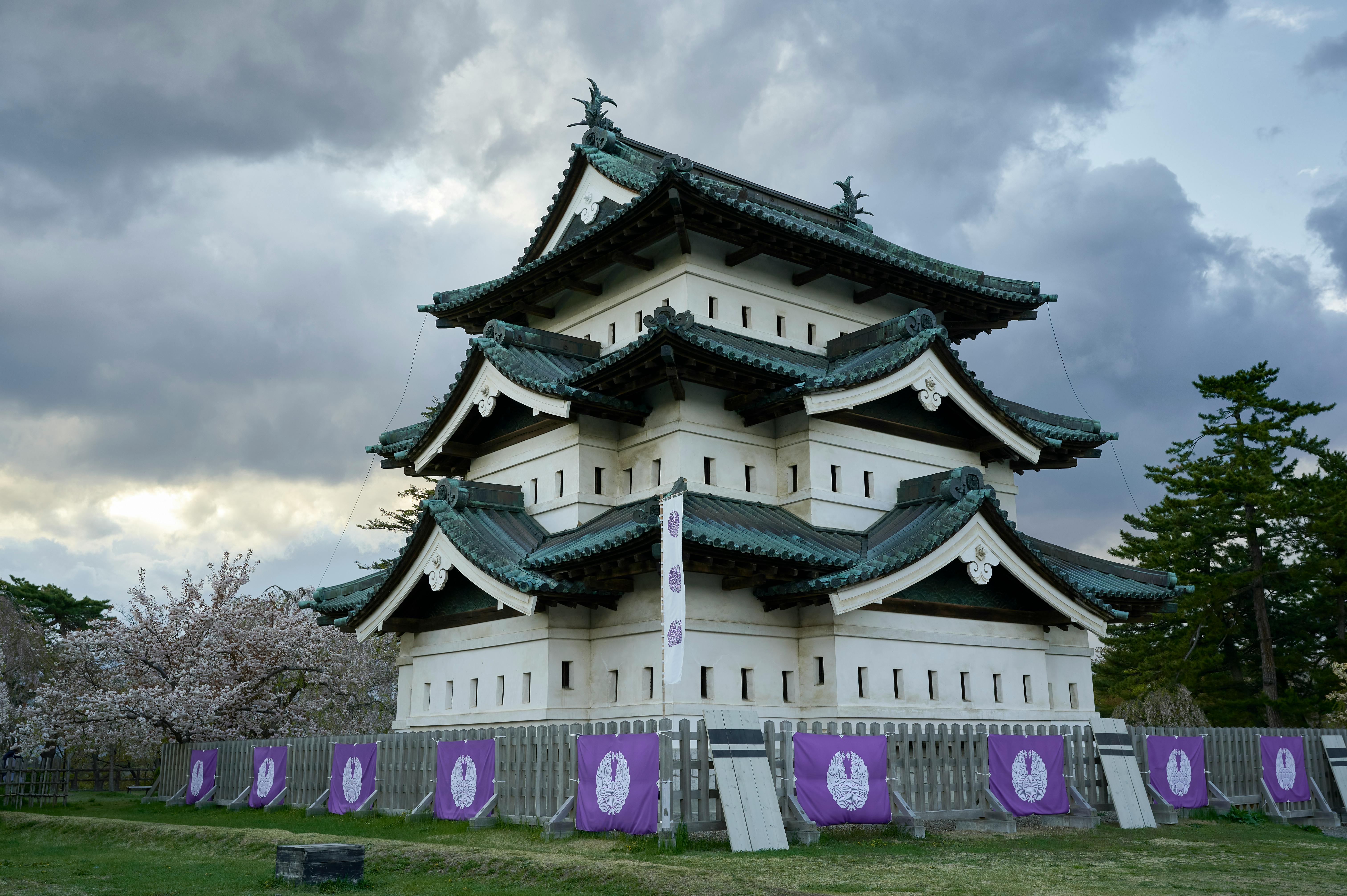
Hirosaki Castle Cherry Blossoms: Where Samurai Stone Meets Fleeting Pink Snow
The first petals fall like soft pink snowflakes onto the black moat, floating so slowly that time itself seems to thicken. You stand at the outer citadel of Hirosaki Castle at 6:30 AM, breathing air so cold it stings your nostrils—a sharp 6°C (43°F)—but you are not alone. A dozen photographers crouch with tripods, waiting for the precise moment when the morning sun crests Mount Iwaki, setting the 2,600 cherry trees ablaze with golden light. Built in 1611 by the Tsugaru clan after a seven-year construction, this hilltop fortress represents the northernmost original castle tower in all of Japan. The three-story, 15-meter (49-foot) keep survived lightning strikes, fire, and the Meiji Restoration's anti-feudal orders only to become, since 1934, the centerpiece of one of the world's great floral pilgrimages. Each spring, over 2 million visitors make the journey to Aomori Prefecture—a three-hour shinkansen ride from Tokyo—to witness the sakura not as decoration but as a living, breathing, and heartbreakingly brief miracle.
Why Hirosaki Castle Embodies Japanese Transience and Resilience
The cherry blossom, or sakura, has symbolized mono no aware—the bittersweet awareness of impermanence—since the Heian period (794–1185). At Hirosaki, this philosophy meets a counter-narrative: stubborn survival. The original five-story keep burned in 1627 due to a lightning strike, yet the Tsugaru clan rebuilt within four years. In 1771, the rebuilt keep was struck again. Rather than reconstruct, the clan relocated the third story of a smaller turret to the original base in 1810. That structure—the three-story, 15-meter (49-foot) keep you see today—still stands, making it one of only 12 original castle towers remaining in Japan. The cherry trees themselves tell a similar story. Following the Meiji Restoration's 1871 abandonment order, the castle fell into ruin. Local physician Motomune Takagi, heartbroken by the decay, donated his life savings to plant 1,000 cherry seedlings in 1903. Today, the 2,600 trees include 1,500 Somei Yoshino (the classic pale pink variety) , 1,000 weeping cherries that cascade like waterfalls of petals, and rare double-blossom varieties that bloom a week later. The engineering challenge solved here was not military but botanical: how to extend a fleeting week of beauty into nearly a month. The park's staggered planting of 52 different cultivars—from early-blooming Kanhizakura to late Kikuzakura—creates a rolling wave of blossoms that peaks in different zones across the 49.2-acre (19.9-hectare) grounds.
The Best Time to Experience Hirosaki Castle Cherry Blossoms
Hirosaki's northern latitude means spring arrives late compared to Tokyo or Kyoto. The Hirosaki Cherry Blossom Festival runs annually from April 23 to May 5 , but peak bloom (mankai) typically occurs between April 28 and May 2 . During this window, temperatures average 8°C to 18°C (46°F–64°F)—ideal for walking but requiring layers. For the most magical photography, arrive by 5:30 AM to 6:30 AM on a clear morning to capture the "Golden Hour" light on the keep. You should avoid May 3–5 (Golden Week) when domestic tourists flood the park and accommodation prices triple. Also, avoid late afternoon (2:00 PM–4:00 PM) on weekends any year; the 21-meter-wide main path becomes shoulder-to-shoulder crowded. Aim for weekdays only. If you miss peak bloom, the "cherry blossom shower" (sakura-fubuki) when petals fall onto the moat occurs May 3–May 6 —a second, equally photogenic window.
Approximate Budget for a 7-Day Trip
This budget assumes a spring trip from Tokyo to Aomori Prefecture, focusing on Hirosaki with side trips to Aomori City. Prices are in Japanese Yen (¥) and US Dollars ($) at ¥150 to $1. Accommodation requires booking 4–6 months in advance for festival dates.
- Accommodation: ¥8,000–¥25,000 ($53–$167) per night. Budget: Dormy Inn Hirosaki (¥8,000, includes hot spring). Mid-range: Hotel Route-Inn Hirosaki (¥12,000). Luxury: Hirosaki Park Hotel with castle views (¥25,000). Book by January for April .
- Food: ¥3,500 ($23) per day. Breakfast at convenience store (¥500). Lunch: Tsugaru soba buckwheat noodles (¥1,000) at Fuji Soba. Dinner: Jappa-jiru salmon miso soup set (¥1,500) at Ajino Sapporo. Festival snacks: candied apples (¥400).
- Transportation: ¥37,000 ($247) total. Round-trip shinkansen Tokyo to Shin-Aomori on Hayabusa (¥17,000 each way, 3 hours). Local JR Line Shin-Aomori to Hirosaki (¥1,500 each way). Loop bus (¥500/day).
- Attractions: ¥2,100 ($14) total. Hirosaki Castle keep (¥350), Fujita Memorial Garden (¥320), Neputa Village (¥630), Aomori Museum of Art (¥700) .
- Miscellaneous: ¥5,000 ($33). Cherry blossom themed omamori charm (¥800), local apple cider (¥600, Aomori produces 50% of Japan's apples), petal-shaped senbei rice crackers (¥1,000).
- Total Estimated Budget for 7 Days: ¥100,000–¥150,000 ($667–$1,000) per person, excluding international flights.
7 Essential Hirosaki Castle Cherry Blossom Experiences
- The "Petal Carpet" of the Western Moat at dawn: Walk the 1.5-kilometer (0.9-mile) circuit around the outer moat between 5:30 AM and 7:00 AM. The still water reflects the weeping cherries above, while fallen petals form a solid pink carpet on the bank. No crowds, only the sound of ducks paddling.
- Climb the original three-story keep (¥350, 9:00 AM–5:00 PM): Inside this 1810 structure, steep wooden stairs lead to the top floor. From the 15-meter (49-foot) height, look north to see Mount Iwaki's snow-capped peak framed by a foreground of blossoms —a scene unchanged in two centuries.
- Rent a rowboat on the outer moat (¥600 for 30 minutes, 9:00 AM–4:30 PM): Paddle directly beneath the drooping cherry branches that hang 3 meters (10 feet) above the water. The petal-covered surface parts around your oars. Limited to 30 boats—arrive before 10:00 AM.
- Evening illumination (sunset to 10:00 PM, ¥0–¥500): During the festival, the castle grounds are lit from 6:30 PM. The keep glows a warm amber while LED lights in the moat make the blossoms appear to float on black water. The main illuminated area near the keep requires a ¥500 donation for night viewing .
- Picnic under a weeping cherry at the Ninomaru Lawn: Bring a blue tarp (¥800 at nearby ¥100 store) and a bento box from Nakano Shoten (¥1,200 for sakura mochi and seasonal onigiri). The 100 weeping cherry trees here are the oldest in the park, some planted in 1903 .
- Visit the Fujita Memorial Garden (¥320, 9:00 AM–5:00 PM): This Meiji-era villa's garden features a formal tea house overlooking a pond where cherry petals collect in eddies. Reserve a tea ceremony (¥1,000) at the small hut—matcha served in a bowl painted with blossoms.
- Photograph the "Three-Shot" from the South Bridge: From the bridge at the southern entrance, a single frame captures three elements: the castle keep, a weeping cherry in full bloom, and Mount Iwaki's snow cap. Best light: 7:00–8:00 AM . Use a telephoto lens (70–200mm).
3 Hidden Gems Most Travelers Miss
- Chōshō-ji Temple's Secret Cherry Garden (5-minute walk from castle): This small Buddhist temple, established 1633, opens its hillside garden only during cherry season. The 200 trees are all Kanzakura (literally "cold cherry") that bloom two weeks earlier than the castle's main trees. Visit April 15–20, before the festival peak crowds arrive . No sign in English—look for the red torii gate behind the temple.
- The Abandoned Railroad of the Aomori Prefectural Line: At the northwestern edge of the park, a decommissioned railway track disappears into a tunnel of cherry trees. The line closed in 2002, but the tracks remain. Walk 200 meters into the tunnel: the blossoms frame the dark opening like a picture frame. Warning: no lighting after sunset. Accessible from the West Gate carpark.
- Hirosaki City Cherry Blossom Archive at the Former 59th Bank Building: This 1926 Renaissance-style building (free entry, 10:00 AM–3:00 PM festival days) contains hand-colored glass lantern slides from 1918–1945 showing the castle's cherry trees before motorcars existed. The third-floor balcony offers a view of the keep that matches exactly the 1920 photographs on the wall .
Cultural & Practical Tips
- Essential Phrase: "O-hanami wa doko ga ichiban desu ka?" (Where is the best cherry blossom viewing spot?). Respond to locals' greetings with "Konnichi wa. Sakura wa utsukushii desu ne" (Hello. The cherry blossoms are beautiful, aren't they?).
- Blue Tarp Etiquette: In Japanese cherry blossom culture, claiming space with a blue leisure sheet is required by 6:00 AM. Arrive early to place yours on the Ninomaru Lawn. Do not step on others' tarps—walk around .
- Waste Management: There are no public trash cans in the park. Bring small plastic bags to carry out all garbage, including bento containers and o-cha bottles. Festival staff will thank you.
- Photography Etiquette: No tripods between 9:00 AM and 5:00 PM on weekends—they block pathways. Use a monopod instead. Do not shake branches to create "falling petal" photos; it damages the trees. Park rangers issue verbal warnings.
- Weather Preparedness: April in Hirosaki averages 11 rainy days. Bring waterproof shoes (the gravel paths turn to mud) and a collapsible umbrella. If rain is forecast, the keep's interior queues extend to a one-hour wait—arrive before 8:30 AM.
- Mosquito Warning: The moat breeds mosquitoes. From mid-April, use DEET-based repellent. The city sprays on April 20, but the week after peak bloom (May 3–10) sees the highest insect activity .
Conclusion: Travel with Impermanence, Not Just Photography
The average Hirosaki cherry blossom lives just five to seven days from first bloom to falling petals. By the time you read this, the particular blossoms in these photographs have already fallen, washed into the moat, and been swept away. That is the lesson of sakura—not sadness but urgency. When you walk beneath these 2,600 trees, you join a chain of millions who have stood in this same spot: samurai on lookout, Meiji-era physicians planting saplings, a photographer in 1920 with a glass plate camera. Do not spend your entire visit looking through a viewfinder. Put down the camera for ten minutes. Stand under a weeping cherry at the Ninomaru Lawn. Let a petal land on your palm. Feel its weight—practically nothing. Then watch the wind take it. That lightness, that briefness, is why you came all this way. Treat it with the reverence it deserves.