
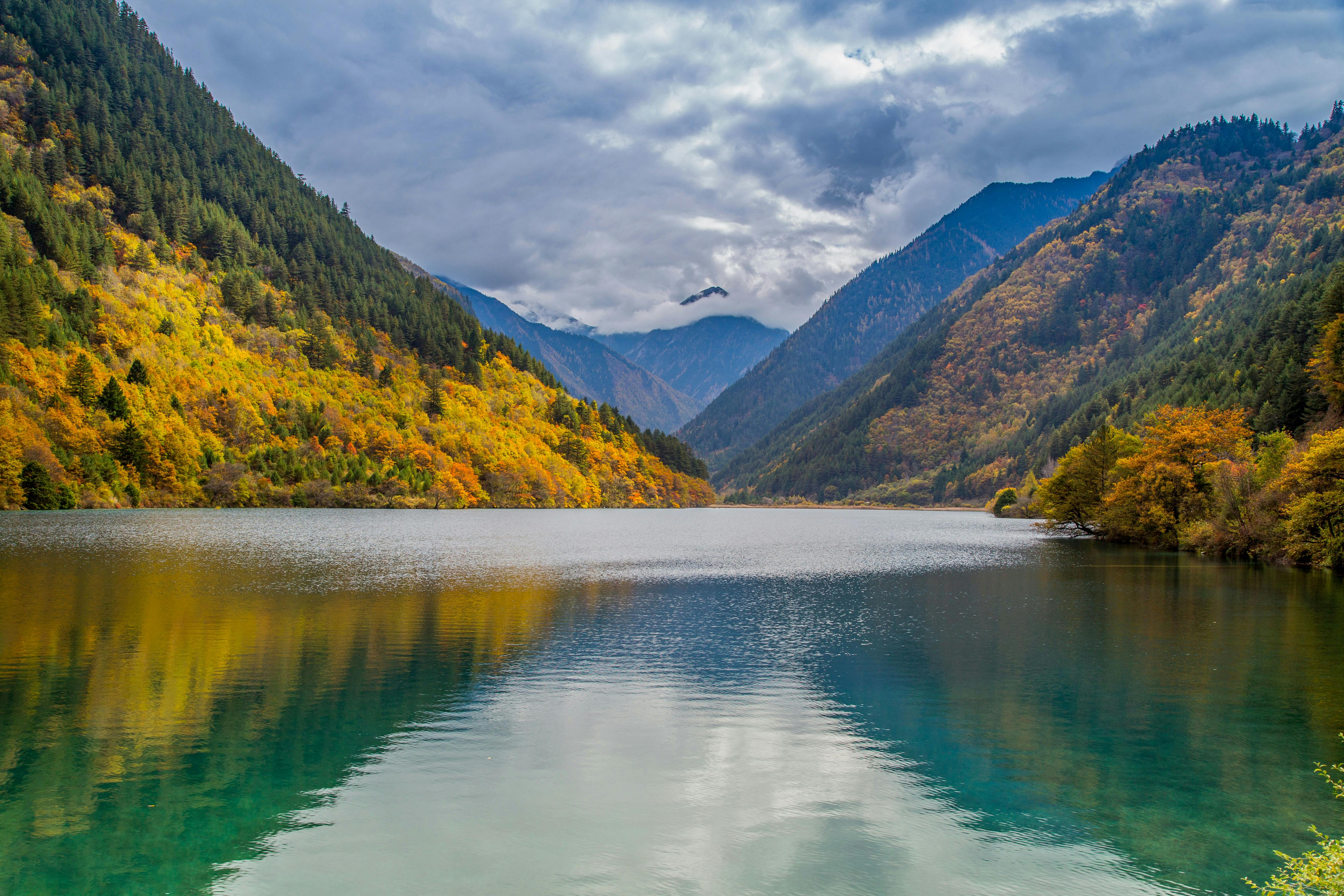
Jiuzhaigou Valley: Where Liquid Turquoise Meets Tibetan Sacred Silence
The prayer flags flutter at 3,100 meters (10,170 feet), their faded blues and yellows whispering mantras into the thin, crisp air of the Min Shan mountain range. You stand at the edge of Five Color Pond, peering into waters so impossibly clear that the submerged ancient tree trunks seem preserved in liquid amber. Then the morning light shifts—and the pond erupts. Patches of peacock blue give way to jade green, then to sunflower yellow, then to a violet so deep it feels prehistoric. This is Jiuzhaigou, a name that translates to "Valley of Nine Villages," and it is not merely a landscape. It is a geologist's fever dream, a Tibetan zhuan shan (sacred mountain pilgrimage) route, and a hydrological masterpiece all rolled into one. Carved by glacial movement and ancient earthquakes, this UNESCO World Heritage Site features 114 turquoise lakes, 47 travertine waterfalls, and a kaleidoscope of mineral deposits that defy standard chemistry. The Tibetan and Qiang people who have lived here for generations call it home—and you are merely a guest in their sacred gallery .
Why Jiuzhaigou Embodies Nature's Palette
To understand Jiuzhaigou, you must first understand calcium carbonate. Over millennia, glacial meltwater rich in minerals has flowed down from the Minshan mountains, depositing layer upon layer of travertine that naturally dams the valley into a series of step-like lake basins . This same mineral soup, when combined with sunlight and aquatic plants like Charophyte algae, refracts light into wavelengths that produce colors not found anywhere else on earth. The Five Flower Lake, at 2,472 meters (8,110 feet) above sea level, demonstrates this phenomenon perfectly: its shallow depths allow for the proliferation of colorful calcareous mosses, while deeper sections absorb red light and reflect blue. The "problem" Emei solved was spiritual; the "problem" Jiuzhaigou solves is aesthetic hunger. It is nature proving that no screen, no filter, and no painter can capture the full depth of what water can become. The valley was "discovered" by the outside world only in the 1970s, when loggers stumbled upon its wonders, leading to a rapid designation as a nature reserve in 1978 and a UNESCO listing in 1992.
The Best Time to Experience Jiuzhaigou's Kaleidoscope
Timing is everything in this high-altitude fairyland. .
- Autumn (Oct 15 – Oct 31): The undisputed golden window. Temperatures range from 5°C to 18°C (41°F to 64°F) during the day, dipping to near freezing at night. The birch, maple, and larch forests explode into reds, golds, and oranges, creating a mirror reflection in the cobalt lakes that is almost painfully beautiful .
- Winter (Dec – March): A silent, crystalline world. Expect -5°C to 8°C (23°F to 46°F). The famous waterfalls—including Nuorilang Waterfall—freeze into immense turquoise ice sculptures. Crowds vanish, and you get the boardwalks almost to yourself .
- Summer (June – August): Lush and green, but rainy. Highs of 18°C to 30°C (64°F to 86°F) . The vibrant water colors are at their most intense due to high light refraction, but afternoon thunderstorms are frequent—pack a poncho.
- Periods to avoid: The first week of May (May 1–7) and the first week of October (Oct 1–7) are China's "Golden Weeks." The valley is capped at 41,000 visitors per day, but tickets sell out instantly, and shuttle queue times can exceed two hours .
Approximate Budget for a 7-Day Trip (in Chinese Yuan ¥)
This budget assumes a round-trip from Chengdu, a mix of mid-range comfort, and one night inside the valley for photographers. Prices are per person.
- Accommodation: ¥150–¥1,200 per night. Budget: Zhangzha Town guesthouses (¥150, e.g., Fairy Tale Cottage) . Mid-range: Hilton Garden Inn (¥500–¥700) . Luxury: Jiuzhai Yunshang (¥900–¥1,200, includes Tibetan design elements) .
- Food: ¥100–¥250 per day. Breakfast (¥20): Noodles or tsampa. Lunch (¥40): Packed snacks or Nuorilang Center buffet. Dinner (¥60–¥150): Yak meat hotpot or wild mushroom stew in Zhangzha Town . Tibetan yogurt is a must-try for ¥15.
- Transportation: Total ~¥330–¥500. High-speed rail (Chengdu East to Huanglong Jiuzhai Station): approx ¥170 each way. Shuttle bus from station to park entrance: ¥50 . Scenic Area shuttle bus (inside park): ¥90 (mandatory) .
- Attractions: ¥190–¥280. Peak season entry (April 1 – Nov 15): ¥190 + ¥90 for shuttle bus = ¥280 total. Off-season (Nov 16 – March 31): ¥80 + ¥80 = ¥160 total . Students/seniors get 50% off with ID.
- Miscellaneous: ¥100. Tibetan silver jewelry, hand-woven wool scarf, or a can of local highland barley beer.
- Total estimated budget for 7 days (incl. travel from Chengdu): ¥2,500 – ¥5,500 (approx. $345 – $760 USD).
7 Essential Jiuzhaigou Experiences
- Witness "Jing Hai" (Mirror Lake) at Dawn: Arrive at the park gate at 7:00 AM (it opens at 8:00 AM) and rush to the Mirror Lake stop on the shuttle bus. For exactly 45 minutes—between 7:30 AM and 8:15 AM—the air is so still that the reflection of the snow-capped peaks is indistinguishable from reality. Bring a wide-angle lens and keep your voice to a whisper .
- Walk the Plank Paths of Rize Valley: Skip the shuttle at Arrow Bambomb Lake and take the 3-kilometer (1.8 mile) boardwalk down to Panda Lake. You will walk through a primeval forest where spongy moss grows over deadfall, and the sound of rushing water (the lifeblood of the valley) is the only thing you hear. This is where the 1980 film "Hero" was filmed .
- Photograph the Magic Five-Color Pond: Located in Zechawa Valley, this is the highest and most colorful body of water at 2,995 meters (9,826 feet). It is only 6.6 meters (21.7 feet) deep, but its floor is coated with ancient calcareous deposits that turn the water into a living opal. Visit between 10:00 AM and 2:00 PM for the best light .
- Eat Yak Meat Hotpot in Zhangzha Town: After a long day of hiking, nothing cuts the alpine chill like a bubbling pot of yak broth. Head to Ama Tibetan Restaurant (an 8-minute walk from the park entrance) for tender yak meat, local mushrooms, and a side of butter tea. Expect to pay around ¥60 per person .
- Catch the Roar of Nuorilang Waterfall: The widest travertine waterfall in China spans 320 meters (1,050 feet) and drops 20 meters (65 feet). Do not just look from the top; take the stairs down to the viewing platform. The spray will hit your face, and the sound resembles rolling thunder. It is the geographical heart of the Y-shaped valley .
- Seek Blessings at Zharu Monastery: While 90% of tourists rush toward Long Lake, duck into the less-visited Zharu Valley. Here, the Zharu Monastery features red walls and golden roofs, with Tibetan aunties offering free butter tea to weary travelers. Spin the prayer wheels (clockwise!) for good luck .
- Hunt for the Blue Ice: If visiting in January or February (late Jan to early Dec is peak ice season), look at the frozen waterfalls . Because of the high mineral content and high density of the ice, it refracts light to appear bright blue—a phenomenon known as "blue ice." The Pear Shoal Waterfall is the best location for this arctic illusion.
3 Hidden Gems Most Travelers Miss
- The Lower Seasonal Lake (下季节海): Located in the Zechawa Valley, this lake plays a disappearing act. In late summer and autumn (July - October), it is a deep, sapphire pool. But in spring (April - June), the water drains out, turning the basin into a lush, flower-filled grassland. It is a geological sinkhole in action . Access: Take the Zechawa Valley shuttle to the end, then walk back 1 km (0.6 mi) on the right side. Few stop here because it is "seasonal."
- The Ruins of Shuzheng Village: Most tourists stay on the main boardwalk and look across the lakes. Take the narrow path on the west side of Shuzheng Lakes to walk directly behind the prayer flags and traditional wooden Tibetan farmhouses. You can smell the burning cedar, see the yaks in the pen, and witness a living culture, not just a diorama. Be respectful of residents' privacy.
- Jianzhu Seab Sight at 2:30 PM: Everyone knows Five Flower Lake, but Jianzhu Seab (Arrow Bamboo Lake) offers a better reflection of the seasonal variations. Visit at 2:30 PM when the sun is high enough to illuminate the bamboo growing out of the lake bottom. If you look closely, you can see the mineral "crust" forming on the leaves, turning them to stone—a process called calcification .
Cultural & Practical Tips
- The "Y" Strategy: The valley is a Y-shape. Rize Valley (left fork) has the best lakes. Zechawa Valley (right fork) has Long Lake and Five Color Pond. The shuttle buses always go to the top first. If you want solitude, get off the bus halfway .
- No Drones, No Pets, No Swimming: This is a strict nature reserve. Rangers patrol the boardwalks. Fines for stepping off the path or throwing items into the water are steep and strictly enforced .
- Altitude Awareness: The valley floor sits at 2,000 meters (6,562 ft) but Long Lake is at 3,100 meters (10,170 ft) . Walk slowly. Chewing on a piece of Rhodiola root (available at any pharmacy in Chengdu) helps with acclimatization. Oxygen cans are sold for ¥20 at the entrance.
- Essential Phrase: "Ja'xi" (pronounced Jah-shee) means "Thank you" in the local Tibetan dialect. Using it at the family-run guesthouses will earn you a warm smile.
- Dress for Three Seasons: Because of the altitude, you will experience cold mornings, hot sunny afternoons, and potentially rain or snow in the span of six hours. The golden rule is layers: T-shirt, fleece, and a waterproof windbreaker .
- Second Entry Hack: If you want to spend two days in the valley, buy a standard ticket. Upon exiting, register your fingerprint/photo at the gate. The next day, you only pay for the shuttle bus (¥80), not the full entrance fee .