
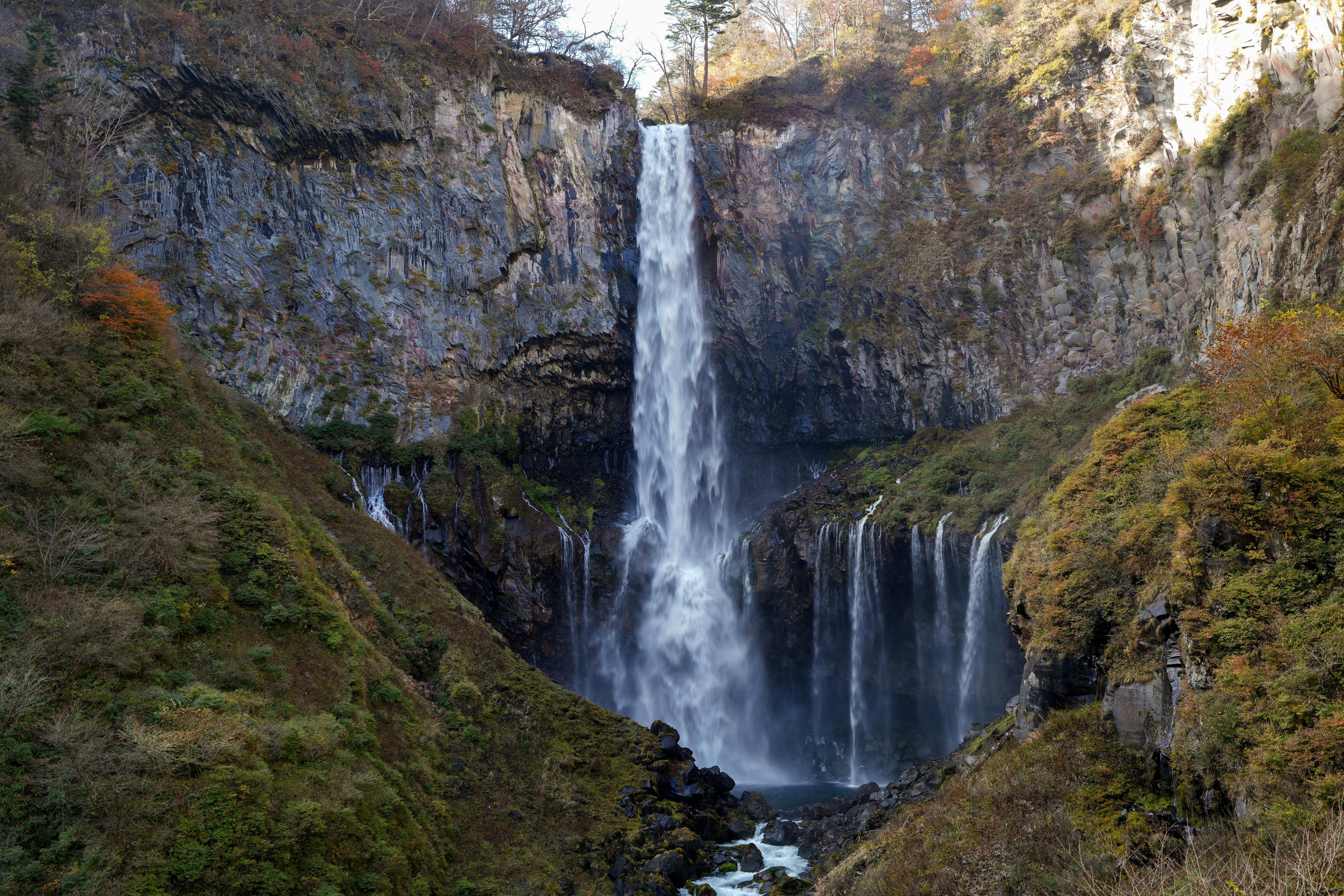
Kegon Falls: Where Volcanic Thunder Meets Sacred Mist
Before you see it, you hear it—a low, persistent rumble that vibrates through the volcanic rock beneath your feet, growing louder with each step toward the eastern edge of Lake Chuzenji. At 1,269 meters (4,163 feet) above sea level, the air is cool and thin, carrying the scent of wet stone and autumn leaves. Then you step onto the free observation deck, and the world opens into a 97-meter (318-foot) vertical plunge of raw, relentless power. This is Kegon Falls (Kegon no Taki), the only outlet for the waters of Lake Chuzenji and the most famous of Nikko's 48 waterfalls . Twelve smaller cascades leak through cracks in the lava flows around the main falls, creating a curtain of white that seems to defy gravity . Designated one of Japan's "Three Most Beautiful Waterfalls" alongside Nachi and Fukuroda, and listed among Japan's Top 100 Waterfalls by the Ministry of the Environment in 1990, this is not merely a waterfall . It is a 20,000-year-old symphony of geology, spirituality, and raw nature .
Why Kegon Falls Embodies Japan's Volcanic Waterfall Majesty
To stand at the base of Kegon Falls is to witness the aftermath of a prehistoric cataclysm. Approximately 20,000 years ago, Mount Nantai—a perfectly conical stratovolcano standing 2,486 meters (8,156 feet) high—erupted violently, sending a massive lava flow across the Daiya River valley . The molten rock cooled and hardened into a natural dam, creating Lake Chuzenji behind it. But water, as it always does, found a way. The lake's overflow carved a new channel through a sheer cliff face at the lake's eastern edge, creating the 97-meter cascade you see today . The geological problem the falls solved was existential—without this release point, Lake Chuzenji would have overtopped its lava dam and flooded the valley below. The technical solution produced one of Japan's most photographed natural wonders. In 1927, the Shōwa-era government recognized Kegon Falls as one of the "Eight Views" best representing Japanese culture and natural beauty . The falls take their name from the Kegon (Avatamsaka) Sutra, a Buddhist text contemplating the interconnectedness of all phenomena—a fitting name for a waterfall that connects lake, river, mountain, and sky.
The Best Time to Experience Kegon Falls
Kegon Falls transforms dramatically with each season, but the most spectacular period is mid-October through late October for autumn foliage (koyo) . During this window, the surrounding trees—maples, beeches, oaks, and lacquer trees—erupt in shades of crimson, gold, and orange, framing the white cascade against a canvas of fire. Temperatures average a crisp 10°C–13°C (50°F–55°F) . For winter enthusiasts, December through February offers frozen cascades, with sections of the waterfall solidifying into dramatic ice formations . January and February are coldest, with temperatures averaging -3.7°C to -4°C (25°F–26°F) . Summer (June–August) brings lush greenery and cooler temperatures (15°C–20°C / 59°F–68°F) than the Tokyo lowlands, making it a popular escape from the capital's humidity . The best time of day for photography is 8:00–10:00 AM, when morning light illuminates the spray and creates rainbows. Avoid weekends in October—traffic on the Irohazaka Winding Road to the falls can stretch the 45-minute bus ride into a 2-3 hour crawl . For official hours, fees, and event updates, visit: kegon.jp .
Approximate Budget for a 7-Day Trip (2 nights near Kegon Falls)
Kegon Falls is located in Oku-Nikko, about 50 minutes by bus from central Nikko. This budget assumes a 2-night stay in the Chuzenji Onsen area, plus access from Tokyo. All prices in Japanese Yen (¥) with approximate USD equivalents (¥150 = $1 USD).
- Accommodation: ¥15,000–¥90,000 per night ($100–$600 USD). Budget: Guesthouses near Chuzenji Onsen (from ¥15,000 pp). Mid-range: Lakeside ryokan or hotels (¥30,000–¥50,000 pp, includes dinner/breakfast). Luxury: The Ritz-Carlton, Nikko (from ¥90,000+ pp). Day-use onsen bathing at many hotels: ¥800–¥1,500.
- Food: ¥4,000–¥8,000 ($27–$53) per day. Breakfast: ¥1,000–¥1,800 (ryokan breakfast or café set). Lunch: ¥1,500–¥2,500 (yuba soba—tofu skin noodles). Dinner: ¥2,500–¥4,500 (izakaya or restaurant near Chuzenji Onsen). Local specialties: yuba (tofu skin), rainbow trout from Lake Chuzenji.
- Transportation from Tokyo (round trip): ¥6,400–¥8,600 ($43–$57). Tobu Limited Express from Asakusa to Tobu-Nikko Station (2 hours, ¥2,400–¥2,800 one way). To Kegon Falls: Tobu Bus from Tobu-Nikko Station to Chuzenji Onsen (50 minutes, ¥1,250 one way, ¥2,300 for 2-day Nikko All Area Pass) .
- Attractions: ¥600–¥2,800 ($4–$19). Kegon Falls elevator to lower observation deck: ¥570–¥600 adults, ¥340 children . Free upper observation deck: ¥0. Akechidaira Ropeway (panoramic view of falls and lake): ¥1,000 round trip .
- Miscellaneous: ¥1,000–¥2,000 ($7–$13). Parking near falls: ¥320 (cash only) . Soft-serve ice cream from refreshment stand (¥400). Postcards and local crafts.
- Total (per person, 2 nights / 7 days mixed): ¥58,000 – ¥218,000 ($387 – $1,453 USD) depending primarily on accommodation choice.
7 Essential Kegon Falls Experiences
- Take the Elevator to the Lower Observation Deck: Pay ¥570–¥600 and descend 100 meters (328 feet) through solid volcanic rock to the base-level platform . From here, the waterfall fills your entire field of vision—97 meters of white water crashing into a turquoise pool, the spray cool against your face. The roar is almost deafening; you will feel it in your chest. The lower deck offers a perspective impossible to appreciate from above. Hours: March–November 8:00 AM–5:00 PM; December–February 9:00 AM–4:30 PM .
- Visit the Free Upper Observation Deck First: Before descending, stand on the free upper platform to understand the waterfall's relationship with Lake Chuzenji. From this vantage point, you see the lake's waters funneling toward the cliff edge before disappearing over the precipice. The upper deck also offers a clearer view of the twelve smaller side waterfalls that emerge from cracks in the lava rock around the main cascade .
- Take the Akechidaira Ropeway for the Classic Postcard View: Located before the Irohazaka Road descent, the Akechidaira Ropeway lifts you 3 minutes to an observation deck at 1,474 meters (4,836 feet). From here, you see Kegon Falls, Lake Chuzenji, Mount Nantai, and the winding Irohazaka Road all in a single frame—the classic Nikko photograph . Round trip: ¥1,000. Go before 10:00 AM or after 2:00 PM to avoid crowds; fog often rolls in after 1:00 PM.
- Witness Autumn Foliage Framing the Falls: From mid-October to late October, the maples, beeches, and oaks surrounding Kegon Falls turn brilliant shades of crimson and gold . The contrast between the white cascade and the fiery foliage is considered one of Japan's premier autumn views. Warning: This is peak tourist season. Come on a weekday, take the first bus from Nikko (around 7:30 AM), or stay overnight at the lake.
- Visit in Winter for Frozen Fantasy: From December through February, Kegon Falls partially freezes, creating dramatic ice formations that cling to the cliff face . The lower temperatures (as low as -4°C / 25°F) mean fewer crowds and a serene, almost monochrome landscape. The elevator operates on reduced winter hours (9:00 AM–4:30 PM), but the experience is worth bundling up for .
- Walk the Path to the Small Shinto Shrine: Near the elevator entrance, a small Shinto shrine sits tucked into the forest . Few tourists pause here, but the shrine offers a quiet moment of reflection—a reminder that these waters have been considered sacred for centuries. The torii gate frames the mist rising from the gorge.
- Combine with Lake Chuzenji on a Single Visit: Kegon Falls is the outlet of Lake Chuzenji—literally walking distance from the Chuzenji Onsen bus terminal . After experiencing the falls, walk five minutes to the lake shore. Rent a rowboat (¥1,000–¥2,000 per hour) or simply sit on a bench and watch Mount Nantai reflect in the calm waters. The lake and falls are two halves of the same geological story.
3 Hidden Gems Most Travelers Miss
- The Side Waterfalls Leaking Through Lava Rock: Most visitors focus entirely on the main 97-meter cascade and miss the twelve smaller waterfalls that seep through cracks in the lava formations around it . These secondary falls are best visible from the upper observation deck near the elevator building, where you can look sideways into the cliff face. They emerge at odd angles, creating a layered, almost dreamlike effect.
- The Historical Memorial to Misao Fujimura: Near the falls, a quiet memorial marks the spot where philosophy student and poet Misao Fujimura ended his life on May 22, 1903. His farewell poem, carved into a tree trunk, read: "Amidst the vastness of heaven and earth, I alone am the one who stands here" . The story was sensationalized and led to what psychologists now call the Werther Effect—copycat suicides. The memorial is sobering but important, connecting the natural wonder to Japan's literary and cultural history.
- The Early Morning Mist Before the Tour Buses Arrive: The first bus from Nikko arrives at Chuzenji Onsen around 8:30 AM. If you stay overnight in the area, walk to the falls at 7:00 AM. The mist still rises from the gorge, the only sounds are the waterfall and birds, and you will have the lower observation deck—once the elevator opens—almost entirely to yourself. The light at this hour is soft, golden, and perfect for photography.
Cultural & Practical Tips
- Buy the Nikko All Area Pass Before You Go: The 2-day pass (¥2,300) covers the bus from Nikko Station to Chuzenji Onsen and back, plus all local bus routes in Oku-Nikko . Without it, the one-way bus alone costs ¥1,250. The pass pays for itself after one round trip. Purchase at Tobu-Nikko Station.
- Traffic on Irohazaka Is Brutal in Autumn: In October, the 45-minute bus ride from Nikko to Chuzenji Onsen can stretch to 2–3 hours on weekends and national holidays . To avoid this: (1) Visit on a Tuesday, Wednesday, or Thursday. (2) Take the first bus of the day (around 7:30 AM). (3) Stay overnight at the lake—evening at the falls is sublime.
- Cash Only for Parking and Small Shops: The elevator accepts cash (exact change appreciated) and some buses accept IC cards, but the parking lot near the falls (¥320) is cash only, as are the small refreshment stands and souvenir shops . Withdraw cash in Nikko town before ascending the mountain.
- You Don't Need Hours Here—But Don't Rush Either: The waterfall itself can be experienced in 30–45 minutes if you are on a tight schedule . But the magic of Kegon Falls is in the details: the mist on your face, the rainbow in the spray, the sound that vibrates through the rock. Allow at least an hour. Combine with Lake Chuzenji for a half-day visit.
- Dress in Layers—Even in Summer: At 1,269 meters (4,163 feet), the temperature at Kegon Falls is consistently 8-10°C (14-18°F) cooler than in Tokyo . A July afternoon in the capital might be 33°C (91°F); at the falls, it will be a pleasant 23°C (73°F) during the day, dropping to 14°C (57°F) by evening. Pack a jacket or fleece even in August. In October and November, bring a warm coat, hat, and gloves.
- Respect the Sacredness of the Site: The falls are named after a Buddhist sutra and have been considered sacred for centuries. Avoid loud shouting, playing music, or littering. The small shrine near the entrance welcomes quiet reflection—a bow and a soft "O-jama shimasu" (excuse my intrusion) before approaching is appreciated.
- Photography Tips for the Lower Deck: The spray from the falls can soak your camera lens within minutes. Bring a microfiber cloth and consider using a rain sleeve or plastic bag for your camera. The best shots are from the far right corner of the lower platform, where the mist creates a rainbow on sunny mornings between 9:00–11:00 AM.
Conclusion: Travel with Reverence, Not Just Camera Cards
You could arrive at Kegon Falls at 11:00 AM, take the elevator down, photograph the cascade from the lower deck, ride back up, and be on the bus by noon. Many travelers do. But that is to mistake a 20,000-year-old geological wonder for a photo op. This waterfall—forged by volcanic fire, named for a sacred Buddhist text, mourned by poets, and protected as one of Japan's natural treasures—asks something different of you. It asks you to stand at the railing long enough for the mist to settle on your skin. To watch the way the light shifts across the rock face as clouds pass overhead. To understand that the same eruption that destroyed a valley also created this thunderous beauty. Japan's three most beautiful waterfalls—Kegon, Nachi, and Fukuroda—each tell a different story of the archipelago's volcanic soul. This one tells the story of patience: water, over twenty millennia, carving a path through lava. Travel with reverence, not just camera cards. That is what the mountain gods intended when they dammed the river twenty thousand years ago.