
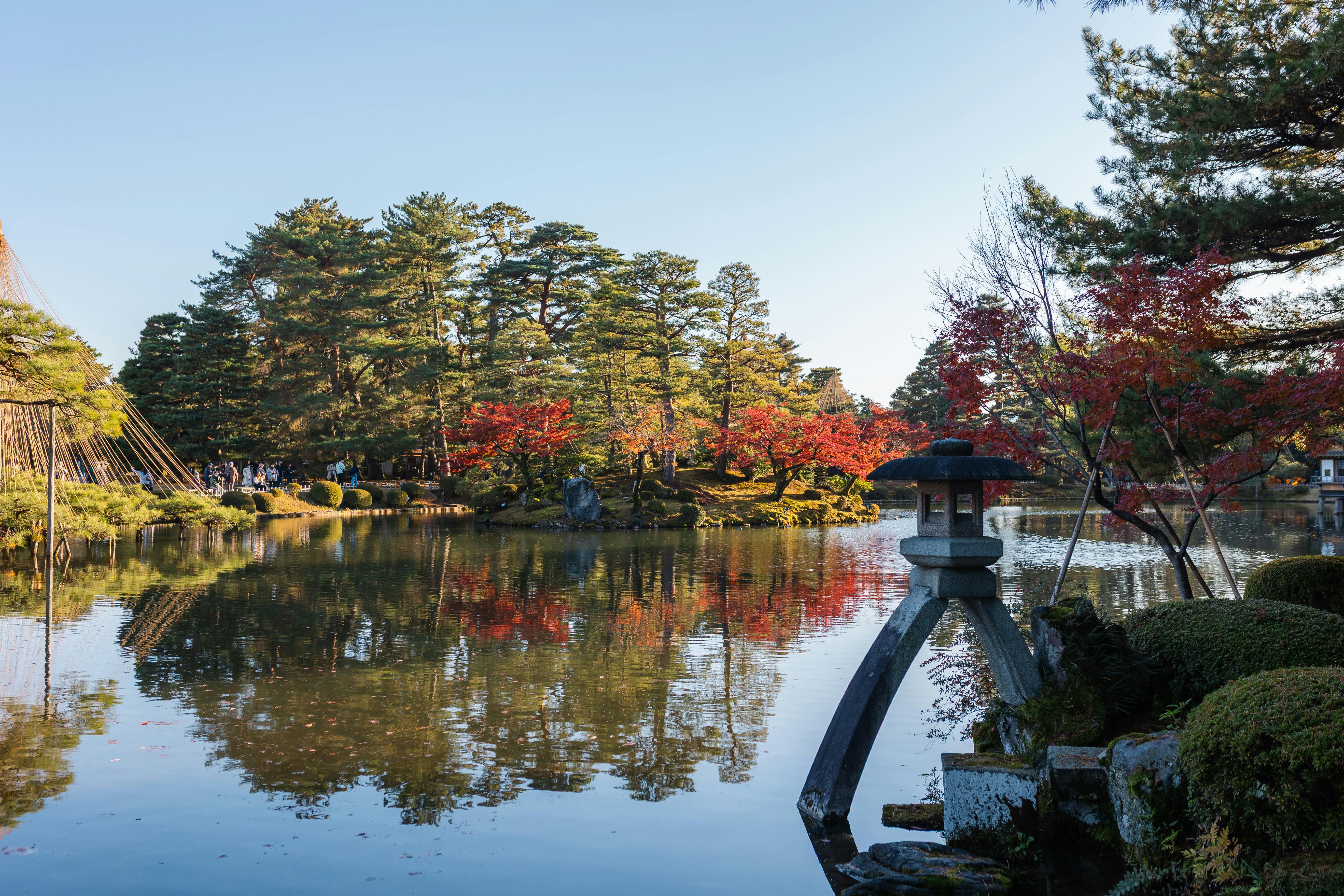
Kenrokuen Autumn: Where Japanese Maples Meet Edo-Period Perfection
The air carries a distinct crispness—that first whisper of winter’s approach—as you step through the Renchimon Gate at 7:00 AM, before the tour buses arrive. Mist still clings to the surface of Kasumigaike Pond, the garden’s 5,000-square-meter (53,820-square-foot) centerpiece, while dew hangs heavy on emerald moss carpets spread beneath towering zelkova trees. Then you see it: the southeastern corner of the garden erupting in a conflagration of gold, crimson, and russet. The Japanese maples (momiji) have reached their peak transformation, each leaf a tiny flame against the deep green of the pine sentinels. This is Kenrokuen in autumn—not merely a garden, but a living painting perfected over two centuries by the Maeda clan, the most powerful daimyo of the Tokugawa Shogunate. Here, the ancient Chinese ideal of the "six sublimities"—spaciousness and seclusion, human artifice and the effects of age, water features and vistas—achieves a balance that garden scholars consider nearly impossible. And in autumn, all six burn brightest.
Why Kenrokuen Embodies the Six Sublimities of Japanese Garden Design
The name Kenrokuen translates literally to "garden of the combined six," a reference to the six essential attributes of a perfect garden documented in 11th-century Chinese landscape texts. What makes this garden extraordinary is that it actually achieves all six simultaneously—a feat most garden designers consider unattainable. The Maeda clan, rulers of the Kaga domain (the largest feudal territory in the Tokugawa Shogunate, encompassing modern Ishikawa and Toyama prefectures), developed this masterpiece between 1670 and 1870, spanning over 200 years of continuous refinement . Covering 25 acres (100,700 square meters), the garden weaves together spaciousness (its vast vistas across Kasumigaike Pond) with seclusion (hidden groves and winding paths that offer intimate moments of solitude). The human artifice of meticulously shaped pines and cascading streams coexists with antique elegance—structures like the Yugao-tei tea house, built in 1774, still standing as the garden's oldest surviving building . The water features, including the oldest fountain in Japan (powered naturally by gravity from the garden's topography), flow alongside wide prospects that frame distant hills and Kanazawa Castle. This wasn't accidental landscaping; it was a political statement by the Maeda family, demonstrating their cultural sophistication to the shogunate.
The Best Time to Experience Kenrokuen's Autumn Colors
Peak autumn foliage in Kenrokuen typically arrives between November 7 and November 29, with the optimal viewing window falling November 10–22. During this period, daytime temperatures average a pleasant 13°C (55°F) in early November, cooling to 8°C (46°F) by month's end. Evening temperatures drop to 4–6°C (39–43°F), so pack layers. The garden opens at 7:00 AM from October through March 15—arriving between 7:00 and 8:30 AM delivers the double reward of soft morning light filtering through mist and the absence of crowds . The worst time to visit? Mid-afternoon (11:00 AM–2:00 PM) on weekends, when tour buses disgorge up to 5,000 visitors hourly, and the magic dissolves into selfie-stick chaos. Also avoid the rainy season's tail end (November 15–25 statistically sees the highest rainfall of autumn, averaging 300mm/11.8 inches in November , so morning visits are safer bets). For definitive seasonal updates and special nighttime illuminations, consult the official tourism resource: www.visitkanazawa.jp. During autumn, the garden hosts free illumination events from 18:00–20:45 on select November dates, when the yukitsuri ropes (traditionally used for snow protection) are lit to create a magical evening atmosphere.
Approximate Budget for a 7-Day Autumn Trip to Kanazawa
This budget assumes mid-November peak foliage season, with rates at their highest. All prices in Japanese Yen (¥), with estimated daily averages based on moderate comfort (not backpacker, not luxury).
- Accommodation: ¥8,000–¥18,000 per night (business hotel near Kanazawa Station, such as Dormy Inn or Via Inn; ryokan with garden views in Hirosaka district run ¥25,000+)
- Food: ¥4,500–¥7,500 per day (breakfast at convenience store: ¥600–¥1,000; lunch at Omicho Market: ¥1,500–¥2,500 for fresh seafood donburi; dinner at local izakaya: ¥2,500–¥4,000). At the garden's Shigure-tei tea house, a bowl of matcha with traditional sweet costs ¥700–¥800.
- Transportation: ¥1,500–¥2,500 daily. Kanazawa Loop Bus (¥200 per ride, day pass ¥800). From Tokyo: JR Hokuriku Shinkansen (¥14,000–¥15,500 one-way, 2.5 hours).
- Attractions: Kenrokuen Garden ¥320 (includes entrance to Kanazawa Castle Park's restored buildings with combo ticket). Kanazawa Castle: included. 21st Century Museum of Contemporary Art: ¥1,500 for special exhibitions. Nagamachi Samurai District free.
- Miscellaneous: ¥3,000–¥5,000 (gold leaf souvenirs—Kanazawa produces 99% of Japan's gold leaf—starting ¥1,500 for small jars; kutani-yaki ceramic teacups ¥2,000+)
Total estimated budget for 7 days (excluding international flights): ¥98,000–¥185,000 ($650–$1,230 USD based on ¥150=1 USD).
7 Essential Kenrokuen Experiences
- Photograph the Kotoji-tōrō Lantern at Dawn: This two-legged stone lantern, resembling a koto (Japanese harp) bridge, is the garden's most iconic image. Arrive by 7:00 AM when Kasumigaike Pond becomes a mirror—the lantern's reflection appears to float on mist while maple branches frame the shot from the northeastern shore.
- Witness Yukitsuri Before Snow Arrives: From November 1, gardeners begin erecting the conical rope supports that protect pine branches from heavy snow (Kanazawa receives over 370mm/14.5 inches annually). Watch them work near the Karasaki Pine—an hour of quiet observation reveals centuries-old horticultural technique.
- Walk the Zigzag Bridge at Hisago-ike Pond: The "Gourd Pond" features a yatsuhashi (zigzag bridge) designed to prevent evil spirits, which legend says can only travel in straight lines. In autumn, the bridge leads you through a tunnel of burning-red momiji—slow down, peer into the water, and spot the koi resting among fallen leaves.
- Take Matcha at Shigure-tei Tea House: Built in 2000 in the style of the garden's original Edo-period pavilion, this open-air tea house offers the quintessential Japanese experience. For ¥800, receive bowl of hand-whisked matcha and a seasonal sweet (wagashi shaped like an autumn leaf). Sit facing the garden's northwest corner—the zelkova canopy turns pure gold here.
- Find Japan's Oldest Fountain: Near the garden's center, water arcs 3.5 meters (11.5 feet) from a stone basin—powered entirely by gravity, not pumps, using the elevation difference from Yamazaki Hill. Built in 1860, it remains a marvel of Edo engineering. Visit at 9:00 AM when the water catches direct sunlight.
- Visit on an Autumn Illumination Night: Select November evenings (check visitkanazawa.jp for exact dates, typically November 7, 14, 15, 21, 22, 28, 29) transform the garden from 18:00–20:45. Strings of lights trace the yukitsuri ropes, while maple leaves glow from below like Japanese paper lanterns. Admission is free .
- Combine with Kanazawa Castle Park: Your ¥320 ticket includes both gardens. Cross the pedestrian bridge to explore the castle's restored Hishi Yagura (arrow storehouse) and Gojikken Nagaya (long storehouse). The view from castle ramparts—looking down into Kenrokuen's autumn canopy—offers a perspective the Maeda lords themselves once enjoyed.
3 Hidden Gems Most Travelers Miss
- Renchimon Gate's Moss Garden: While crowds cluster near the Kotoji Lantern, the area surrounding the original 17th-century entrance (Renchimon Gate, near the garden's southwestern edge) contains a koke-dera-style moss garden rarely photographed. Over 35 species of moss carpet the forest floor here, with dewdrops clinging until 9:00 AM. Most visitors rush past this gate toward the pond—stop, kneel, and study the miniature landscape.
- Yugao-tei's Hidden Calligraphy Room: Kenrokuen's oldest surviving structure (1774) appears on maps, but few visitors notice the small calligraphy study tucked behind the main tea room. Fusuma sliding doors here bear original sumi-e ink paintings rarely featured in guidebooks. Access requires asking at the tea house entrance—staff will sometimes unlock it for quiet visitors before 9:00 AM.
- The Silent Path Along Yamazaki Hill's Base: To escape the main circuit, follow the narrow path beneath Yamazaki Hill's western slope—unmarked and unpaved, it runs between the hill and the garden's outer fence. Here, fallen maple leaves collect undisturbed, and the only sounds are water trickling from the hill's drainage channels. The path emerges near the Kaisei-to Pagoda, a three-tiered stone tower erected by the Maeda family's 13th lord in 1814. Fewer than 10 visitors per hour pass this way even in peak season.
Cultural & Practical Tips
- Photography courtesy: Tripods are banned until 30 minutes before closing—the garden prioritizes visitor flow. For that dawn shot, use the handrails along Kasumigaike Pond as stabilization. No drones, ever.
- Local phrase to know: "Kirei na momiji desu ne" (kee-ray nah mo-mee-jee dess nay)—"The autumn leaves are beautiful, aren't they?" Locals will appreciate your effort and might invite you for tea.
- Footwear strategy: The garden's fumi-ishi (stepping stones) remain damp until 10:00 AM. Waterproof walking shoes with grip are essential—fallen wet leaves turn stone bridges into skating rinks by 8:30 AM.
- Beat the crowds with the "Golden Route Reversal": Most tour groups enter via Katsurazaka Gate (the main entrance) at 9:30 AM. Use the Renchimon Gate instead, walking the garden counter-clockwise. You'll face oncoming traffic but avoid the human logjam around Kasumigaike Pond.
- Cash is still king: The garden's tea houses, souvenir kiosks, and nearby Omicho Market stalls do not accept credit cards. ATMs at Kanazawa Station's 7-Eleven (24 hours) accept international cards; withdraw ¥10,000 minimum.
- Seasonal hazard: November brings kamoshika (Japanese serow) down from the mountains—these goat-antelopes are shy but may block narrow paths at dusk. Give them space; they're protected.
- Combo ticket trick: The ¥320 Kenrokuen ticket is valid all day. Exit the garden, have lunch outside (cheaper and better than inside), then re-enter after 2:00 PM when morning crowds thin. Show your ticket stub at any gate.
Conclusion: Travel with Reverence, Not Just Pictures
In a world that measures travel by checklist completions and social media likes, Kenrokuen demands something rarer: patience. The Japanese maple doesn't explode into color overnight—it spends 200 years learning the precise angle to hold its branches, the exact depth of crimson that complements gray November skies. The gardeners who tighten the yukitsuri ropes each November know that their work will be undone by March's thaw, yet they perform the ritual anyway, century after century. To walk Kenrokuen in autumn is to understand that the garden's true value lies not in capturing the perfect lantern photograph, but in sitting still long enough to hear water move over stones older than your country. Slow down. Put the phone away for fifteen minutes. Watch a single leaf spiral down to Kasumigaike Pond. That quiet moment—not the image you post—is the souvenir no one can take from you.