
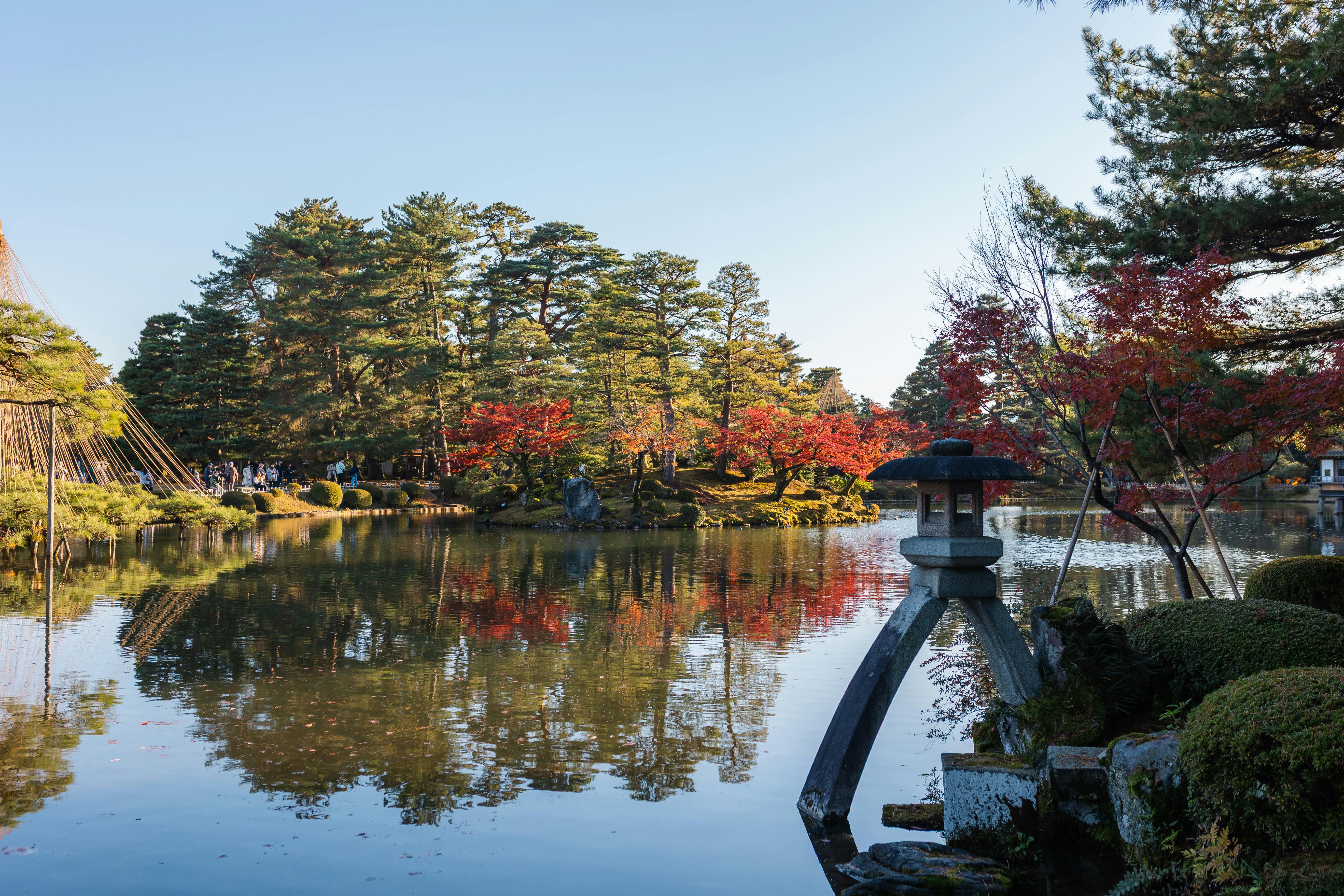
Kenrokuen Garden: Where Six Sublimities Meet Seasonal Perfection
The first light of 6:30 AM filters through the ancient Japanese zelkova trees, casting dappled shadows across the 5,000-square-meter surface of Kasumigaike Pond—Misty Pond, named for the fog that rises from its depths on autumn mornings. You stand at the edge of the water, the only sound a distant shishi-odoshi (deer scarer) releasing its bamboo arm with a hollow clack every thirty seconds, a rhythm unchanged since the Edo period. This is Kenrokuen, one of Japan's Three Great Gardens, occupying 110,000 square meters—approximately 28 acres—just southeast of Kanazawa Castle . Built over two centuries by the Maeda clan, the wealthiest daimyo of the Tokugawa Shogunate, this strolling garden solved a problem that haunts landscape designers to this day: how to embody all six attributes of a perfect garden—spaciousness, seclusion, artifice, antiquity, watercourses, and panoramic views—within a single composition . The name itself announces the ambition: Kenrokuen means "Garden of the Six Sublimities," and as you walk its 8,750 trees and 183 plant species, you realize the Maeda lords succeeded beyond any measure .
Why Kenrokuen Embodies Japanese Garden Mastery
The garden's creation spans from the 1620s to the 1840s—more than two centuries of continuous refinement by the Maeda family, the most powerful daimyo of the Edo period, ruling the Kaga Domain (modern Ishikawa and Toyama prefectures) . Unlike the smaller, contemplative gardens of Kyoto, Kenrokuen solved a unique design problem: how to create a landscape that remained engaging across all seasons while incorporating the six classical Chinese garden attributes: spaciousness (ichi), seclusion (rei), artifice (jin), antiquity (ko), watercourses (sen), and panoramic views (ryō) . The result is a kaiyū-shiki (strolling garden) designed to be experienced differently with every step. Its four ponds include Kasumigaike (over 5,000 square meters) and the gourd-shaped Hisago-ike, believed to be the earliest constructed feature . The garden also contains a rare Midori Waterfall, built in 1774—an unusual element in Japanese garden design, where waterfalls are typically small; here, the Maeda lords deliberately placed maple branches in front of the cascade to add depth and character . The garden opened to the public in 1871, and its Kotoji-tōrō—a two-legged stone lantern that has become the symbol of Kanazawa—stands as the most photographed element, though the garden's true genius lies in the harmony of its entire composition .
The Best Time to Experience Kenrokuen Garden
Each season transforms the garden into a different masterpiece. For cherry blossoms, arrive between April 1 and April 15, when 400 cherry trees of 40 species burst into bloom, with daytime temperatures averaging 14°C–18°C (57°F–64°F) . Autumn foliage peaks from October 20 to November 10, when Japanese maples ignite in crimson and gold, temperatures ranging 13°C–18°C (55°F–64°F) . Winter offers a uniquely Kanazawa spectacle: yukitsuri (snow ropes) appear from November 1 to mid-March, when park workers string ropes from pine treetops to lower branches, creating cone-shaped silhouettes that prevent snow damage—a scene so iconic it appears on half of Ishikawa Prefecture's tourism posters . The garden opens at 7:00 AM from March 1 to October 15, and 8:00 AM from October 16 to February 28; last entry is 30 minutes before closing . Free illumination events occur on weekends during cherry blossom and autumn foliage seasons. Avoid Golden Week (April 29–May 5) and weekends in November, when path congestion makes contemplative strolling impossible. .
Approximate Budget for a 7-Day Trip
This budget assumes a solo traveler or couple based in Kanazawa City, with day trips to the garden and nearby attractions like Kanazawa Castle and the Higashi Chaya District. All figures in Japanese Yen (¥) with USD equivalents based on exchange rates (¥150 = $1 USD).
- Accommodation: ¥6,000–¥25,000 ($40–$167 USD) per night. Budget: Guesthouse near Kanazawa Station from ¥3,000–¥6,000 ($20–$40); Mid-range: Hotel Pacific or similar 3-star hotel: ¥10,000–¥15,000 ($67–$100); Luxury: Kenrokuen Garden House Hotel or traditional ryokan: ¥20,000–¥25,000 ($133–$167) .
- Food: ¥3,500–¥7,000 ($23–$47) per day. Breakfast at convenience store: ¥500 ($3.30); Kaga-ryori traditional lunch (jibu-ni stew and sushi): ¥1,500–¥2,500 ($10–$17); Dinner at izakaya with local seafood and sake: ¥2,000–¥3,500 ($13–$23).
- Transportation: ¥1,250–¥3,500 ($8–$23) daily. Hokutetsu Bus from Kanazawa Station to Kenrokuen-shita: ¥230 one-way ; 1-day pass for city buses: ¥800 ($5.30); Shinkansen from Tokyo to Kanazawa: ¥14,520 ($97) each way (2.5 hours).
- Attractions: ¥320 ($2.10) for Kenrokuen entry (adults 18+); ¥100 ($0.65) for children 6–17 ; ¥500 combined ticket with Kanazawa Castle Park ; ¥800 ($5.30) for matcha and sweet at Yugao-tei teahouse .
- Miscellaneous: ¥2,000–¥5,000 ($13–$33) for gold-leaf souvenirs (Kanazawa produces 99% of Japan's gold leaf), Kutani-yaki ceramics, or traditional sweets from the Omicho Market.
Total estimated 7-day budget (mid-range, excluding transportation to Kanazawa): ¥97,000–¥195,000 ($650–$1,300 USD).
7 Essential Kenrokuen Garden Experiences
- Find the Kotoji-tōrō at Golden Hour: The two-legged stone lantern—Kenrokuen's most famous feature—sits at the edge of Kasumigaike Pond. Arrive at 4:30 PM in autumn for the "Kotoji Reflection," when the low sun aligns perfectly to cast the lantern's shadow across the water, creating the illusion of a musical instrument's bridge (koto). This phenomenon occurs for approximately 10 days around October 25 and March 20.
- Watch Japan's Oldest Fountain at Midday: Built in 1850 using only natural water pressure (no pumps), this 3.5-meter-high fountain rises from the garden's upper pond. The water source is 20 meters higher, creating a hydraulic system that continues to function after 174 years. The fountain operates from 9:00 AM to 4:00 PM and is most powerful between 11:00 AM and 1:00 PM .
- Take Matcha at Yugao-tei Teahouse in Autumn: Kanazawa's oldest teahouse, Yugao-tei ("Evening Face" teahouse, named after a character from The Tale of Genji) sits surrounded by maple trees and a small waterfall. For ¥800, receive a bowl of frothy matcha and a seasonal wagashi sweet. The teahouse fills quickly during foliage season—arrive when the garden opens to secure a window seat overlooking the vermilion leaves reflected in the pond .
- Walk the Yukitsuri Snow Ropes in Winter: Between November and March, over 500 pine trees receive the yukitsuri treatment—ropes radiating from central poles like open umbrellas to support snow-heavy branches. The most dramatic example is the 500-year-old Karasaki-no-Matsu (Crooked Pine), its ropes creating a silhouette visible from every corner of the garden. The best viewing is on snowy weekday mornings, when fresh powder accumulates on the ropes.
- Cross the Gourd Pond's Stone Bridges: Hisago-ike (Gourd Pond) derives its name from the hourglass shape of the water body. Two stone bridges cross its narrow waist—one flat, one arched—each offering different perspectives of the surrounding hills. Stand on the arched bridge at 7:30 AM in June, when water lilies bloom and the reflection of Chikuyama Hill creates a double landscape.
- Contemplate Seclusion at Seppōraku-tei Teahouse: Unlike the popular Yugao-tei, this smaller teahouse sits hidden on the garden's eastern edge, accessible via a winding path through bamboo groves. The name means "Snow, Pine, Fall, Joy"—a seasonal invitation. The teahouse is only open from April to November, with impromptu tea ceremonies on Sunday mornings (¥500, no reservation required). Most tourists miss it because the entrance is unmarked.
- Photograph the Midori Waterfall Through Maple Branches: This 6.5-meter waterfall, built in 1774, is a rarity among Japanese gardens—most feature streams and ponds, not cascades. The Maeda lords placed a single Japanese maple directly in front of the falls; in late October, the red leaves frame the white water in a composition that has been painted by artists for 250 years. The best shot comes at 9:00 AM when sunlight strikes the falls at a 45-degree angle .
3 Hidden Gems Most Travelers Miss
- The 500-Year-Old "Sleeping Dragon" Pine: While the Crooked Pine gets the attention, look for Garyū-no-Matsu (Sleeping Dragon Pine) near the garden's north exit. This tree was trained over three centuries to grow parallel to the ground—its main trunk runs horizontal for 12 meters before turning upward. The effect suggests a dragon resting before flight. Most visitors walk past without noticing its directional orientation: the "head" points east toward the rising sun, an intentional Shinto alignment. Access: from the Renchi-mon Gate, walk north for 100 meters; the pine is unmarked but recognizable by its horizontal form and moss-covered base.
- The Uchihashi-tei "Secret" Tea Garden: Located down an unmarked path off the main circuit, Uchihashi-tei (Inside Bridge Pavilion) is a small teahouse and garden that most visitors never find. Unlike the main garden's open vistas, this sub-garden is designed for miegakure (hide-and-reveal)—each step reveals a new composition of stone lantern, water basin, and clipped shrub. The teahouse itself is closed to the public, but the approach path offers the garden's only view of Kanazawa Castle's Ishikawa-mon Gate framed through a circular window. Access: after crossing the Kasumigaike's northern bridge, look for a narrow gravel path leading between two azalea bushes; follow it for 50 meters. Free, open during garden hours.
- The Pre-Dawn Gardener's Bench (By Appointment Only): Kenrokuen offers a little-known program: Go-enshu no Asa-sanpo (Early Morning Stroll with the Head Gardener) on the first Tuesday of each month. For ¥5,000 ($33), you enter the garden at 6:00 AM—one hour before public opening—and walk with the head gardener while learning pruning techniques, soil management, and the names of 50 moss species. The program includes tea and a small pruning shear souvenir. Only five spots per month; reservations required through the garden office at 076-234-3800 at least two weeks in advance.
Cultural & Practical Tips
- Buy the combo ticket with Kanazawa Castle Park: For ¥500 ($3.30), you gain access to both Kenrokuen and the adjacent Kanazawa Castle grounds—a saving of ¥120 compared to buying separately. The castle's reconstruction includes the original stone foundations and a museum of Maeda clan armor .
- Learn to say "Roku-ri o tashinamu": Pronounced "Roh-koo-ree oh tah-shee-nah-moo." This phrase means "I savor the six attributes"—a compliment gardeners appreciate. Use it at the information desk, and staff may offer you a free map marked with hidden viewpoints not shown on the standard brochure.
- Arrive at 7:00 AM in April or November: The garden receives 2.5 million visitors annually, with peak congestion between 11:00 AM and 2:00 PM during cherry blossom and autumn foliage seasons. The first hour after opening is the only time you'll have the Kotoji lantern entirely to yourself for photography. The garden is busiest on Sunday mornings when local families arrive; Tuesday mornings are least crowded .
- Carry ¥5,000–¥10,000 in cash: The Yugao-tei teahouse (¥800 matcha set), the small souvenir shop near the Seisonkaku Villa, and several food stalls accept cash only. The nearest ATM is at the Kenrokuen-shita bus stop convenience store (7-Eleven, open 24/7), but it charges a ¥220 fee for foreign cards.
- Respect the "no walking on moss" rule: Kenrokuen's 50 varieties of moss are its most fragile feature. Staff will whistle at you from 50 meters away if you step off the gravel paths. In winter, some paths become icy—rent slip-on ice cleats at the information desk for ¥100 (refundable deposit).
- Photography restrictions during illumination events: Tripods are banned on the bridges during evening illuminations (April cherry blossoms, November autumn leaves) because they block pedestrian flow. Use a monopod or handheld stabilizer instead. Flash photography is prohibited year-round near the teahouses to preserve the tatami mats.
- Visit the Seisonkaku Villa on a rainy afternoon: This 1863 villa, built for the 13th Maeda lord's mother, has the garden's only indoor viewing areas. On rainy days, sit in the second-floor zashiki (tatami room) and watch the garden through a 19th-century plate-glass window—a luxury when glass was hand-blown and extremely expensive. The rain adds a reflective sheen to the garden paths and fills the ponds, creating a "rain garden" effect most visitors flee from. Entry: ¥320 (separate from garden ticket).
Conclusion: Travel with Contemplation, Not Just a Camera
There is a tendency in the age of Instagram to treat Kenrokuen as a backdrop—a checklist of six attributes to photograph and check off. But the Maeda lords who built this garden over two centuries understood something that social media cannot capture: that a garden's beauty is not in its individual elements but in the relationship between them. The Kotoji lantern is lovely, yes, but its true meaning emerges only when you see its shadow on the water, framed by a pine branch, with a heron standing motionless in the foreground. To walk Kenrokuen is to enter a conversation between human artifice and natural wildness—300 years of dialogue conducted in the language of stone and water, moss and maple. So put down your phone at the entrance. Take the path that looks less traveled. Sit on a bench facing the Gourd Pond and watch the light change for twenty minutes. The garden has been waiting for your slowness since 1840. Do not disappoint it.
Image Description: Early morning mist drifting across Kasumigaike Pond with the iconic Kotoji stone lantern reflected in still waters at Kenrokuen Garden