
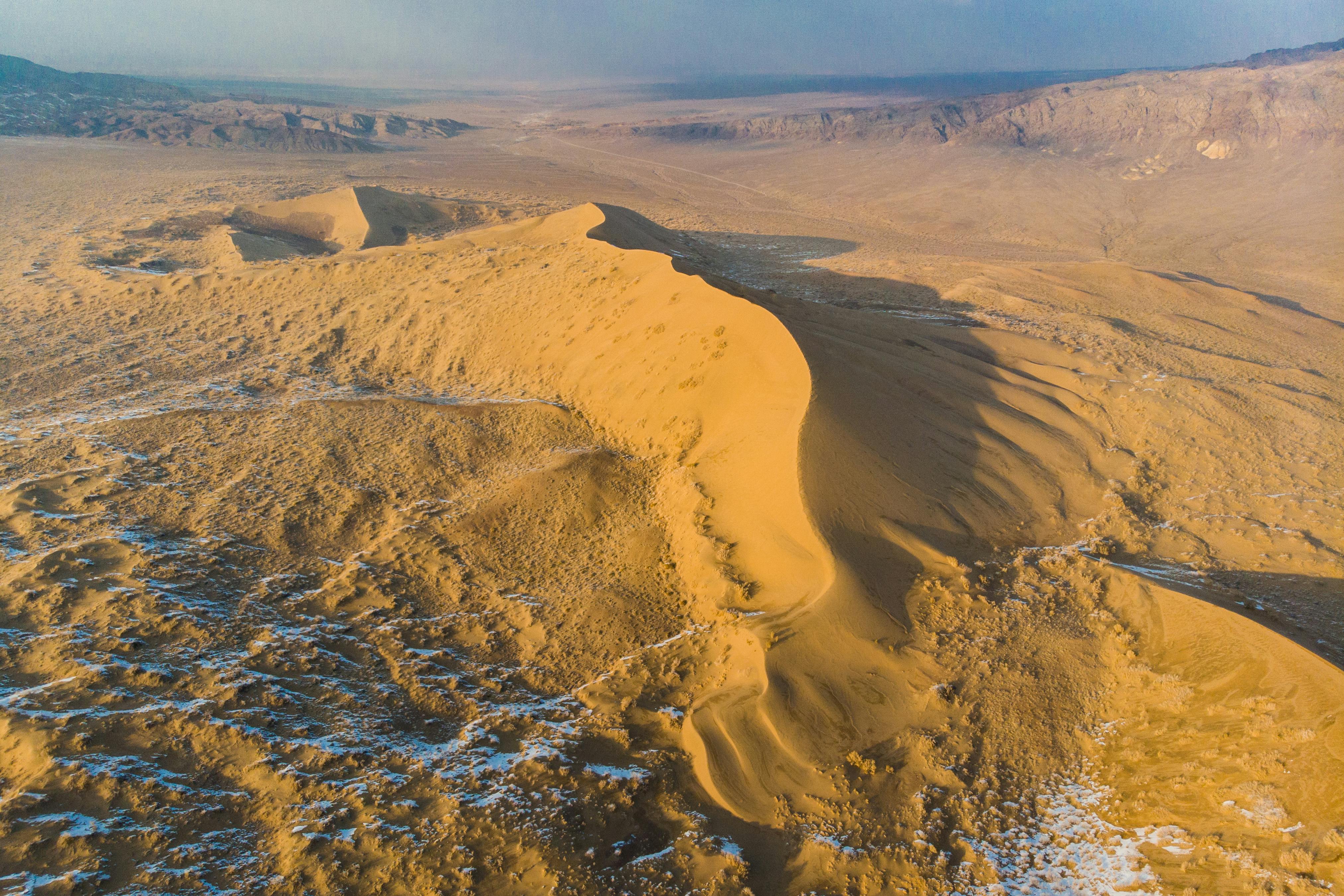
Singing Sand Dunes: Where Aeolian Music Meets Silk Road Eternity
At 5:47 AM, the Gobi Desert holds its breath. You stand at the base of Mingsha Mountain—鸣沙山, the Singing Sand Dunes—and the air carries a chill that will vanish by noon, dropping from 8°C (46°F) to 33°C (91°F) in the span of six hours. The first rays fracture across 40 kilometers (25 miles) of wind-sculpted ridges, turning the quartz grains from umber to molten gold. Somewhere above you, a camel bell clinks; the sound carries differently here, refracted by the massive parabolic bowls of sand that rise 1,715 meters (5,626 feet) above sea level. Then the wind shifts, and you hear it—not a howl, not a whisper, but a sustained, resonant hum like a Tibetan singing bowl the size of a mountain. This is the acoustic phenomenon that has drawn travelers since the Han Dynasty (206 BCE–220 CE): millions of sand grains colliding in synchronized motion, their outer layers vibrating like loudspeaker cones, producing notes that ancient texts described as the music of the earth itself. You are not merely visiting a desert; you are standing inside a natural instrument that has played for two millennia.
Why Singing Sand Dunes Embodies the Resilience of Silk Road Civilization
The Singing Sand Dunes are not merely a geological curiosity—they are a monument to the improbable persistence of human culture against environmental extremes. Stretching 40 kilometers (25 miles) east to west and 20 kilometers (12 miles) north to south, these dunes guarded the southern route of the Silk Road, the 6,400-kilometer (4,000-mile) trade artery that connected Chang'an (modern Xi'an) to the Mediterranean between 130 BCE and 1453 CE.
What makes this site extraordinary is not just the sound, but the paradox it shelters: Crescent Lake (月牙泉, Yuèyáquán), a freshwater spring measuring 100 meters (328 feet) long and 54 meters (177 feet) wide, sits just 10 meters (33 feet) from the flowing sand yet has never been buried. For thousands of years, the spring has reflected the dunes while the dunes have protected the spring—a geomorphological harmony that Chinese scholars have called “mountain and spring coexist, sand and water are in harmony.” The water remains pure and clear, fed by an underground aquifer that defies the desert's 42 millimeters (1.7 inches) of annual rainfall and 3,247 hours of blistering annual sunshine.
The sand itself is composed of five distinct minerals—red, yellow, blue, white, and black quartz—that create variegated patterns visible only in the angled light of dawn and dusk. When wind velocity reaches specific thresholds, the grains collide at frequencies between 80 and 120 hertz, producing the “singing” effect that scientists now attribute to synchronized grain motion and surface vibration. The Han Chinese named this place Shajiao Mountain; Tibetan Buddhists called it the Holy Sand Mountain. Today, it stands as a UNESCO-adjacent cultural landscape, a testament to how trade, faith, and natural wonder converged at the continent's edge.
The Best Time to Experience Singing Sand Dunes
The optimal window for visiting spans May 18–June 12 and September 8–October 15, when daytime temperatures hover between 18°C and 28°C (64°F–82°F) and the wind patterns are most favorable for hearing the dunes sing. During these periods, sunrise occurs between 6:00 and 6:30 AM, offering cool sand temperatures and empty ridges; sunset arrives around 7:30–8:00 PM, painting the dunes in vermillion and violet.
Avoid July 15–August 25, when domestic summer vacation crowds surge and sand surface temperatures exceed 60°C (140°F) between 11:00 AM and 4:00 PM. Winter visits (November–March) offer solitude and 50% accommodation discounts, but nighttime temperatures plummet to -15°C (5°F), and the dunes' acoustic properties diminish in frozen conditions.
For the full sensory experience, plan your dune climb for 6:00–7:30 AM (sunrise photography, cool sand, active camel caravans) or 5:00–7:30 PM (golden hour light, optimal singing sand conditions as evening winds rise). The park opens at 5:00 AM and closes at 8:30 PM (April–October), with last entry at 7:30 PM.
Approximate Budget for a 7-Day Trip
Prices below reflect the May–October peak season in Chinese Yuan (CNY), with off-season (November–March) alternatives noted where applicable. The exchange rate averages 7.2 CNY = 1 USD.
- Accommodation: ¥200–¥600 per night ($28–$83 USD)
- Budget: Hostel dormitories near Shazhou Night Market, ¥60–¥80/night ($8–$11)
- Mid-range: City-center hotels (Dunhuang Yunyihotel, Zhongzhou International), ¥300–¥500/night ($42–$69)
- Scenic: Desert-view guesthouses near Mingsha Mountain entrance, ¥400–¥600/night ($56–$83); book 30+ days ahead
- Off-season discount: 50% reduction across all categories (November–March)
- Food: ¥80–¥150 per day ($11–$21)
- Breakfast: ¥10–¥20 ($1.40–$2.80) — almond tea (xìngrén chá), sesame seed cake
- Lunch: ¥25–¥40 ($3.50–$5.60) — hand-pulled noodles (lāmiàn) with lamb
- Dinner: ¥45–¥90 ($6.25–$12.50) — red willow kebabs (hóngliǔ dàokǎo), donkey meat sandwiches (lǘròu huángmiàn) at Shazhou Night Market
- Transportation:
- Bus Route 3 to Mingsha Mountain: ¥2 ($0.28) one way, runs 7:30 AM–9:00 PM
- Taxi (city center to dunes): ¥15–¥20 ($2.10–$2.80) one way
- West Line day tour (Yangguan Pass, Yumen Pass, Yardang Geopark): ¥120–¥150 ($17–$21) carpool, or ¥400–¥450 ($56–$63) private vehicle
- Bicycle rental near dunes: ¥20 ($2.80) per day
- Attractions:
- Mingsha Mountain & Crescent Lake: ¥110 ($15.30) May–October; ¥55 ($7.60) November–April (valid for 3 consecutive days with fingerprint registration)
- Mogao Caves (standard A-ticket): ¥238 ($33)
- Mogao Caves (emergency B-ticket): ¥100 ($14)
- Yardang National Geopark: ¥50 ($7) + ¥70 ($9.70) shuttle
- Yangguan Pass: ¥50 ($7)
- Camel ride (dunes): ¥100 ($14) for 40 minutes
- Sandboarding rental: ¥30 ($4.20) per hour
- Shoe covers (防沙靴, fángshāxuē): ¥15 ($2.10) rental at entrance
- Miscellaneous:
- Souvenir silk scarf (hand-painted Dunhuang motif): ¥80–¥120 ($11–$17)
- Dunhuang Research Academy mural-painting workshop: ¥200 ($28)
- Desert camping (tent, bonfire, stargazing): ¥300–¥500 ($42–$69) per night
- Emergency water (2L bottle inside park): ¥15 ($2.10); buy outside for ¥3 ($0.42)
Total 7-day budget: ¥2,800–¥4,500 ($390–$625 USD) for mid-range travel; ¥1,500–¥2,200 ($210–$305 USD) for budget backpackers; ¥6,000+ ($830+ USD) for premium experiences including special Mogao cave access and private desert camps.
6 Essential Singing Sand Dunes Experiences
- Pre-Dawn Ridge Ascent: Arrive at the Middle Gate by 5:30 AM. Climb the eastern ridge via the wooden stairway half-buried in sand, reaching the summit by 6:00 AM. From 1,715 meters (5,626 feet), watch the Taklamakan Desert horizon ignite as Crescent Lake reflects the first light like a jade mirror. The sand is firmest and coolest now; you will hear no singing yet, only the rhythmic breathing of camels being saddled below.
- Camel Caravan at Golden Hour: Board your Bactrian camel at the base camp between 4:30 and 5:30 PM. The 40-minute ride follows the ancient Silk Road trajectory, ascending the western ridges as the sun drops toward the Qilian Mountains. The camel's pace—1.5 kilometers per hour (0.9 mph)—forces a meditative rhythm; you feel the heat radiating from the sand through the saddle, then dissipating as shadows lengthen.
- Acoustic Dune Descent: Sit at the crest of the main peak and slide down the 45-degree leeward face. The sand begins to sing when your body triggers the avalanche—start with a small handful to test the resonance, then commit to the full descent. The sound peaks at 30–40 seconds, a sustained baritone drone that seems to emanate from the earth's core rather than the surface. Best conditions: dry sand, wind speed 10–15 km/h (6–9 mph), between 3:00 and 5:00 PM.
- Crescent Lake Circumambulation: Walk the full perimeter of the spring (approximately 300 meters/984 feet) at 7:00 AM, when mist still hovers above the water. The Yueya Pavilion pagoda, rebuilt in 1960 after Qing Dynasty collapse, frames the lake in traditional Han architecture; photograph it from the northeast corner where the dunes create a natural vignette.
- Sand Bath Therapy: Burrow into the 60°C (140°F) sand up to your neck at the designated therapy zone near the southern ridge. Local practitioners claim the mineral-rich quartz alleviates rheumatism; you will claim it is the most surreal sauna on earth. Limit exposure to 15 minutes; bring water and a hat. Available 10:00 AM–4:00 PM, ¥50 ($7) per session.
- Stargazing from the Dune Crest: Remain in the park after 9:00 PM (night buses extend to 10:30 PM during peak season). With annual precipitation of only 42 millimeters (1.7 inches) and 3,247 hours of annual sunshine, the atmospheric clarity is exceptional. The Milky Way arches directly overhead from June through August; bring a red-filtered flashlight and a tripod. Desert camping operators provide telescopes and hot ginger tea.
3 Hidden Gems Most Travelers Miss
- The Five-Color Sand Quarry (五彩沙湾): Located 3 kilometers (1.9 miles) west of the main tourist zone, this abandoned excavation site reveals stratified layers of red, yellow, blue, white, and black quartz. Access via the dirt track behind the Mingsha Mountain Desert Research Station; no public transport—hire a bicycle (¥20/$2.80) or walk 45 minutes from the Middle Gate. Visit at 4:00 PM when oblique light makes the layers fluoresce. Most tourists never venture beyond the camel loop; this spot offers complete solitude and macro-photography opportunities.
- Dunhuang Xihu Wetlands (敦煌西湖湿地): A 45-minute drive west of the city (Bus Route 12, ¥8/$1.10, departs 8:00 AM and 2:00 PM), this ecological barrier against desert expansion hosts black storks, whooper swans, and relict poplar forests. The contrast between the wetlands' 2,000 hectares (4,940 acres) of reeds and the adjacent Gobi is hallucinatory. Best visited October 10–25 when golden poplars reflect in still water. Bring binoculars; the birdwatching platform is 800 meters (0.5 miles) from the parking area.
- The Leiyin Temple Subterranean Library (雷音寺): A working Buddhist monastery 1.5 kilometers (0.9 miles) south of the Mingsha Mountain entrance, often bypassed for the more famous Mogao Caves. The temple houses a climate-controlled repository of 3,000+ sutra scrolls copied by hand since the Ming Dynasty (1368–1644). The abbot, Master Jinghui, permits silent viewing of three Song Dynasty (960–1279) manuscripts on Tuesday and Thursday mornings (9:00–11:00 AM); no photography, no entry fee, donations accepted. Contact the temple office at +86-937-888-XXXX (replace XXXX with local directory assistance) to confirm the abbot's availability. The meditation hall overlooks the dunes, offering the most contemplative view in Dunhuang.
Cultural & Practical Tips
- Modest dress is mandatory: Dunhuang contains active Muslim communities and Buddhist sacred sites. Shoulders and knees must be covered when visiting Mogao Caves or Leiyin Temple; lightweight linen trousers and long-sleeved UV shirts serve dual purposes.
- Hydration protocol: The desert's 8% average humidity and extreme diurnal temperature swings (20°C/36°F variance) demand 3–4 liters of water daily. Carry a 2-liter minimum when entering Mingsha Mountain; dehydration onset is rapid and insidious. Electrolyte tablets are essential.
- Essential Mandarin phrases:
- “Míngshā shān zài nǎlǐ?” (鸣沙山在哪里?) — “Where is Mingsha Mountain?” [MING-sha SHAN zai NAH-lee]
- “Wǒ xiǎng qí luòtuo” (我想骑骆驼) — “I want to ride a camel” [WOR shee-ahng chee LOO-oh-twaw]
- “Zhè shì shénme shāzi?” (这是什么沙子?) — “What kind of sand is this?” [Jeh shuh SHEN-meh SHAH-dzuh]
- Photography guidelines: Tripods are permitted on the dunes but prohibited inside Mogao Caves (flash damages 1,600-year-old pigments). For dune shots, use a polarizing filter to cut glare; the golden hour window is 6:30–7:30 PM in May, 7:00–8:30 PM in September. Drone flight requires prior registration with Dunhuang Cultural Heritage Bureau—unauthorized drones are confiscated.
- Footwear strategy: The orange shoe covers (¥15/$2.10 rental) are worth the expense; sand temperatures reach 60°C (140°F) at midday and will destroy standard hiking boots over repeated visits. Alternatively, wear closed-toe sandals with ankle straps and shake them out every 20 minutes.
- Ticket fingerprint registration: To use the 3-day re-entry privilege, you must record your fingerprints with security staff when exiting. The system uses facial recognition software; remove hats and sunglasses during registration. Free-entry visitors (children under 1.2 meters, seniors 70+) cannot access this multi-day benefit.
- Wind and sandstorm protocol: Spring (March–April) brings occasional shāchén bào (沙尘暴) sandstorms with winds exceeding 60 km/h (37 mph). If the sky turns orange and visibility drops below 100 meters (328 feet), seek shelter in the Crescent Lake pagoda complex or return to the Middle Gate visitor center. Do not attempt dune climbs during dust storms—the abrasive sand can damage eyes and respiratory systems.
Conclusion: Travel with Reverence, Not Just Curiosity
The Singing Sand Dunes do not owe you their song. The acoustic phenomenon requires specific grain size, humidity, and wind velocity; some visitors climb and descend in silence, hearing only the rasp of their own breath. This is the desert's first lesson: not every miracle performs on demand. The second lesson arrives at Crescent Lake, where water persists despite every climatic imperative—a reminder that resilience, not dominance, defines survival in extreme environments.
As you leave Dunhuang, the sand will remain in your shoes, your camera sensor, the creases of your journal. Let it stay there. Let it serve as grit against complacency, as audible memory of a place where the earth itself hums. The Silk Road was never merely a trade route; it was a conversation between civilizations conducted across impossible terrain. When you listen to the dunes sing, you are not hearing a tourist attraction—you are eavesdropping on that conversation, still ongoing after two thousand years. Travel slowly here. Climb one dune, not five. Sit until the camels pass. Let the sand teach you what it has taught every caravan: that the journey is the destination, and the desert, finally, is the most honest cartographer.