
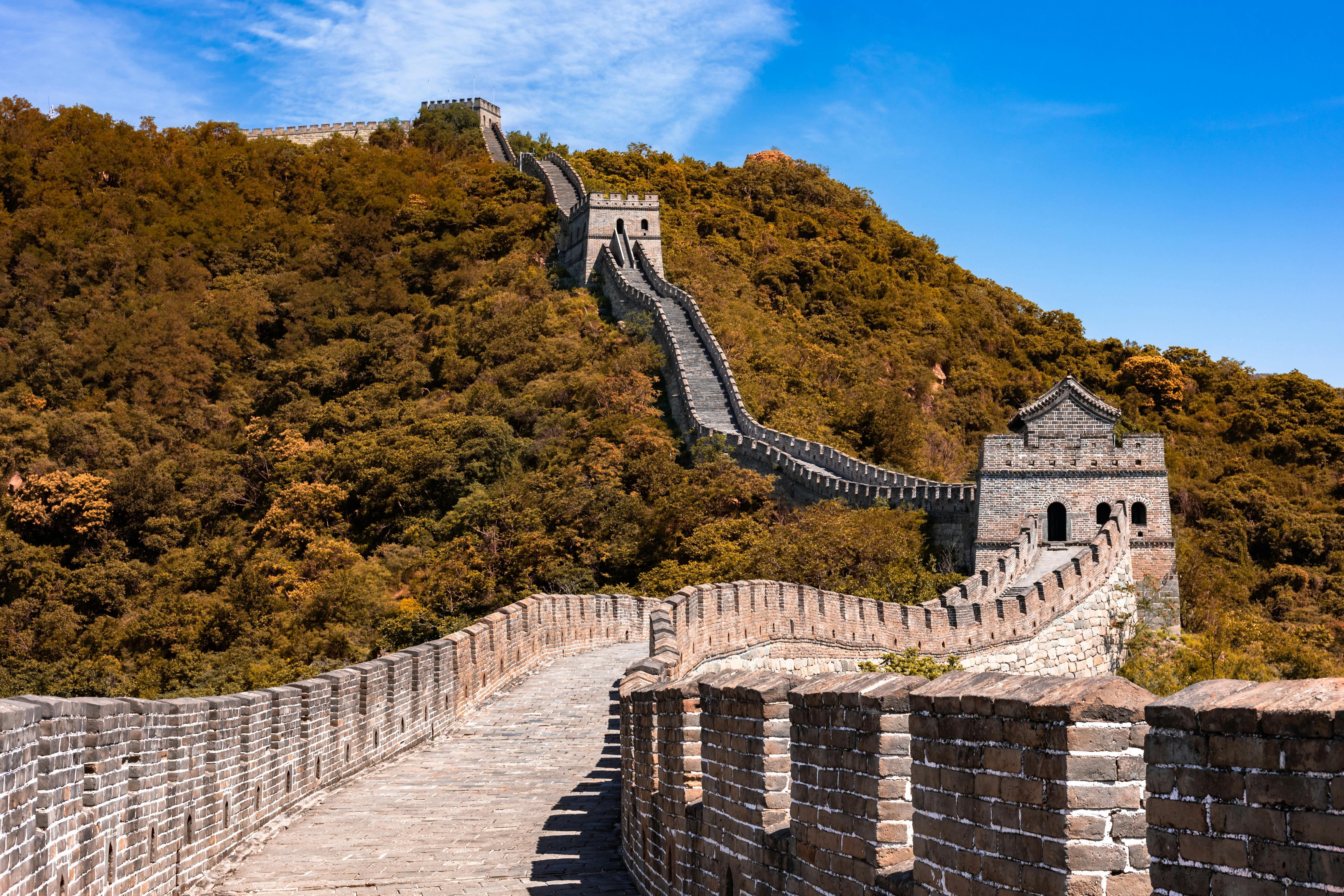
The Great Wall of China: Where Ancient Stone Meets Dragon's Spine
The sun crests the ridgeline at 6:47 AM—a molten-gold coin rising behind crenellations worn smooth by six centuries of monsoon rain and winter frost. You stand on a rampart averaging 7.8 meters (26 feet) in height, running your palm across bricks that a Ming Dynasty soldier laid in 1567. The wall exhales morning mist as it snakes eastward—21,196 kilometers (13,171 miles) from the Hushan Mountains in Liaoning Province to the Jiayu Pass in Gansu's western deserts . Watchtowers break the ridgeline every 50 to 100 meters, their arrow slits framing a landscape of terraced farmland and pine-laced peaks . No photograph prepares you for the physicality of this place: the steepness dragging at your calves, the ancient stone warm beneath your hands, the silence broken only by wind whistling through beacon towers that once passed smoke signals from Mongolia to Beijing in under 24 hours. This is not merely a wall. It is China's spine—a living monument to ambition, sacrifice, and the human desire to draw a line against the unknown.
Why the Great Wall Embodies Millennia of Military Genius
The Great Wall solves a deceptively simple problem: how do you defend the longest continuous land border on Earth against mounted archers who carry their infrastructure on horseback? The answer evolved over 2,700 years. Construction began in the 7th century BCE, when the state of Chu erected a "Square Wall" of rammed earth . But the visionary who connected these disparate fortifications was Qin Shi Huang—China's first emperor—who, in 221 BCE, ordered 300,000 soldiers and conscripted laborers to link existing walls into a single system . The method proved brutally efficient: workers packed layers of earth between wooden forms, compacting each stratum until it achieved near-concrete density. The Ming Dynasty (1368–1644) perfected this technology, facing the walls with kiln-fired bricks and limestone mortar that has survived earthquakes and artillery. The wall's genius lies in its redundancy: outer parapets feature crenellations for archers, while inner walls hide smoke-signal platforms capable of transmitting intelligence 24 kilometers (15 miles) per beacon. Watchtowers served dual purposes as barracks and supply depots, their strategic placement ensuring that no enemy approach went unobserved . Recent discoveries in 2023 revealed over 130 hidden doors—camouflaged passages allowing scouts to exit for surprise attacks, their brick facades disguising hollow interiors that soldiers could "break like eggshells" to flank invaders . This is tactical architecture as living organism.
The Best Time to Experience the Great Wall
Spring (March 15–May 31) and autumn (September 1–November 15) offer the most comfortable conditions for climbing, with temperatures ranging from 12°C to 25°C (54°F–77°F). April proves particularly magical as apricot flowers blanket the slopes below sections like Mutianyu . For photographers, the golden window arrives 7:00–8:30 AM when morning light rakes across the undulating parapets, or 4:30–6:00 PM when sunsets set the western watchtowers aflame. Summer (June 1–August 31) brings heat and humidity reaching 32°C (90°F), plus dense crowds at Badaling—though night tours operate from April 30 through October 6, transforming the wall into an illuminated "golden dragon" . Winter (December 1–February 28) offers solitude and the possibility of snow-capped watchtowers, but temperatures drop to -10°C (14°F) with icy steps. Avoid China's National Day holiday (October 1–7) and Labor Day weekend (May 1–3) when domestic tourists flood the most accessible sections. Real-time updates and official ticketing: https://en.mutianyugreatwall.com/
Approximate Budget for a 7-Day Trip
This budget assumes a self-guided itinerary from Beijing visiting two wall sections (Badaling and Mutianyu), mid-range accommodation, and a mix of street food and restaurant meals. Costs reflect high-season pricing (April–October).
- Accommodation: ¥300–¥600 per night (central Beijing near Dongsi or Gulou, 3-star hotels or quality hostels with private rooms)
- Food: ¥150–¥250 per day (breakfast: ¥20 for jianbing crepes and soy milk; lunch: ¥50 for dumplings or noodles near wall sections; dinner: ¥80–¥150 for Peking duck or hotpot with beer)
- Transportation: ¥120–¥500 daily (Subway to Beijing North Station: ¥5–¥10; high-speed train to Badaling: ¥25–¥40; private driver to Mutianyu: ¥400–¥600 round-trip split among 4 travelers)
- Attractions (per person): Badaling entrance: ¥40 high-season (¥35 low-season) ; Mutianyu entrance + shuttle: ¥60; Cable car at Badaling: ¥140 round-trip ; Toboggan at Mutianyu: ¥100 downhill
- Miscellaneous: ¥200–¥400 (Great Wall souvenir medal: ¥50–¥80; calligraphy scroll from Beijing's Panjiayuan Market: ¥100–¥300; bottled water and snacks on the wall)
Total estimated 7-day budget (excluding international flights): ¥3,800–¥6,500 per person (approximately $525–$900 USD). Budget travelers can reduce costs by hiking instead of using cable cars and eating from street stalls; luxury travelers booking private guides and 5-star hotels should budget ¥15,000+ ($2,070+).
7 Essential Great Wall Experiences
- Conquer Hero Slope at Badaling: Between the 7th and 8th North Towers awaits a 60-degree incline that requires using both hands and feet . The reward: Badaling's highest point at 1,015 meters (3,330 feet) and a photo with the character slab reading "The man who does not reach the Great Wall is not a true man." Arrive when gates open at 6:30 AM (April–October) to ascend before tour buses disgorge their crowds.
- Hike Jinshanling to Simatai at Sunrise: This 10.5-kilometer (6.5-mile) ridgeline traverse between two original Ming sections offers the most dramatic unbroken hike . Start at Jinshanling's east gate at 5:00 AM (arrange a Simatai village driver the night before) and watch dawn ignite 67 watchtowers—some original, some partially collapsed, all silent except for wind. The hike takes 4–5 hours; bring 2 liters of water per person.
- Ride the Toboggan Down Mutianyu: After exploring 22 watchtowers and the "Long Live Chairman Mao" hillside inscription, descend via metal sled on a 1.5-kilometer (0.9-mile) winding track . The chairlift ascends past chestnut trees planted during the Tang Dynasty; the toboggan descends at speeds you control with a center brake. Open daily 8:00 AM–5:00 PM, toboggan ¥100.
- Photograph the Water Great Wall at Huanghuacheng: The only lakeside section open to visitors results from 1970s dam construction that flooded the valley, submerging portions of the wall . From the eastern dam, you capture the impossible sight of watchtowers rising directly from jade-green water—surreal at sunset when the western light hits submerged bricks. Access requires a 1.5-hour drive from Beijing; entry ¥60.
- Night Tour Badaling's Golden Dragon: From April 30 to October 6, 18:30–22:00, LED lighting transforms the 1.3-kilometer (0.8-mile) stretch between North 4th and South 4th towers into a luminous serpent . Ming Dynasty reenactors patrol the parapets; traditional musicians play guzheng from watchtower windows. Night tickets ¥198 weekdays, ¥298 weekends. Warning: cable car operates 17:30–19:30 only; wear sturdy shoes as lighting can obscure step edges.
- Uncover Secret Passages at Jiankou: This unrestored "Wild Wall" section—named for its arrow-shaped bends—requires a guide but reveals the Great Wall's original condition: crumbling ramparts, collapsed towers, and a dozen of the 130+ hidden doors discovered in 2023 . Hike the 3-kilometer (1.8-mile) stretch from Jiankou to Mutianyu (4 hours, guided tours from ¥800) and spot sliding brick panels that once concealed scout exits. Visit September–October when foliage hasn't yet obscured the archaeological details.
- Walk a Kilometer of Original Qin-Han Wall at Gansu: Most visitors never see the wall predating the Ming—but 200 kilometers (124 miles) west of Jiayuguan Pass, the Yumen Guan fortress preserves Han Dynasty (206 BCE–220 CE) rammed-earth walls. The beige, eroded ramparts stand just 3 meters (10 feet) tall now, but standing here at sunset, you occupy the exact spot where Silk Road caravans once presented jade for passage . Access requires a private driver from Dunhuang (¥500 round-trip, 2 hours each way).
3 Hidden Gems Most Travelers Miss
- Gubeikou's Panlongshan ("Coiled Dragon") Section: Located 140 kilometers (87 miles) northeast of Beijing, this unrestored Ming wall earned its nickname from a shape that forces hikers to traverse actual dragon-back ridges—walls so steep they require iron chains bolted into the stone. Unlike crowded Badaling, you'll share the 5-kilometer (3.1-mile) hike with local farmers who ascend to collect medicinal herbs. Access: Take bus 980 from Beijing Dongzhimen to Miyun (¥15, 2 hours), then local minibus to Gubeikou Village (¥20). Entry ¥25; hire a village guide (¥100) to avoid the unmarked minefields—literally, as this area saw Sino-Japanese conflict.
- The Underground Beacon Tower at Changping: Hidden beneath a nondescript hillside 40 kilometers (25 miles) northwest of Beijing, this partially excavated tower preserves a Ming-era communication system intact: stone signal braziers, original smoke flues, and a tunnel connecting it to the main wall 2 kilometers distant. The Beijing Great Wall Research Team discovered it in 2018 and has kept it deliberately unmarked to prevent looting. Contact the Changping District Cultural Relics Bureau (+86 10 6974 2261) at least 72 hours in advance to request a guided visit (¥200 donation requested).
- Xiangshuihu "Sound of Water" Gate: Outside the tourist town of Yanqing, a Ming Dynasty water gate spans a narrow gorge where spring melt rushes through original sluice mechanisms built to flood the valley in case of invasion. The name derives from the acoustics: standing beneath the 8-meter (26-foot) arch at midday, dropping water creates echoes that simulate approaching cavalry. To find it: take Yanqing bus 920 to Xidayao Village, walk 2 kilometers east following the dry riverbed. No signage; entry free but seasonal flooding closes access May–June. Visit September for optimal acoustics and golden light through the arch.
Cultural & Practical Tips
- Etiquette: Never climb on unrestored sections or remove bricks as souvenirs—locals consider this a curse on one's ancestors. When photographing Chinese tourists, gesture toward your camera and say "Qǐng" (ching, meaning "please") before shooting.
- Language: Learn "Duō shǎo qián?" (dwoh shao chyen) meaning "How much money?" for souvenir vendors. Pronunciation guide: "Xièxie" (syeh-syeh) for thank you should be delivered as two falling tones.
- Photography rules: Drones are banned within 5 kilometers of all restored sections (Badaling, Mutianyu, Jinshanling) due to military sensitivity. At unrestored sections like Jiankou, you can fly below 120 meters but must avoid watchtowers—rangers confiscate drones spotted above parapets.
- Physical preparation: A single kilometer on the wall involves 300-500 steps with risers averaging 25 centimeters (10 inches)—steeper than standard stairs. Train by climbing stadium stairs for 30 minutes straight before attempting Jinshanling's 4-hour hike. Bring hiking poles with rubber tips to protect ancient stone.
- What to wear: The wall creates its own weather—temperatures at Badaling's North 8th Tower can be 8°C (15°F) colder than the parking lot. Wear wool socks and layered synthetic fabrics; cotton becomes hypothermia-dangerous when sweat-soaked in autumn winds.
- Hydration strategy: No potable water exists on the wall after the ticket gates. Carry 2 liters minimum for half-day hikes, 4 liters for Jinshanling–Simatai. Electrolyte powders help in summer—you'll lose 1.5 liters of sweat per hour climbing Badaling's Hero Slope in July.
- Transport hack: The 7:20 AM S2 "Great Wall" train from Beijing North Station to Badaling offers panoramic windows framing the wall 30 minutes before arrival. Reserve seats via Trip.com 14 days in advance—standing for 1.5 hours after the 6:00 AM tourist bus crowds makes the early start worthwhile.
Conclusion: Travel with Understanding, Not Just Photos
You'll see travelers at Badaling spend 20 minutes posing for the perfect Instagram shot—then descend without touching a single original brick, having experienced the wall only as backdrop. But each of the estimated 40 million annual visitors accelerates erosion: hand oils degrade exposed stone; footsteps widen cracks that winter freezes then explode. The truth is that the Great Wall is dying—only 600 miles of its original length remain in stable condition . Yet walking it mindfully—feeling the 500-year-old soldier's hand groove worn into a watchtower sill, noticing how Ming bricks bear fingerprints of the conscript who fired them—transforms you from tourist into witness. This is not a Disneyland recreation. It is a 2,700-year-old conversation between ambition and entropy. The wall asks nothing of you except presence: to stand where emperors strategized, where sentries watched stars wheel above the steppe, where stone touches sky, and to understand that some lines—once drawn—can never be erased. Walk it slowly. Listen to the wind in the beacon towers. It has been speaking for 27 centuries.