
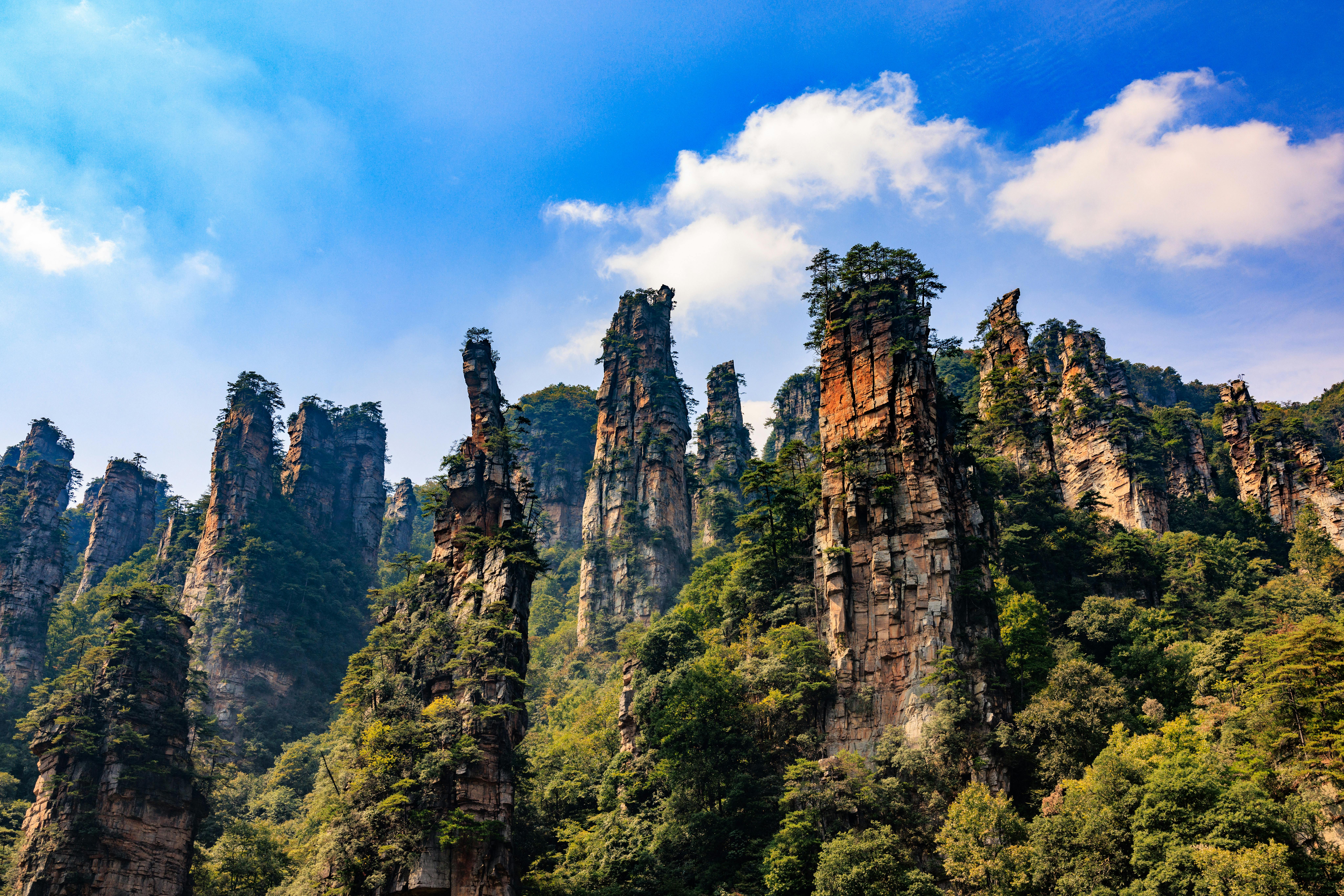
Wulingyuan Scenic Area: Where Avatar Mountains Meet Misty Gorges
The first light spills over three thousand quartzite sandstone pillars—some reaching 200 meters skyward—as mist coils through ravines like silk unfurling in slow motion. You stand at the edge of Yuanjiajie, where the Hallelujah Mountains of James Cameron's Avatar found their real-world inspiration . Below, Golden Whip Stream winds through a canyon so narrow that sunlight filters through the canopy in scattered coins of gold. This is Wulingyuan, a 26,400-hectare UNESCO World Heritage site that remained hidden from all but local hunters until 1979, when the painter Wu Guanzhong discovered its magic and brought it to the world's attention . The landscape defies easy description: more than three thousand pillar formations, two natural bridges, 40 caves, and gorges carved by ice-age glaciers . The Bailong Elevator—the world's tallest outdoor lift at 326 meters (1,070 feet)—transports you from valley floor to mountain peak in just 88 seconds. But no technology can prepare you for the silence up there: a profound quiet interrupted only by wind through ancient pines and the distant cry of a rhesus macaque. This is not a landscape you observe. It is a landscape that dwarfs you.
Why Wulingyuan Embodies Quartzite Sandstone Majesty
Wulingyuan solves a geological riddle that has puzzled scientists for decades: how did these thousands of pillar formations emerge from what was once a vast sea? The answer lies 380 million years ago, when quartzite sandstone layers accumulated on an ancient seabed. Tectonic uplift raised the entire region 200 meters, and then water—over eons—did the rest. Creeks and rivers found cracks in the stone, widening them into ravines, slowly carving the massive plateau into individual pillars through frost wedging and chemical weathering. The result is the only place on earth where quartzite sandstone pillars occur at this density and scale . The local Tujia people, who have inhabited these mountains for over 2,000 years, built their stilted villages and terraced farms in the narrow valleys between these giants—a testament to human adaptation in one of China's most challenging landscapes. The area gained international recognition in 1992 when UNESCO inscribed it as a World Natural Heritage site, citing its "exceptional natural beauty" and "aesthetic importance" .
The Best Time to Experience Wulingyuan Scenic Area
The ideal windows for visiting Wulingyuan are April 1–May 31 and September 1–November 15, when temperatures range from 15–25°C (59–77°F) and rainfall is moderate . April and May bring the famous "yun hai" (sea of clouds) that transforms the sandstone pillars into islands floating above a white ocean—the very phenomenon that inspired Avatar's floating mountains. For photographers, 6:00–8:00 AM offers the softest light and the most dramatic mist conditions. October provides the clearest skies and longest viewing distances, with autumn foliage beginning to appear late in the month . Avoid October 1–7 (National Day Golden Week), when daily visitor numbers exceed 50,000 and queues for the Bailong Elevator exceed three hours. July and August bring heat and humidity reaching 30°C (86°F) with frequent afternoon thunderstorms; December through February sees temperatures drop to 2–10°C (36–50°F) with occasional snow on higher peaks. .
Approximate Budget for a 7-Day Trip
This budget assumes a solo traveler or couple sharing accommodations, basing themselves in Wulingyuan Town (adjacent to the park's eastern entrance) or downtown Zhangjiajie. Prices reflect the 2026 season and are listed in Chinese Yuan (CNY); 1 CNY ≈ 0.14 USD ≈ 0.13 EUR.
- Accommodation: 150–600 CNY per night — Budget guesthouses in Wulingyuan Town (150–250 CNY), mid-range hotels near the eastern gate (250–450 CNY), or Hilton Garden Inn Zhangjiajie Tianmen Mountain (550–650 CNY) for premium comfort near the cable car station .
- Food: 60–200 CNY per day — Breakfast 10–20 CNY (noodles or steamed buns), lunch 20–40 CNY (picnic supplies or park food stalls), dinner 30–120 CNY (Tujia-style smoked meat, sour fish soup, or wild-fired oven bread at Little Forest Bakery for 25–45 CNY per loaf) .
- Transportation: 200–600 CNY one-way — High-speed rail from Changsha South to Zhangjiajie West (186 CNY, 2.5 hours), then bus No. 4 to Wulingyuan (12 CNY). Hehua Airport to Wulingyuan by taxi (120–150 CNY, 30 minutes) . Internal eco-friendly shuttles within the park are included in the entrance ticket .
- Attractions: 228–680 CNY — Wulingyuan Core Scenic Area 4-day pass: 228 CNY (includes eco-friendly shuttle) . Add-ons: Bailong Elevator 72 CNY (one-way), Tianzi Mountain Cableway 72 CNY (one-way), Huangzhai Cableway 65 CNY (one-way). Tianmen Mountain National Forest Park: 278 CNY (includes world's longest cableway) .
- Miscellaneous: 50–300 CNY — Tujia embroidery (50–200 CNY), local rice wine (30–80 CNY), glass walkway shoe covers 5 CNY, calligraphy workshop (80–150 CNY including materials) .
- Total (7 days including transport from Changsha): 1,800–3,800 CNY (approximately 250–530 USD) per person excluding international flights.
7 Essential Wulingyuan Experiences
- Ride the Bailong Elevator at sunrise: Arrive at the elevator base by 6:45 AM (opening time is 7:00 AM) to board the first cars. This 326-meter (1,070-foot) glass lift ascends the sheer cliff face in 88 seconds, revealing the entire Yuanjiajie peak forest emerging from morning mist. The 72 CNY ticket is worth every yuan for the experience alone; request a window position on the mountain-facing side .
- Walk the Yuanjiajie platform above the "Avatar Mountains": From the Bailong Elevator exit, follow the marked trail to the Southern Sky Column—the 200-meter pillar that directly inspired the Hallelujah Mountains. The 3.5-kilometer loop trail takes two to three hours and crosses several natural bridges offering vertiginous views straight down to the valley floor. Go before 10:00 AM to avoid tour groups.
- Hike Golden Whip Stream (Jinbian Xi): This 7.5-kilometer valley trail follows a crystal creek between towering pillars—a flat, shaded walk suitable for all fitness levels. The route takes three to four hours and passes the "Two Concubines Peeking" pillars and the "Litterateur's Study" rock formation. Watch for rhesus macaques; do not feed them. Start at the Forest Park entrance and exit at the Siliqiao shuttle stop.
- Descend via the Tianzi Mountain Cableway: After exploring the Tianzi Peak Forest, board the 72 CNY cable car for a 3-kilometer ride descending 900 vertical meters. Mountain-facing seats offer uninterrupted views of the Sijian (Four Gates) valley and the 1,200-meter Emperor Peak. The cableway operates 7:30 AM–5:00 PM; afternoon rides catch golden light on the eastern pillars .
- Cross the Ten-Mile Natural Gallery: This 5.6-kilometer valley floor trail (or optional 38 CNY miniature train) features pillars shaped by erosion into recognizable forms: the Old Man Gathering Herbs, the Fingers of Buddha, and the Couple Embracing. The walk takes two hours on flat ground—choose the path under the electric trolley lines for the best photography angles.
- Explore Huanglong Cave's underground chambers: This 15-kilometer cavern system (opened 1984) maintains a constant 16–20°C (61–68°F) year-round—perfect for escaping summer heat or winter cold. Highlights: the 19-meter-high Golden Buddha Hall, the 20-meter-tall Stone Tapestry curtain, and an underground river boat ride (included in the 100 CNY ticket). Allow two to three hours.
- Take a Tujia oral history walk: Hire a local guide (150–200 CNY for half a day) through the Wulingyuan Town tourist office to hear the stories embedded in the landscape—how the Tujia people harvested gallnuts before tourism, which caves served as hideouts during the 16th-century Yao uprisings, and the meaning behind the "Crying Marriage" songs still sung in mountain villages.
3 Hidden Gems Most Travelers Miss
- Little Forest Wild-fired Oven Bakery (Xiao Senlin Yao Kao): Hidden among the greenery of Wulingyuan District, this small courtyard bakery uses a traditional red-clay earthen kiln fired with charcoal—no industrial ovens, no additives. The result: naturally fermented sourdough loaves with caramelized crusts and smoky undertones. Signature items include the Lost-ive Cumin Potato and Beef Bread (savory and filling, perfect for hiking lunches) and the Cumin King Oyster Mushroom Bagel. Reservations are essential as bread is baked at fixed times. Address: No. 103, Building B, Xinwu Group, Zhangjiajie Village, Guta Street, Wulingyuan District .
- Night calligraphy workshop on Xibu Street: Most visitors eat dinner in Wulingyuan Town and return to their hotels, missing the small cultural workshop tucked between souvenir shops on Xibu Street. Here, a retired calligraphy teacher offers two-hour sessions (80 CNY including materials) where you can try your hand at brush-and-ink on rice paper. Even a few strokes—an attempt at the character for "mountain" (shān)—feels deeply connected to the landscape surrounding you. The workshop is open 7:00–9:30 PM daily; look for the red lantern with a brush painted on it .
- Yangjiajie Scenic Area's unmarked eastern trails: While most visitors crowd the Yuanjiajie and Tianzi Mountain circuits, the eastern section of Yangjiajie—requiring an additional 45-minute walk from the Wulong Village shuttle stop—receives perhaps 5% of the park's visitors. The trail leads to the "Five Fingers Peak" viewpoint, less spectacular than the main pillars but offering solitude and the chance to watch sunset without sharing it with 200 other people. Bring a headlamp for the walk back; the last shuttle leaves at 5:30 PM.
Cultural & Practical Tips
- Biometric entry process: The Wulingyuan ticket is tied to your passport and fingerprints. You must use the same passport at each entry gate; the system does not accommodate photocopies or digital copies. The 4-day pass (228 CNY) requires fingerprint scanning on first entry; subsequent entries pass through automated gates .
- Pack for altitude and weather changes: Even in July, the mountain peaks can be 8°C (14°F) cooler than the valley floor. Wear layers: a moisture-wicking base layer, insulating mid-layer, and a waterproof shell. The mist, while beautiful, soaks through cotton in minutes. Hiking boots with ankle support are non-negotiable—the limestone staircases remain slick even after light rain.
- Learn key phrases: While park signs have English translations, Tujia vendors appreciate "Nǐ hǎo" (Nee Haow - Hello), "Duōshǎo qián?" (Dwo-shao Chyen - How much?), and "Hǎo chī" (Haow Chir - Delicious). A sincere "Xièxie" (Shieh-shieh - Thank you) goes a long way.
- Avoid the central route during peak hours: The main path between the Bailong Elevator and the Yuanjiajie platform is shoulder-to-shoulder from 10:00 AM–2:00 PM. Instead, take any side trail marked with a brown sign—even a 200-meter detour reduces crowd density by 90%.
- Respect the macaques: Rhesus macaques are wild animals, not pets. Do not make eye contact, do not smile (they interpret bared teeth as aggression), and never carry plastic bags visibly—they associate them with food. Keep all snacks in closed zipper pockets. If approached, back away slowly without turning your back.
- Book tickets online three days in advance: The only official booking channel is the "Zhangjiajie Tourism" WeChat public account. Pre-booking is mandatory for Tianmen Mountain and strongly recommended for Wulingyuan during April, May, September, and October .
Conclusion: Travel with Awe, Not Just Checkmarks
You could rush through Wulingyuan in two days—ride the elevator, snap the pillars, descend the cableway, and tick another World Heritage site off your list. But these mountains were never meant for efficiency. They took 380 million years to carve. The Tujia people spent two millennia learning to read weather in cloud formations and to find healing herbs in moss-covered crevices. When you stand at the edge of Yuanjiajie, the mist rising from the valley is the same mist that inspired a painter in 1979 to wander off the road and discover this place—the same mist that whispered to a filmmaker that somewhere on earth, mountains could float. Slow down. Sit on a rock and watch a single pillar change color as the sun moves across the quartzite. Listen for the sound of water dripping in caves thousands of years in the making. Leave the checklist in your hotel room. Wulingyuan does not reward speed. It rewards patience: the willingness to stand still until the landscape stops being a backdrop and starts being a presence.