
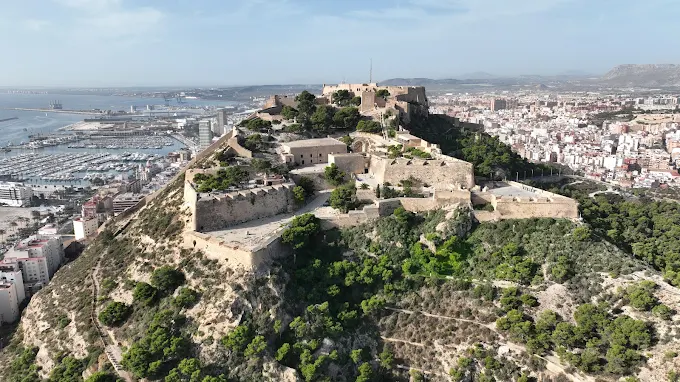
Alicante Santa Bárbara Castle Medieval Stone Meets Mediterranean Light
Dawn breaks over Mount Benacantil as the first light catches the limestone ramparts—glowing amber against the deep blue of the Mediterranean while the city of Alicante stirs 166 meters below. You stand at the highest point of the Alicante Santa Bárbara Castle, breathing air scented with salt and wild thyme, listening to the distant hum of traffic mixed with the cry of gulls circling the Tower of Homage. This fortress, whose origins date back to the 9th century under Moorish rule, has watched over the Costa Blanca for over a millennium, surviving sieges, earthquakes, and the march of time. The silence here is deceptive; beneath the stone, tunnels carved by prisoners echo with history, and the walls themselves bear the scars of cannon fire from the War of Spanish Succession. In 2026, as modern development encroaches on historic skylines, the Alicante Santa Bárbara Castle matters because it remains a defiant monument to resilience—demanding visitors climb not just for the view, but to witness the layers of conflict and culture that built the Valencian identity.
Why Alicante Santa Bárbara Castle Embodies Strategic Defense
The Alicante Santa Bárbara Castle solves a fundamental strategic problem: how to control the natural harbor of Alicante while defending against invasion from the sea and the interior. Perched atop Mount Benacantil, this 166-meter-high fortress spans 40,000 square meters, making it one of the largest medieval castles in Europe. The historical significance is profound; originally built by the Moors in the 9th century as an alcazaba, it was conquered by Alfonso X of Castile in 1248 and later expanded by the Crown of Aragón. The technical engineering is staggering: the walls utilize tapial (rammed earth) and limestone masonry, with thicknesses reaching 3 meters in key defensive points to withstand artillery bombardment. The complex is divided into three levels: the lower ward (11th century), the middle ward (14th century), and the upper ward (16th century), each representing a different era of military architecture.
Tragedy and triumph define the modern identity of the site. In 1709, during the War of Spanish Succession, the castle withstood a massive siege before finally surrendering, an event commemorated by the Felipe II Bastion. Conservation efforts, managed by the Ayuntamiento de Alicante, employ 30 conservators to stabilize the crumbling ramparts. The 2021–2025 restoration project (€6.2 million investment) focused on reinforcing the Tower of Homage and clearing vegetation that threatened the masonry. This preservation fulfills a need for tangible connection to the past; in 2026, amidst sanitized heritage sites, the Alicante Santa Bárbara Castle offers a raw, unvarnished encounter with a history where stone remembers blood. The castle serves not just as a museum but as a public park, integrating the ancient with the modern in a way few fortresses achieve.
The Best Time to Experience Alicante Santa Bárbara Castle
For optimal hiking conditions—when the stone is cool to the touch and the visibility extends to the horizon—target March 15–May 25 or September 20–November 10. During these windows, daytime temperatures in Alicante range 18–26°C (64–79°F), while evenings cool to 12–17°C (54–63°F), perfect for sunset viewing without summer heat. For photography and atmosphere, arrive at the castle entrance by 9:30–10:00 AM, when the morning light illuminates the facade before tour buses arrive from the cruise port.
The golden hour before sunset—approximately 8:30–9:30 PM in June, 7:00–8:00 PM in October—casts warm amber light onto the limestone blocks, creating ideal conditions for capturing the texture of medieval masonry against the darkening sky. Visit Tuesday through Thursday to avoid weekend crowds from Madrid and Valencia; Saturday afternoons see visitor numbers exceed 3,000 people, creating bottlenecks at the elevator and the narrowest points of the ramparts. Avoid July 1–August 31 unless you tolerate temperatures exceeding 35°C (95°F) and zero shade on the exposed walls; similarly, avoid December 24–January 6 when the site closes for holidays or operates on reduced hours.
Verify current opening hours and elevator status at the official Alicante Tourism website: https://castillodesantabarbara.com/ or call the Visitor Center at +34 965 141 100.
Approximate Budget for a 7-Day Trip (2026)
This budget reflects mid-range travel with comfortable accommodations, quality dining, and cultural experiences—based on 2025 pricing adjusted for Spain's projected 3.2% inflation rate for 2026. Alicante is an affordable destination compared to Barcelona, but prices rise during the Hogueras de San Juan festival in June. This itinerary assumes a mix of city exploration and beach relaxation.
Accommodation: €90–€180 per night
- 3-star hotel in Old Town (Barrio de la Santa Cruz): €90–€130 (Hotel Ciudad de Alicante)
- Boutique hotel near Explanada: €150–€180 (Hotel AC Alicante)
- Apartment rental (sea view): €120–€160 (requires 3-night minimum)
Food: €45–€75 per day
- Breakfast: €7–€12 (coffee, pastry, toast at local café)
- Lunch: €16–€28 (menú del día: paella, meat, or fish with wine)
- Dinner: €25–€40 (traditional restaurant: steak, wine, dessert)
Transportation:
- Train/Metro from Airport (TRAM): €4.50 one-way, 45 minutes
- Local bus within Alicante: €1.50 per ride
- Rental car (7 days, compact): €260–€330 (for coastal day trips)
- Fuel for regional exploration (350 km): €55–€65
Attractions & Experiences:
- Castle entry: Free (Museum €3)
- Elevator ticket (round-trip): €3.50
- MACA Museum entry: €5
- Guided castle tour: €12
- Boat trip to Tabarca Island: €35
Miscellaneous:
- Local wine (Alicante DO, bottle): €10–€20
- Souvenirs and art prints: €30–€60
- Travel insurance (7 days): €35–€55
- Emergency fund: €100 (recommended)
Total for 7 days (mid-range): €1,400–€1,850 per person (excluding international flights)
6 Essential Alicante Santa Bárbara Castle Experiences
- Walk the Ramparts from Lower to Upper Ward: This is the core experience of the Alicante Santa Bárbara Castle. Enter through the main gate at 10:00 AM. The path winds up the mountain for 1 kilometer. The stone is uneven; wear sturdy shoes. You'll pass the Door of Felipe II and the Tower of Homage. Allow 2 hours. The views encompass the city, the port, and the Mediterranean. Photography is permitted; respect barriers near unstable walls. This experience offers the full scale of the fortification.
- Visit the Castle Museum: Located inside the Felipe II Bastion. Open Tuesday–Sunday, 10:00 AM–6:00 PM. Entry €3 (free on Sundays). The collection features archaeological finds from the site, including Moorish ceramics and medieval weapons. The highlight is the model showing the castle's evolution. Allow 60 minutes. This experience contextualizes the military history of the fortress. Photography permitted without flash.
- Take the Elevator from Postiguet Beach: For those who prefer not to hike, the elevator tunnels through the mountain. Enter at Av. de Jovellanos. The ride takes 2 minutes and emerges near the upper ward. Cost €3.50 round-trip. Queues can be long in summer; arrive by 9:00 AM. Best visited when light hits the valley. This option saves energy for exploring the top. Note: It can be closed for maintenance; check status online.
- Climb the Tower of Homage: The highest point of the castle (166 meters elevation). Climb the 60 stone steps at 4:00 PM. The view from the top reveals the layout of the city below and the Explanada promenade. Best visited when light hits the harbor. Entry included in castle ticket. Allow 45 minutes. The wind can be strong; bring a jacket. This viewpoint offers the best photo opportunity.
- Walk the Old Town (Barrio de la Santa Cruz): The colorful neighborhood sits at the foot of the castle. Access via the stairs near the castle entrance. The streets are paved with cobblestones and lined with geraniums. Walk at 7:00 PM when the stones cool down. The view looks up at the castle you just visited. Allow 60 minutes. This experience connects the fortress to the urban fabric. Free to access; no ticket required.
- Dine in the Old Town: Experience local cuisine at Restaurant El Portal (Carrer del Mar 20). Reserve a table for 9:00 PM. Order arroz a banda (rice with fish stock) or grilled red prawns (€25). The terrace overlooks the port, providing ambient sounds of boats. Open 1:00–11:00 PM. Prices average €35 per person without wine. This meal connects you to the gastronomic traditions of the Costa Blanca. Wine pairing: Monastrell from Alicante (€15 per bottle).
3 Hidden Gems Most Travelers Miss
- Tunnel of Santa Bárbara: Located within the castle complex, this 18th-century tunnel was used for troop movement and storage. Access via guided tour only (€5 extra, Saturdays at 11:00 AM). The acoustics amplify the sound of footsteps. It is overlooked because it requires a separate booking. Best visited with a flashlight to see the stone carvings. This site reveals the engineering ingenuity of the defenders.
- La Mola Tower: Located on the opposite peak of Mount Benacantil. Access via a rugged path from the castle (30-minute hike). The 19th-century fortification offers a different perspective of the city. Entry free; open daylight hours. It is special because it is rarely visited by tourists. Visit at sunset when the light hits the sea. No facilities exist; bring water. This spot offers solitude impossible on the main ramparts.
- Gravina Museum of Fine Arts: Located in the city center at Carrer Gravina 15. Entry €3; open Tuesday–Sunday, 10:00 AM–8:00 PM. The collection features Valencian painters from the 19th century. It is overlooked by visitors focused on the castle. Best visited at 11:00 AM when the light hits the canvases. This site reveals the artistic heritage often overshadowed by the military history.
Cultural & Practical Tips
- Language etiquette: Spanish and Valencian (Catalan) are spoken. Key phrases: Hola (OH-lah = hello), Por favor (por fah-VOR = please), Gracias (GRAH-see-ahs = thank you), ¿Habla inglés? (ah-BLAH een-GLES = do you speak English?). Using Valencian greetings shows respect for local identity.
- Hydration is critical: There are no water fountains on the castle mountain. Carry at least 1.5 liters of water per person. Temperatures on the exposed stone are 5°C higher than in the town. Dehydration risks are high in summer. This is the most important safety tip for visiting the Alicante Santa Bárbara Castle.
- Footwear imperative: The paths are paved with irregular stones and loose gravel. Heels and smooth-soled shoes are dangerous. Wear hiking boots or sneakers with grip. The descent to the town is steep; trekking poles are helpful for those with knee issues.
- Photography guidelines: Flash photography is prohibited inside the museum. Tripods are permitted on the ramparts but cannot block pathways. Drones require permission from the town council (email turismo@alicante.es 14 days ahead). Best light for exterior photos is early morning or late evening.
- Accessibility considerations: The castle is partially wheelchair accessible via the elevator and main paths. The Tower of Homage and some ramparts are NOT accessible due to stairs. Inform staff at the ticket office for assistance; they can suggest alternative viewing points. Taxis can drop off at the elevator entrance.
- Weather considerations: Alicante is one of the sunniest cities in Europe. The Levante wind can bring humidity. Check forecasts at meteocat.gencat.cat before traveling. Summer temperatures exceed 35°C; sun protection is critical. Wear SPF 50+ and hats. Winter nights can drop to 8°C; layer clothing.
- Ticket strategy: Entry to the castle grounds is free, but the museum costs €3. Buy the combined ticket (Castle + Museums) for €10 to save 20%. Tickets are valid for 3 days. Keep the ticket safe; it is not replaceable. This pass is essential for a comprehensive experience of the heritage sites.
Conclusion: Travel with Memory, Not Just Checklists
The Alicante Santa Bárbara Castle does not exist merely for your Instagram feed—it stands as a silent witness to a millennium of siege, faith, and defiance. What it deserves is your memory: the willingness to walk slowly across the ramparts without rushing to the next landmark, to understand that the stone beneath your feet supported armies and prisoners alike, to recognize that this landscape is a palimpsest of human endeavor first and a tourist attraction second. In 2026, as historical narratives are increasingly contested, Alicante offers a model of preservation—demonstrating how cities can honor their past without freezing it in time. Sit on the wall overlooking the port not to check a box, but to watch the light change on the Mediterranean. Eat the local prawns not for novelty, but to taste the continuity of the sea. Let the arches teach you that endurance is quiet. Travel to Alicante not to consume history, but to honor it, ensuring your visit respects the legacy of those who built this stone chronicle and whose legacy remains etched in every block.