
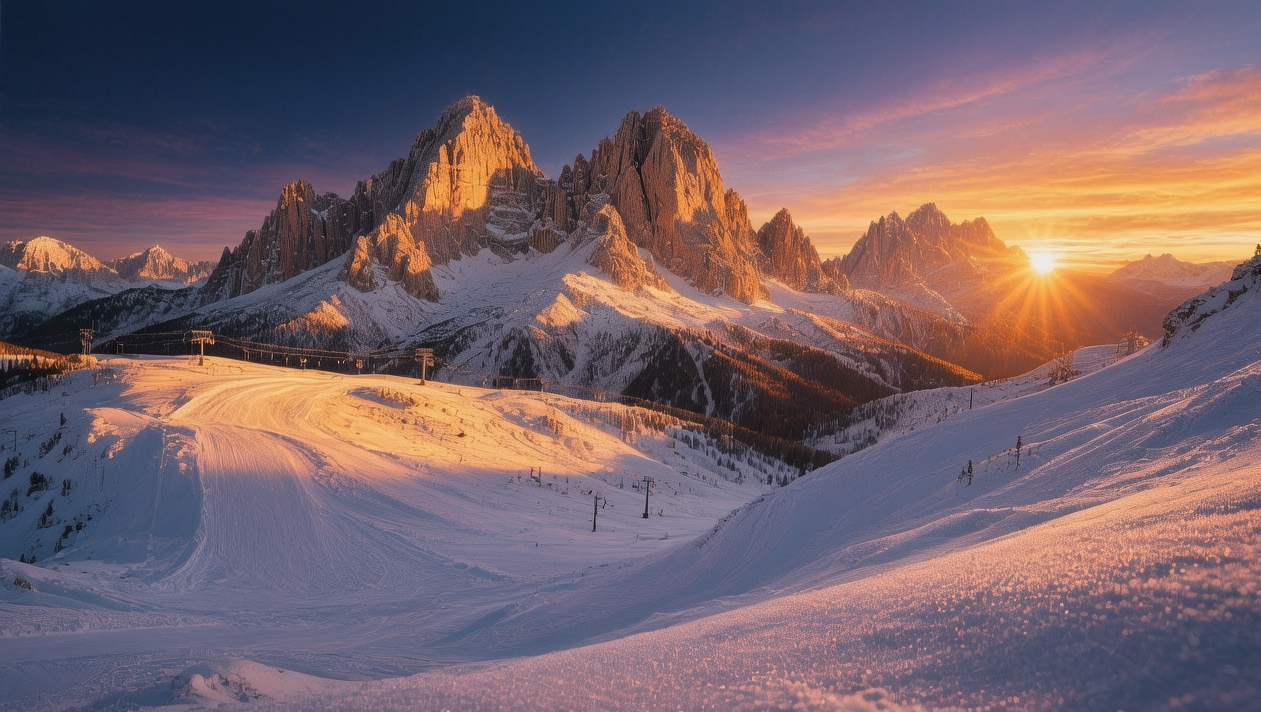
Arabba Ski Area Alpine Majesty Meets Ladin Legacy
Dawn breaks over the Marmolada glacier as first light gilds snow-covered slopes that rise 3,343 meters (10,968 feet) above sea level—part of the Dolomites UNESCO World Heritage Site since 2009. You stand on the Sella Ronda circuit where the scent of espresso mingles with crisp alpine air at -6°C (21°F), while the distant rumble of grooming machines prepares 60 kilometers of slopes for another legendary day. At 1,602 meters in Italy’s Veneto region, Arabba solves a fundamental winter paradox: balancing world-class skiing with sustainable mountain stewardship. Nestled in the heart of the Dolomiti Superski alliance, this Ladin village serves as the crucial eastern gateway to the Sella Ronda—the world’s most famous ski carousel connecting four valleys across 400 kilometers of slopes. The resort’s engineering marvels are precise: snowmaking covers 95% of slopes using water from glacial reservoirs; cable cars ascend 1,200 vertical meters in 15 minutes; and avalanche control systems deploy military-grade artillery to ensure safety. In 2026, as climate change threatens Alpine ecosystems, Arabba matters precisely because it pioneers sustainability—its “Dolomiti Superski” alliance implements carbon-neutral operations while preserving Ladin cultural heritage. This isn’t just skiing—it’s skiing with soul.
Why Arabba Ski Area Embodies Alpine Excellence
Arabba solves a fundamental winter sports paradox: how to deliver world-class skiing while honoring fragile mountain ecosystems. Its strategic location in the Fodom Valley—surrounded by the Sella, Marmolada, and Conturines massifs—creates a natural amphitheater with north-facing slopes that retain snow through April. The technical infrastructure is staggering: 22 lifts transport 45,000 skiers hourly across 60 kilometers of slopes graded 35% beginner, 45% intermediate, 20% expert; snowmaking systems cover 95% of terrain using 8 glacial reservoirs that collect meltwater without depleting aquifers; and the legendary Sella Ronda circuit connects four valleys via 400 kilometers of meticulously maintained slopes. Historically, Arabba fulfilled dual roles—as mountaineering birthplace (the Alpine Club established its first Italian chapter here in 1870) and cultural crossroads where Ladin traditions blend with Italian sophistication. The 2026 Winter Olympics return catalyzed sustainability innovations: electric shuttle buses replace private vehicles; biomass heating warms hotels using forest-thinning waste; and the “Leave No Trace” campaign educates visitors on protecting endemic species like the Alpine ibex. Critically, Arabba balances luxury with responsibility—the chic boutiques of Corso Roma coexist with strict building codes that preserve traditional wood-and-stone architecture, ensuring development never overshadows Dolomite grandeur.
The Best Time to Experience Arabba Ski Area
For optimal snow conditions and manageable crowds, visit between January 15–February 28 or March 10–April 5, 2026—when base temperatures average -9°C to 1°C (16–34°F) with consistent powder and stable avalanche conditions [[61]]. Arrive at major lifts like Burz by 8:30 AM to secure fresh tracks before crowds arrive; morning light provides ideal visibility for navigating challenging terrain like the Forcella Pordoi couloirs. Avoid December 20–January 10 when holiday crowds overwhelm lifts (wait times exceed 40 minutes) and accommodation prices peak 45% above baseline. Spring skiing (April 6–May 1) offers softer snow but risks afternoon slush on south-facing slopes. Summer visits (June–September) provide hiking access but lack winter magic. For real-time snow reports and lift status, verify with Dolomiti Superski’s official portal at dolomitisuperski.com 48 hours before departure, as weather occasionally triggers avalanche controls that close select runs.
Approximate Budget for a 7-Day Trip
This budget reflects mid-range luxury ski travel based in Arabba with full mountain access, using 2026 projected pricing with 4.2% inflation adjustment from 2024 baseline figures per ISTAT regional data. All costs in euros (€).
- Accommodation: €200–€320 per night for 4-star ski-in/ski-out hotel or luxury chalet in Arabba center (e.g., Hotel Ciasa Salares or Chalet Miramonti); includes breakfast featuring local cheeses and speck
- Food: €72 per day average—breakfast €17 (fresh ricotta and speck), lunch €26 (polenta with venison stew at mountain rifugio), dinner €29 (primo of canederli dumplings, secondo of Alpine trout at family-run trattoria)
- Transportation: €300 total—Venice Marco Polo Airport to Arabba via Cortina Express bus (€24 round-trip, 2h 15m); daily ski shuttle pass €15; parking at hotel garage €22/day
- Attractions: Dolomiti Superski 6-day pass €318; guided off-piste tour €115; Olympic Museum entry €10; thermal spa at QC Terme €42
- Miscellaneous: €140—ski rental €85, luxury souvenir €30, donation to avalanche safety program €25
Total estimated cost: €2,200–€2,680 for seven days
6 Essential Arabba Ski Area Experiences
- Ski the Legendary Sella Ronda: Take the first lift at 8:30 AM to tackle the complete 40-kilometer circuit clockwise (“orange route”) or counterclockwise (“green route”). The orange route features the challenging Pordoi Pass descent—intermediate skiers can take the easier “Panorama” variant marked with blue circles.
- Ride the Burz Cable Car at Sunrise: Board the modern 10-seater gondola at 8:00 AM for panoramic views of the Marmolada glacier. The 15-minute ascent to 2,900m reveals Arabba nestled in the valley below—bring binoculars to spot ibex on distant ridges.
- Dine at Rifugio Capanna Alpina: Ski to this mountaintop hut at 12:30 PM for authentic Ladin cuisine. Sample “casunziei” (beetroot ravioli) paired with local Lagrein wine—reservations essential during peak season.
- Explore the Hidden Forcella Pordoi Couloirs: Hire a certified guide for this advanced off-piste adventure. The northeast-facing chutes hold powder for days after storms—helmet and avalanche beacon mandatory.
- Attend the Torchlight Descent: Join the weekly Wednesday evening event (19:00–20:30) where 150 skiers illuminate the Mesdì slope with headlamps—a tradition since the 1970s.
- Relax at QC Terme Spa: Unwind after skiing at this alpine sanctuary (open 10:00–22:00). The outdoor thermal pool at 36°C offers views of the Marmolada peaks—book sunset slots for golden hour magic.
3 Hidden Gems Most Travelers Miss
- Lago di Fedaia Secret Access: A 45-minute hike from Pian dei Fiacconi leads to this emerald-green reservoir surrounded by sheer dolomite walls. Visit at dawn (6:00–8:00 AM) when mist clings to the water—summer access only (June–September).
- Museo Ladino Archives: In Arabba’s town hall basement, unpublished land management records from 1550–1800 document sustainable forestry practices. Email archivio@comune.arabba.bl.it 72 hours ahead specifying interest in “Documenti Forestali 1550–1800”; bring ID.
- Rifugio Scoiattoli: Accessible via the hidden Val Corva trail, this 2,250m hut serves the best “smacafam” (Ladin polenta cake). Visit Tuesday–Thursday when chef Maria prepares her secret recipe—call +39 0436 79122 ahead.
Cultural & Practical Tips
- Wear proper ski attire—Arabba maintains dress codes at upscale venues; avoid ripped jeans or non-ski casual wear in town centers.
- Greet locals with "Bon dì" (BON DEE)—Ladin for "good day"—a traditional courtesy that shows respect for indigenous heritage.
- Carry avalanche safety gear—transceiver, probe, and shovel mandatory for off-piste; rentals available at Sport Abate (€28/day).
- Respect wildlife corridors—ibex and chamois frequent lower slopes at dawn/dusk; maintain 50-meter distance and never feed animals.
- Photography drones require authorization from Comune (+39 0436 790111); handheld cameras permitted but avoid blocking ski routes.
- Support sustainability by using the free ski buses—proceeds fund reforestation projects replacing trees lost in the 2018 Vaia storm.
- Book lessons early—English-speaking instructors fill quickly; Scuola Sci Arabba offers certified programs for all levels (from €70/half-day).
Conclusion: Travel with Intention, Not Just Adrenaline
To experience Arabba is to engage with mountains as living entities—not mere playgrounds but partners in a delicate balance. In 2026, as climate change accelerates glacial retreat, this resort stands as both pioneer and protector: proving that world-class skiing can coexist with ecological responsibility. Your presence here carries consequence—the €318 ski pass funds avalanche safety and reforestation, yet your choices determine whether luxury becomes exploitation. True engagement means slowing beyond speed: sharing grappa with rifugio keepers who’ve guarded these slopes for generations, understanding that preservation requires both financial support and mindful movement. Leave no trace beyond tracks; take no fragment beyond memories. For Arabba endures not as a backdrop for conquest, but as a testament to what happens when humans choose harmony over dominance—a covenant written in snow and stone that asks only this: that we remember why some peaks must be honored, not just summited.