
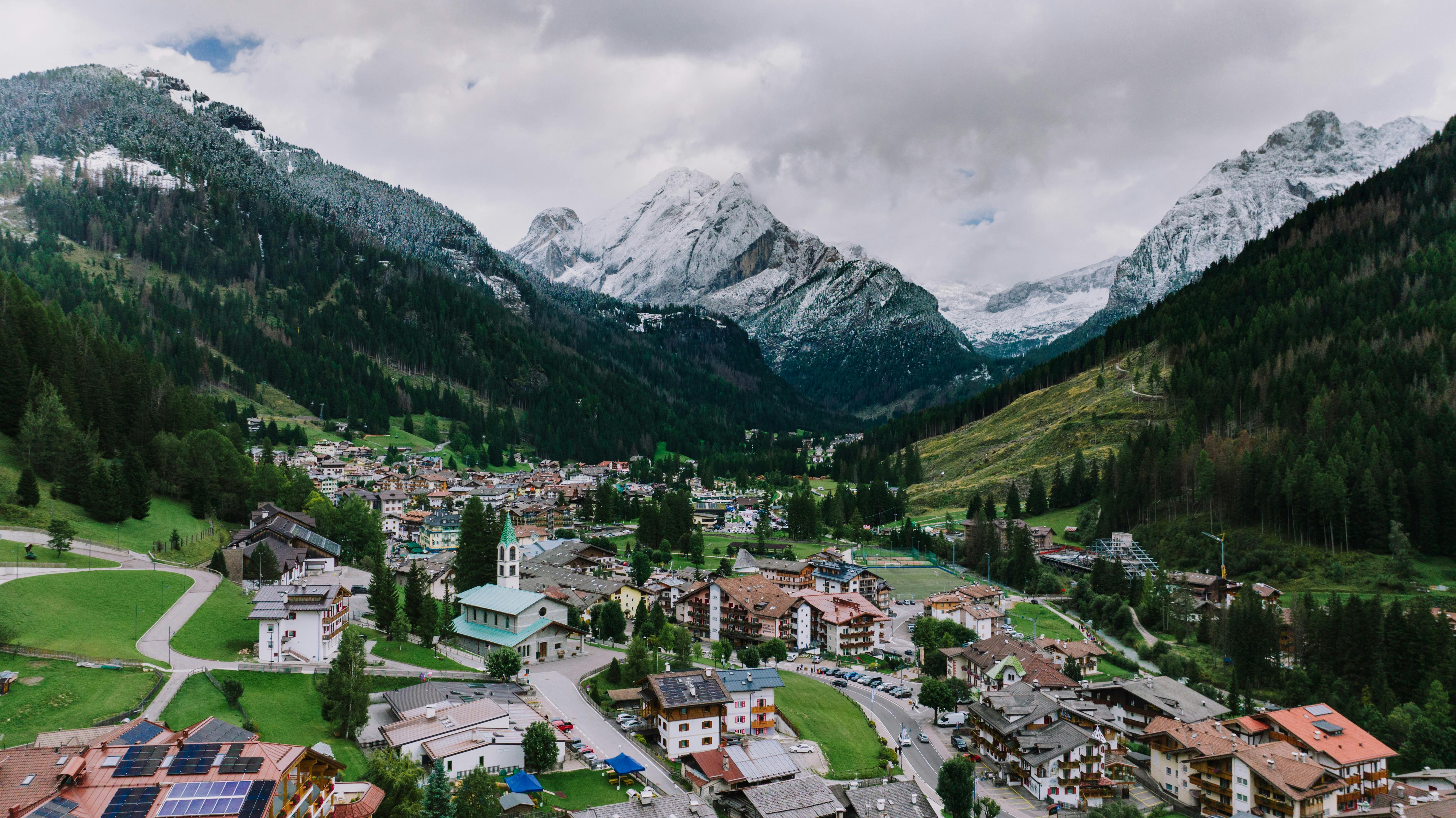
Canazei Village Ladin Soul Meets Alpine Majesty
Dawn breaks over the Marmolada glacier as mist clings to emerald meadows where Ladin shepherds have grazed cattle since Roman times. You stand in Canazei’s cobblestone square where the scent of freshly baked casunziei (beetroot ravioli) mingles with alpine pine at 4°C (39°F), while cowbells chime a rhythm unchanged for two millennia. At 1,450 meters in Trentino’s heart—part of the Dolomites UNESCO World Heritage Site since 2009—this valley solves a fundamental cultural paradox: preserving Europe’s most resilient mountain traditions while embracing sustainable tourism. The town’s strategic position along ancient trade routes connecting Venice to Austria made it a crossroads of cultures, yet its Ladin identity remains fiercely intact—85% of residents still speak the language dating to 15 BCE when Roman soldiers married local Raeti tribeswomen. Historically, Canazei fulfilled critical needs: its woodcarving tradition (since 1630) sustained families through harsh winters, while communal pasture management (Regole) prevented overgrazing for 800 years. Today, strict architectural codes preserve traditional wood-and-stone buildings, while tourism revenue funds language immersion schools. In 2026, as globalization threatens mountain cultures, Canazei matters precisely because it proves that authenticity and accessibility can coexist.
Why Canazei Village Embodies Cultural Resilience
Canazei solves a fundamental alpine paradox: how to maintain centuries-old traditions in a rapidly changing world. Its Ladin heritage—spoken by 30,000 people across five Alpine valleys—is preserved through deliberate cultural engineering. The technical preservation is precise: bilingual street signs (Ladin/Italian) guide visitors; schools teach Ladin as a core subject using standardized orthography developed in 1983; and the Istitut Cultural Ladin requires all public employees to achieve B2 proficiency. Historically, the town fulfilled dual roles—as artistic hub (producing intricate woodcarvings since 1630) and agricultural stronghold (managing 12,000 hectares of communal pastures through centuries-old Regole councils). The 2009 UNESCO designation formalized protection protocols: new buildings must follow traditional architectural codes (wood shingles, stone foundations); tourism revenue funds language immersion programs; and cultural festivals like La Tora blend ancient solstice rites with contemporary art. Critically, Canazei balances innovation with tradition—contemporary artists incorporate abstract elements into sacred carvings, while ski resorts implement carbon-neutral operations without sacrificing Ladin character. This synthesis makes the village not just a scenic wonder but a living laboratory of cultural sustainability.
The Best Time to Experience Canazei Village
For optimal cultural immersion and comfortable exploration, visit between May 20–June 15 or September 10–October 5, 2026—when daytime temperatures average 12–18°C (54–64°F) with minimal rainfall and stable mountain conditions [[62]]. Arrive in the village center by 9:00 AM to experience artisan workshops before crowds arrive; morning light provides ideal conditions for examining fine details in woodcarvings. Avoid July 15–August 25 when temperatures exceed 22°C (72°F), humidity reaches 70%, and tourist numbers peak—particularly during midday hours when popular workshops operate at capacity. Winter visits (December–February) offer exceptional skiing but present challenges: shorter daylight hours (sunset at 16:30), frequent snowstorms that may delay transport, and higher accommodation prices during holiday periods. For real-time updates on festival dates and workshop hours, verify with the Val di Fassa Tourism Board’s portal at
Approximate Budget for a 7-Day Trip
This budget reflects mid-range cultural-artistic travel based in Canazei with day excursions to surrounding Dolomite sites, using 2026 projected pricing with 3.8% inflation adjustment from 2024 baseline figures per ISTAT regional data. All costs in euros (€).
- Accommodation: €105–€155 per night for traditional B&B or 3-star hotel in Canazei (e.g., Hotel Cimon or B&B La Stua); includes mountain views and breakfast featuring local cheeses and speck
- Food: €50 per day average—breakfast €11 (fresh ricotta and speck), lunch €15 (canederli dumplings at workshop café), dinner €24 (primo of casunziei beetroot ravioli, secondo of venison stew at family-run trattoria)
- Transportation: €230 total—Verona Airport to Canazei via Azienda Trasporti Verona bus line 164 (€10.50, 2h 15m); daily car rental €48 including fuel for Dolomite excursions; parking free in village outskirts
- Attractions: Museum de Fascia €8; guided wood carving workshop €32; cable car to Marmolada glacier €30; Ladin Cultural Institute tour €14
- Miscellaneous: €80—hand-carved souvenir €38, Trentino wine tasting €22, donation to Ladin preservation fund €20
Total estimated cost: €1,120–€1,350 for seven days
6 Essential Canazei Village Experiences
- Witness Morning Carving Rituals: Visit Pitschel Art workshop in Canazei at 9:00 AM to observe master carvers selecting Swiss pine blocks. Note how they read grain patterns like topographic maps—avoiding knots that could fracture delicate features like Madonna’s flowing robes.
- Attend a Ladin Language Demonstration: Join the “Voices of the Valley” session (Mondays/Wednesdays at 11:00 AM) at the Istitut Cultural Ladin. Practice basic phrases like "Bun dì" (good day) with native speakers—learn how vowel sounds differ from Italian.
- Hike the Regole Pasture Trail: Walk the 6-kilometer path from Canazei to Pozza at 8:00 AM. Along the route, observe centuries-old boundary stones marking communal grazing zones—still respected by local shepherds today.
- Photograph Village Architecture at Golden Hour: Position yourself in the main square at 18:30 to capture traditional wood-and-stone buildings bathed in warm light. Use a telephoto lens (70-200mm) to compress the dramatic scale against the Marmolada glacier.
- Explore Museum de Fascia’s Collection: Spend 10:00–12:00 examining 500 years of Ladin craftsmanship. Focus on the 1750 “Madonna del Latte”—note how the Virgin’s milk veins are carved as actual channels symbolizing nourishment.
- Attend the La Tora Festival: If visiting June 20–25, witness this unique solstice celebration where locals carry flaming wooden towers through meadows while reciting Ladin poetry. The event blends pre-Christian fire rites with Catholic traditions—arrive by 21:00 for best viewing.
3 Hidden Gems Most Travelers Miss
- Archivio Storico delle Regole: In Canazei’s town hall basement, unpublished pasture records from 1200–1800 document communal land management. Email archivio@comune.canazei.tn.it 72 hours ahead specifying interest in “Documenti Regolieri 1200–1800”; bring ID for the 30-minute viewing.
- Cappella di San Nicolò Secret Altar: Behind the main church, this 17th-century chapel contains an unsigned masterpiece attributed to Giovanni Battista Moroder. Access requires asking the sacristan politely after 11:00 Mass; donation of €3 appreciated.
- Laghetto di Antermoia Secret Pond: A 2.5-hour hike from Passo San Pellegrino leads to this hidden glacial tarn surrounded by sheer cliffs. Visit at dawn (6:00–8:00 AM) when mist clings to the water—summer access only (June–September).
Cultural & Practical Tips
- Wear quiet-soled shoes—workshop floors amplify footsteps, disturbing the concentration essential for fine carving.
- Greet artisans with "Bun dì" (BOON DEE)—Ladin for "good day"—a traditional courtesy that shows respect for their linguistic heritage.
- Ask permission before photographing works-in-progress—many consider unfinished pieces spiritually vulnerable until blessed.
- Respect sacred subjects—avoid touching religious carvings unnecessarily; many believe the wood absorbs prayers over time.
- Photography drones prohibited in village centers; handheld cameras allowed but no flash in workshops (dries wood prematurely).
- Support preservation by purchasing directly from workshops—look for the “Artigianato Val di Fassa” certification plaque guaranteeing authentic craftsmanship.
- Visit museums before workshops—contextual understanding transforms your appreciation from aesthetic admiration to historical comprehension.
Conclusion: Travel with Reverence, Not Just Curiosity
To experience Canazei is to witness culture made visible—a place where every chisel mark carries centuries of faith, and every Ladin phrase breathes with mountain spirit. In 2026, as globalization flattens minority languages, this Alpine enclave stands as both sanctuary and standard: proving that authenticity requires neither isolation nor stagnation. Your presence here carries consequence—the €32 workshop fee sustains apprenticeship programs, yet your gaze must move beyond aesthetics to honor the living tradition. True engagement means slowing beyond documentation: feeling the wood’s grain beneath your fingertips, understanding that preservation requires both financial support and respectful distance. Leave no trace beyond awe; take no fragment beyond memories. For Canazei endures not as a museum of relics, but as a testament to what happens when communities choose continuity over convenience—a covenant written in wood and words that asks only this: that we remember why some silences must be honored, not just observed.