
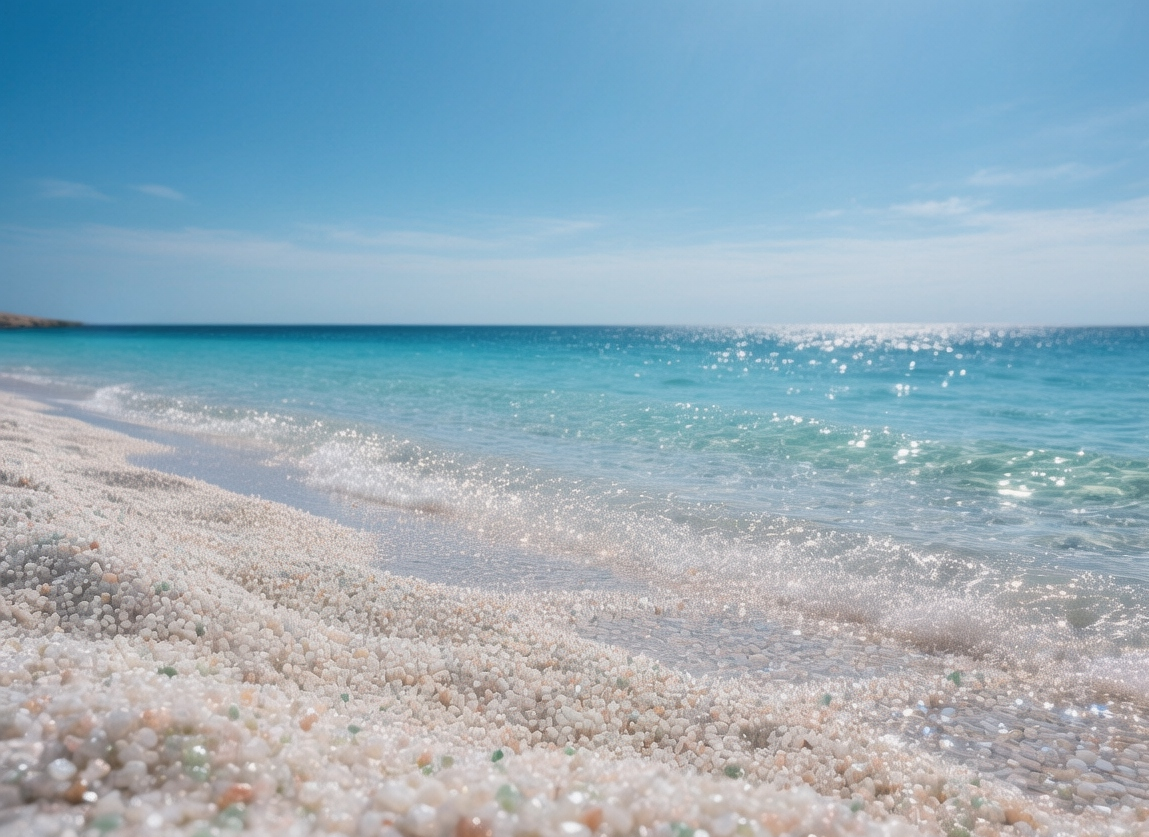
Arutas Quartz Beach Singing Sands Meet Mediterranean Silence
Mid-morning sun fractures through the Tyrrhenian atmosphere, igniting a shoreline that shimmers like scattered diamonds. You step onto Is Arutas beach and immediately hear it—the soft, crystalline chime of millions of quartz grains shifting beneath your feet, a sound locals call "su cantu de s’arena" (the song of the sand). Each grain, polished over millennia by wave action into perfect rice-sized ovals averaging 2–3 millimeters, reflects light with such intensity that the beach appears snow-covered despite Sardinia’s 24°C (75°F) warmth. Located on the protected Sinis Peninsula just 3.2 kilometers south of Tharros’ ancient ruins, this extraordinary cove stretches 300 meters along a sheltered bay where pink-hued granite outcrops frame waters so transparent you count every shell fragment on the seabed 10 meters below. Formed when the Monte Arci volcanic complex eroded over 3 million years, these sands contain 98% pure quartz—unlike any other beach in the Mediterranean. In 2026, as overtourism flattens coastal experiences into generic backdrops, Is Arutas matters precisely because its geology enforces presence—a place where beauty isn’t just seen but heard, felt, and remembered.
Why Is Arutas Quartz Beach Embodies Geological Rarity
Is Arutas solves a fundamental coastal paradox: how to create auditory beauty through mineral purity. Its uniqueness stems from the erosion of Monte Arci’s volcanic complex—Sardinia’s only obsidian source—which over 3 million years released quartz-rich sediments into the Sinis Peninsula’s currents. Wave action then polished these fragments into perfectly rounded, rice-grain-sized crystals (2–3 mm average) that chime when compressed—a phenomenon occurring in fewer than 35 beaches worldwide. The technical specifications are staggering: quartz content measures 98% purity (compared to 30–60% in typical Mediterranean sands), with grains composed of silicon dioxide crystals that refract light at 1.544 refractive index—creating the beach’s signature diamond-like sparkle. Historically, this geological rarity remained unknown until the 1970s when geologists studying Tharros’ ancient harbor noted unusual sediment patterns. Today, the beach’s protection is critical—it lies within the Sinis Peninsula Marine Protected Area (established 1997), which enforces strict protocols: no sand removal (even a handful carries €500 fines under Regional Law 12/2021), speed limits for boats within 500 meters of shore, and daily visitor caps (max 400 people) to prevent compaction that silences the singing sands. Culturally, Is Arutas fulfills a modern need: offering sensory authenticity in an age of digital overload, where the simple act of walking becomes a meditative experience amplified by nature’s subtle music.
The Best Time to Experience Is Arutas Quartz Beach
For optimal acoustic and visual conditions, visit between May 22–June 18 or September 10–October 5, 2026—when daytime temperatures average 22–26°C (72–79°F) with low humidity and minimal rainfall [[41]]. Arrive by 8:30 AM to experience the beach in solitude when morning light creates maximum refraction through quartz crystals, and the sands produce their clearest chime before daily foot traffic compacts the surface. Avoid July 15–August 25 when temperatures exceed 30°C (86°F), humidity reaches 78%, and visitor numbers regularly hit the 400-person cap by 10:00 AM—diminishing both the acoustic phenomenon and visual clarity. Winter visits (November–February) offer solitude but present challenges: frequent rain reduces quartz reflectivity, and strong Mistral winds can make the exposed cove uncomfortable. For real-time updates on visitor capacity and weather-related closures, verify with the Ente Gestore Area Marina Protetta Penisola del Sinis – Isola di Mal di Ventre’s portal at ampsinis.it 48 hours before departure, as dynamic management adjusts access based on environmental conditions.
Approximate Budget for a 7-Day Trip (2026)
This budget reflects mid-range cultural-nature travel based in Cabras with day excursions to Is Arutas and surrounding Sinis sites, using 2026 projected pricing with 3.8% inflation adjustment from 2024 baseline figures per ISTAT regional data. All costs in euros (€).
- Accommodation: €85–€125 per night for agriturismo or B&B in Cabras (e.g., Agriturismo Sa Cottilla or B&B Su Nuraxi); includes traditional breakfast with pecorino cheese and homemade bread
- Food: €42 per day average—breakfast €8 (fresh ricotta and pane carasau), lunch €15 (panino with bottarga at beach kiosk), dinner €19 (primo of malloreddus pasta with saffron, secondo of grilled orata fish at family-run trattoria)
- Transportation: €210 total—Cagliari Elmas Airport to Cabras via ARST bus line 1072 (€7.50, 2h 15m); daily car rental from Cabras €48 including fuel for Sinis Peninsula exploration; parking at Is Arutas trailhead €4/day
- Attractions: Guided quartz beach ecology tour €28; Tharros archaeological site €8.50; boat excursion to Mal di Ventre island €32; Museo Civico di Cabras €5
- Miscellaneous: €65—handwoven textile souvenir €30, Sardinian wine tasting €20, donation to quartz conservation program €15
Total estimated cost: €970–€1,170 for seven days
6 Essential Is Arutas Quartz Beach Experiences
- Listen to the Singing Sands at Dawn: Arrive by 8:00 AM and walk slowly along the waterline where wet quartz produces the clearest chime. Remove your shoes to feel the cool, rounded grains shift beneath your feet—a sensation described by locals as "walking on liquid stars."
- Photograph the Diamond Effect at Mid-Morning: Position yourself on the eastern granite outcrop between 10:00–11:30 AM when sunlight creates maximum refraction through quartz crystals. Use a polarizing filter to reduce glare and emphasize the contrast between sparkling sand and turquoise water.
- Explore the Granite Outcrops: Climb the pink-hued boulders framing the cove between 9:00–11:00 AM to discover hidden tidal pools teeming with life. Look for the rare Sardinian goby fish in crystal-clear waters where quartz sediment has settled.
- Attend a Geology Demonstration: Join the “Voices of Quartz” session (Tuesdays/Thursdays at 11:00 AM) where marine biologists explain the beach’s formation. Handle samples of Monte Arci obsidian that created these sands—note how quartz purity affects sound frequency.
- Swim in the Protected Cove: Wade into the 24°C (75°F) waters after 14:00 when crowds diminish. The transparency allows you to see quartz grains settling on the seabed 10 meters below—swim parallel to shore to avoid disturbing the delicate ecosystem.
- Compare with Nearby Beaches: Visit Spiaggia di San Giovanni di Sinis (4 km north) in the afternoon to contrast Is Arutas’ quartz with typical Mediterranean pebbles. Note how light quality and sound differ dramatically between the two shorelines.
3 Hidden Gems Most Travelers Miss
- Cala Maimoni Secret Access: Reachable only via a 25-minute hike from the SP6 road, this untouched cove features similar quartz deposits but remains unknown to most tourists. Visit at low tide (check Oristano port authority tables at when hidden sea caves become accessible.
- Monte Arci Obsidian Workshop: Located 15 kilometers inland near Paulilatino, this archaeological site shows how ancient Sardinians mined the volcanic glass that created Is Arutas’ sands. Visit Tuesday–Sunday 10:00–17:00; demonstrations of tool-making occur at 11:00 and 15:00.
- Quartz Sound Laboratory: At the Cabras Civic Museum, a special exhibit lets you compare sound frequencies of different sand types. Visit between 10:00–12:00 when acoustics specialist Dr. Elena Piredda explains why Is Arutas’ quartz produces musical notes (C# to E range).
Cultural & Practical Tips
- Wear water shoes with grip soles—even “soft” quartz beaches have sharp granite fragments near outcrops; barefoot walking risks cuts requiring medical attention.
- Greet local guides with "Sa die d’e sòccussu" (SAH dee-eh deh SOH-koo-soo)—Sardinian for "good health"—a traditional blessing acknowledging their role as cultural stewards.
- Never remove sand—what seems like a harmless souvenir carries €500 fines under Regional Law 12/2021; even footprints should be minimized to preserve the acoustic phenomenon.
- Carry reef-safe sunscreen (zinc oxide-based) and biodegradable soap; chemical sunscreens containing oxybenzone are prohibited in the marine park.
- Photography drones require special authorization from Ente Gestore AMP (+39 0783 250011); handheld cameras are permitted but avoid disturbing wildlife in adjacent dunes.
- Support conservation by purchasing the official quartz beach map (€8) from Cabras tourist office—proceeds fund sediment monitoring programs.
- Visit during low tide for best acoustic conditions—the wet quartz near waterline produces clearer chimes than dry upper beach areas.
Conclusion: Travel with Presence, Not Just Perception
To experience Is Arutas is to engage all senses in a dialogue with deep time—a place where geology sings and light dances in ways impossible to capture through screens. In 2026, as coastal destinations increasingly prioritize convenience over connection, this quartz beach stands as both sanctuary and test: its crystalline shores invite wonder, but its fragile ecosystem demands restraint. Your presence here carries consequence—the €28 guided tour fee funds marine research protecting these unique sands, yet your footsteps simultaneously accelerate compaction that silences their song. True engagement means slowing beyond documentation: removing shoes to feel millennia of wave-polished quartz, listening to the subtle music beneath your feet, understanding that preservation requires both financial support and mindful movement. Leave no trace beyond footprints; take no fragment beyond memories. For Is Arutas endures not as a backdrop for our adventures, but as a testament to Earth’s patient artistry—a covenant written in silicon and seawater that asks only this: that we remember why some places must be experienced with all our senses, not just our eyes.