
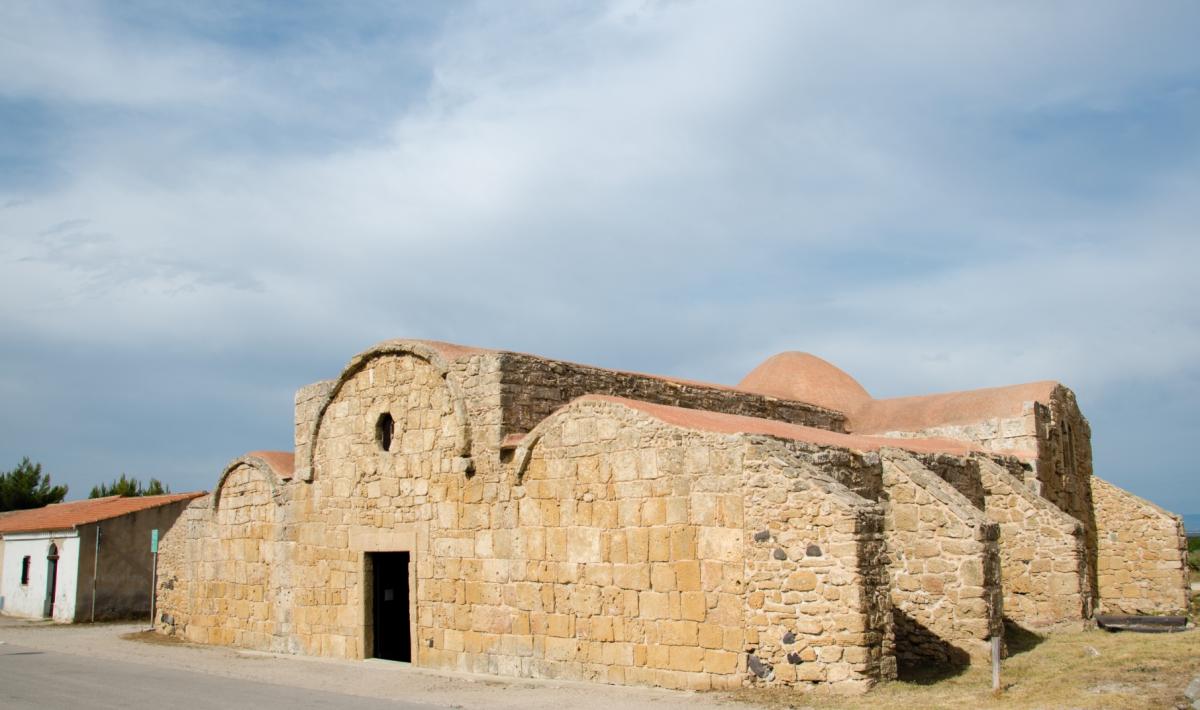
San Giovanni di Sinis Byzantine Stones Meet Mediterranean Clarity
Dusk settles over the Tyrrhenian Sea as golden light gilds the white pebbles of San Giovanni di Sinis—each stone polished smooth by millennia of wave action into perfect ovals that chime softly underfoot. You stand where early Christians once gathered in secret, the sixth-century paleochristian church’s weathered facade casting long shadows across a beach so transparent you count every shell fragment on the seabed 8 meters below. The air carries the briny tang of salt mingled with wild myrtle clinging to the limestone outcrops that frame this crescent of purity, just 800 meters north of Tharros’ grander ruins yet infinitely more intimate. At 39°53′N latitude, this tiny village—population 120 souls—sits at the crossroads of civilizations: Phoenician traders bartered here in 800 BCE, Roman senators bathed in nearby thermal springs, and Byzantine monks carved chapels into volcanic rock during the Dark Ages. Today, its beach forms part of the Sinis Peninsula Marine Protected Area, where Posidonia oceanica meadows filter water to 30-meter visibility. In 2026, as overtourism flattens coastal experiences, San Giovanni di Sinis matters precisely because it refuses scale—a place where history isn’t staged but lived, and every pebble whispers of resilience.
Why San Giovanni di Sinis Embodies Sacred Intimacy
San Giovanni di Sinis solves a fundamental spiritual paradox: how to create sanctuary through understatement. Its centerpiece—the sixth-century paleochristian church—was built not for grandeur but survival, when Byzantine monks fled Arab raids by carving chapels into the peninsula’s volcanic rock. Unlike Tharros’ monumental Roman forum just 1 kilometer south, this humble structure (measuring 12 by 8 meters) features rough-hewn basalt blocks fitted without mortar, its apse oriented precisely to capture winter solstice light through a narrow eastern window. The engineering is deceptively simple: walls 1.2 meters thick withstand Tyrrhenian storms; a subterranean hypogeum chamber repurposed a Punic tomb for early Christian burials; and rainwater channels carved into the roof feed a cistern capable of storing 2,000 liters—enough for 20 monks through Sardinia’s dry summers. Historically, the village served as Tharros’ spiritual annex: while Roman elites bathed in marble-lined calidaria, commoners worshipped here in quiet devotion. The beach itself fulfills ecological needs—its unique white pebbles (averaging 3–5 cm in diameter) result from the erosion of Monte Arci’s volcanic complex, creating a natural breakwater that calms waves while supporting endemic species like the Sardinian goby fish. Culturally, San Giovanni di Sinis embodies continuity: the annual Festa di San Giovanni (June 24) blends Catholic ritual with pre-Christian solstice celebrations, where locals still light bonfires on the beach at dawn—a tradition unchanged since Nuragic times.
The Best Time to Experience San Giovanni di Sinis
For optimal conditions and authentic cultural immersion, visit between May 20–June 15 or September 10–October 5, 2026—when daytime temperatures average 21–26°C (70–79°F) with minimal rainfall and stable sea conditions [[42]]. Arrive at the beach by 8:30 AM to experience solitude before day-trippers arrive, and visit the paleochristian church between 11:00–13:00 when the volunteer custodian unlocks the hypogeum chamber. Avoid July 15–August 25 when temperatures exceed 31°C (88°F), humidity reaches 78%, and visitor numbers peak—particularly during midday hours when the narrow village streets become congested. Winter visits (November–February) offer profound solitude but present challenges: shorter daylight hours (sunset at 17:15), frequent rain that obscures details in the stonework, and reduced custodian hours at the church. For real-time updates on opening hours and weather-related closures, verify with the Comune di Cabras’ portal at 48 hours before departure, as seasonal adjustments occasionally affect access to the hypogeum.
Approximate Budget for a 7-Day Trip (2026)
This budget reflects mid-range cultural-nature travel based in Cabras with day excursions to San Giovanni di Sinis and surrounding Sinis sites, using 2026 projected pricing with 3.8% inflation adjustment from 2024 baseline figures per ISTAT regional data. All costs in euros (€).
- Accommodation: €80–€120 per night for agriturismo or B&B in Cabras (e.g., Agriturismo Sa Cottilla or B&B Su Nuraxi); includes traditional breakfast with pecorino cheese and homemade bread
- Food: €40 per day average—breakfast €8 (fresh ricotta and pane carasau), lunch €14 (panino with bottarga at beach kiosk), dinner €18 (primo of malloreddus pasta with mint, secondo of grilled orata fish at family-run trattoria)
- Transportation: €200 total—Cagliari Elmas Airport to Cabras via ARST bus line 1072 (€7.50, 2h 15m); daily car rental from Cabras €45 including fuel for Sinis Peninsula exploration; parking free in village outskirts
- Attractions: Guided paleochristian church tour €15; Tharros archaeological site €8.50; boat excursion to Mal di Ventre island €32; Museo Civico di Cabras €5
- Miscellaneous: €60—handwoven textile souvenir €25, Sardinian wine tasting €20, donation to church preservation fund €15
Total estimated cost: €920–€1,110 for seven days
6 Essential San Giovanni di Sinis Experiences
- Attend the Dawn Solstice Ritual: Visit during the Festa di San Giovanni (June 24) to witness locals lighting bonfires on the beach at 5:30 AM—a tradition blending Catholic and Nuragic solstice rites. The flames reflect on the white pebbles, creating a path of light toward the paleochristian church.
- Explore the Hypogeum Chamber: Visit the church between 11:00–13:00 when the custodian unlocks the underground chamber. Descend the 12-step staircase carved into volcanic rock to see early Christian burial niches repurposed from a Punic tomb—bring a headlamp to examine the faded frescoes.
- Swim in the Protected Cove: Wade into the 23°C (73°F) waters after 14:00 when crowds diminish. The transparency allows you to see Roman pottery shards resting on white pebbles at 5-meter depth—swim parallel to shore to view submerged foundation walls of Tharros’ ancient harbor.
- Photograph the Pebble Patterns at Golden Hour: Position yourself on the eastern outcrop at 18:30 to capture the beach bathed in warm light, with the white pebbles creating mesmerizing patterns against turquoise water. Use a polarizing filter to reduce surface glare and emphasize texture.
- Attend a Traditional Fisherman’s Demonstration: Join the daily 17:00 briefing at the small harbor where pescatori demonstrate sustainable net techniques used since Phoenician times. Learn how to identify MSC-certified catches—look for the blue tag on local seafood menus.
- Walk the Tharros Connection Path: Take the 800-meter coastal trail south to Tharros at 9:00 AM. The path winds through wild fennel and sea lavender, offering panoramic views of both sites—the perfect way to understand their historical relationship.
3 Hidden Gems Most Travelers Miss
- Casa del Custode Secret Garden: Behind the paleochristian church, the custodian’s home features a hidden courtyard with citrus trees and original Byzantine tiles. Access requires asking politely at the church door (tip €2 appreciated); open 11:00–13:00 daily.
- Pozzo Sacro di Predio Canopoli: Located 2 kilometers inland, this Nuragic sacred well dates to 1200 BCE. During equinoxes, sunlight perfectly illuminates the water chamber—a feat of Bronze Age astronomy. Visit Tuesday–Sunday 10:00–17:00; closed Mondays.
- Archivio Storico di San Giovanni: In the village town hall basement, unpublished baptismal records from 1580–1800 document continuous habitation. Email archivio@comune.cabras.or.it 72 hours ahead specifying interest in “Documenti San Giovanni 1580–1800”; bring ID for the 30-minute viewing.
Cultural & Practical Tips
- Wear water shoes with grip soles—even “smooth” pebbles become slippery when wet; barefoot walking risks ankle injuries on uneven surfaces.
- Greet locals with "Sa die d’e sòccussu" (SAH dee-eh deh SOH-koo-soo)—Sardinian for "good health"—a traditional blessing acknowledging their role as cultural stewards.
- Respect the church’s spiritual significance—shoulders and knees must be covered when entering; silence is expected during prayer times (12:00–13:00 daily).
- Carry reef-safe sunscreen (zinc oxide-based) and biodegradable soap; chemical sunscreens containing oxybenzone are prohibited in the marine park under Regional Law 12/2021.
- Photography drones require special authorization from Comune di Cabras (+39 0783 250001); handheld cameras are permitted but avoid disturbing religious ceremonies.
- Support preservation by purchasing the official village map (€7) from the tourist office—proceeds fund church restoration projects.
- Visit the beach during low tide (check Oristano port authority tables at porto-di-oristano.it/maree) when hidden rock pools become accessible.
Conclusion: Travel with Reverence, Not Just Curiosity
To experience San Giovanni di Sinis is to confront beauty that refuses amplification—a place where history whispers rather than shouts, and every stone carries the weight of centuries. In 2026, as destinations increasingly curate themselves for social media, this village stands as both antidote and anchor: its white pebbles and Byzantine walls invite simplicity, but its living traditions demand respect. Your presence here carries consequence—the €15 church tour fee sustains the custodian who keeps this heritage alive, yet your haste could disrupt the quiet concentration of a community that has guarded these stones for generations. True engagement means slowing beyond documentation: sitting silently in the hypogeum chamber to feel the mountain’s breath, tracing mortarless joints with reverent fingertips, understanding that preservation requires both financial support and physical restraint. Leave no trace beyond footprints; take no fragment beyond photographs. For San Giovanni di Sinis endures not as a backdrop for our adventures, but as a testament to what happens when humility and history align—a covenant written in stone and seawater that asks only this: that we remember why some places must be experienced in stillness, not just seen.