
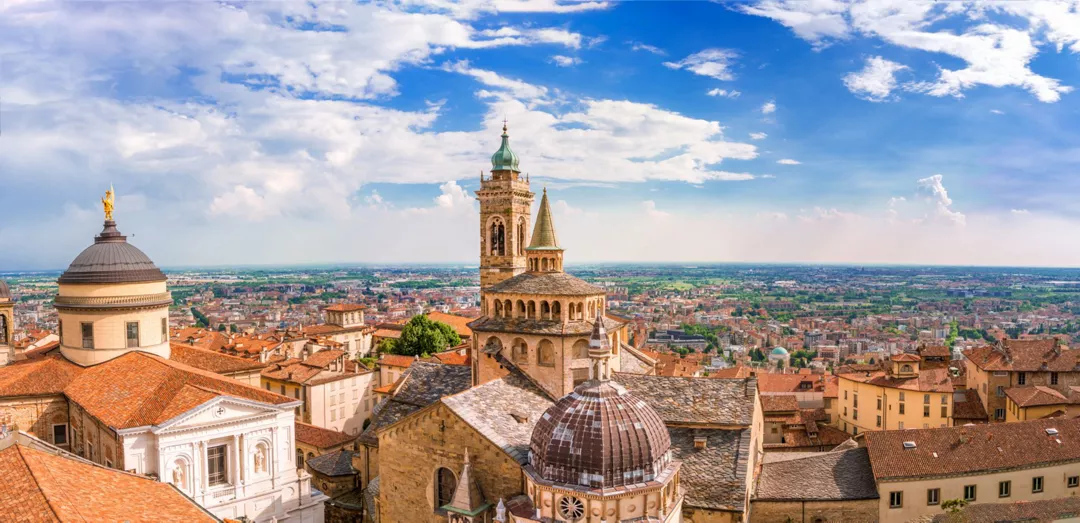
Bergamo Old Town Alpine Light Meets Venetian Stone
The late sun gilds the rooftops of Bergamo Alta—casting long shadows across Piazza Vecchia, where the scent of espresso and polenta taragna drifts from hidden courtyards. You hear the distant chime of the Campanone bell, the rustle of chestnut leaves in the breeze, and the murmur of Italian families gathering beneath frescoed arcades. Perched on a hill 240 meters above the modern city, this walled citadel has stood since the 12th century, later fortified by the Venetians in the 16th century with 6-kilometer-long walls that now form a UNESCO World Heritage site. Its narrow caruggi (alleyways) lead to hidden piazzas, Romanesque churches, and panoramic belvederes overlooking the Po Valley and the snow-capped Bergamo Alps. In 2026, as overtourism bypasses lesser-known gems for crowded hotspots, Bergamo offers something rare: monumental history without the queues, where every cobblestone whispers of merchants, artists, and the quiet resilience of Lombard culture.
Why Bergamo Old Town Embodies Fortified Harmony
Bergamo’s old town—known locally as Città Alta—isn’t just picturesque; it’s a masterclass in defensive urban planning fused with civic beauty. After falling under Venetian rule in 1428, the Republic of Venice commissioned the construction of massive fortifications between 1561 and 1588 to protect its western frontier. The result was a 6-kilometer circuit of bastions, gates, and ramparts built from local gray stone, designed by renowned military engineer Francesco Tansini. Within these walls, the medieval core flourished: Piazza Vecchia became one of Italy’s most harmonious squares, framed by the 12th-century Palazzo della Ragione, the 17th-century Biblioteca Angelo Mai, and the 12th-century Torre Civica (Campanone)—a 52-meter bell tower whose hourly chime once signaled the opening of city gates. The town solved a dual need: military security and cultural prestige. Today, the Venetian Walls are among Europe’s best-preserved Renaissance fortifications, recently restored and opened to the public as a walking path with panoramic views. This seamless blend of defense and daily life—where churches, markets, and homes coexist within stone ramparts—makes Bergamo not a relic, but a resilient, living community.
The Best Time to Experience Bergamo Old Town
To explore the old town in comfortable weather and soft light, target the precise window of May 15–29, 2026. During these weeks, daytime temperatures range from a pleasant 17–23°C (63–73°F)—ideal for walking the Venetian Walls and climbing the Campanone [[24], [27]]. Mornings between 8:00–9:30 AM offer crisp light that highlights the texture of medieval stone and empty piazzas perfect for photography. Alternatively, September 12–26, 2026 provides similar conditions with golden autumn light and fewer tourists. Avoid visiting during peak periods: all of July and August, when heat exceeds 30°C (86°F) and narrow streets become congested, and major holidays like Ferragosto (August 15) [[29]]. For the most magical experience, stay overnight—day-trippers vanish by 6:00 PM, revealing the town’s quiet, residential soul. Always verify opening hours via the official tourism portal (visitbergamo.net).
Approximate Budget for a 7-Day Trip (2026)
This budget reflects mid-range 2025 pricing adjusted for Italy’s projected 2026 inflation rate of 1.5% [[37]], offering a realistic estimate for a solo traveler based in Bergamo Alta or nearby Città Bassa.
- Accommodation: €770–€1,050 total (€110–€150 per night) for a boutique guesthouse or private apartment within the walls—many with views of the valley or access to the Venetian Walls.
- Food: €490 total (€70 per day). Breakfast at Caffè del Tasso (€4 for cappuccino and cornetto); lunch of casoncelli pasta with butter and sage (€14); dinner at a family-run osteria (€45 for polenta with cheese, rabbit stew, and house Moscato di Scanzo wine).
- Transportation: €55 total. Includes train from Milan (€15 round-trip); funicular from Città Bassa to Alta (€2); and occasional taxi for luggage (€38).
- Attractions: €65 total. Campanone climb (€5); Accademia Carrara art gallery (€12); guided Venetian Walls walk (€20); San Vigilio Basilica visit (€3); and gelato from Gelateria La Cremeria (€4).
- Miscellaneous: €90 total. A high-quality print from Libreria L’Eco (€25); locally made Taleggio cheese (€20); leather journal from Bottega del Libro (€30); and espresso at historic Caffè del Tasso (€4).
Total Estimated Budget: €1,470–€1,760
6 Essential Bergamo Old Town Experiences
- Climb the Campanone at Sunrise: Ascend 248 steps to the top of the 52-meter bell tower by 8:00 AM for panoramic views of the Alps and Po Valley—before crowds arrive and the sun beats down.
- Walk the Venetian Walls at Dawn: Enter at Porta San Giacomo and stroll the 6-kilometer ramparts as morning mist lifts off the valley—a perspective few tourists seek.
- Sip Espresso in Piazza Vecchia: At Caffè del Tasso (est. 1780), enjoy a ristretto at the marble counter while watching sunlight filter through frescoed arches—the same spot where intellectuals gathered for centuries.
- Explore the Accademia Carrara: Discover one of Italy’s finest art collections, featuring Bellini’s Pietà, Raphael’s St. Sebastian, and Titian’s Venus—a testament to Bergamo’s Renaissance patronage.
- Visit San Vigilio Basilica: Climb the steep path to this 12th-century church perched on the highest point of the hill. Its crypt houses relics of Bergamo’s patron saint, and the terrace offers sweeping views.
- Attend the Campanone Bell Ceremony: At 10:00 PM daily, the bell rings 100 times—a tradition dating to 1600 when it signaled the closing of city gates. Stand in Piazza Vecchia to feel history echo through stone.
3 Hidden Gems Most Travelers Miss
- Oratorio di Sant’Antonio Abate: Tucked near the cathedral, this 13th-century chapel features rare frescoes by Giovanni Baschenis. Often empty, it’s a serene counterpoint to the bustling piazzas.
- Libreria L’Eco: Established in 1920, this independent bookstore specializes in Lombard history and poetry. Its reading room overlooks a hidden courtyard—a favorite among local scholars.
- Bottega del Libro: Near Porta Sant’Agostino, this artisanal bookbinder creates hand-bound journals using traditional techniques. Watch craftsmen at work through the open window.
Cultural & Practical Tips
- Use the funicular wisely: The cable car from Città Bassa runs every 15 minutes (€2 round-trip). It’s far easier than the steep 10-minute walk uphill with luggage.
- Wear sturdy shoes: Streets are steep and paved with uneven cobblestones. Sandals or flip-flops are impractical for daily exploration.
- Respect religious sites: Shoulders and knees must be covered in churches like the Duomo or San Maria Maggiore.
- Learn key phrases: “Dov’è la Città Alta?” (doh-VEH lah chee-TAH AHL-tah?) for directions; “Grazie mille” (GRAHT-see-eh MEE-leh) for sincere thanks.
- Carry cash for small vendors: Many artisan shops and cafés don’t accept cards. Tipping isn’t expected, but rounding up is appreciated.
Conclusion: Travel with Curiosity, Not Just Checklists
In 2026, Bergamo invites more than sightseeing—it calls for engagement. Your presence supports local cheesemakers who age Taleggio in mountain caves, artisans who restore frescoes, and historians who keep Lombard dialects alive. Choosing a family osteria over a tourist trap keeps euros in the community; tracing the grooves of the Venetian Walls connects you to engineers who shaped Italy’s frontier; sipping espresso where Donizetti once composed ties you to centuries of cultural life. Slow down: taste wine pressed from local grapes, listen to the echo of footsteps in Piazza Vecchia, let the silence of the Accademia settle your mind. By traveling with curiosity—prioritizing depth over speed—you help ensure Bergamo remains not just a stop on a map, but a living testament to resilience and beauty. Let your visit be a thread in its enduring story—and these stones will remember your respect long after you’ve left the hilltop.