
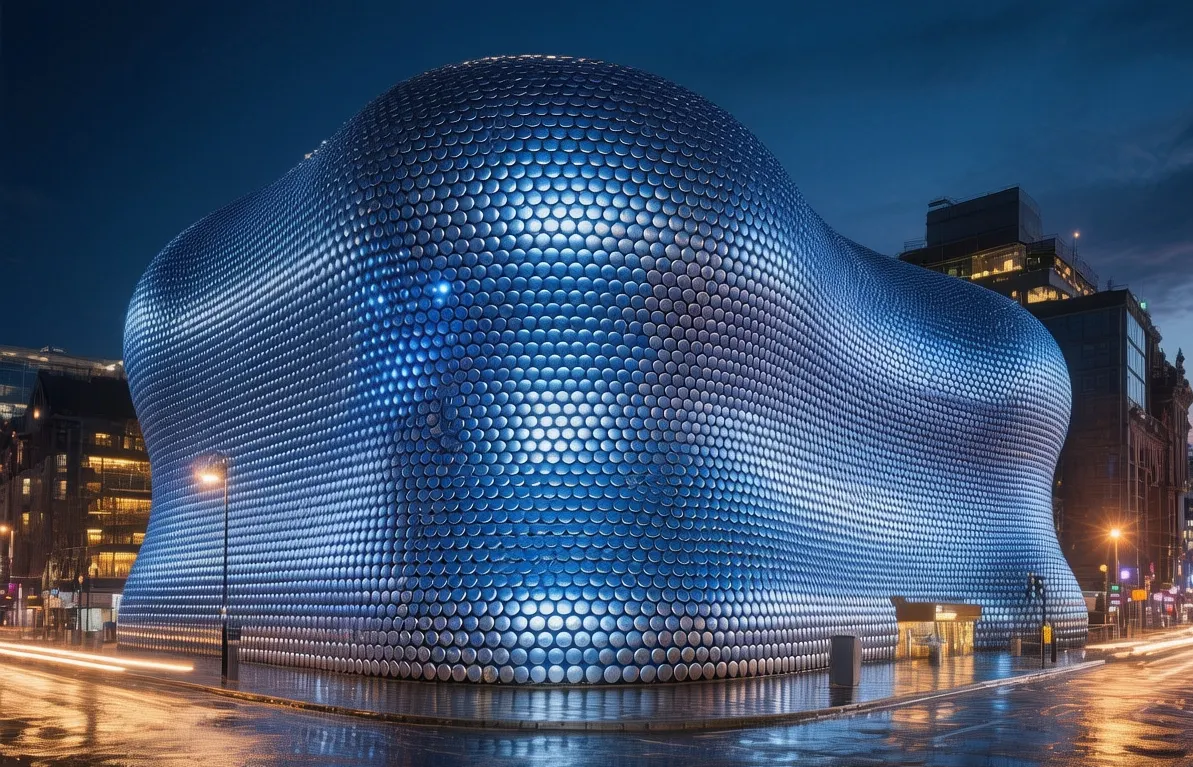
Birmingham Bullring Modern Architecture Meets Market Heritage
Steel hums beneath the floor as dusk settles over the city—vibrating through the soles of your shoes while 15,000 aluminum discs on the Selfridges facade glow like a digital constellation against the grey sky. You stand in the heart of the Birmingham Bullring, the scent of roasted nuts and rain mixing in the air, while the distant chime of St Martin's Church bells echoes from the courtyard below. A market has existed on this site since the 1150s, but the current structure, opened in 2003 by Future Systems architects, redefined the concept of the shopping center as a public landmark. As you trace the cold metal of the railing, looking up at the curved walls that seem to breathe with the light, you realize this place matters now more than ever: in an era of online retail, the Birmingham Bullring remains a testament to physical community, a tangible anchor for social interaction that continues to define the city's identity in 2026.
Why Birmingham Bullring Embodies Urban Regeneration
The Birmingham Bullring is not merely a retail complex; it is a forensic record of post-industrial transformation carved into the city center. Built to replace the 1960s concrete structure that had become synonymous with urban decay, the 2003 redevelopment solved a critical logistical problem: how to reintegrate a fortified mall into the organic street grid of a medieval city. The architecture utilizes a curved organic form to blend with the existing road layout, covering 105,000 square meters (1.13 million square feet) of retail space. Technical engineering involves a steel frame clad in 15,000 anodized aluminum discs, creating a skin that reflects the weather and light, changing appearance hourly. This infrastructure supports over 35 million visitors annually, proving the resilience of physical spaces in a digital economy.
Today, it fulfills a cultural need for connection to a shared public realm. Managed by Hammerson, the site hosts over 160 stores ranging from high-street chains to luxury boutiques, creating a layered narrative of commerce and culture. When you walk the concourses, you traverse a space where Victorian markets once stood and where modern Brummies gather to socialize. The Birmingham Bullring represents a continuous thread of civic pride, preserved by the very organization that now maintains the climate control systems to protect the shoppers from the unpredictable Midlands weather and the erosion of time.
The Best Time to Experience Birmingham Bullring
To witness the Birmingham Bullring in optimal atmospheric conditions, plan your visit between May 18 and June 12. During this window, temperatures average 12-18°C (54-64°F), and daylight extends until 9:15 PM, maximizing time for photography and dining. The best light for capturing the aluminum facade occurs between 7:30-9:30 AM when morning mist lifts off the streets, and 6:00-8:00 PM for golden hour illumination on the discs. Visiting early also allows you to explore the stores before the lunch rush arrives from the business district, typically between 12:00 PM and 2:00 PM.
Autumn offers a secondary window—specifically September 10 to October 15—when summer crowds dissipate and the city takes on a crisp energy. Temperatures remain mild at 11-16°C (52-61°F), though daylight hours shorten rapidly. Avoid November 25 to December 24 when Christmas shopping pushes visitor numbers above 100,000 daily, creating congestion on the escalators and limited seating in cafes. Winter months (January-February) offer solitude but challenging conditions; some outdoor markets close, and sunset occurs as early as 4:05 PM in December. For current opening hours and event schedules, verify information at www.bullring.co.uk or contact the customer service desk at +44 (0)121 632 2222.
Approximate Budget for a 7-Day Trip (2026)
Exploring the Birmingham Bullring and the wider West Midlands requires moderate budgeting, as the city commands competitive prices compared to London. The following budget reflects mid-range travel for one person in 2026, accounting for approximately 4.5% UK inflation (ONS data, January 2026). Prices assume a base in City Centre or Digbeth for optimal access to the Bullring and transport links.
- Accommodation: £90-£150 per night for a boutique hotel in City Centre (6 nights = £540-£900). Budget options: £50-£70 for hostels in Digbeth or camping at Cannon Hill Park.
- Food: £45-65 per day total • Breakfast: £8-12 (Full English at The Breakfast Club) • Lunch: £12-18 (Street food at Bullring Markets) • Dinner: £25-35 (Three-course meal at The Ivy or Dishoom)
- Transportation: • Train London Euston to Birmingham New Street: £55-95 return (advance booking) • Local bus (National Express West Midlands): £4.50 day pass • Car rental (optional): £60/day plus fuel £1.58/liter • Parking at Bullring: £20/day (March-October)
- Attractions: • Bullring Shopping: Free entry • Birmingham Museum & Art Gallery: Free • Library of Birmingham: Free • Cineworld IMAX Ticket: £15
- Miscellaneous: • Shopping budget: £100-£300 • Local artisan souvenirs: £30 • Travel insurance: £40-60 for week • Waterproof gear rental: £20
Total estimated cost: £1,350-£1,750 for 7 days (excluding international flights)
5 Essential Birmingham Bullring Experiences
- Photograph the Selfridges Facade: Arrive at the Grand Avenue entrance by 8:00 AM to capture the building before crowds. The 15,000 aluminum discs reflect the sky; bring a polarizing filter. Spend 30 minutes walking the perimeter to find the best angle. The texture is smooth and cool to the touch. This experience connects you to the architectural icon that put modern Birmingham on the global map.
- Explore the Bullring Markets: Walk to the outdoor market section near St Martin's Church. The scent of spices and fresh produce is strongest in the morning. Spend 60 minutes browsing the stalls. Look for local cheeses and handmade crafts. Open 9:00 AM-5:00 PM daily. This context enriches your visit, showing the continuity of trade from the 1150s to 2026.
- Visit St Martin's Church: Located in the center of the complex, this 14th-century church offers a quiet respite. Entry is free; open 9:00 AM-5:00 PM. Spend 30 minutes examining the nave and tower. The view from the churchyard offers the best panorama of the modern architecture surrounding it. This experience provides historical depth, showing the spiritual heart of the market.
- Dine at the Food Court: Head to the Upper Level for the wide range of dining options. Order a gourmet burger or Asian fusion dish (£15). Sit by the window overlooking the concourse. The sound of the city hums below. Best visited at 1:00 PM when the energy is highest. This experience demonstrates the social role of the center beyond retail.
- Walk to the Rotunda: Dedicate 30 minutes to walking the 500 meters to this cylindrical tower. The building was renovated in 2008 and now houses apartments and offices. The view looking back at the Bullring is iconic. Best visited at sunset. This experience connects the Bullring to the wider architectural regeneration of the city center.
3 Hidden Gems Most Travelers Miss
- St Martin's Courtyard: While crowds cluster at the main entrances, this secluded garden behind the church remains surprisingly quiet. Access via the path near the markets (parking at SP065865). The space features benches and seasonal planting. Visit between 2:00-4:00 PM when light hits the stone. No facilities exist—bring water. The City Council notes this area has high historical interest due to medieval graves.
- The Digbeth Walk: Located 500 meters east, grid reference SP070860, lies the creative quarter. Access via the footpath from the Bullring. The street art and independent studios offer a raw view of the city. Visit during weekday mornings when the site is empty. No facilities exist—bring snacks. This spot demonstrates the artistic history of the area, offering a contrast to the polished retail environment.
- The Old Square: Contact the visitor center (+44 (0)121 632 2222) for access updates to this historic plaza nearby. The site features a fountain and legal district buildings. Access is restricted to footpath only; no vehicles. The space offers a tangible connection to the quieter side of the city. This site reveals the acoustic properties of the plaza, showing how the sound of traffic fades behind the stone walls.
Cultural & Practical Tips
- Respect the space: This is a busy public area. Follow staff instructions regarding security checks. Keep bags closed. The Management reports 5-10 incidents annually due to pickpockets in crowded zones.
- Understand parking: The car park has 3,500 spaces but fills quickly. Check www.bullring.co.uk for availability. Never block loading bays. If full, use the Park & Ride from the suburbs. The traffic team monitors the area closely.
- Leave no trace: Remove all litter, including biodegradable items. The Center collects 15 tonnes of waste annually from the concourses. Do not remove plants or fixtures—this violates local bylaws. Photograph specimens in situ instead.
- Learn local terminology: "Brummie" (local dialect); "Concourse" (walkway); "High Street" (main road). Using these terms shows respect for local heritage and helps guides assist you better during tours.
- Photography guidelines: Tripods are permitted in public areas but restricted inside stores without permission. Drone use requires written permission from the Management and Civil Aviation Authority—apply 6 weeks in advance. Respect other visitors; do not block pathways for extended shoots during peak hours (12:00 PM-4:00 PM).
- Weather preparedness: The city is exposed; wind chill is common even in summer. Pack waterproof layers; Midlands showers are sudden. Wear sturdy shoes with grippy soles—tiles become slippery when wet. Sun protection is essential; reflection from glass increases UV exposure by 15%.
- Accessibility considerations: The center is wheelchair accessible with lifts. The Markets have some uneven surfaces. Alternative viewing exists from the upper levels. Request an accessibility map at the customer service desk upon arrival.
Conclusion: Travel with Community, Not Just Consumption
The Birmingham Bullring does not exist merely to be shopped—it exists to be understood as a gathering place for the city. When you walk these concourses in 2026, you are not observing a static mall; you are entering a space where commerce meets culture and history meets modernity. The merchants who sold wool are gone, but their spirit remains embedded in the market stalls. The architects who designed the curves are gone, but their vision still shapes the skyline. This is not heritage frozen in amber—it is heritage living, breathing, enduring.
So slow down. Sit on the benches for ten minutes without your phone. Listen to the hum that once carried the sounds of industry and now carries the laughter of families. Buy your lunch from a vendor whose owners pay rates that support the local community. Donate to a local charity rather than purchasing unnecessary goods. Leave only footprints on polished floors, take only memories of light and steel, carry home only the profound understanding that some things—community, architecture, public space—cannot be rushed, cannot be owned, can only be honored. The Bullring will still stand in 2126 if we choose stewardship over exploitation today.