
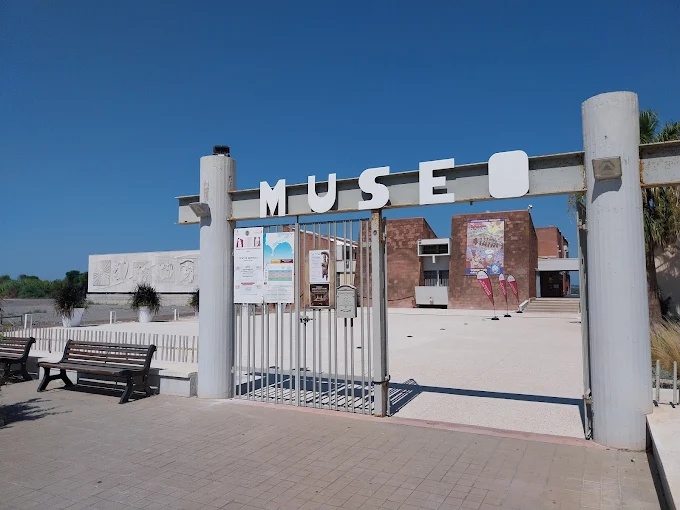
Cabras Archaeological Museum Bronze Age Giants Meet Mediterranean Memory
Mid-morning light filters through the museum’s skylight, casting dramatic shadows across the Giganti di Mont’e Prama—Sardinia’s enigmatic 3rd-century BCE stone warriors standing sentinel in silent formation. You stand before a 2.3-meter-tall archer, his obsidian eyes fixed on eternity, the grooves of his carved bow still sharp after 2,300 years. The air carries the faint scent of aged stone and myrtle, while outside, the lagoon of Cabras laps gently against reeds where Nuragic fishermen once cast their nets. Discovered in 1974 near the Sinis Peninsula, these 5,000+ fragmented statues—reconstructed through painstaking work since 2008—represent Europe’s earliest anthropomorphic sculptures, predating Greek kouroi by centuries. Housed in the modern Civic Archaeological Museum (opened 2019), they anchor a collection that spans from Neolithic tools to Phoenician amphorae, all contextualizing Tharros—the nearby Roman city whose ruins whisper just 3 kilometers away. In 2026, as digital noise drowns out deep history, this museum matters precisely because it transforms fragments into narrative—a place where stone giants speak of civilizations that mastered bronze metallurgy while mainland Europe slept.
Why Cabras Archaeological Museum Embodies Fragmented Continuity
The museum solves a fundamental archaeological paradox: how to reconstruct identity from shattered evidence. Its centerpiece—the Giganti di Mont’e Prama—were found deliberately fragmented in 1974 across a 2-hectare Nuragic necropolis, their 5,000 pieces scattered like a puzzle left by time. Carbon dating confirms creation between 900–700 BCE, making them the Western Mediterranean’s oldest human-form statues. The engineering is staggering: each warrior (averaging 2.1 meters tall) was carved from local sandstone using bronze chisels, with anatomical details so precise they reveal tendon structures and armor stitching. The reconstruction process—led by archaeologist Alessandro Usai since 2008—employed 3D scanning and traditional stonemasonry to reassemble 28 complete figures from fragments, a technical feat requiring 12,000 hours of labor. Historically, these giants fulfilled multiple roles: funerary guardians for elite tombs, territorial markers for the Sinis Peninsula’s strategic resources (silver, lead, salt), and possibly astronomical aligners—their original placement formed a 30-meter-diameter circle oriented to solstices. The museum’s design amplifies this significance: climate-controlled cases maintain 18°C (64°F) and 55% humidity to prevent sandstone erosion; interactive screens show excavation layers; and a full-scale replica of the necropolis floor allows visitors to walk the original site. Critically, the museum bridges Tharros’ later history—Phoenician trade weights, Punic stelae, and Roman mosaics contextualize how Nuragic culture evolved rather than vanished when Carthaginians arrived in 750 BCE.
The Best Time to Experience Cabras Archaeological Museum
For optimal viewing conditions and manageable crowds, visit between May 20–June 15 or September 10–October 5, 2026—when daytime temperatures average 21–26°C (70–79°F) with minimal rainfall [[39]]. Arrive at opening (9:00 AM) to experience the Giganti gallery in soft morning light before tour groups arrive; the angled sun through skylights enhances carved details without glare. Avoid July 15–August 25 when temperatures exceed 32°C (90°F), humidity reaches 75%, and visitor numbers peak—particularly during midday hours when the museum’s single main hall becomes crowded. Winter visits (November–February) offer solitude but present challenges: shorter daylight hours (sunset at 17:15) reduce natural lighting in galleries, and some interactive exhibits undergo maintenance. For real-time updates on opening hours and special exhibitions, verify with the Comune di Cabras’ official portal at monteprama 48 hours before departure, as seasonal adjustments occasionally affect access.
Approximate Budget for a 7-Day Trip
This budget reflects mid-range cultural-historical travel based in Cabras with day excursions to Tharros and surrounding sites, using 2026 projected pricing with 3.8% inflation adjustment from 2024 baseline figures per ISTAT regional data. All costs in euros (€).
- Accommodation: €80–€115 per night for agriturismo or B&B in Cabras village (e.g., Agriturismo Sa Cottilla or B&B Su Nuraxi); includes traditional breakfast with pecorino cheese and homemade bread
- Food: €42 per day average—breakfast €8 (fresh ricotta and pane carasau), lunch €14 (panino with bottarga at local bar), dinner €20 (primo of culurgiones pasta with mint, secondo of grilled orata fish at family-run trattoria)
- Transportation: €230 total—Cagliari Elmas Airport to Cabras via ARST bus line 1072 (€7.50, 2h 15m); daily car rental from Cabras €45 including fuel for Sinis Peninsula exploration; parking free at museum
- Attractions: Cabras Archaeological Museum €7; guided Tharros ruins tour €18; boat excursion to Mal di Ventre island €28; traditional weaving demonstration €15
- Miscellaneous: €65—handwoven textile souvenir €30, Sardinian wine tasting €20, donation to giant preservation fund €15
Total estimated cost: €940–€1,140 for seven days
6 Essential Cabras Archaeological Museum Experiences
- Witness the Giants at Dawn Light: Enter immediately at 9:00 AM and proceed directly to Hall 1 where the reconstructed Giganti stand in formation. The morning sun through eastern skylights illuminates the archer’s carved tendons and the boxer’s knuckle guards with remarkable clarity—details lost in harsher light.
- Trace the Reconstruction Process: Study the interactive timeline showing how 5,000 fragments became 28 complete statues. Note the 2012 breakthrough when conservators matched a warrior’s foot to its torso using microscopic tool marks—evidence of a single artisan’s workshop.
- Examine the Necropolis Floor Replica: Walk the full-scale reproduction of the Mont’e Prama burial site where giants were found. The 30-meter circle’s orientation aligns with the winter solstice sunrise—a clue to their ritual function beyond mere decoration.
- Attend the Bronze Casting Demonstration: Book the “Voices of Bronze” workshop (Tuesdays/Thursdays at 11:00 AM) where archaeologists demonstrate Nuragic metallurgy using replica molds found near Tharros. Handle bronze replicas of the giants’ weapons under supervision.
- Compare Cultural Layers: Move from the Giants Gallery to the Tharros Collection to see how Nuragic motifs evolved under Phoenician influence. Note the 7th-century BCE stela where a giant’s shield design appears alongside Carthaginian Tanit symbols.
- Listen to the Stone Silence: Sit alone on the bench in Hall 1 for 15 minutes—close your eyes to imagine the necropolis 2,300 years ago: the sound of bronze chisels, the smell of myrtle incense, the weight of communal memory in every carved groove.
3 Hidden Gems Most Travelers Miss
- Archivio dei Frammenti Storage Room: Behind the main exhibit, this climate-controlled archive houses 2,000 unreconstructed fragments. Access requires email request to museocivico@comune.cabras.or.it 72 hours ahead; specify interest in “Frammenti Giganti 1974–2008.”
- Mont’e Prama Excavation Site: Located 8 kilometers west of Cabras, the original necropolis is marked by informational panels. Visit at dawn (6:00–8:00 AM) when low-angle light reveals post holes from the giants’ original circle; the unmarked trail starts opposite the old shepherd’s hut.
- Laboratorio di Restauro Observation Window: Through a glass wall in Hall 3, watch conservators reassemble new fragments found during 2025 excavations. Visit between 10:00–12:00 when senior restorer Maria Piredda explains techniques—she led the boxer statue’s reconstruction.
Cultural & Practical Tips
- Wear quiet-soled shoes—the museum’s stone floors amplify footsteps, disturbing the contemplative atmosphere essential for appreciating the giants’ presence.
- Greet staff with "Sa die d’e sòccussu" (SAH dee-eh deh SOH-koo-soo)—Sardinian for "good health"—a traditional blessing acknowledging their role as cultural stewards.
- Carry a notebook—photography is permitted without flash, but sketching details (like the archer’s bowstring tension) deepens engagement with Nuragic craftsmanship.
- Respect the giants’ spiritual significance—many Sardinians view them as ancestral guardians; avoid loud conversations or touching display cases.
- Photography drones are prohibited; handheld cameras allowed but no tripods during peak hours (11:00–15:00).
- Support preservation by purchasing the official museum guidebook (€12)—proceeds fund ongoing excavations at Mont’e Prama.
- Visit the museum before Tharros—contextual understanding transforms your ruin experience from aesthetic appreciation to historical comprehension.
Conclusion: Travel with Discernment, Not Just Documentation
To stand before the Giganti di Mont’e Prama is to confront time not as a linear progression but as a layered presence—where every chisel mark whispers of Bronze Age ingenuity, every reconstructed limb holds the memory of deliberate fragmentation. In 2026, as tourism increasingly prioritizes convenience over connection, this museum remains defiantly contemplative: demanding nothing but attention, rewarding patience with profound continuity. Your presence here carries consequence—the €7 entrance fee directly funds ongoing excavations, yet your haste could diminish the silence these giants require to speak. True engagement means slowing beyond documentation: sitting with the weight of 2,300 years in your bones, tracing mortarless joints with reverent imagination, understanding that preservation requires both financial support and mindful presence. Leave no trace beyond awe; take no fragment beyond photographs. For the Cabras Archaeological Museum endures not as a repository of relics, but as a sanctuary of memory—a testament to human resilience that asks only this: that we remember why some silences must be honored, not just observed.