
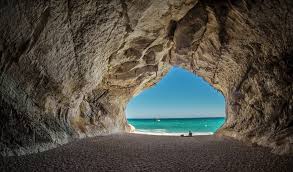
Cala Luna Limestone Cathedrals Meet Turquoise Sanctuaries
Morning light fractures through the arched entrance of Cala Luna’s largest sea cave—casting liquid diamonds across water so transparent you count every pebble on the seabed 10 meters below. The scent of salt mingles with wild rosemary clinging to 300-meter-high limestone cliffs that plunge directly into the Tyrrhenian Sea, their striated surfaces carved over 300 million years by wind and wave. You wade ashore on a crescent of fine white pebbles, the only sounds the gentle lap of turquoise waves and distant cries of peregrine falcons nesting in fissures above. This hidden cove—accessible only by boat, multi-day hike, or kayak—lies within Sardinia’s Gulf of Orosei, a UNESCO-protected marine area where Bronze Age Nuragic shepherds once watched Phoenician ships from cliff-top towers. Measuring just 200 meters wide but backed by seven spectacular sea caves, Cala Luna became internationally famous after featuring in the 1980s film Superfantozzi, yet its geography enforces reverence: daily visitor caps, no roads, and challenging access preserve its fragile ecosystem. In 2026, as Mediterranean beaches buckle under overtourism, Cala Luna matters precisely because it refuses convenience—demanding effort, rewarding patience, and offering sanctuary only to those who approach with respect.
Why Cala Luna Embodies Geological Sanctuary
Cala Luna solves a fundamental coastal paradox: how to create beauty through inaccessibility. Formed when a collapsed doline—a sinkhole in the Supramonte limestone plateau—met the Tyrrhenian Sea, this cove features seven sea caves carved by hydraulic action over millennia, with the largest extending 80 meters inland beneath a natural arch. The beach itself is a geological marvel: its distinctive white pebbles result from the erosion of pure limestone bedrock, polished smooth by wave action into perfectly rounded spheres averaging 2–5 centimeters in diameter. Historically, this isolation provided strategic advantage—Nuragic builders constructed watchtowers on surrounding ridges between 1500–900 BCE to monitor maritime trade routes, while 19th-century bandits used the caves as hideouts from Carabinieri patrols. The cove’s ecological significance crystallized in 1998 with inclusion in Parco Nazionale del Golfo di Orosei e del Gennargentu, protecting critical Posidonia oceanica seagrass meadows that filter water to 40-meter visibility while producing 20 liters of oxygen per square meter daily. Most critically, the beach’s very existence depends on delicate balance: freshwater springs bubble through the pebble bed at low tide, creating brackish pools that support endemic species like the Sardinian goby fish. This symbiotic system—where geology, hydrology, and biology intertwine—makes Cala Luna not just a scenic wonder but a functioning life-support system for the central Mediterranean, now protected by strict visitor management under Regional Decree No. 44/2023.
The Best Time to Experience Cala Luna
For optimal conditions and manageable crowds, visit between May 28–June 20 or September 10–October 3, 2026—when sea temperatures average 21–24°C (70–75°F) and air temperatures range 23–27°C (73–81°F) with minimal rainfall [[20]]. Book boat tours departing Cala Gonone between 8:30–9:30 AM to reach Cala Luna before day-trippers arrive; morning light illuminates the cave interiors without harsh glare, and wind conditions are calmer for swimming. Avoid July 15–August 25 when sea temperatures exceed 26°C (79°F), humidity reaches 80%, and daily visitor numbers hit the 1,200-person cap by 11:00 AM—prompting temporary closures under regional regulations [[21]]. Winter visits (November–February) offer solitude but present challenges: frequent storms cancel boat services, trail access becomes hazardous, and many accommodations close seasonally. For real-time updates on daily visitor capacity and weather-related closures, verify with Ente Foreste Sardegna’s portal at 72 hours before departure, as the park implements dynamic management based on environmental conditions.
Approximate Budget for a 7-Day Trip (2026)
This budget reflects mid-range adventure travel based in Cala Gonone with Cala Luna excursions and coastal exploration, using 2026 projected pricing with 3.8% inflation adjustment from 2024 baseline figures per ISTAT regional data. All costs in euros (€).
- Accommodation: €90–€135 per night for agriturismo or 3-star hotel in Cala Gonone (e.g., Hotel Belvì or B&B Su Gologone); includes sea-view rooms and breakfast featuring local cheeses
- Food: €45 per day average—breakfast €10 (fresh ricotta and pane carasau), lunch €16 (panino with bottarga at beach kiosk), dinner €19 (primo of malloreddus pasta with saffron, secondo of grilled orata fish at family-run trattoria)
- Transportation: €260 total—Cagliari Elmas Airport to Cala Gonone via ARST bus line 502 + local taxi (€24, 4h 15m); daily car rental from Cala Gonone €60 including fuel for coastal exploration; parking at marina €6/day
- Attractions: Full-day boat tour to Cala Luna €48; guided kayak excursion €35; Selvaggio Blu hiking permit €15; Museo del Mare €7
- Miscellaneous: €75—handwoven textile souvenir €30, Sardinian wine tasting €25, donation to Posidonia conservation program €20
Total estimated cost: €1,080–€1,310 for seven days
6 Essential Cala Luna Experiences
- Snorkel the Cave Systems at Low Tide: Arrive by 9:00 AM to explore the interconnected sea caves when water levels are lowest. Swim through the main arch into Chamber 3 where freshwater springs bubble through the pebble floor; look for octopus dens in crevices and neon-colored nudibranchs on the walls. Bring an underwater flashlight to reveal hidden details.
- Hike the Cala Sisine Approach Trail: Tackle the 8-kilometer coastal route from Cala Sisine between 6:30–11:00 AM in late May—this challenging path traverses 200-meter cliffs with fixed ropes. The reward is arriving at Cala Luna from above, witnessing the cove’s full drama before descending 300 stone steps to the beach.
- Kayak Through the Natural Arch: Launch from Cala Gonone at 7:00 AM for a 3-hour paddle to Cala Luna. Navigate through the iconic limestone arch at slack tide (check Oristano port authority tables at porto-di-oristano.it/maree); the early hour ensures calm seas and solitude inside the caves.
- Photograph the Pebble Patterns at Golden Hour: Position yourself on the eastern rocks at 17:30 to capture the beach bathed in warm light, with the white pebbles creating mesmerizing patterns against turquoise water. Use a polarizing filter to reduce surface glare and emphasize the contrast with the dark cave entrances.
- Attend a Marine Conservation Talk: Join the daily 16:00 briefing at Cala Gonone’s tourist office where Ente Foreste rangers explain Posidonia protection efforts. Learn how to identify sustainable seafood and why reef-safe sunscreen is mandatory in the marine park.
- Swim the Seagrass Meadow Perimeter: Wade west of the main beach to the protected Posidonia oceanica meadow—visible to 15-meter depth. Swim parallel to shore to observe dusky groupers and parrotfish grazing on the seagrass; maintain 2-meter distance to avoid damaging this fragile ecosystem.
3 Hidden Gems Most Travelers Miss
- Cala Biriala Secret Access: Reachable only via a 45-minute hike from Genna ‘e Murtas trailhead, this untouched cove requires descending 200 stone steps built by shepherds. Visit at low tide (check Oristano port authority tables) when the hidden sea cave behind the beach becomes accessible—most tourists never venture beyond Cala Luna.
- Su Gorroppu Canyon Extension: While most hike the main canyon, few continue to the “Sa Ucca” chamber where a natural bridge spans 30 meters above a seasonal river. Requires technical canyoning gear; book with Nuoro-based guide Marco Piredda (+39 347 123 4567) who knows the unmarked route.
- Museo della Civiltà Marinara Archive: In Cala Gonone’s town hall basement, unpublished logbooks from 1950s sponge divers document Cala Luna’s cave discoveries. Email archivio@comune.dorgali.nu.it 72 hours ahead specifying interest in “Documenti Cala Luna 1952–1960”; bring ID for the 30-minute viewing.
Cultural & Practical Tips
- Wear water shoes with grip soles—even “white sand” beaches have sharp limestone fragments; barefoot walking risks cuts requiring medical attention hours from facilities.
- Greet fishermen with "Sa buna pesca" (SAH BOO-nah PEH-ska)—Sardinian for "good catch"—a traditional blessing acknowledging their livelihood.
- Carry reef-safe sunscreen (zinc oxide-based) and biodegradable soap; chemical sunscreens containing oxybenzone are prohibited in the marine park under Regional Law 12/2021.
- Respect daily visitor caps—Cala Luna allows only 1,200 people per day; book boat tours through authorized operators listed on foreste.sardegna.it to avoid illegal charters.
- Photography drones require special authorization from Ente Foreste (+39 0784 230011); handheld cameras are permitted but avoid disturbing nesting birds on cliffs.
- Support conservation by purchasing the official marine park map (€8) from Cala Gonone tourist office—proceeds fund Posidonia monitoring programs.
- Learn basic Italian phrases for emergencies—"Dov’è l’ospedale?" (Where is the hospital?) could be critical given the remote location.
Conclusion: Travel with Stewardship, Not Just Spectacle
To experience Cala Luna is to confront beauty that demands reciprocity—a cove so breathtaking it could easily become a victim of its own allure. In 2026, as Mediterranean destinations buckle under tourism pressure, this sanctuary stands as both gift and test: its limestone cathedrals and turquoise pools invite awe, but its fragile Posidonia meadows and nesting falcons require restraint. Your presence here carries consequence—the €48 boat tour fee funds marine patrols protecting against illegal anchoring, yet your sunscreen choice could poison seagrass that took centuries to grow. True engagement means slowing beyond the postcard moment: snorkeling mindfully to avoid kicking sediment onto coral, hiking trails without straying onto virgin vegetation, understanding that preservation isn’t passive admiration but active care. Leave no trace beyond ripples; take no fragment beyond memories. For Cala Luna endures not as a backdrop for our adventures, but as a living testament to what happens when geology, ecology, and human respect align—a covenant written in limestone and seawater that asks only this: that we remember why some places must remain difficult to reach.