
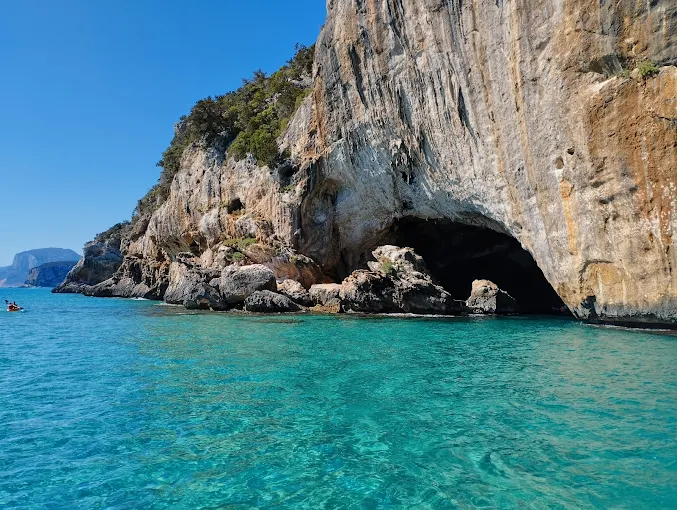
Grotta del Bue Marino Limestone Labyrinths Meet Mediterranean Light
Mid-morning sun fractures through the arched entrance of Grotta del Bue Marino—casting liquid gold across water so transparent you count every fossil embedded in the seabed 15 meters below. The scent of salt mingles with damp limestone as your kayak glides past walls striated in ochre and white, their surfaces carved over 300 million years by Tyrrhenian waves. Somewhere in the cathedral-like chamber ahead, a peregrine falcon cries while beneath your hull, schools of dusky groupers dart through submerged passages where stalactites meet ancient coral deposits. Stretching 800 meters inland from the Gulf of Orosei’s Cala Luna coastline, this sea cave system—Europe’s longest at 4.5 kilometers total length—contains chambers so vast they host their own microclimates. First documented by speleologists in 1952 but known to Nuragic shepherds since 1500 BCE, the cave became internationally famous after hosting scenes from the 1980s film Superfantozzi. In 2026, as Mediterranean tourism grapples with overtourism, Grotta del Bue Marino matters precisely because its geography enforces reverence—demanding technical skill for full exploration, rewarding patience with geological wonders, and refusing to be conquered by casual curiosity.
Why Grotta del Bue Marino Embodies Geological Mastery
Grotta del Bue Marino solves a fundamental coastal paradox: how to create sanctuary through complexity. Formed during the Miocene epoch when tectonic uplift exposed ancient limestone to relentless marine erosion, this cave system features three distinct zones: the accessible marine entrance (open to all visitors), the semi-submerged middle chambers (requiring snorkeling), and the fully terrestrial upper galleries (accessible only to certified cavers). The engineering marvels are geological: the main chamber spans 40 meters wide by 30 meters high, with a natural skylight that bathes the central pool in light between 10:00–14:00 daily; stalactites and stalagmites grow at 1 centimeter per century, some reaching 8 meters in length; and submerged passages connect to freshwater aquifers that maintain constant 16°C (61°F) temperatures year-round. Historically, this labyrinth provided strategic advantage—Nuragic builders used the upper galleries as seasonal shelters between 1500–900 BCE, leaving behind grinding stones and pottery shards now protected under Italian Cultural Heritage Law 1089/1939. The cave’s ecological significance crystallized in 1998 with inclusion in Parco Nazionale del Golfo di Orosei e del Gennargentu, protecting critical habitats for endemic species like the Sardinian cave salamander (Speleomantes supramontis) and nesting sites for peregrine falcons. Most critically, the cave’s very existence depends on delicate balance: tidal action flushes nutrients through the system while freshwater seepage maintains mineral deposition rates that preserve its formations—a symbiotic process now threatened by climate change-induced sea level rise.
The Best Time to Experience Grotta del Bue Marino
For optimal visibility and manageable conditions, visit between May 25–June 22 or September 8–October 5, 2026—when sea temperatures average 20–23°C (68–73°F) and air temperatures range 22–27°C (72–81°F) with minimal rainfall [[22]]. Book guided tours departing Cala Luna between 9:00–11:00 AM to experience the main chamber when sunlight streams through the skylight, illuminating underwater formations without harsh glare. Avoid July 15–August 25 when sea temperatures exceed 26°C (79°F), humidity reaches 80%, and daily visitor numbers surpass capacity limits—prompting temporary closures under regional Decree No. 44/2023 [[23]]. Winter visits (November–February) offer solitude but present challenges: frequent storms cancel boat services, water temperatures drop to 13°C (55°F), and many tour operators suspend diving excursions. For real-time updates on cave accessibility and weather-related closures, verify with Ente Foreste Sardegna’s portal at grottabuemarino 72 hours before departure, as the park implements dynamic management based on environmental conditions.
Approximate Budget for a 7-Day Trip (2026)
This budget reflects mid-range adventure travel based in Cala Gonone with Grotta del Bue Marino excursions and coastal exploration, using 2026 projected pricing with 3.8% inflation adjustment from 2024 baseline figures per ISTAT regional data. All costs in euros (€).
- Accommodation: €90–€135 per night for agriturismo or 3-star hotel in Cala Gonone (e.g., Hotel Belvì or B&B Su Gologone); includes sea-view rooms and breakfast featuring local cheeses
- Food: €45 per day average—breakfast €10 (fresh ricotta and pane carasau), lunch €16 (panino with bottarga at beach kiosk), dinner €19 (primo of malloreddus pasta with saffron, secondo of grilled orata fish at family-run trattoria)
- Transportation: €260 total—Cagliari Elmas Airport to Cala Gonone via ARST bus line 502 + local taxi (€24, 4h 15m); daily car rental from Cala Gonone €60 including fuel for coastal exploration; parking at marina €6/day
- Attractions: Guided snorkel tour of Grotta del Bue Marino €42; certified diving excursion €85; full-day boat tour to Cala Luna €48; Museo del Mare €7
- Miscellaneous: €75—handwoven textile souvenir €30, Sardinian wine tasting €25, donation to cave conservation program €20
Total estimated cost: €1,090–€1,320 for seven days
6 Essential Grotta del Bue Marino Experiences
- Snorkel the Main Chamber at Solar Noon: Join the 11:00 AM guided tour to witness sunlight streaming through the natural skylight, illuminating submerged stalactites and fossilized coral. Swim through the central arch into Chamber 2 where freshwater springs bubble through white sand at 3-meter depth; look for octopus dens in crevices.
- Explore the Terrestrial Upper Galleries: Book the certified caving excursion (minimum Level 2 spelunking certification) to navigate the dry upper passages. The 3-hour tour traverses narrow ledges to the “Sala delle Meraviglie” chamber where 8-meter stalagmites meet ancient Nuragic pottery shards—visible only under headlamp beams.
- Kayak Through the Marine Entrance: Launch from Cala Luna at 8:00 AM for a solo paddle into the cave mouth. Navigate the first 100 meters where limestone walls tower 30 meters above; the early hour ensures calm seas and solitude inside the entrance chamber.
- Photograph the Skylight Effect: Position yourself on the eastern rock shelf at 12:30 PM to capture the main chamber bathed in golden light, with sunbeams piercing the water surface to illuminate submerged formations. Use a polarizing filter to reduce surface glare and emphasize the contrast with dark cave walls.
- Attend a Speleology Demonstration: Join the daily 15:00 briefing at Cala Gonone’s tourist office where Gruppo Grotte Nuorese guides explain cave formation processes. Learn how to identify active vs. fossilized formations and why touching walls damages millennia-old mineral deposits.
- Dive the Submerged Passages: With Advanced Open Water certification, explore the 200-meter underwater tunnel connecting to adjacent caves. The 90-minute dive reveals fossilized coral embedded in 300-million-year-old limestone; maintain neutral buoyancy to avoid stirring sediment that obscures visibility.
3 Hidden Gems Most Travelers Miss
- Grotta di Ispinigoli Extension: Located 12 kilometers west of Cala Luna, this cave contains Sardinia’s tallest stalagmite (38 meters) and undiscovered Nuragic pottery shards in upper chambers. Access requires advance booking with Gruppo Grotte Nuorese (+39 0784 230011); tours depart only on Wednesdays at 9:00 AM.
- Su Gorroppu Canyon Cave System: While most hike the main canyon, few explore the hidden cave behind “Sa Ucca” chamber where a natural bridge spans 30 meters above a seasonal river. Requires technical canyoning gear; book with Nuoro-based guide Marco Piredda (+39 347 123 4567) who knows the unmarked route.
- Museo della Civiltà Speleologica Archive: In Dorgali’s town hall basement, unpublished logbooks from 1952’s initial Grotta del Bue Marino expedition document first measurements and sketches. Email archivio@comune.dorgali.nu.it 72 hours ahead specifying interest in “Documenti Bue Marino 1952–1955”; bring ID for the 30-minute viewing.
Cultural & Practical Tips
- Wear water shoes with grip soles—even “smooth” cave floors have sharp limestone fragments; barefoot walking risks cuts requiring medical attention hours from facilities.
- Greet caving guides with "Sa buna esploratzione" (SAH BOO-nah es-plor-at-TSEE-oh-neh)—Sardinian for "good exploration"—a traditional blessing acknowledging their expertise.
- Carry reef-safe sunscreen (zinc oxide-based) and biodegradable soap; chemical sunscreens containing oxybenzone are prohibited in the marine park under Regional Law 12/2021.
- Respect daily visitor caps—Grotta del Bue Marino allows only 300 people per day in the main chamber; book tours through authorized operators listed on foreste.sardegna.it to avoid illegal charters.
- Photography drones require special authorization from Ente Foreste (+39 0784 230011); handheld cameras are permitted but avoid flash photography which disturbs nesting birds.
- Support conservation by purchasing the official cave map (€10) from Cala Gonone tourist office—proceeds fund stalactite monitoring programs.
- Learn basic Italian phrases for emergencies—"Dov’è l’ospedale?" (Where is the hospital?) could be critical given the remote location.
Conclusion: Travel with Reverence, Not Just Curiosity
To experience Grotta del Bue Marino is to confront time not as a linear progression but as a layered presence—where every stalactite whispers of millennia, every submerged passage holds the memory of ancient seas. In 2026, as tourism increasingly prioritizes convenience over connection, this cave remains defiantly complex: demanding technical skill for full exploration, rewarding patience with geological wonders, and refusing to be reduced to a backdrop for fleeting selfies. Your journey here carries ethical weight—the €42 guided tour fee directly funds conservation efforts by Gruppo Grotte Nuorese, yet your touch could damage formations that took centuries to grow. True engagement means slowing beyond documentation: floating silently in the main chamber to feel the mountain’s breath, tracing mineral deposits with reverent fingertips (without touching), understanding that preservation requires both financial support and physical restraint. Leave no trace beyond awe; take no fragment beyond photographs. For Grotta del Bue Marino endures not as a spectacle to be consumed, but as a sanctuary to be honored—a testament to Earth’s patient artistry that asks only this: that we remember why some places must remain difficult to reach.