
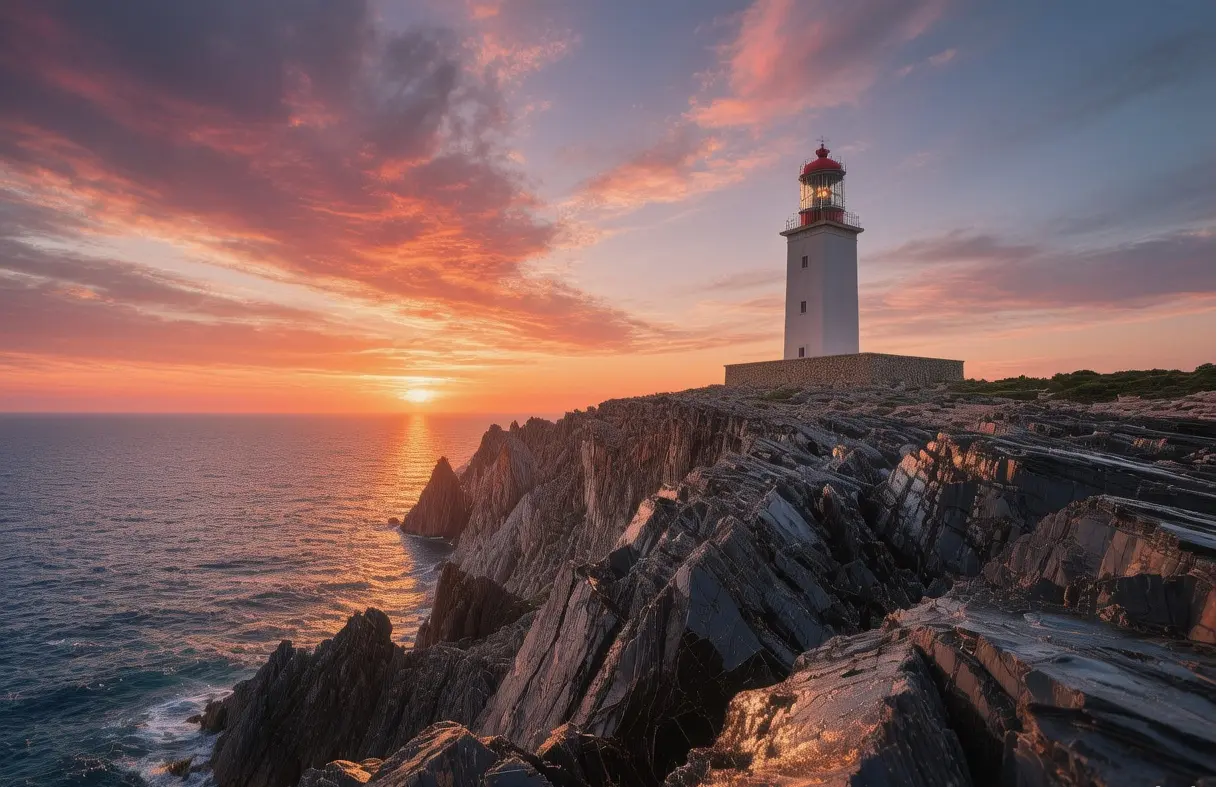
Cap de Creus Rugged Slate Meets Mediterranean Light
The Tramuntana wind howls through fissured slate as dawn breaks over the easternmost point of the Iberian Peninsula—light catching the white tower of the lighthouse while the Mediterranean churns against cliffs dropping 143 meters to the sea. You stand on the GR-92 trail, breathing air scented with thyme and salt, listening to the rhythmic crash of waves against geological formations sculpted over 250 million years. This is Cap de Creus, a 8,380-hectare Natural Park established in 1998 to protect the unique intersection of land and sea where Salvador Dalí found inspiration for his surrealist landscapes. The silence here is profound, broken only by the cry of Audouin's gulls and the distant foghorn signaling ships through the busy shipping lane. In 2026, as coastal erosion accelerates and mass tourism threatens fragile ecosystems, Cap de Creus matters because it remains a sanctuary where geological time dwarfs human ambition, demanding visitors tread lightly on landscapes that have endured millennia of wind and wave.
Why Cap de Creus Embodies Geological Drama
The Cap de Creus Natural Park solves a critical conservation need: protecting the most easterly point of mainland Spain from uncontrolled development while preserving a landscape of unique geological significance. This 8,380-hectare sanctuary represents the only place in the Iberian Peninsula where metamorphic slate rock meets the open Mediterranean, creating a jagged coastline of cliffs, coves, and islets formed during the Hercynian orogeny. The park's creation in 1998 addressed the urgent problem of urbanization pressure from nearby Cadaqués and Roses, establishing strict building codes that prohibit new construction within 500 meters of the shoreline. Today, it serves as a refuge for 150 bird species, including the largest colony of Audouin's gulls in Catalonia, and protects 1,000+ plant species adapted to saline winds.
Technical measurements reveal the scale of erosional forces: the lighthouse, built in 1853 and automated in 1985, stands 143 meters above sea level, visible from 25 nautical miles away. The coastline features vertical cliffs dropping 80–100 meters into deep water, creating underwater caves explored by divers since the 1960s. The park's hydrological system includes no permanent rivers; instead, rainwater filters through porous slate, emerging as freshwater springs directly into the sea—a phenomenon visible at Cala Culip after heavy storms. Conservation efforts, managed by the Generalitat de Catalunya, employ 25 rangers who monitor visitor impact, ensuring that the 300,000 annual visitors do not degrade the fragile vegetation zones where endemic species like the Linaria de Cap de Creus bloom. This preservation fulfills a need for travelers seeking raw nature; in 2026, amidst sanitized coastal resorts, Cap de Creus offers an unvarnished encounter with the elements.
The Best Time to Experience Cap de Creus
For optimal hiking conditions—when wildflowers blanket the slate rocks and the Tramuntana wind subsides—target May 15–June 20 or September 10–October 15. During these windows, daytime temperatures range 18–26°C (64–79°F), while nights cool to 12–16°C (54–61°F), perfect for exploring exposed headlands without summer's scorching heat or winter's gale-force winds. For photography and atmosphere, arrive at the lighthouse parking area by 7:30–8:00 AM, before shuttle buses arrive from Cadaqués.
The golden hour before sunset—approximately 8:45–9:45 PM in June, 7:15–8:15 PM in September—casts long shadows across the white slate, creating ideal conditions for capturing the contrast between rock and sea. Visit Tuesday through Thursday to avoid weekend crowds from Girona and Barcelona; Saturday mornings see visitor numbers exceed 1,000 people, triggering capacity closures at the shuttle bus station. Avoid August 1–20 unless you tolerate temperatures exceeding 30°C (86°F) and dense crowds; similarly, avoid December through February when the Tramuntana wind frequently closes access roads without warning due to safety hazards.
Approximate Budget for a 7-Day Trip (2026)
This budget reflects mid-range travel with comfortable accommodations, quality dining, and outdoor experiences—based on 2025 pricing adjusted for Spain's projected 3.2% inflation rate for 2026. Cap de Creus sits in the Empordà region; costs are moderate, but summer demand drives prices up in Cadaqués and Port de la Selva.
Accommodation: €100–€200 per night
- Rural masia near Port de la Selva: €100–€140 (Mas Marota)
- Mid-range hotel in Cadaqués: €150–€200 (Hotel Playa Sol)
- Camping site (El Port de la Selva): €40–€60 per night
Food: €45–€75 per day
- Breakfast: €7–€12 (coffee, pastry, toast at local café)
- Lunch: €16–€28 (menú del día: fresh fish, paella, or lamb with wine)
- Dinner: €25–€40 (traditional restaurant: squid ink rice, wine, dessert)
Transportation:
- Rental car (7 days, compact): €280–€350 (essential for accessing trailheads)
- Shuttle bus to lighthouse (mandatory summer): €3 round-trip
- Bus Barcelona to Roses (SARFA): €22 one-way, 2 hours 45 minutes
- Fuel for regional exploration (350 km): €55–€65
Attractions & Experiences:
- Park entry: Free
- Guided hiking tour (full day): €45
- Lighthouse museum entry: €5
- Boat rental (half-day): €120
- Dalí House Museum (nearby): €14
Miscellaneous:
- Local wine (Empordà DO, bottle): €12–€25
- Souvenirs and maps: €25–€40
- Travel insurance (7 days, adventure coverage): €35–€55
- Emergency fund: €100 (recommended)
Total for 7 days (mid-range): €1,400–€1,850 per person (excluding international flights)
6 Essential Cap de Creus Experiences
- Hike to the Lighthouse: This iconic route begins at the parking area (120 meters elevation) and follows the paved road for 1.5 kilometers to the tower. The path is well-maintained, gaining 23 meters elevation over 20 minutes one-way. You'll pass slate formations sculpted by wind into surreal shapes resembling animals and faces. Arrive by 8:00 AM to beat the shuttle buses; private cars are prohibited June–September. The return offers views of the Bay of Roses reflecting in rock pools. Allow 1 hour round-trip including museum visit.
- Explore Cala Culip: For swimming, this secluded cove offers turquoise water protected from north winds. Access via the GR-92 trail from the lighthouse parking area (1.2 kilometers, 30 minutes). The path involves rocky steps; wear sturdy shoes. The cove features a small pebble beach and freshwater springs emerging from the cliff face. Best visited at 11:00 AM when sunlight penetrates the water. Bring snorkeling gear; posidonia seagrass beds host diverse marine life. No facilities exist; pack out all waste.
- Walk the GR-92 Coastal Path: This long-distance trail traverses the park's entire coastline. For a day hike, tackle the section from Port de la Selva to Cala Tavallera (8 kilometers, 3 hours). The path climbs 200 meters elevation, offering panoramic views of the Pyrenees and Mediterranean. You'll pass ancient stone huts (barracas) used by shepherds centuries ago. Allow 4 hours round-trip. Access requires parking at Port de la Selva (€10 per day). Trail markers are white-and-red; download offline maps as signal is spotty.
- Visit the Lighthouse Museum: Located inside the lighthouse complex, this small exhibition explains the history of navigation along this dangerous coast. Open 10:00 AM–2:00 PM and 4:00–7:00 PM (summer). Entry €5; includes access to the tower gallery (85 steps). The view from the top reveals the curvature of the earth on clear days. Rangers provide context about shipwrecks; over 200 vessels have sunk here since 1850. Photography permitted without flash.
- Spot Wildlife at Dawn: The park is home to falcons, gulls, and wild goats. Position yourself at the Mirador del Mandrès viewpoint at 7:00 AM with binoculars (10x42 recommended). Eleonora's falcons nest on cliff ledges; wild goats graze on steep slopes above the trail. The Audouin's gull, with a wingspan of 1.3 meters, hunts fish offshore. Maintain a distance of 100+ meters to avoid disturbing nesting sites. This experience offers solitude impossible during midday hours.
- Dine in Port de la Selva: After hiking, enjoy fresh seafood in this fishing village. Reserve a table at Restaurant El Port (Carrer del Mar 4). Order suquet de peix (fish stew) or grilled prawns (€22–€30). The terrace overlooks the harbor where boats unload the morning catch. Open 1:00–4:00 PM and 8:00–11:00 PM. Prices average €35 per person without wine. This experience connects you to the maritime culture that sustained the region before tourism.
3 Hidden Gems Most Travelers Miss
- Ermita de Sant Pere de Rodes: While thousands visit the coast, this 10th-century monastery sits 500 meters above the park on Mount Verdaguer. Accessible via a 3-kilometer hike from Port de la Selva, the ruins offer panoramic views of the entire headland. The church dates to 974 AD; the cloister features original Romanesque capitals. Entry €6; open 10:00 AM–6:00 PM. This site is overlooked because it requires an uphill climb, but the historical context is unmatched. Best visited at 5:00 PM when light illuminates the stone arches.
- Cala Joncols: Accessible only by boat or a steep 45-minute hike from the road, this secluded cove features crystal-clear water and no facilities. Join the water taxi from Cadaqués harbor (departs 11:00 AM and 4:00 PM, €15 round-trip) to avoid the strenuous walk. The cove is protected within the Natural Park, limiting visitors to 150 per day. Bring a picnic; no food is sold onsite. This spot is overlooked because it requires effort, but the isolation is unparalleled. Best visited weekdays to avoid boat crowds.
- Menhir de la Creu d'en Cobertella: This 2.7-meter tall standing stone dates to the Neolithic period (3000 BC), predating the lighthouse by 5,000 years. Located 2 kilometers inland from the coast near the C-260 road. Access requires a 20-minute walk from the parking area; follow brown heritage signs. The menhir aligns with the summer solstice sunrise. This site is special because it reveals human presence long before navigation became critical. No entry fee; donations accepted for maintenance. Visit at dawn for optimal lighting.
Cultural & Practical Tips
- Access restrictions: Private vehicles are prohibited from reaching the lighthouse between June 15–September 30. Park at the designated lot near Cadaqués (€10 per day) and take the shuttle bus (€3 round-trip). Arrive by 8:30 AM to guarantee a parking spot; lots fill completely by 9:30 AM on weekends. Violators face €200 fines.
- Weather preparedness: The Tramuntana wind can reach speeds of 100 km/h, making hiking dangerous. Check forecasts at meteocat.gencat.cat before visiting. Even in summer, evenings can be breezy; bring a windbreaker. Sun protection is critical; reflection off white slate intensifies UV exposure. Wear SPF 50+ and hats.
- Language essentials: Catalan is the primary language; Spanish is widely understood. Key phrases: Bon dia (BON DEE-ah = good morning), On és el camí? (ON es el ca-MEE = where is the path?), Aigua (AHY-gwah = water), Gràcies (GRAH-see-es = thank you). Using Catalan greetings shows respect for local identity.
- Photography guidelines: Drones are prohibited within the Natural Park boundaries without special research permits (contact parcsnaturals@gencat.cat). Tripods are permitted but cannot obstruct trails. Respect privacy of nearby residents; some coves have private properties. Best light for coastal photography is mid-morning when sun penetrates the water.
- Water safety: Stream water appears pure but may contain livestock bacteria. Filter or boil water from springs if refilling bottles. Carry 2–3 liters per person for full-day hikes; refill stations exist only at Port de la Selva and Cadaqués. Dehydration risks increase with wind exposure despite cool temperatures.
- Trail etiquette: Stay on marked paths to protect endemic vegetation. Walking on posidonia seagrass beds damages the ecosystem; use designated swimming areas. Dogs are allowed on leash in most areas but prohibited in sensitive nesting zones (marked with signs). Clean up all waste; pack out what you pack in.
- Emergency contacts: Mobile coverage is spotty in deep coves. Download offline maps (Google Maps or Maps.me). Emergency number is 112. Ranger stations are located at the lighthouse and Port de la Selva. Inform someone of your hiking route before departing; trails can be confusing in foggy conditions.
Conclusion: Travel with Reverence, Not Just Checklists
Cap de Creus does not exist merely for your Instagram feed—it has stood firm against the Tramuntana wind for 250 million years before the first hiker laced up a boot. What it deserves is your reverence: the willingness to walk softly on trails worn by shepherds and smugglers alike, to listen to the wind in the slate rocks without needing to capture it on camera, to understand that the silence of the headland is a privilege, not a right. In 2026, as protected spaces worldwide face pressure from overtourism and climate instability, Cap de Creus asks us to be stewards, not just consumers. Hike to the lighthouse not to conquer the point, but to witness the horizon's persistence. Watch the gulls not to tick a box, but to honor their fragile survival. Let the slate walls teach you that endurance is quiet. Travel to Cap de Creus not to leave your mark, but to ensure your presence leaves no trace, preserving this cathedral of stone and sea for the next generation of dreamers who need to know that wild places still exist.