
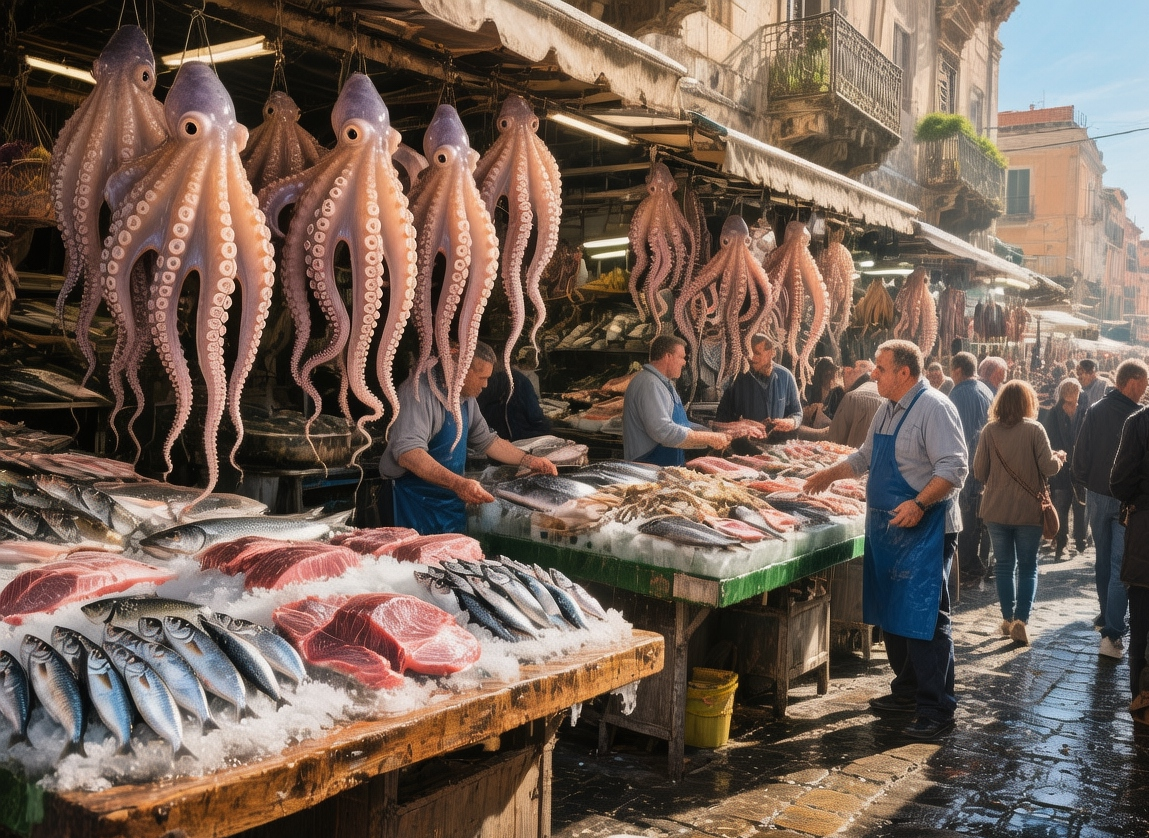
Catania Fish Market Volcanic Bounty Meets Sicilian Soul
The morning sun filters through strings of drying octopus and vibrant red tuna steaks hanging over narrow alleyways, casting dappled shadows on cobblestones slick with seawater and fish scales. You hear the rhythmic chant of vendors calling out “Vieni, vieni! Freschissimo!”, the clatter of ice being shoveled onto glistening displays of swordfish and sardines, and the low hum of a thousand daily transactions in Sicily’s most authentic open-air theater. This is La Pescheria, Catania’s historic fish market, a sensory explosion that has pulsed through the city since the 19th century, nestled between the Baroque splendor of Piazza del Duomo and the slopes of Mount Etna. Here, the bounty of the Ionian Sea meets the fertile volcanic soil, creating a culinary crossroads where tradition is not performed for tourists, but lived with fierce authenticity. In an age of sanitized supermarkets and digital convenience, La Pescheria matters now more than ever—it is a defiant celebration of real food, real people, and the messy, magnificent chaos of life.
Why Catania Fish Market Embodies Culinary Resilience
La Pescheria is far more than a place to buy seafood; it is the beating heart of a city shaped by fire and sea. Established in the late 1800s after the devastating 1693 earthquake, the market was built on the ruins of the old city, its layout following the natural curve of the ancient Roman amphitheater that once stood here. Its location is no accident—nestled between the port and the historic center, it served as the vital artery connecting the sea’s bounty to the city’s kitchens. The market’s unique character stems from Catania’s dual identity: a coastal city whose cuisine is enriched by the mineral-rich soil of Mount Etna. This volcanic terroir produces citrus, capers, and olive oil that perfectly complement the day’s catch—swordfish, tuna, sardines, and the famous ricci di mare (sea urchins). This symbiosis “solved” a fundamental need: how to feed a growing population with fresh, local produce in an era before refrigeration. Today, it fulfills a modern crisis—the hunger for authenticity in a globalized world. La Pescheria is not a tourist attraction; it is a living organism where community is forged over shared meals and neighborhood gossip.
The Best Time to Experience Catania Fish Market
To experience La Pescheria in its most vibrant yet manageable state, plan your visit for the specific windows of April 15–May 30 or September 10–October 20, 2026. During these periods, Catania enjoys ideal weather, with daytime temperatures ranging from a comfortable 22–27°C (72–81°F), and the summer crowds have yet to arrive or have already departed [[11]]. The best time of day to explore is in the morning, between 8:00 AM and 11:00 AM, when the stalls are fully stocked, the energy is high, and you can witness the full spectacle of the market in action. It is strongly advised to avoid the peak summer months of July and August, when temperatures can soar above 34°C (93°F), making the crowded, unshaded alleys uncomfortably hot [[64]]. For the most current information on market days, special food festivals, and guided tours, always consult the official tourism portal: comune.catania.it.
Approximate Budget for a 7-Day Trip (2026)
This budget is calculated for a solo traveler seeking a comfortable, culturally immersive experience in eastern Sicily in 2026, based on current inflation trends and average regional costs.
- Accommodation: €80–€140 per night. Staying in a boutique hotel in the historic center offers easy access to the market and major sites. Options near the Teatro Massimo are slightly more upscale.
- Food: €40 per day. Breakfast (€4): a cappuccino and brioche at a local bar. Lunch (€15): a panelle and crocchè sandwich from a market stall. Dinner (€21): a main course like pasta con le sarde at a family-run trattoria.
- Transportation: €100 total. A regional train ticket from Catania Airport to the city center (€6). A weekly AMAT pass for unlimited public transport (€15). Local transport within the center is primarily on foot.
- Attractions: Guided street food tour of the market (€35). Entry to the Catania Cathedral and Bellini Gardens (€10). Visit to the Benedictine Monastery (€8).
- Miscellaneous: €90. This covers a bottle of local wine (€15), several gelato stops (€3 each), a hands-on cooking class (€40), and souvenirs like a ceramic dish or a jar of caponata.
Total Estimated Cost: €855–€975
6 Essential Catania Fish Market Experiences
- Start Your Day at La Pescheria: Arrive by 8:30 AM to see the market in full swing. Wander the chaotic lanes between Via Pardo and Via Dusmet, sampling arancini di pesce (fish rice balls) and seltz al limone (lemon-flavored sparkling water).
- Take a Street Food Tour: Book a guided tour to navigate the stalls safely and learn the stories behind the dishes. Taste stigghiola (grilled lamb intestines), arancini, and cannoli filled to order—all while hearing the history of each bite.
- Shop for Produce at Fera 'o Luni: Adjacent to the fish market, this fruit and vegetable market (open Mondays) is a feast for the eyes with pyramids of blood oranges, glistening eggplants, and mountains of fresh herbs grown in Etna’s volcanic soil.
- Eat Like a Local at a Friggitoria: Grab a paper cone of freshly fried crocchè (potato croquettes) or milza (spleen sandwich) from a hole-in-the-wall stall. Eat standing up, as the Catanese do.
- Visit a Historic Panificio: Step into a traditional bakery like Antico Forno San Giuseppe to watch sfincione (Sicilian pizza) being made in wood-fired ovens. The smell alone is worth the trip.
- Explore the Market's Backstreets: Venture beyond the main drag to discover hidden courtyards where fishermen mend nets and nonnas prepare the day’s catch. It’s raw, authentic, and rarely visited by tourists.
3 Hidden Gems Most Travelers Miss
- The Secret Courtyard of Palazzo Biscari: Hidden behind the market, this deconsecrated church now houses artists’ studios and a peaceful garden. It’s a serene oasis in the middle of the chaos—ask a local for directions.
- The Spice Stall of Signora Rosa: In a quiet corner near Via Etnea, this tiny shop sells homemade spice blends like annatto and dried wild fennel. Ask for her secret recipe for caponata—it’s legendary.
- The Fish Auction at Porto Ulisse: Just off the main market, this small, working fish auction happens early morning. Local chefs bid on the day’s catch—it’s raw, authentic, and rarely visited by tourists. Go before 9:00 AM.
Cultural & Practical Tips
- Carry cash in small denominations: Most vendors don’t accept cards. Having €5 and €10 notes makes transactions much smoother.
- Dress modestly and comfortably: The market is a working environment. Wear closed-toe shoes (the ground can be wet and slippery) and avoid flashy jewelry.
- Learn a few key phrases: “Quanto costa?” (KWAHN-toh KOS-tah?) for “How much does it cost?”, and “Posso assaggiare?” (POS-soh ah-sah-JAH-reh?) for “Can I taste it?”
- Ask before taking photos: Many vendors are happy to be photographed, but always ask with a smile first. A simple “Permesso?” (pehr-MEH-soh?) goes a long way.
- Beware of pickpockets in crowded areas: Keep your bag in front of you, especially in La Pescheria during peak hours.
- Tipping is not expected but appreciated: Rounding up the bill or leaving €1–€2 for exceptional service is a kind gesture.
Conclusion: Travel with Heart, Not Just a Stomach
La Pescheria is not a culinary theme park; it is the soul of Catania, laid bare in all its glorious, chaotic beauty. In 2026, as we seek travel experiences that are both authentic and transformative, this market offers a powerful lesson in humanity. Your journey here should be one of heart—not just tasting the food, but listening to its stories, respecting its traditions, and connecting with the people who keep them alive. By traveling with this open-hearted engagement, you honor the resilience of a community that has turned necessity into art. Slow down. Sit on a step and watch the world go by. In that moment of genuine connection, you don’t just visit Catania—you become part of its enduring, flavorful story.