
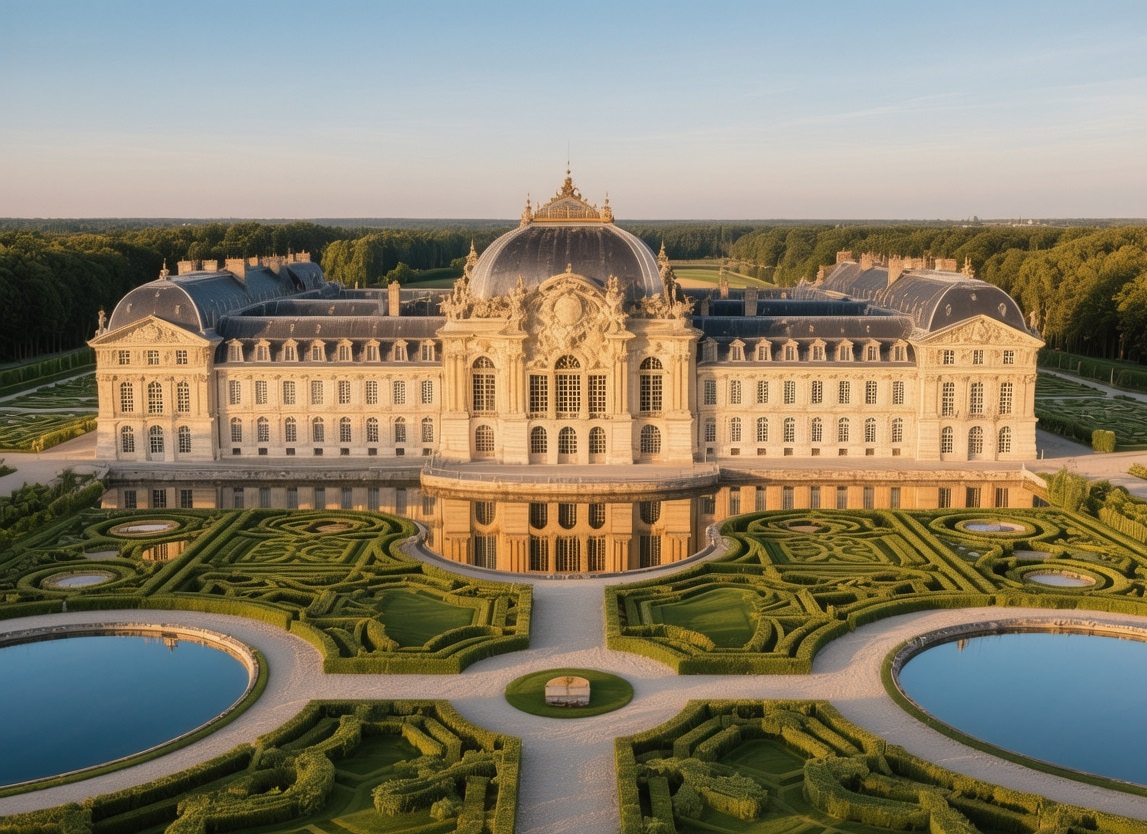
Château de Vaux-le-Vicomte : Ambition Built a Masterpiece—and Toppled an Empire
The story begins not with stone, but with audacity. On August 17, 1661, Nicolas Fouquet—Louis XIV's finance minister—hosted France's most extravagant fête at his newly completed château. As twilight fell, 6,000 guests watched a Molière premiere by candlelight, dined on silver plates later tossed into the fountain as souvenirs, and marveled as fireworks illuminated gardens where orange trees bloomed in gilded tubs. The young Sun King attended, smiled politely, and departed before midnight. Three weeks later, he ordered Fouquet arrested for embezzlement. The minister's crime wasn't theft—it was outshining royalty. Yet from this tragedy emerged Europe's first unified masterpiece of architecture, landscape, and interior design: a 17th-century synthesis so perfect it became Versailles' blueprint. In 2026, Vaux-le-Vicomte remains not merely a château, but a cautionary tale in limestone and topiary—where every parterre whispers of ambition's price.
Why Château de Vaux-le-Vicomte Transcends Typical French Châteaux
Vaux-le-Vicomte represents more than architectural beauty—it embodies the birth of French classical harmony. While Versailles sprawls with imperial ego, Vaux achieves perfection through restraint: a single architect (Louis Le Vau), a single landscape designer (André Le Nôtre), and a single painter-decorator (Charles Le Brun) collaborated for the first time in history to create seamless dialogue between building and garden. The château's genius lies in forced perspective—Le Nôtre's 1.5-kilometer axial vista appears twice its length through optical illusion, drawing the eye from gravel courtyard to Hercules statue to distant horizon. Inside, Le Brun's ceiling frescoes dissolve architectural boundaries, while Le Vau's oval salon pioneered spatial fluidity that would define French classicism. Unlike state-owned monuments, Vaux remains privately owned by the Vogüé family since 1875, preserved not as museum but as living estate where 17th-century craftsmanship techniques still inform restoration. This continuity grants Vaux an intimacy Versailles cannot match: here, you don't observe history—you inhabit its most human moment.
The Best Time to Experience Château de Vaux-le-Vicomte
For optimal conditions—blooming parterres, dramatic light, and authentic atmosphere—visit on a weekday between May 15 and June 10. Daytime temperatures average 16–23°C (61–73°F), the 500,000 hand-clipped boxwood plants in Le Nôtre's parterres reach peak definition, and the grand canal reflects sky without summer haze. Arrive by 10:00 AM to experience the gardens in morning solitude before coach tours arrive—a critical window when light streams along the central axis, accentuating Le Nôtre's forced perspective without harsh shadows. September 5–20 offers a second excellent opportunity: warm days, departing crowds, and autumn light gilding the lime-tree allée. For transformative evening experiences, attend the Soirées aux Chandelles (candlelit evenings) held select Saturdays May–October—when 2,000 candles illuminate interiors as they appeared in 1661, with period musicians performing in the oval salon. Avoid French school holidays and July–August weekends when pathways become congested.
Approximate Budget for a 7-Day Trip (2026)
Based on 2025 benchmarks adjusted for 4% inflation (per INSEE and Île-de-France Tourism Board projections), here's a realistic mid-range budget for a Paris-based itinerary including Vaux-le-Vicomte:
- Accommodation: €110–€160 per night for a boutique hotel in Paris' Marais district or near Gare de Lyon (essential for easy Vaux access).
- Food: €90–€105 per day—breakfast at bakery (€7), lunch picnic from Paris market (€15–€20), dinner at neighborhood bistro (€45–€55).
- Transportation: €42 round-trip via private shuttle from Paris (booked through chateau-vaux-le-vicomte.com)—includes 1-hour transfer and avoids complex train/bus connections. Alternatively: Train from Gare de Lyon to Melun (€8), then taxi to château (€25).
- Attractions: Château entry with gardens: €21. Candlelit evening supplement: €10. Horse-drawn carriage ride: €12. Audio guide: €6. Allocate €80 total for Paris museums.
- Miscellaneous: €50 for artisanal honey from château's beehives, reproduction prints of Le Brun frescoes, or contributions to the preservation foundation.
Total Estimated Cost: €1,250–€1,750 for seven days, excluding international flights.
5 Essential Château de Vaux-le-Vicomte Experiences
- The Grand Perspective: Stand at the château's central window and follow Le Nôtre's 1.5-km axial vista—gravel path to Hercules statue to reflecting canal to horizon—a masterclass in forced perspective that inspired Versailles' gardens.
- Oval Salon: Louis Le Vau's revolutionary double-height space where architecture dissolves into Le Brun's ceiling fresco of Fouquet as Hercules—best viewed mid-morning when north light illuminates gilded stuccoes without glare.
- Grotto of Thetis: Le Nôtre's hydraulic marvel where hidden pipes create "singing" water effects in a shell-encrusted cavern—activated hourly for visitors who request demonstration at the garden kiosk.
- Candlelit Evenings (Soirées aux Chandelles): Experience the château as Fouquet did: 2,000 beeswax candles illuminating frescoes while musicians perform Lully compositions in period costume—reservations essential 4 weeks ahead.
- Horse-Drawn Carriage Tour: A 25-minute ride through the 120-acre park following 17th-century pathways, with commentary on Le Nôtre's engineering—departures hourly 11:00 AM–4:00 PM.
3 Hidden Gems Most Travelers Miss
- Belvédère du Désert: Beyond the formal gardens, follow the unmarked path behind the orangery to this secluded pavilion overlooking Le Nôtre's "wilderness" section—where untamed groves contrast with geometric parterres, revealing his philosophy of controlled nature.
- Chapelle des Enfants du Désert: A tiny 18th-century chapel hidden in the park's eastern woods (ask groundskeepers for directions near the vegetable garden)—still used for Sunday Mass with original Fouquet-era pews.
- Atelier de Taille de Pierre: The château's active stone-carving workshop near the entrance—observe artisans using 17th-century tools to restore weathered sculptures every Tuesday/Thursday morning (9:00–11:00 AM).
Cultural & Practical Tips
- Book Transportation Early: Reserve the official Paris shuttle 3–4 weeks ahead via chateau-vaux-le-vicomte.com—public transport requires complicated transfers that consume half your visit.
- Strategic Timing: Arrive at opening (10:00 AM) to experience interiors before crowds. Spend first hour inside, then gardens when light optimizes Le Nôtre's perspectives (11:00 AM–1:00 PM).
- Photography Ethics: Flash prohibited indoors—damages 350-year-old pigments. Tripods banned. Best shots captured handheld near Oval Salon windows between 10:30–11:30 AM.
- Learn Key Phrases: "Bonjour Madame/Monsieur," "Merci," and "Où est le belvédère secret?" (Where is the secret viewpoint?)—groundskeepers often share hidden perspectives with respectful visitors.
- Support Preservation: Purchase tickets directly from official website—revenue funds ongoing restoration. Avoid third-party vendors who divert funds from conservation.
Conclusion: Travel with Historical Humility, Not Just Admiration
Vaux-le-Vicomte endures not as monument to wealth, but as testament to artistry's power to outlive political vengeance. As a conscious traveler, your presence should honor this legacy: walk garden paths slowly to appreciate Le Nôtre's mathematical precision; support the estate's preservation foundation through official channels; understand that your visit sustains a rare model where private stewardship protects public heritage. By approaching Vaux not as backdrop for social media, but as immersive lesson in artistic synthesis, you participate in its enduring purpose—to remind us that true greatness lies not in outshining others, but in creating beauty that transcends the ambitions of its creator. In an age of spectacle, Vaux offers something rarer: perfection achieved not through scale, but through harmony.