
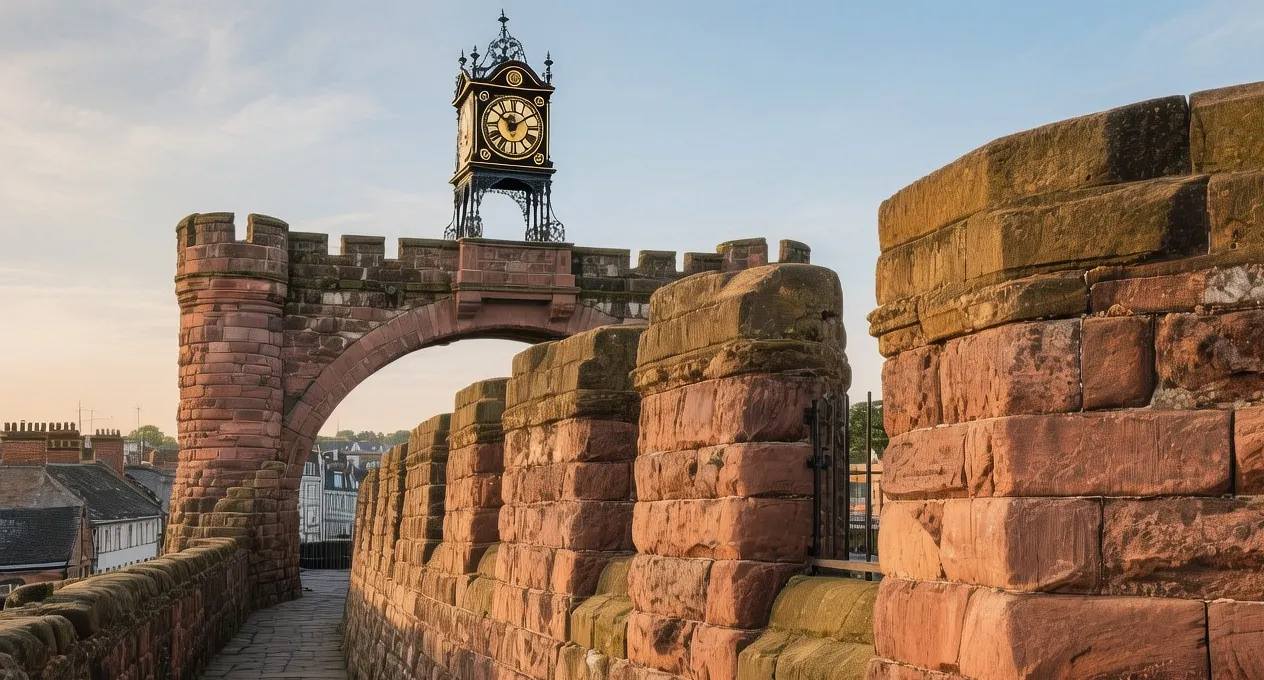
Chester Roman Walls Ancient Stone Meets Modern City
Red sandstone glows warmly as dusk settles over the city—casting long shadows across the 3.2-kilometer (2-mile) circuit that has defended this settlement for nearly 2,000 years. You walk the elevated path of the Chester Roman Walls, the scent of old mortar and city traffic mixing in the cool air, while the distant chime of the Cathedral clock echoes from the center below. Constructed originally around 70 AD for the Legio II Adiutrix and rebuilt in stone between 100 and 120 AD, this fortification encloses the original Roman fortress of Deva Victrix, surviving Viking raids and Civil War sieges to remain the most complete defensive circuit in Britain. As you trace the weathered surface of the stone, looking out over the distinctive Black-and-White Rows, you realize this place matters now more than ever: in an era of ephemeral digital structures, the Chester Roman Walls offer a tangible connection to endurance, preserving a physical boundary between past and present that continues to define the city's identity in 2026.
Why Chester Roman Walls Embodies Historical Continuity
The Chester Roman Walls are not merely a tourist attraction; they are a forensic record of military engineering adapted for urban life. Built to solve a critical defensive problem for the Roman Empire's northwestern frontier, the walls originally stood 6 meters (20 feet) high with 22 interval towers and four main gates. The structure utilizes local red sandstone bonded with lime mortar, a technical choice that has allowed the masonry to breathe and survive centuries of weathering. Unlike York or London, where walls are fragmented, Chester's circuit remains 95% intact, fulfilling a modern need for historical context within a bustling commercial hub. The walls solved the need for security; today, they fulfill the need for perspective.
Managed by Chester City Council and Historic England, the site hosts over 2 million visitors annually who walk the same parapets as Roman sentries. The architecture showcases layers of history: Roman foundations topped with Medieval stonework, repaired again after the English Civil War in 1645. When you walk the path, you traverse a space where legions marched and where Victorian tourists first marveled at the view. The Chester Roman Walls represent a continuous thread of occupation, preserved by the very organization that now maintains the sandstone against the corrosive power of industrial pollution and the erosion of time. It stands as a testament to the transition from military fortress to heritage asset, a shift that defines the conservation efforts we uphold today.
The Best Time to Experience Chester Roman Walls
To witness the Chester Roman Walls in optimal atmospheric conditions, plan your visit between May 18 and June 12. During this window, temperatures average 14-19°C (57-66°F), and daylight extends until 9:15 PM, maximizing time for photography and walking. The best light for capturing the red stone occurs between 7:30-9:30 AM when morning mist lifts off the River Dee, and 6:00-8:00 PM for golden hour illumination on the battlements. Visiting early also allows you to explore the North Gate before tour coaches arrive from Manchester, typically between 11:00 AM and 3:00 PM.
Autumn offers a secondary window—specifically September 10 to October 15—when summer crowds dissipate and the foliage in the Grosvenor Park turns russet and gold. Temperatures remain mild at 12-17°C (54-63°F), though daylight hours shorten rapidly. Avoid July 25 to August 25 when school holidays and the Chester Races push visitor numbers above 5,000 daily, creating congestion on the narrow walkways and limited seating in cafes. Winter months (November-February) offer solitude but challenging conditions; some sections close during icy weather, and sunset occurs as early as 4:05 PM in December. For current opening hours and closure notices, verify information at www.visitchester.com or contact the visitor center at +44 (0)1244 402247.
Approximate Budget for a 7-Day Trip (2026)
Exploring the Chester Roman Walls and the wider Cheshire countryside requires moderate budgeting, as the region commands premium prices during peak season. The following budget reflects mid-range travel for one person in 2026, accounting for approximately 4.2% UK inflation (ONS data, January 2026). Prices assume a base in Chester City Centre for optimal access to the walls and transport links.
- Accommodation: £95-£160 per night for a boutique hotel or B&B in City Centre (6 nights = £570-£960). Budget options: £55-£75 for hostels near the Station or camping at Chester Lakes.
- Food: £50-70 per day total • Breakfast: £10-15 (Full English at The Chef's Table) • Lunch: £15-20 (Ploughman's lunch at The Pied Bull) • Dinner: £25-35 (Three-course meal at The Chester Grosvenor or Pizza Express)
- Transportation: • Train London Euston to Chester: £65-110 return (advance booking) • Local bus (Arriva routes 1, 4): £4.50 day pass • Car rental (optional): £65/day plus fuel £1.58/liter • Parking at Q-Park: £20/day (March-October)
- Attractions: • Wall Walk: Free • Chester Cathedral Entry: £10 • Roman Gardens: Free • Dewa Roman Experience: £16.50
- Miscellaneous: • Ordnance Survey Explorer Map 266: £10.99 • Local artisan souvenirs: £30 • Travel insurance: £40-60 for week • Waterproof gear rental: £20
Total estimated cost: £1,450-£1,800 for 7 days (excluding international flights)
5 Essential Chester Roman Walls Experiences
- Walk the Full Circuit at Sunrise: Arrive at the North Gate by 7:00 AM to experience the walls before crowds. The view encompasses the Cathedral and the River Dee. Bring a windbreaker; exposure at this height creates wind chill 5°C below street temperatures. Spend 90 minutes completing the 3.2-kilometer loop. This experience connects you to the daily rhythm of the Roman sentries who patrolled this path.
- Explore the North Gate (Porta Principalis): Located at the highest point of the circuit, this structure houses a museum. Entry is included with city pass. Spend 45 minutes examining the artifacts. The scent of old stone and wood fills the room. Open 10:00 AM-5:00 PM daily. This context enriches your walk, showing the defensive capabilities of the original fortress.
- View the Amphitheatre: Walk to the southern section near the Railway Station. The remains of the largest Roman amphitheatre in Britain are visible. Spend 30 minutes examining the sandstone foundations. The view from the walls offers the best perspective. Open 24 hours daily. This experience demonstrates the leisure activities that complemented the military presence.
- Photograph the Eastgate Clock: Dedicate 30 minutes to capturing this Victorian addition built on the Roman gate. The ironwork is intricate and painted red. Best visited at noon when the clock chimes. The sound echoes off the stone walls. This experience connects the Roman heritage to the Victorian embellishment that defines the city today.
- Hike to Phoenix Tower: Walk the northern section to this 17th-century tower. The view over the racecourse is panoramic. Spend 20 minutes resting on the benches. The scent of grass and horses fills the air. Best visited during race week for atmosphere. This experience offers a vantage point used by King Charles I during the Civil War.
3 Hidden Gems Most Travelers Miss
- The Watergate: While crowds cluster at the Eastgate, this western gate leading to the River Dee remains surprisingly quiet. Access via the path from the Castle (parking at SJ405665). The archway dates to the 13th century. Visit between 2:00-4:00 PM when light hits the stone. No facilities exist—bring water. The City Council notes this area has high historical interest due to river trade connections.
- Bridgegate Chambers: Located 500 meters south, grid reference SJ410660, lies a medieval gatehouse with Roman foundations. Access via the footpath from the Bridge Street. The stone walls date to the 1350s. Visit during weekday mornings when the site is empty. No facilities exist—bring snacks. This spot demonstrates the evolution of the city's defenses, offering a raw view of the layers before tourism took hold.
- The Roman Gardens: Contact the visitor center (+44 (0)1244 402247) for access updates to this open-air museum. The site features reconstructed hypocausts and stone carvings. Access is restricted to footpath only; no vehicles. The space offers a tangible connection to the domestic side of the fortress. This site reveals the artistic output of the legionaries, showing how utility met beauty in the 1st century.
Cultural & Practical Tips
- Respect the structure: Do not climb on the fragile masonry. Follow staff instructions regarding closed sections. Keep voices low near residential areas. The Council reports 5-10 incidents annually due to visitors ignoring safety barriers.
- Understand the terrain: The walkway is uneven and steep in sections. Check www.visitchester.com for weather warnings. Never walk during icy conditions without crampons. If paths are closed, respect the barriers. The rescue team monitors the area closely.
- Leave no trace: Remove all litter, including biodegradable items. The Council collects 10 tonnes of waste annually from the walls. Do not remove stones or artifacts—this violates the Ancient Monuments Act. Photograph specimens in situ instead.
- Learn local terminology: "Deva" (Roman name); "Rows" (covered walkways); "Parapet" (wall top). Using these terms shows respect for local heritage and helps guides assist you better during tours.
- Photography guidelines: Tripods are permitted on the walls but restricted during busy periods. Drone use requires written permission from the Council and Civil Aviation Authority—apply 6 weeks in advance. Respect other visitors; do not block pathways for extended shoots during peak hours (11:00 AM-3:00 PM).
- Weather preparedness: The walls are exposed; wind chill is common even in summer. Pack waterproof layers; Cheshire showers are sudden. Wear sturdy shoes with grippy soles—sandstone becomes slippery when wet. Sun protection is essential; reflection from stone increases UV exposure by 15%.
- Accessibility considerations: The walls involve steps and uneven surfaces; not fully wheelchair accessible. Alternative viewing exists from street level. The Visitor Centre is fully accessible. Request an accessibility map at the ticket office upon arrival.
Conclusion: Travel with Reverence, Not Just Sightseeing
The Chester Roman Walls do not exist merely to be walked—they exist to be understood as a boundary between eras. When you traverse this circuit in 2026, you are not observing a static monument; you are entering a space where legions once stood and where modern life flows below. The engineers who laid the foundations are gone, but their calculations remain embedded in the curve. The sentries who watched the horizon are gone, but their view still commands the landscape. This is not heritage frozen in amber—it is heritage living, breathing, enduring.
So slow down. Sit on the stone benches for ten minutes without your phone. Listen to the wind that once carried the sounds of marching boots and now carries the chatter of shoppers. Buy your lunch from a café whose owners pay rates that support the local community. Donate to the Heritage Fund rather than purchasing plastic souvenirs. Leave only footprints on ancient stone, take only memories of red sandstone and history, carry home only the profound understanding that some things—defense, community, natural beauty—cannot be rushed, cannot be owned, can only be honored. The walls will still stand in 2126 if we choose stewardship over exploitation today.