
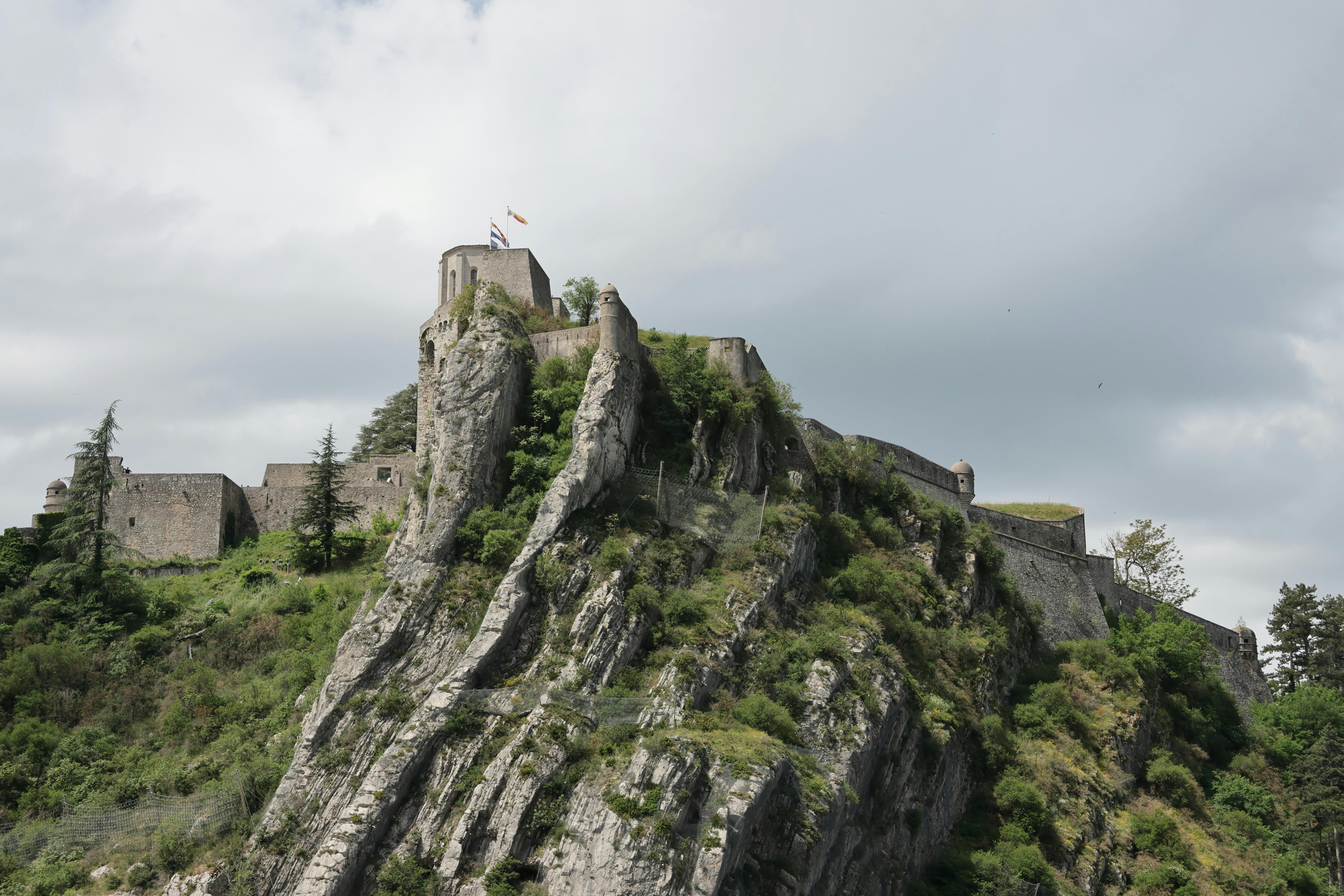
Citadelle de Sisteron : Stone, Strategy, and Southern Light Converge
Before the mistral wind scours the valley clean, Sisteron Citadel emerges from dawn haze like a ship of stone sailing through limestone waves. Perched atop a 200-meter cliff where the Durance River carves a narrow passage between the Alps and Provence, this 12th-century fortress doesn't merely occupy the landscape—it commands it. Sunlight strikes the weathered ramparts not as illumination but as revelation, exposing centuries of strategic genius in every archway and crenellation. The only sounds are the whisper of wind through arrow slits and the distant rush of the river that has flowed beneath these walls since Roman legions first recognized this choke point's military value. This is not a restored theme park but a raw testament to defensive architecture—where every stone bears witness to sieges survived, empires risen and fallen, and the relentless Provençal sun that has baked these walls for eight centuries. In 2026, Sisteron Citadel endures not as museum piece, but as living chronicle of how geography shapes destiny.
Why Sisteron Citadel Represents Strategic Architecture Perfected
Sisteron Citadel embodies more than military history—it represents Europe's most sophisticated adaptation of natural topography for defense. Built between the 12th and 17th centuries atop the Rocher de la Baume—a sheer limestone monolith bisected by the Durance River—the citadel exploits geology as its primary fortification. Unlike flatland castles requiring massive walls, Sisteron's defenders needed only to fortify the narrow 30-meter saddle connecting cliff to town, creating an impregnable gateway controlling the only viable north-south route between the Alps and Mediterranean before modern engineering. Vauban himself, Louis XIV's master military architect, declared it "the key to Provence" after reinforcing its bastions in 1692. Today, the citadel's power lies in preserved authenticity: no reconstructed turrets or staged demonstrations, just weathered stone bearing visible scars from the 1562 Huguenot siege and 1944 Allied liberation. As France's most visited free monument outside Paris (per 2025 Ministry of Culture statistics), it succeeds not through spectacle, but by allowing visitors to trace strategic thinking in stone—where every embrasure aligns with river approaches, every cistern collected rainwater for sieges, and every vantage point reveals why this spot decided regional fate for centuries.
The Best Time to Experience Sisteron Citadel
For optimal conditions—dramatic light on limestone, comfortable exploration temperatures, and authentic atmosphere—visit between May 10 and June 5 or September 15–30. These windows deliver daytime temperatures of 19–26°C (66–79°F), creating ideal conditions for ascending the 300-step Grand Escalier without summer's oppressive heat. Morning visits between 8:00–10:00 AM offer the most dramatic illumination: low-angle light accentuates the citadel's stratified limestone layers while casting long shadows that reveal defensive architecture details invisible at noon. This window also provides near-solitude before tour groups arrive—a critical advantage for experiencing the fortress's contemplative power. September offers a second excellent opportunity: warm days, departing crowds, and autumn light that gilds the Durance Valley while mistral winds clear atmospheric haze for panoramic views stretching to Mont Ventoux. Avoid July 15–August 20 when temperatures exceed 34°C (93°F), making stone surfaces dangerously hot to touch and interior passages uncomfortably warm. Note that the citadel closes entirely during heavy mistral events (winds exceeding 100 km/h) and for one week in early November for essential conservation work.
Approximate Budget for a 7-Day Trip (2026)
Based on 2025 benchmarks adjusted for 4% inflation (per INSEE and Provence-Alpes-Côte d'Azur Tourism Board projections), here's a realistic mid-range budget for a Haute-Provence itinerary:
- Accommodation: €95–€140 per night for a family-run guesthouse in Sisteron's historic center or a boutique hotel in nearby Aubignosc—essential for experiencing town atmosphere after day-trippers depart.
- Food: €85–€100 per day—breakfast at lodging, lunch of garbure soup and local cheese (€18–€22), dinner featuring Sisteron lamb with Forcalquier wines (€42–€52).
- Transportation: €42 for a 7-day Zou! Pass (covers regional buses). Car rental essential for rural exploration (€46/day). Fuel costs: ~€65/week. Free parking available at Citadel base lot.
- Attractions: Citadel access: free. Audio guide rental: €5. Musée Terre et Temps (local history): €7. Guided military history tour (Saturdays only): €12. Allocate €75 total.
- Miscellaneous: €50 for Sisteron lavender honey, artisanal olive oil from Domaine de la Citadelle, or handmade santons from Place de l'Hôtel de Ville market.
Total Estimated Cost: €1,050–€1,500 for seven days, excluding international flights.
5 Essential Sisteron Citadel Experiences
- Grand Escalier Ascent: The 300-step staircase carved directly into limestone—climb slowly at 8:30 AM to witness morning light transforming the Durance Valley from silver to gold while avoiding midday heat.
- Vauban Ramparts Walk: Trace the 17th-century bastions along the cliff edge for panoramic views where Alps meet Provence—best experienced between 9:00–10:30 AM when shadows accentuate defensive geometry.
- Chapelle Saint-Marcel: The citadel's 12th-century chapel with exposed stone walls and minimal restoration—sit quietly to absorb centuries of whispered prayers from soldiers who sought solace before battle.
- Siege Tunnels: Explore the network of subterranean passages where defenders stored supplies during sieges—accessible via unmarked entrance near the western bastion (ask custodian for torch).
- Sunset from Tour de l'Horloge: The clock tower offers the only 360-degree vista encompassing river, town, and surrounding peaks—arrive 45 minutes before sunset for optimal light without crowds.
3 Hidden Gems Most Travelers Miss
- Rocher de la Baume Secret Path: Behind the main entrance, a discreet trail (marked by faded blue dot on rock face) ascends 50 meters above the citadel to a natural platform offering the only perspective where the entire fortress appears to float above the valley—locals call it "le nid d'aigle" (eagle's nest).
- Fontaine des Pénitents: A hidden 16th-century spring located 200m downhill from the citadel's eastern wall (follow path behind No. 7 Rue des Pénitents)—where soldiers drew water during sieges, still flowing with cool water today.
- Atelier du Tailleur de Pierre: A working stone-carving workshop in the lower town (12 Rue de la République) where artisans use medieval techniques to repair citadel stonework—open Tuesday mornings for respectful visitors.
Cultural & Practical Tips
- Footwear is Non-Negotiable: The Grand Escalier's limestone steps are uneven and polished smooth by centuries of use. Wear grippy-soled hiking shoes—sandals cause dangerous slips, especially after morning dew.
- Respect Military Sanctity: Never climb on unprotected ramparts or enter restricted tunnels marked with red signs—several sections remain unstable despite conservation efforts.
- Learn Key Phrases: "Bonjour," "Merci," and "Où est le chemin secret?" (Where is the secret path?) show respect—local historians often share hidden perspectives with curious visitors.
- Photography Protocol: Tripods prohibited on narrow passages. Best architectural shots captured between 8:30–9:30 AM when eastern light illuminates defensive details without harsh shadows.
- Support Authentic Preservation: Purchase souvenirs only from certified artisans in Place de l'Hôtel de Ville—revenue funds the Association des Amis de la Citadelle's conservation work.
Conclusion: Travel with Strategic Reverence, Not Just a Camera
Sisteron Citadel endures not as attraction to be consumed, but as lesson in how humans collaborate with landscape for survival. As a conscious traveler, your presence should honor this legacy: ascend the Grand Escalier slowly to appreciate the engineering that made this fortress impregnable, support local stonemasons preserving ancestral techniques, and understand that your footsteps tread ground where history turned on geographic necessity. Sit quietly on the western ramparts at dusk and watch light fade across the Durance Valley—the same light that illuminated Roman scouts, medieval knights, and Resistance fighters who used these walls for liberation. By approaching Sisteron not as backdrop for achievement, but as teacher of strategic humility, you help ensure these stones continue to shelter not just memory, but meaning—for those who recognize that true strength lies not in dominating terrain, but in understanding its gifts.