
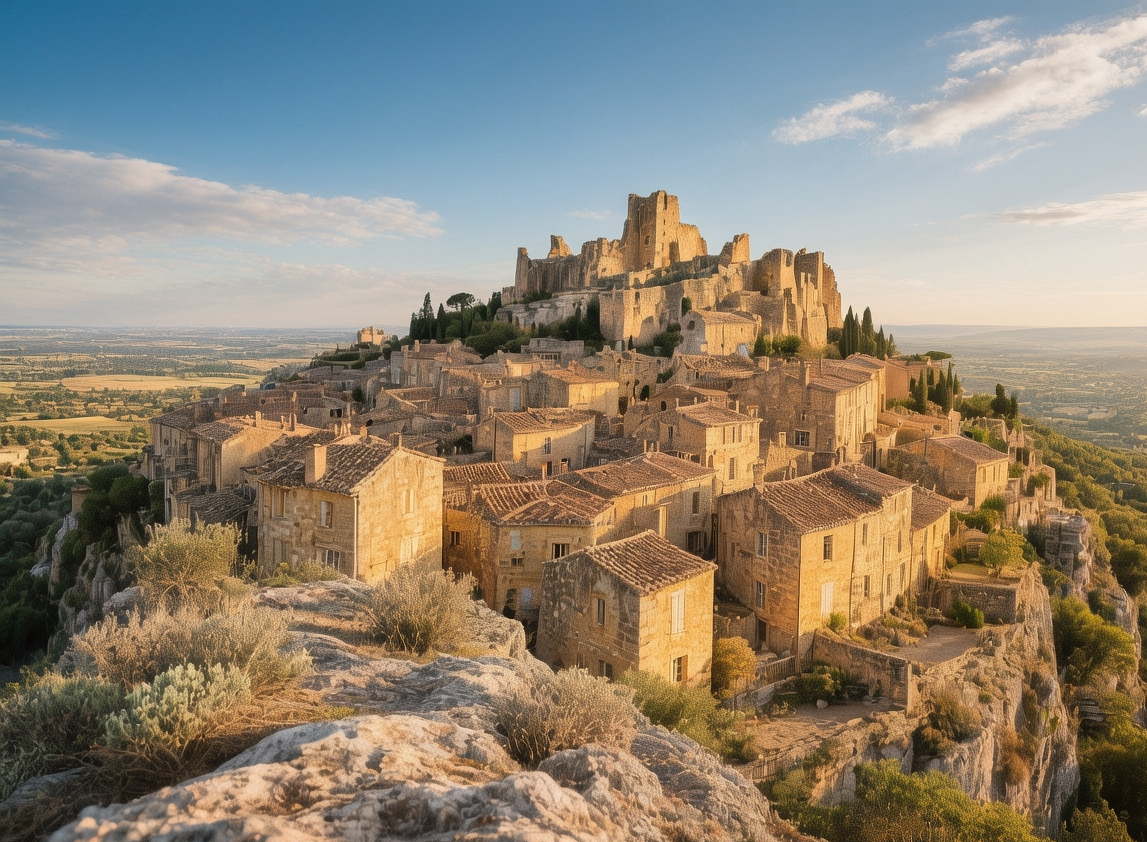
Les Baux-de-Provence : Stone, Light, and Silence Converge
Before the first tourists arrive, when mist still pools in the Val d'Enfer below, Les Baux-de-Provence reveals its true character. Sunlight strikes the village's limestone walls not as glare but as gradual revelation—illuminating 12th-century ramparts, the skeletal arches of Saint-Vincent Church, and cobblestones worn smooth by eight centuries of footsteps. The only sounds are the whisper of mistral wind through cypress trees and the distant clang of a goat bell from terraced slopes where olive trees twist from rock like ancient sculptures. This is not a preserved museum piece but a living testament to Provençal resilience—a village that thrived as a medieval fortress, declined into near-abandonment, and reemerged not as theme park but as sanctuary. In 2026, Les Baux endures not for its postcard perfection, but for its uncompromising authenticity: where every stone bears witness to time's patient hand.
Why Les Baux-de-Provence Transcends Typical Hilltop Villages
Les Baux-de-Provence represents more than scenic charm—it embodies Provence's layered history carved directly into geology. Perched on a 245-meter limestone spur in the Alpilles range, this village evolved from Bronze Age settlement to powerful feudal stronghold controlling Rhône Valley trade routes. Its strategic importance peaked in the 12th century when the Lords of Baux claimed descent from the Biblical Magi—a legend reflected in the village's name (Baux derives from bauxite, but locals insist it stems from Bethlehem). Unlike sanitized heritage sites, Les Baux retains raw authenticity: castle ruins stand exposed to elements rather than reconstructed, olive mills still press fruit using 19th-century presses, and the village population remains under 400 year-round residents who maintain ancestral ties to the land. This continuity creates rare depth—where walking the ramparts means tracing paths worn by troubadours, crusaders, and Resistance fighters who used these same cliffs as hideouts during WWII. As a designated Plus Beau Village de France, Les Baux succeeds not through curation, but by honoring the weathered beauty of survival.
The Best Time to Experience Les Baux-de-Provence
For optimal conditions—golden light on limestone, manageable crowds, and authentic village rhythm—visit between April 25 and May 20 or September 10–28. These windows deliver daytime temperatures of 18–25°C (64–77°F), wildflowers blooming on ramparts, and the intense summer heat not yet arrived. Arrive by 8:00 AM to experience the village in near-solitude before tour buses arrive—a critical window when morning light streams through ruined arches, casting long shadows that accentuate stonework textures without harsh glare. September offers a second excellent opportunity: warm days, departing crowds, and autumn light that gilds the Alpilles foothills while olive harvest begins. Avoid July 15–August 20 when temperatures exceed 32°C (90°F), narrow streets become uncomfortably congested, and many local artisans close shops for vacation. Note that winter months (November–February) offer stark beauty and complete solitude, though some restaurants reduce hours and mistral winds can exceed 100 km/h.
Approximate Budget for a 7-Day Trip (2026)
Based on 2025 benchmarks adjusted for 4% inflation (per INSEE and Provence-Alpes-Côte d'Azur Tourism Board projections), here's a realistic mid-range budget for a Provence-focused itinerary:
- Accommodation: €105–€155 per night for a family-run chambre d'hôtes in Les Baux or nearby Maussane-les-Alpilles—essential for experiencing village atmosphere after day-trippers depart.
- Food: €90–€105 per day—breakfast at lodging, lunch of salade aux chèvres chauds at village café (€20–€25), dinner featuring locally pressed olive oil and wines (€45–€55).
- Transportation: €45 for a 7-day regional bus pass. Car rental essential for rural exploration (€48/day). Fuel costs: ~€70/week. Parking in Les Baux: €5/day at designated lots outside walls.
- Attractions: Village access: free. Château des Baux ruins: €12. Carrieres de Lumieres immersive exhibition: €15. Olive oil tasting at Moulin Castelas: €8. Allocate €90 total.
- Miscellaneous: €55 for estate-bottled olive oil, Alpilles honey, or handmade santons from village artisans.
Total Estimated Cost: €1,150–€1,650 for seven days, excluding international flights.
5 Essential Les Baux-de-Provence Experiences
- Château des Baux Ramparts: Walk the 12th-century fortress walls at dawn for panoramic views across Provence to the Mediterranean—best experienced before 9:00 AM when light illuminates the Val d'Enfer's dramatic rock formations.
- Saint-Vincent Church: The village's 12th-century Romanesque church with exposed stone walls and minimal restoration—sit quietly in a wooden pew to absorb centuries of whispered prayers.
- Carrieres de Lumieres: The former bauxite quarries transformed into immersive art spaces—current 2026 exhibition features Van Gogh's Provençal works projected across 7,000m² of rock face (visit weekday afternoons for fewer crowds).
- Place des Aires: The village's main square where plane trees shade café tables—observe daily life as elderly residents play pétanque and shopkeepers arrange displays of lavender and olive wood.
- Val d'Enfer Viewpoint: The "Valley of Hell" below the village—a dramatic limestone landscape that inspired Dante's Inferno—best viewed from Chemin de la Croix at sunset when shadows deepen the rock formations' drama.
3 Hidden Gems Most Travelers Miss
- Rue Porte Magne Secret Passage: Behind the main street, an unmarked archway (between No. 14–16) leads to a hidden courtyard with a 14th-century cistern and views into private gardens—locals call it "le jardin des souvenirs."
- Moulin Castelas Olive Mill: A 16th-century working mill 2km outside village walls—book morning tours (9:00 AM) via moulin-castelas.com to witness traditional stone pressing and taste oils paired with local bread.
- Chemin des Bergers Trail: A 3km footpath starting behind the cemetery (follow faded yellow markers) leading to secluded viewpoints over the Alpilles—favored by shepherds and rarely walked by tourists.
Cultural & Practical Tips
- Respect Residential Spaces: Over 60% of buildings remain private homes. Never photograph interiors through windows or block narrow passages—many streets are less than one meter wide.
- Parking Strategy: Park at the official lot outside walls (€5/day) and walk the 10-minute uphill path—driving into the village is prohibited except for residents and deliveries before 10:00 AM.
- Learn Key Phrases: "Bonjour," "Merci," and "Une huile d'olive de Les Baux, s'il vous plaît" show respect in this proudly Provençal community where French is preferred over English.
- Photography Ethics: Never use tripods on narrow streets—they obstruct passage. Best architectural shots captured between 8:00–9:30 AM when light streams through eastern archways without crowds.
- Support Authentic Artisans: Purchase olive oil directly from domaines like Castelas or La Tour du Roy rather than souvenir shops—look for AOC Vallée des Baux-de-Provence certification.
Conclusion: Travel with Reverence for Stone and Silence
Les Baux-de-Provence endures not as attraction to be consumed, but as testament to human resilience etched into limestone. As a conscious traveler, your presence should honor this legacy: walk slowly on cobblestones worn by centuries of footsteps, support the dozen remaining families who maintain ancestral homes, and understand that your visit occurs within a living community—not a stage set. Sit quietly on a rampart bench at dusk and watch light fade across the Alpilles—the same light that illuminated troubadours and shepherds for generations. By approaching Les Baux not as backdrop for social media, but as sanctuary demanding quiet contemplation, you help ensure these stones continue to shelter not just history, but humanity—for those who recognize that true beauty lies not in perfection, but in the dignified weathering of time.