
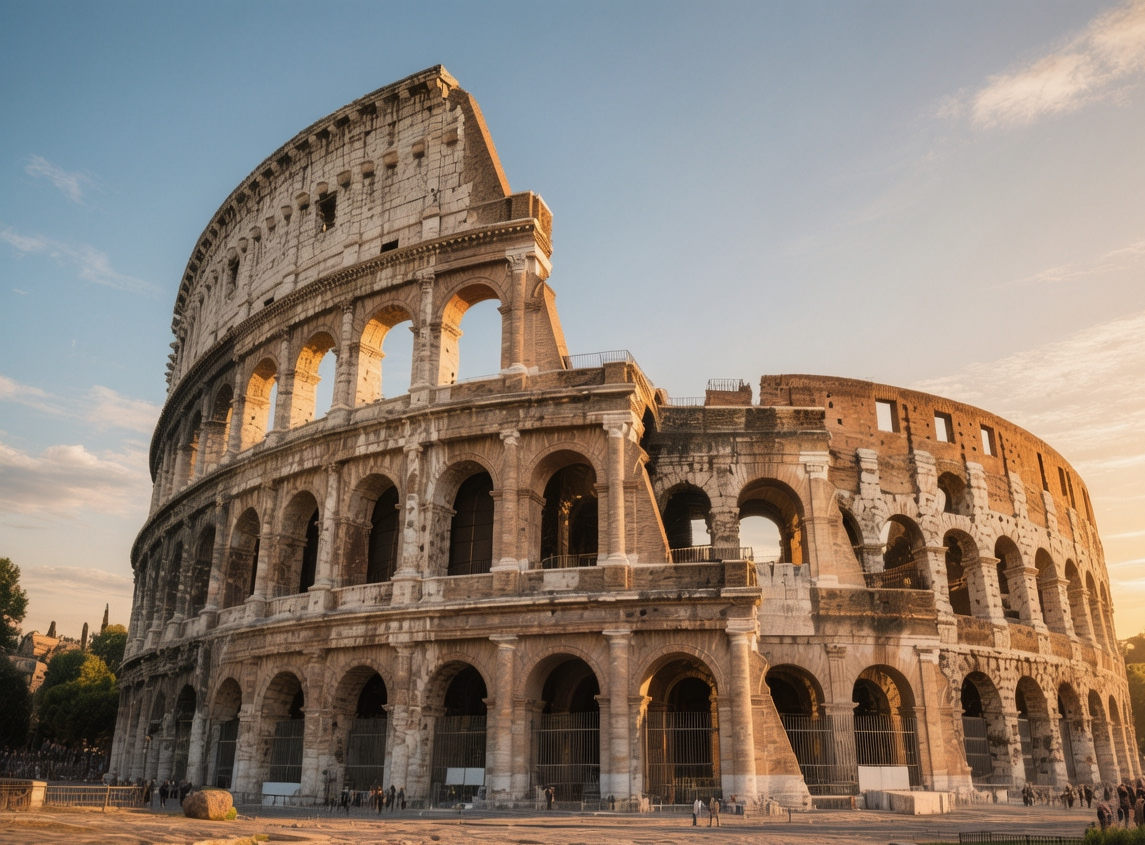
Colosseum Imperial Grandeur Meets Eternal Echoes
The late afternoon sun bathes the Colosseum’s weathered travertine façade in a warm, honeyed light, casting long shadows through its 80 towering arches. You stand in the Piazza del Colosseo, the air thick with the scent of espresso from nearby cafes and the low hum of the modern city. Yet, beneath your feet, the ground seems to vibrate with the ghostly roar of 50,000 spectators—a visceral echo from nearly 2,000 years ago. Completed in 80 AD under Emperor Titus, this colossal amphitheater was the epicenter of Roman entertainment, hosting gladiatorial contests, wild beast hunts, and even mock naval battles that flooded its arena floor [[1]]. Standing 48 meters (157 feet) tall and spanning 189 meters (620 feet) in length, it was the largest amphitheater ever built, a marvel of concrete and stone engineering that could empty its entire audience in just 15 minutes thanks to its ingenious system of vaults and exits [[2]]. In 2026, as we seek places that connect us to the raw pulse of human history, the Colosseum remains an unparalleled monument to both the grandeur and the brutality of empire.
Why Colosseum Embodies Engineering and Spectacle
The Colosseum is far more than a ruin; it is a testament to Roman engineering genius and their mastery of mass spectacle. Commissioned by Emperor Vespasian in 72 AD as a gift to the Roman people, it was built on the site of Nero’s private lake, a deliberate act of political reparation that transformed a symbol of imperial excess into one of public generosity [[1]]. Its construction was a feat of logistics and innovation. The primary materials were travertine limestone for the load-bearing piers, tuff for the radial walls, and concrete for the vaults—materials that created a structure both immensely strong and remarkably light. The amphitheater’s elliptical design ensured optimal sightlines from every one of its estimated 50,000 to 80,000 seats, which were strictly organized by social class. Perhaps its most astonishing feature was the velarium, a massive canvas awning operated by a team of 1,000 sailors from the Roman navy, which could be unfurled to shade the audience from the sun [[2]]. For the modern visitor, the Colosseum fulfills a profound need: it provides a tangible, walkable connection to the heart of the ancient world, where the scale of human ambition is still palpable in every stone.
The Best Time to Experience Colosseum
To experience the Colosseum with fewer crowds and in the most beautiful light, plan your visit for the specific window of April 15–May 10, 2026. During these spring weeks, the Roman weather is mild and pleasant, and the summer tourist hordes have yet to arrive [[7]]. Daytime temperatures are a comfortable 18°C to 22°C (64°F–72°F)—ideal for exploring the extensive site without the intense heat of summer [[7]]. The absolute best time of day is 8:30–10:00 AM, right when the site opens. This allows you to enter before the large tour groups descend, giving you precious moments of relative quiet to absorb the monument’s immense scale. Avoid visiting during the peak summer months of July and August, when temperatures can soar above 35°C (95°F) and the site becomes overwhelmingly crowded [[7]]. For the most current information on opening hours, special night openings, and the mandatory online reservation system, always consult the official Parco Colosseo website: parcocolosseo.it/en [[1]].
Approximate Budget for a 7-Day Trip (2026)
This budget is calculated for a comfortable, mid-range cultural trip to Rome in 2026, factoring in a 4% annual inflation rate as per ISTAT (Italy’s national statistics institute).
- Accommodation: €120–€180 per night for a room in a 3-star hotel or a well-reviewed guesthouse in the Monti or Celio districts, within easy walking distance of the Colosseum.
- Food: €55 per day. Breakfast (€8): a cappuccino and cornetto at a local bar. Lunch (€20): a Roman pasta dish like cacio e pepe or carbonara at a trattoria near the Forum. Dinner (€27): a three-course meal featuring classics like saltimbocca alla romana or grilled fish.
- Transportation: A 7-day Roma Pass costs €53 and includes unlimited public transport and free entry to the first two visited sites (including the Colosseum). The pass also covers the metro ride from Fiumicino Airport to the city center.
- Attractions: Entry to the Colosseum, Roman Forum, and Palatine Hill is €18 for adults, plus a mandatory €2 online booking fee [[1]]. A guided tour of the arena floor or underground areas is a worthwhile splurge at €25 extra.
- Miscellaneous: Allow €70 for souvenirs (e.g., a book on Roman history, a replica gladiator helmet) and small experiences like a gelato from Giolitti (€4) or a coffee at a historic café.
Total Estimated Cost: €1,100–€1,400 for one person for 7 days.
6 Essential Colosseum Experiences
- Walk the Arena Floor: Book a special-access ticket to step onto the reconstructed wooden arena floor. From this vantage point, you can look up at the tiers of seats and truly imagine the roar of the crowd and the drama that unfolded below.
- Explore the Underground Hypogeum: Descend into the labyrinthine network of tunnels and chambers beneath the arena where gladiators and animals awaited their fate. This is where the true machinery of the spectacles was hidden, and it’s a haunting, powerful experience.
- View it from the Oppian Hill Park: For a stunning, crowd-free panoramic view, walk to the Parco del Colle Oppio. From here, you can see the Colosseum in its entirety, framed by cypress trees and with the modern city as a backdrop—a perfect photo opportunity.
- Attend a Night Opening: During the summer months, the Colosseum offers special evening tours. Walking through the silent, floodlit arches at night is a uniquely atmospheric and almost spiritual experience.
- Visit the On-Site Museum: Located on the second tier, this small but excellent museum displays artifacts found on-site, including models of the original structure, statues of gladiators, and inscriptions that bring the history to life.
- Combine it with the Roman Forum: Your ticket includes entry to the adjacent Roman Forum and Palatine Hill. Allow a full day to explore this vast archaeological park, which was the political and religious heart of ancient Rome.
3 Hidden Gems Most Travelers Miss
- The Church of San Pietro in Carcere: Just across the street from the Colosseum, this small church is built over what tradition holds was the prison of Saints Peter and Paul. Its quiet interior and ancient stone walls offer a poignant spiritual counterpoint to the pagan spectacle next door.
- The Ludus Magnus (Gladiator School): A short walk from the Colosseum, the ruins of the largest gladiator training school are often overlooked. You can see the foundations of the practice arena and the cells where the fighters lived. It’s free to enter and rarely crowded.
- The View from the Keyhole of the Knights of Malta: While not in the immediate vicinity, this famous keyhole on the Aventine Hill offers a perfectly framed view of St. Peter’s Basilica. It’s a magical, lesser-known spot that provides a different perspective on the city’s layered history.
Cultural & Practical Tips
- Book tickets online in advance: Walk-up tickets are no longer available. You must reserve a specific entry time on the official Parco Colosseo website to avoid long lines and disappointment.
- Dress respectfully and comfortably: Wear sturdy walking shoes—the site involves a lot of uneven stone surfaces. Also, cover your shoulders and knees if you plan to visit any churches afterward.
- Learn a few key phrases: A polite “Buongiorno” (bwon-jor-noh) and “Grazie” (graht-see-eh) will go a long way with local vendors and staff.
- Beware of unofficial “guides”: Many individuals outside the Colosseum will offer tours or “skip-the-line” access. Only book through official channels to avoid scams.
- Carry water and sun protection: There is little shade inside the Colosseum. A hat, sunscreen, and a bottle of water are essential, especially from April through October.
Conclusion: Travel with Reverence, Not Just Itineraries
In 2026, the Colosseum stands as more than an ancient ruin; it is a mirror held up to humanity itself. It reflects our capacity for both breathtaking creativity and profound cruelty, for building wonders that endure for millennia while the societies that created them fade into dust. To visit here is not just to check off a bucket-list item, but to engage in a dialogue with the past. By traveling with reverence—with a willingness to listen to the echoes in the stones and to reflect on the complex legacy they represent—you honor the millions of lives, seen and unseen, that are part of this story. Your mindful presence supports the ongoing, vital work of preservation that ensures this eternal symbol will continue to teach and inspire for generations to come. So, slow down. Look beyond the postcard view. Let the Colosseum speak to you.