
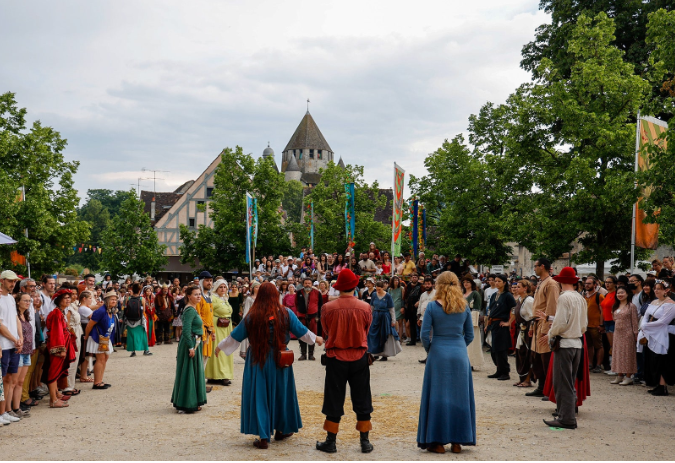
Provins Medieval Fairs Living History Meets Champagne Hills
The air thrums with the sound of lutes, the clang of a blacksmith’s hammer, and the excited chatter of merchants haggling in a dozen tongues. You step through the Porte Saint-Jean into a world suspended in time—Provins, a UNESCO World Heritage site, is hosting its legendary medieval fair. The cobbled streets are lined with over 150 stalls draped in rich fabrics, selling everything from hand-forged daggers to honey mead. The scent of roasting chestnuts and woodsmoke mingles with the earthy smell of damp stone from the 12th-century ramparts that encircle the town. This is no reenactment; it is a full sensory immersion into the 13th century, when Provins was one of Europe’s most important trade hubs, hosting two major annual fairs that drew merchants from as far as the Middle East [[1]]. In 2026, as we crave authentic, participatory experiences, the Provins medieval fairs offer a rare chance to not just see history, but to live it.
Why Provins Medieval Fairs Embodies Authentic Reenactment
The medieval fairs of Provins are not a modern invention but a revival of a deeply historical tradition. From the 12th to the 14th centuries, Provins was a powerhouse of the Champagne region, its strategic location making it a crossroads for European trade routes. The town hosted two major fairs each year—the “Fair of the Cold Weather” (November–January) and the “Fair of the Hot Weather” (June–August)—which were so significant they were protected by royal charter and featured their own courts and currency exchange [[1]]. Today’s fairs, held primarily in June and September, are meticulously researched and executed to be as historically accurate as possible. Over 700 costumed participants—artisans, knights, musicians, and merchants—populate the town for four days, demonstrating crafts like calligraphy, weaving, and falconry using only period-appropriate tools and techniques. The fair solves a modern problem: it transforms passive tourism into active engagement, allowing visitors to touch, taste, and participate in history. The setting itself is unparalleled; the entire upper town of Provins is a preserved medieval fortress, with its 1,200-meter-long ramparts, the 35-meter-high Caesar Tower, and labyrinthine streets providing an authentic backdrop that no theme park can replicate.
The Best Time to Experience Provins Medieval Fairs
To experience the full spectacle of the main medieval fair, you must plan your visit for the official event dates: June 12–15, 2026. This is the larger of the two annual fairs, featuring the most elaborate performances, the greatest number of artisans, and special events like the grand knight’s tournament [[6]]. During this period, daytime temperatures are a pleasant 19°C to 23°C (66°F–73°F)—ideal for spending long days outdoors in the bustling streets [[6]]. The best time of day to arrive is early morning, between 9:00 and 11:00 AM, before the largest crowds arrive from Paris. This allows you to enjoy the opening ceremonies and explore the quieter corners of the fair. Avoid visiting on the final Sunday afternoon, as the fair begins to wind down and many stalls close early. For the most current information on the exact program, ticket prices, and any weather-related changes, always consult the official Provins Tourism website: provins.net/en [[6]].
Approximate Budget for a 7-Day Trip (2026)
This budget is calculated for a comfortable, mid-range cultural trip centered on Provins and the Île-de-France region in 2026, accounting for a 4% annual inflation rate as per INSEE standards. It includes attendance at the June medieval fair.
- Accommodation: €90–€130 per night for a room in a charming 3-star hotel or guesthouse within the medieval walls of Provins. Staying inside the town is essential for the full fair experience.
- Food: €50 per day. Breakfast (€8): coffee and a croissant at a local boulangerie. Lunch (€18): fair food like a bowl of hearty stew or a roasted chicken leg eaten at a wooden trestle table. Dinner (€24): a three-course meal at a traditional French restaurant featuring local Brie de Meaux cheese and regional dishes.
- Transportation: The easiest way to reach Provins is by train from Paris (Gare de l’Est to Provins, a direct 1-hour 15-minute journey). A round-trip ticket costs around €20. Within the compact medieval town, walking is the only option.
- Attractions: A combined ticket for the medieval fair, access to the Caesar Tower, and the underground tunnels (Les Souterrains) costs €22 for adults, €12 for children (5-15) [[6]]. A guided tour of the fair with a historian is a worthwhile splurge at €8 extra.
- Miscellaneous: Allow €60 for souvenirs (e.g., a hand-thrown pottery mug, a leather belt from the fair) and small experiences like a falconry demonstration (€10) or a tasting of local mead (€5).
Total Estimated Cost: €800–€1,000 for one person for 7 days.
6 Essential Provins Medieval Fairs Experiences
- Attend the Grand Knight’s Tournament: Held in the field below the Caesar Tower, this is the fair’s centerpiece. Watch armored knights on horseback joust with lances, their colorful heraldry flashing in the sun. The show is both thrilling and historically detailed.
- Explore the Artisan Market: Spend hours wandering the 150+ stalls. Talk to the blacksmith forging iron nails, the scribe writing your name in Gothic script, and the herbalist explaining medieval remedies. Every stall is a living history lesson.
- Climb the Caesar Tower: For a panoramic view of the entire fair and the surrounding Champagne hills, climb the 137 steps to the top of this 12th-century keep. The perspective is unmatched and gives you a sense of the town’s strategic importance.
- Descend into Les Souterrains: These mysterious underground tunnels, carved from the local limestone, were used for storage and defense. A guided tour reveals their secrets and offers a cool respite from the fair’s bustle.
- Watch a Falconry Demonstration: In the gardens near the Grange aux Dîmes, expert falconers showcase the noble art of hunting with birds of prey, a favorite pastime of medieval nobility.
- Dine Like a Medieval Merchant: Grab a seat at one of the communal tables in the Place du Châtelet and enjoy a simple, hearty meal of stew, bread, and mead, served in wooden bowls—just as it would have been 800 years ago.
3 Hidden Gems Most Travelers Miss
- The Church of Saint-Quiriace: This beautiful 12th-century church, with its unfinished dome, is often overlooked in the rush to the fair. Its quiet interior and stunning Romanesque architecture offer a peaceful counterpoint to the festival’s energy. It’s just a short walk from the main square.
- The View from Mont Griffon: A 15-minute walk outside the town walls, this hill offers a breathtaking panoramic vista of the entire medieval city, with the Caesar Tower as its crown. Go at sunset for a magical, crowd-free photo opportunity.
- The Rose Garden (Jardin des Roses): Located near the Tour César, this tranquil garden features over 300 varieties of roses. It’s a perfect spot to relax after a day at the fair and is especially beautiful in June during the main event.
Cultural & Practical Tips
- Wear comfortable, period-inspired clothing: While not required, wearing simple, natural-fiber clothing (like a linen tunic or a long skirt) will enhance your experience and help you blend in with the atmosphere.
- Bring cash in small denominations: Many of the artisan stalls at the fair prefer cash, and it’s easier for making small purchases like a cup of mead or a hand-carved whistle.
- Learn a few key phrases: A polite “Bonjour, Madame/Monsieur” (bon-zhoor, mah-dam/muh-syuh) will be warmly received by the costumed performers and local vendors.
- Arrive early and stay late: The fair is less crowded in the early morning and the golden hour before closing, offering the best light for photography and a more intimate experience.
- Respect the performers: The costumed participants are dedicated historians. Feel free to ask them questions about their craft, but be respectful of their space and their work.
Conclusion: Travel with Immersion, Not Just Itineraries
In 2026, the medieval fairs of Provins offer a powerful antidote to superficial tourism. This is not a place to be a passive observer, but to become a participant in a grand, living tapestry of history. By engaging with the artisans, tasting the food, and listening to the music, you honor the legacy of a town that once connected the known world through trade and culture. Your mindful presence supports the hundreds of local historians and craftspeople who dedicate themselves to this extraordinary act of preservation. So, leave your modern worries at the gate. Let the rhythm of the lute and the clang of the anvil transport you. In Provins, you don’t just visit the Middle Ages—you live them.