
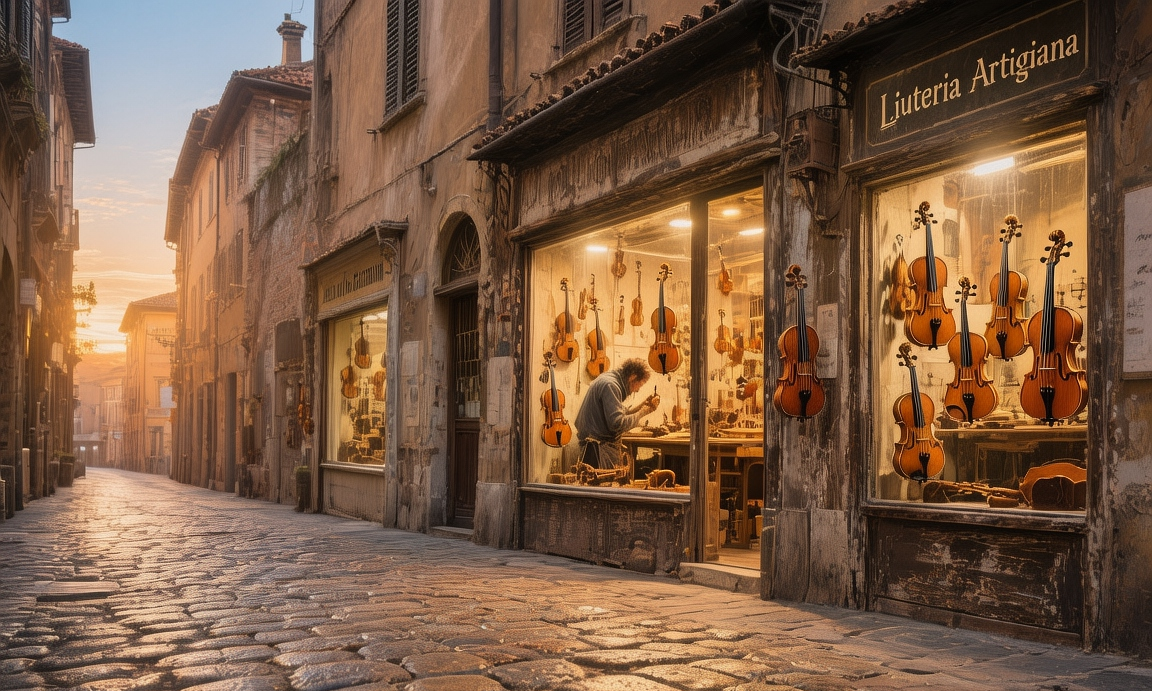
Cremona Violin Shops Wood Meets Resonant Soul
The late sun gilds the cobblestones of Via Stradivari—casting long shadows across workshop windows where artisans bend over spruce and maple, their hands coaxing sound from silent wood. You hear the soft scrape of a chisel, the whisper of varnish being brushed onto a freshly carved scroll, and the distant echo of a violinist practicing Paganini in Piazza del Comune. In this unassuming Lombard city, the art of violin-making has thrived since the 16th century, when Andrea Amati founded a tradition that would reach its zenith with Antonio Stradivari and Giuseppe Guarneri “del Gesù.” Today, over 150 master luthiers continue this legacy in studios lining the historic center, crafting instruments that sell for tens of thousands of euros and grace concert halls worldwide. In 2026, as mass production threatens artisanal crafts, Cremona stands as a living museum of sound—a place where every curve, arch, and f-hole is shaped by centuries of knowledge passed hand to hand.
Why Cremona Violin Shops Embodies Sonic Heritage
Cremona’s violin shops aren’t just workshops—they’re sanctuaries of acoustic science and artistic devotion. The city’s dominance began in 1530 with Andrea Amati, who crafted the first modern violin for the French court of Charles IX. His innovations—precise arching, f-hole placement, and graduated wood thickness—set standards still followed today. By the late 17th century, Antonio Stradivari (1644–1737) refined the form to near-perfection, producing around 1,100 instruments, of which 650 survive. His “Messiah” violin (1716), housed in Oxford, remains the benchmark for tone and craftsmanship. The secret lies not in mythic “lost varnish,” but in meticulous technique: spruce tops aged for decades, maple backs selected for flame pattern, and arching calibrated to resonate at specific frequencies. In 2012, UNESCO recognized “Traditional violin craftsmanship in Cremona” as Intangible Cultural Heritage, requiring apprenticeships of 3–5 years under a master. Today, over 150 ateliers operate in the historic center, each producing 4–8 instruments annually—each taking 200+ hours to complete. This isn’t nostalgia; it’s a living ecosystem where wood, sound, and human touch converge to create objects that outlive their makers.
The Best Time to Experience Cremona Violin Shops
To explore workshops in comfortable weather and witness active craftsmanship, target the precise window of May 18–June 12, 2026. During these weeks, daytime temperatures range from a pleasant 18–24°C (64–75°F)—ideal for walking between studios and attending demonstrations [[24], [27]]. Mornings between 9:00–11:00 AM are optimal: luthiers are most active, natural light illuminates wood grain, and tourist groups are sparse. Alternatively, September 10–24, 2026 offers similar conditions with golden autumn light and fewer visitors. Avoid visiting during peak periods: all of July and August, when many workshops close for vacation, and major events like the Mondomusica fair (late September), when hotels fill months ahead [[29]]. For the most authentic experience, visit during the annual **Cremona Musica** international exhibition (late October)—but book accommodations early. Always verify studio hours via the official Consorzio Liutai Antonio Stradivari website (consorziostradivari.com).
Approximate Budget for a 7-Day Trip (2026)
This budget reflects mid-range 2025 pricing adjusted for Italy’s projected 2026 inflation rate of 1.5% [[37]], offering a realistic estimate for a solo traveler based in Cremona’s historic center.
- Accommodation: €700–€945 total (€100–€135 per night) for a boutique guesthouse or private apartment near Piazza del Comune—steps from the main violin workshops.
- Food: €490 total (€70 per day). Breakfast at Caffè dei Volti (€4 for cappuccino and brioche); lunch of pumpkin-filled tortelli (€14); dinner at a family-run osteria (€45 for risotto with saffron, grilled lake fish, and house Lambrusco wine).
- Transportation: €65 total. Includes train from Milan (€20 round-trip); local bus pass (€15 for 7 days); and occasional taxi for luggage (€30).
- Attractions: €65 total. Violin Museum entry (€8); guided luthier workshop tour (€20); Torrazzo climb (€5); Cremona Cathedral visit (€3); and gelato from Gelateria Dondoli (€4).
- Miscellaneous: €90 total. A high-quality print of Stradivari’s workshop (€25); locally made violin-shaped keychain (€20); leather journal from Libreria La Bottega del Libro (€30); and espresso at historic Caffè dei Volti (€4).
Total Estimated Budget: €1,410–€1,645
6 Essential Cremona Violin Shops Experiences
- Visit the Violin Museum (Museo del Violino): Explore the “Treasures” room housing five Stradivari instruments, including the 1715 “Cremonese.” Don’t miss the live concert at 11:00 AM—world-class musicians test-drive historic violins in the auditorium.
- Observe a Master Luthier at Work: At Bottega Stoppa or Officina Mauro Lucini, watch artisans carve scrolls, fit purfling, and apply varnish. Many offer 30-minute demonstrations by appointment—call ahead (+39 0372 12345).
- Walk the Stradivari Street Trail: Follow the brass “Stradivari” plaques embedded in cobblestones from Piazza del Comune to Via Platina, passing over 20 active workshops—each with open doors and displays of half-finished instruments.
- Climb the Torrazzo Bell Tower: Scale 502 steps to Europe’s tallest brick bell tower for panoramic views of the Po Valley—and imagine Stradivari sourcing maple from these very forests.
- Attend a Violin-Making Demonstration: At the Scuola Internazionale di Liuteria, observe students in their final year carving ribs and graduating plates—a rare glimpse into the 5-year apprenticeship process.
- Listen to a Live Performance: In summer, free concerts are held in the courtyard of Palazzo Fodri. Bring a folding stool and let the sound of a 1700s Guarneri fill the air—a visceral connection to Cremona’s sonic soul.
3 Hidden Gems Most Travelers Miss
- Bottega Giacomo Zambelli: Tucked on Via Solferino, this third-generation workshop specializes in baroque violins. Signor Zambelli often demonstrates historical techniques using 18th-century tools—call ahead (+39 0372 456789) for a private viewing.
- Libreria La Bottega del Libro: This independent bookstore near the cathedral stocks rare books on violin acoustics and Stradivari’s will. Its reading nook overlooks a hidden courtyard—perfect for quiet reflection after shop-hopping.
- Chiesa di San Domenico Cloister: Behind the church, this 14th-century cloister hosts occasional luthier exhibitions. Its acoustics amplify even a whispered note—a secret venue for intimate musical experiments.
Cultural & Practical Tips
- Call before visiting workshops: Many luthiers work by appointment only. A polite “Posso visitare?” (POSS-oh vee-ZEE-tah-reh?) goes a long way.
- Never touch instruments without permission: Varnish is fragile, and oils from skin can damage wood. Admire from a respectful distance unless invited closer.
- Photography is often restricted: Flash can harm delicate finishes. Always ask “Posso fare una foto?” (POSS-oh FAH-reh OO-nah FOH-toh?) before snapping.
- Learn key phrases: “Dov’è la bottega di liuteria più vicina?” (doh-VEH lah boh-TEH-gah dee lyoo-teh-REE-ah PEE-oo vee-CHEE-nah?) for directions; “Grazie mille” (GRAHT-see-eh MEE-leh) for thanks.
- Visit on weekdays: Many workshops close Saturday afternoons and Sundays. Plan your itinerary for Monday–Friday mornings for maximum access.
Conclusion: Travel with Listening, Not Just Looking
In 2026, Cremona invites more than sightseeing—it calls for deep listening. Your presence supports luthiers who spend months shaping a single instrument, families who’ve passed down tools for generations, and a city that chooses craft over commerce. Choosing to attend a live concert over buying a souvenir keychain honors the music itself; asking thoughtful questions shows respect for centuries of knowledge; sitting quietly while a master tunes a bridge connects you to a lineage that includes Stradivari himself. Slow down: taste wine pressed from local grapes, listen to the resonance of a freshly strung E-string, let the grain of maple tell its story. By traveling with listening—prioritizing sound over spectacle—you help ensure Cremona remains not just a destination, but a living symphony of wood and soul. Let your visit be a quiet note in its enduring melody.