
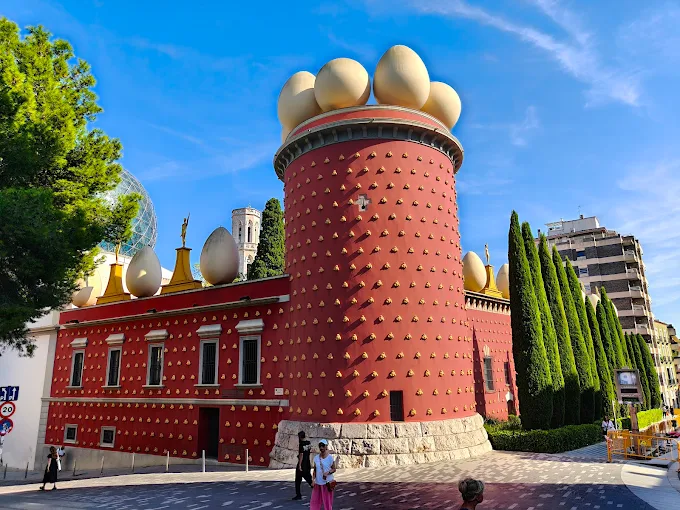
Dalí Museum Figueres Surrealist Dreams Meet Catalan Stone
The geodesic dome glows amber against the twilight sky as the last visitors depart—leaving behind a silence heavy with the weight of 1,500 artworks and the ghost of a genius who refused to conform. You stand before the Dalí Museum Figueres, breathing air scented with old paint and Mediterranean dust, listening to the distant chime of bells from the Church of Sant Pere where Salvador Dalí was baptized in 1904. This is no ordinary gallery; it is the largest surrealist object in the world, built upon the ruins of the Municipal Theatre destroyed in 1939 during the Spanish Civil War. Dalí himself designed every curve, from the egg-topped walls to the Cadillac raining inside a glass box, transforming a scar of war into a monument of imagination. In 2026, as digital reproduction flattens art into pixels, the Dalí Museum Figueres matters because it demands physical presence—forcing you to confront the scale, texture, and madness of surrealism in the very space where the master intended it to be seen.
Why Dalí Museum Figueres Embodies Surrealist Architecture
The Dalí Museum Figueres solves a fundamental curatorial problem: how to display an artist's work without constraining his chaotic vision within traditional white walls. Salvador Dalí conceived this space between 1960 and 1974, transforming the burnt shell of the 1849 Municipal Theatre into a labyrinthine journey through his psyche. The building measures 4,000 square meters across three floors, featuring a central courtyard covered by a transparent geodesic dome rising 15 meters high—a structural engineering feat that floods the interior with natural light while protecting the artworks from UV damage. This design fulfills a need for total immersion; unlike standard museums where art hangs passively, here the architecture itself is part of the exhibit, with walls painted pink and adorned with giant bread sculptures and egg motifs symbolizing hope and love.
Technical details reveal the depth of Dalí's control: the facade incorporates remnants of the original 19th-century theater walls, blending neoclassical columns with surrealist statues by John Deaver. Inside, the Palace of the Wind features a ceiling mural spanning 1,000 square meters, painted directly onto the curved surface without scaffolding. The museum houses 1,500 works spanning Dalí's entire career, from early impressionist pieces to late holographic experiments. Managed by the Gala-Salvador Dalí Foundation, established in 1983, the site employs 45 conservators who maintain humidity levels at 50% ±5% to preserve oil paints and delicate installations. This preservation ensures that the Dalí Museum Figueres remains not just a repository of objects, but a living testament to an artist who understood that context is as crucial as content.
The Best Time to Experience Dalí Museum Figueres
For optimal conditions—when crowds are manageable and the light through the geodesic dome is soft—target May 15–June 25 or September 10–October 15. During these windows, daytime temperatures in Figueres range 18–26°C (64–79°F), while evenings cool to 12–16°C (54–61°F), perfect for walking the cobblestone streets after your visit. For photography and atmosphere, arrive at the museum entrance by 9:30–10:00 AM when doors open; the morning light illuminates the courtyard without the glare of midday sun.
The golden hour before sunset—approximately 8:45–9:45 PM in June, 7:15–8:15 PM in September—casts dramatic shadows across the pink facade, creating ideal conditions for capturing the surreal sculptures against the sky. Visit Tuesday through Thursday to avoid weekend day-trippers from Barcelona and Girona; Saturday afternoons see visitor numbers exceed 1,500 people, creating bottlenecks in the narrow stairwells. Avoid August 1–20 unless you tolerate temperatures exceeding 32°C (90°F) and peak tourist density; similarly, avoid December 24–January 6 when the museum closes for holidays or operates on reduced hours.
Verify current opening hours and ticket availability at the official Foundation website: www.salvador-dali.org or call the ticket office at +34 972 677 500.
Approximate Budget for a 7-Day Trip (2026)
This budget reflects mid-range travel with comfortable accommodations, quality dining, and cultural experiences—based on 2025 pricing adjusted for Spain's projected 3.2% inflation rate for 2026. Figueres is affordable compared to Barcelona, but costs rise during summer festivals. This itinerary includes day trips to nearby Dalí sites.
Accommodation: €80–€160 per night
- 3-star hotel in Figueres center: €80–€110 (Hotel Menhir)
- Boutique hotel near museum: €130–€160 (Hotel Duran)
- Rural apartment (self-catering): €90–€120 (requires 3-night minimum)
Food: €40–€70 per day
- Breakfast: €6–€10 (coffee, pastry, toast at local café)
- Lunch: €15–€25 (menú del día: Catalan sausage, fish, or meat with wine)
- Dinner: €20–€35 (traditional restaurant: steak, wine, dessert)
Transportation:
- Train Barcelona to Figueres (RENFE): €16 one-way, 55 minutes
- Local bus/taxi within Figueres: €10–€20 total for week
- Rental car (7 days, compact): €250–€320 (for coastal day trips)
- Fuel for regional exploration (300 km): €50–€60
Attractions & Experiences:
- Dalí Museum entry: €24 (adult)
- Dalí House Museum (Portlligat): €14 (booking essential)
- Dalí Castle (Púbol): €10
- Empúries Greek/Roman ruins: €8
- Guided tour of Figueres: €15
Miscellaneous:
- Local wine (Empordà DO, bottle): €10–€20
- Souvenirs and art prints: €30–€60
- Travel insurance (7 days): €35–€55
- Emergency fund: €100 (recommended)
Total for 7 days (mid-range): €1,200–€1,600 per person (excluding international flights)
6 Essential Dalí Museum Figueres Experiences
- Enter Through the Geodesic Dome: Your journey begins in the central courtyard under the transparent dome. Look up at 10:00 AM when sunlight filters through the glass structure, illuminating the rain installation below. The acoustics amplify the sound of water droplets, creating a meditative atmosphere. This space serves as the orientation point for all three floors. Allow 15 minutes to acclimate to the surreal environment before proceeding to the exhibits. Photography is permitted without flash.
- Explore the Mae West Room: Located on the main floor, this optical illusion transforms a living room into the face of actress Mae West. Stand at the marked spot on the floor (distance: 5.5 meters from the wall) to see the lips become lips, the eyes become paintings, and the hair become curtains. The perspective only works from this exact point; moving sideways breaks the illusion. This installation demonstrates Dalí's mastery of paranoiac-critical methods. Audio guides explain the symbolism; included in entry fee.
- Witness the Rainy Cadillac: In the courtyard, a 1940 Cadillac sits inside a glass box while rain falls on it continuously. The mechanism pumps 20 liters of water per minute, recirculated to prevent waste. Children love this exhibit; adults appreciate the commentary on decay and preservation. Visit at noon when light reflects off the wet chrome. The sound of rain contrasts with the dry museum interior, creating sensory disorientation typical of Dalí's work.
- Visit Dalí's Tomb: Beneath the stage of the old theater lies the crypt where Salvador Dalí is buried. Access is via a narrow staircase near the Mae West Room. The space is simple, marked only by a stone slab bearing his name. Visitors often leave small tokens or flowers; maintain silence as this is a grave. The temperature here is 2°C cooler than the main halls. This moment offers a somber counterpoint to the whimsy above, grounding the experience in mortality.
- Climb to the Palace of the Wind: The top floor features the Palace of the Wind, where Dalí lived and worked during the museum's construction. The ceiling mural depicts a cloudy sky that blends with the actual windows, confusing interior and exterior. Look for the Wind Palace furniture designed by Dalí himself. The view from the terrace overlooks Figueres and the Pyrenees. Allow 30 minutes; this area is less crowded than the main floors. Best visited late afternoon for soft light.
- Attend a Guided Tour: Book the official foundation tour (€15 extra, 90 minutes) departing at 11:00 AM and 4:00 PM. Guides provide context on hidden symbols, such as the ants representing decay and the crutches symbolizing support. They reveal details missed by independent visitors, like the microscopic paintings in the jewelry collection. Groups are limited to 20 people; reserve online 2 weeks ahead. This experience deepens understanding of the Dalí Museum Figueres beyond visual spectacle.
3 Hidden Gems Most Travelers Miss
- Dalí's Birthplace Museum: Located at Carrer Monturiol 6, just 200 meters from the main museum, this apartment preserves the room where Dalí was born in 1904. Entry €6; open Tuesday–Sunday, 10:00 AM–6:00 PM. The space is intimate, featuring family photos and early sketches. It is overlooked because visitors focus on the larger theater museum, but it provides crucial biographical context. Audio guides describe his relationship with his sister Anna Maria. Allow 45 minutes; combined tickets available at the main desk.
- Church of Sant Pere Baptismal Font: This 16th-century church features the stone font where Dalí was baptized. Located on Plaça de la Iglesia, entry is free during Mass or €2 for visits. The baroque altar contrasts with the surrealist art nearby. It is special because it connects the artist's spiritual origins to his later blasphemous imagery. Visit at 12:00 PM when light hits the stained glass. Respect religious services; photography prohibited during worship. This site anchors Dalí's life in local tradition.
- Empúries Archaeological Site: A 30-minute drive from Figueres, these Greek and Roman ruins inspired Dalí's classical references. Entry €8; open 9:00 AM–8:00 PM (summer). The site spans 15 hectares, featuring mosaics and temples dating to 500 BC. It is overlooked by art tourists, but understanding classical history enriches appreciation of Dalí's mythological themes. Guided tours available in English at 11:00 AM. Bring sun protection; shade is limited. This experience balances modern art with ancient history.
Cultural & Practical Tips
- Booking essential: Tickets for the Dalí Museum Figueres sell out weeks in advance during summer. Purchase online at least 7 days ahead to guarantee entry. Timed entry slots are enforced; latecomers may be denied access. Print tickets or use mobile app; Wi-Fi inside can be spotty. Cancellation policy allows changes up to 48 hours before visit.
- Language etiquette: Catalan is the primary language; Spanish and English are widely spoken. Key phrases: Bon dia (BON DEE-ah = good morning), Entrada (en-TRAH-dah = entrance), Gràcies (GRAH-see-es = thank you). Using Catalan greetings shows respect for local identity. Staff at the museum speak multiple languages; ask for English guides if needed.
- Photography guidelines: Flash photography is strictly prohibited to protect oil paintings. Tripods require written permission from the foundation (email info@salvador-dali.org 14 days ahead). Selfie sticks are banned inside exhibition halls. Respect other visitors; do not block pathways for shots. Best light for exterior photos is morning; interior lighting is designed by Dalí and should not be altered.
- Accessibility considerations: The museum has elevators connecting all three floors. Wheelchair access is available via the main entrance ramp. Restrooms are adapted on every level. Audio guides offer hearing loop compatibility. Service animals are permitted with documentation. Inform staff at ticket counter for assistance; they provide priority access to avoid queues.
- Weather considerations: Figueres can be windy, especially in winter. The geodesic dome amplifies rain noise; bring earplugs if sensitive to sound. Summer temperatures exceed 30°C; the museum is air-conditioned but queues are outside. Wear layers; interior temperature is maintained at 20°C year-round. Check forecasts at meteocat.gencat.cat before traveling.
- Dining schedules: Lunch runs 1:30–3:30 PM; dinner doesn't begin until 8:30 PM. Many restaurants close between 4:00–8:00 PM; plan accordingly. For authentic Empordà cuisine, try suquet de peix (fish stew) or botifarra (sausage). Reservations recommended for weekends. Tipping 5–10% is appreciated for good service. Water is safe to drink from taps.
- Security checks: Bag searches are mandatory upon entry. Large backpacks must be checked in the cloakroom (free). Scanners detect metal; remove belts and keys to speed up process. Prohibited items include food, drinks, and sharp objects. Allow 15 minutes extra for security during peak times. This ensures safety for the invaluable artworks inside.
Conclusion: Travel with Curiosity, Not Just Checklists
The Dalí Museum Figueres does not exist merely for your social media feed—it stands as a deliberate provocation against conventional understanding, built by a man who valued paranoia over logic. What it deserves is your curiosity: the willingness to look beyond the melting clocks and mustaches, to understand the trauma of war that shaped these walls, to recognize that surrealism was not a game but a method of processing reality. In 2026, as AI generates endless images, experiencing Dalí's physical handiwork becomes an act of preserving human imperfection. Walk the courtyard not to snap a photo, but to hear the rain on the Cadillac. Stand before the Mae West illusion not to check a box, but to question your own perception. Let the eggs and crutches teach you that symbols carry weight beyond their appearance. Travel to Figueres not to consume art, but to engage with a mind that refused to be ordinary, ensuring your visit honors the complexity of the genius who built this theater of dreams.