
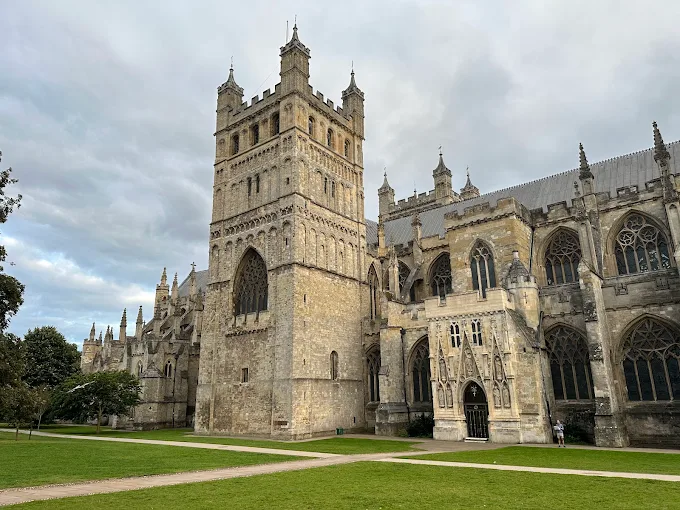
Exeter Cathedral Gothic Stone Meets Devonshire Light
Light filters through the stained glass as the clock strikes noon—its astronomical face turning silently, a mechanical universe surviving since 1484. You stand beneath the vaulted ceiling of the Exeter Cathedral, 96 meters (315 feet) of continuous medieval stone soaring above, while the scent of old wax and polished wood fills the nave. Construction began in 1275 under Bishop Peter Quinel; unlike other English cathedrals modified over centuries, this structure remains the most complete example of Decorated Gothic architecture in the country. Outside, the Cathedral Close stretches toward the River Exe where merchants once traded wool; inside, the longest uninterrupted medieval vaulted ceiling in the world holds the weight of history without a single supporting column. As you trace the cold stone of a pillar carved by hands long turned to dust, you realize Exeter Cathedral matters now more than ever: in a fragmented world, it stands as a testament to unified vision, enduring faith, and the quiet power of preservation against the erosion of time.
Why Exeter Cathedral Embodies Architectural Purity
The Exeter Cathedral is not merely a church; it is a statement of intent carved in Heavitree sandstone and Purbeck marble. While Canterbury and York evolved through multiple stylistic phases, Exeter was conceived as a complete vision—built rapidly between 1275 and 1328 to serve the Diocese of Exeter. This speed ensured stylistic consistency: the ogee arches, the ballflower ornamentation, and the dark marble shafts create a visual rhythm unmatched in English Gothic architecture. The ceiling, constructed without wooden centering, represents a pioneering feat of engineering; it distributes weight across the walls, allowing for the expansive stained glass windows that flood the interior with colored light.
This structure solved a geopolitical need: establishing ecclesiastical authority in a growing region distant from the political unrest of London. Today, it fulfills a cultural need for continuity. The cathedral houses the oldest working astronomical clock in Britain (1484), which displays the phase of the moon and the rotation of the earth—a reminder that the heavens once governed daily life. The Cloisters, built in the 14th century, remain a space for contemplation unchanged since the Middle Ages. When you walk these corridors, you traverse a space where medieval canons walked, where constitutions were written, and where history was archived. The building is not a relic; it is a living machine of worship and memory, maintained by the Cathedral Council and funded by over 350,000 annual visitors who ensure its stones remain sound for future generations.
The Best Time to Experience Exeter Cathedral
To witness Exeter Cathedral in its most ethereal state, plan your visit between May 15 and June 25. During this window, the Cathedral Green is lush green, and temperatures average 15-20°C (59-68°F)—ideal for walking the grounds without summer sweat. The best light for photography occurs between 7:30-9:00 AM when morning mist lifts off the Close, and the east windows glow with sunrise. Evensong services at 5:30 PM offer acoustic perfection when the nave is less crowded, allowing the choir's polyphony to resonate against the stone vaults.
Autumn provides a secondary window—specifically September 10 to October 15—when golden leaves frame the towers and air quality is crisp at 12-17°C (54-63°F). However, avoid July 25 to August 31 when school holidays bring visitor numbers above 2,000 daily, creating queues for the tower climb and clock viewing. Winter months (November-February) offer solitude but limited daylight; sunset occurs as early as 4:05 PM in December, restricting ground exploration. For real-time opening hours and service schedules, verify information at www.exeter-cathedral.org.uk or contact the visitor center at +44 (0)1392 285983.
Approximate Budget for a 7-Day Trip (2026)
Visiting Exeter Cathedral and the surrounding Devon countryside requires moderate budgeting, as rural England can be costlier than urban centers. The following budget reflects mid-range travel for one person in 2026, accounting for approximately 4.2% UK inflation (ONS data, January 2026). Prices assume a base in Exeter city center for optimal access to the Close.
- Accommodation: £90-£150 per night for a boutique hotel within the Cathedral Close (6 nights = £540-£900). Budget options: £55-£75 for B&Bs in St David's.
- Food: £50-70 per day total • Breakfast: £10-15 (Full English at The House That Jack Built) • Lunch: £15-20 (Ploughman's lunch at The Old Firehouse) • Dinner: £25-35 (Three-course meal at The Pig Hotel or Carluccio's)
- Transportation: • Train London Paddington to Exeter St Davids: £60-100 return (advance booking) • Local bus (Stagecoach routes 56, 57): £4.50 day pass • Bicycle rental: £18/day (essential for Quay exploration) • Car rental (optional): £65/day plus fuel £1.55/liter
- Attractions: • Cathedral Entry (Donation suggested): £10 • Tower Tour: £12 • Royal Albert Memorial Museum: Free • Underground Passages Tour: £9.50
- Miscellaneous: • Guidebook and map: £15 • Local artisan ceramics: £30 • Travel insurance: £40-60 for week • Souvenir postcards: £5
Total estimated cost: £1,300-£1,600 for 7 days (excluding international flights)
5 Essential Exeter Cathedral Experiences
- Climb the West Tower: Book the 90-minute Tower Tour (departing 11:00 AM daily). You will ascend 105 steps through narrow medieval staircases, emerging onto the lead roof at 47 meters (154 feet). The view encompasses the Devonshire countryside and the city grid; bring a windbreaker as temperatures drop 5°C at height. You'll see the bell chamber where the Great Peter Bell swings—a engineering marvel hidden from ground view.
- View the Astronomical Clock: Located in the north transept, this 1484 mechanism is one of the oldest in Europe. Visit between 10:00-11:30 AM to avoid school groups. The clock face displays the phase of the moon and the position of the sun relative to the earth. A guide explains the geocentric model—foundational concepts for medieval science still relevant in 2026. The jousting knights appear every 15 minutes.
- Attend Choral Evensong: Held weekdays at 5:30 PM and Sundays at 3:30 PM. Arrive 20 minutes early to secure a stall in the Quire. The acoustic resonance of the 16th-century organ against the vaulted ceiling creates a physical sensation of sound. No ticket is required, but a donation is customary. Silence is strictly enforced during the service.
- Walk the Cathedral Close: This 14th-century precinct is the largest in Britain. Walk slowly to observe the historic canon houses built for the clergy. The north side contains the medieval library; the south side leads to the Green. It is the perfect spot for quiet reflection away from the main nave traffic.
- Explore the Underground Passages: Exit the Close via the south gate and walk toward the High Street. This network of 14th-century tunnels supplied water to the city. Entry is £9.50. Spend 45 minutes examining the brickwork and learning about medieval engineering. Best visited at 2:00 PM when guided tours depart. The sound of traffic above contrasts with the silence below.
3 Hidden Gems Most Travelers Miss
- The Cathedral Library: While the nave is famous, this room above the Cloisters is often overlooked. Access is restricted but available during Heritage Open Days (usually second week of September). The collection features manuscripts dating to the 10th century. It offers a tangible connection to the intellectual history of the diocese. Contact the Archivist at +44 (0)1392 285983 to book.
- St. Martin's Church: Located in the Cathedral Close, this parish church contains elaborate chantry chapels rarely seen outside major cathedrals. Access is free; open 9:00 AM-4:00 PM. The stone carvings depict medieval merchants and guilds. Visit between June 1-20 for peak bloom in the churchyard. It provides a quiet respite from the main tourist flow and shows lay devotion.
- The Bishop's Throne: Tucked in the Quire, this 14th-century wooden structure is the tallest of its kind in England. Access is limited during services but visible from the nave. The carving details are intricate, depicting saints and kings. Visit during weekday mornings when light hits the wood. This site demonstrates the craftsmanship of medieval joinery, showing the skill required to build without modern tools.
Cultural & Practical Tips
- Dress code matters: Shoulders and knees must be covered inside the nave. This is a working church, not just a museum. Remove hats upon entry. Security may deny access if attire is deemed inappropriate for worship spaces.
- Photography guidelines: Handheld photography is permitted in the nave without flash. Tripods require written permission from the Media Office (email: media@exeter-cathedral.org.uk). No photography during services. The Clock cannot be photographed due to preservation light limits.
- Respect silence zones: The Quire and Chapter House are quiet zones. Keep phone volume off. Speak in whispers. The acoustic environment is part of the heritage; loud conversations disrupt worship and other visitors' contemplation.
- Learn local terminology: "The Close" (the cathedral precinct); "Evensong" (evening prayer service); "Verger" (church attendant). Using these terms shows respect for ecclesiastical tradition and helps staff assist you better.
- Weather preparedness: The Close is exposed; wind chill is common even in summer. Pack a waterproof layer; Devon showers are sudden. Wear sturdy shoes for the Tower Tour—stone steps are uneven and worn by 800 years of footsteps.
- Accessibility: The nave is wheelchair accessible via the north door. The Tower Tour is not accessible due to stairs. Loop hearing systems are available for services; request a receiver at the welcome desk upon arrival.
- Support preservation: Entry is technically by donation, but £10 is suggested. Your contribution funds stone conservation. Consider becoming a Friend of Exeter Cathedral (£60/year) for free entry and exclusive event access.
Conclusion: Travel with Reverence, Not Just Sightseeing
The Exeter Cathedral does not exist merely to be photographed—it exists to be experienced as a continuum of human aspiration. When you stand beneath its vaults in 2026, you are not observing a static monument; you are entering a space where prayer, politics, and art have converged for eight centuries. The stonemasons who carved the capitals are gone, but their intent remains embedded in the sandstone. The choristers who sing Evensong carry a tradition unbroken since the 13th century. This is not heritage frozen in amber—it is heritage breathing, ringing, enduring.
So slow down. Sit in a wooden stall for ten minutes without your phone. Listen to the silence between the bells. Buy your lunch from a shop in the Close whose owners pay rates that support the cathedral's upkeep. Donate to the conservation fund rather than purchasing plastic souvenirs. Leave only footprints on the ancient stone, take only the memory of light through lancet windows, carry home only the profound understanding that some things—faith, community, architectural unity—cannot be rushed, cannot be optimized, can only be honored. The spire will still pierce the sky in 2126 if we choose reverence over consumption today.