
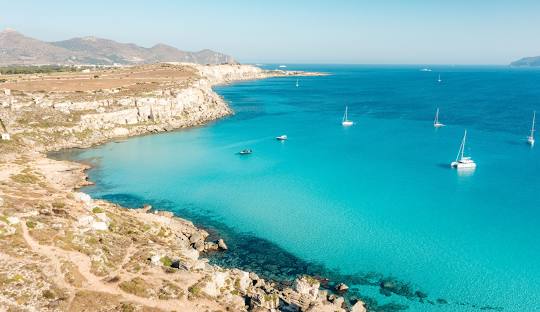
Favignana Island Limestone Coves Meets Tyrrhenian Blue
The morning sun glints off the turquoise waters of the Tyrrhenian Sea as gentle waves lap against the white pebble shore of Cala Azzurra. You hear the soft crunch of your footsteps on the smooth stones, the distant cry of a shearwater gull circling the sheer limestone cliffs, and the low hum of a small fishing boat returning to harbor. This is Favignana, the largest of Sicily’s Egadi Islands, a place where time moves to the rhythm of the tides and the legacy of tuna fishing shapes every street and square. With an area of just 19.8 square kilometers (7.6 square miles), the island is shaped like a butterfly—its wings formed by two hills connected by a flat central plain [[40]]. Once home to a thriving tuna fishery that supplied Europe for centuries, Favignana now offers a sanctuary of unspoiled beauty and slow living. In an age of overtourism and digital noise, Favignana matters now more than ever—it is a place where you can disconnect completely and reconnect with the simple, profound joy of sea, stone, and silence.
Why Favignana Island Embodies Coastal Simplicity
Favignana’s charm lies in its perfect balance of natural drama and human scale—a harmony forged by centuries of tuna fishing and limestone quarrying. The island’s unique topography, with its dramatic cliffs and hidden coves, was shaped by the same geological forces that created its valuable resources. For over 2,000 years, the island’s economy revolved around two industries: the famed mattanza (tuna slaughter) and the extraction of soft limestone from its quarries. The Florio family, who industrialized the tuna fishery in the 19th century, built the imposing Tonno Florio factory in 1859—a red-brick monument to a bygone era that now houses a museum [[40]]. This industry “solved” a critical problem of its time: how to feed a growing European population with a sustainable, protein-rich resource. Today, while the mattanza is largely ceremonial, its legacy lives on in the island’s cuisine, architecture, and spirit. The abandoned quarries have become swimming holes, and the old fishermen’s houses have been lovingly restored into guesthouses. This transition fulfills a modern need—for a destination that is both authentically rooted in its past and peacefully present in its natural beauty.
The Best Time to Experience Favignana Island
To experience Favignana in its most serene and comfortable state, plan your visit for the specific windows of May 10–June 15 or September 10–October 5, 2026. During these periods, the weather is ideal, with daytime temperatures ranging from a pleasant 22–26°C (72–79°F), and the sea has warmed to a swimmable 20–23°C (68–73°F) [[11]]. The best time of day to explore the beaches is in the early morning, between 8:00 AM and 10:30 AM, when the light is soft, the water is calm, and you can often have a cove to yourself before the day-trippers arrive from Trapani. It is essential to avoid the peak summer period of July 20–August 25, when the island’s small ferry terminal becomes congested, accommodation prices double, and the tranquil atmosphere gives way to a more bustling energy [[58]]. For the most current information on ferry schedules, local events, and guided tours,
Approximate Budget for a 7-Day Trip (2026)
This budget is calculated for a solo traveler seeking a comfortable, nature-focused experience on Favignana in 2026, based on current inflation trends and average regional costs.
- Accommodation: €90–€150 per night. Staying in a restored fisherman’s house in the historic center offers an authentic experience. Options near Cala Rossa are more luxurious but require a scooter to reach town.
- Food: €45 per day. Breakfast (€5): a cappuccino and brioche at Bar Centrale. Lunch (€18): a plate of pasta with fresh tuna at a seaside trattoria. Dinner (€22): a main course like grilled swordfish with a glass of local Grillo wine.
- Transportation: €160 total. Round-trip ferry from Trapani to Favignana (€25). A weekly scooter rental for exploring the island (€70). Occasional bike rentals (€15/day).
- Attractions: Entry to the Museo del Tonno (Tuna Museum) (€5). Guided boat tour of the coastline (€30). Visit to the ancient Punic tombs (€3).
- Miscellaneous: €100. This covers a bottle of local olive oil (€15), several gelato stops (€3 each), a snorkeling set rental (€20), and souvenirs like a jar of capers.
Total Estimated Cost: €925–€1,045
6 Essential Favignana Island Experiences
- Swim at Cala Azzurra: Arrive by 8:30 AM to secure a spot on this iconic cove, nestled beneath dramatic limestone cliffs. The water is so clear it feels like liquid glass—perfect for snorkeling among colorful fish and seagrass.
- Explore the Tuna Museum (Museo del Tonno): Housed in the historic Florio factory, this museum tells the story of the island’s most important industry. Don’t miss the exhibit on the mattanza, a ritual that shaped Favignana’s identity for centuries.
- Rent a Scooter to Discover Hidden Coves: A scooter is the best way to explore the island’s 30+ beaches. Head to Cala Rossa, a stunning inlet with red-hued rocks, or the secluded Cala San Nicola, accessible only by a short hike.
- Take a Boat Tour Around the Island: Book a small-group tour to see the island from the water. Glide through sea caves, past the dramatic Scalo Cavallo rock formation, and into coves inaccessible by land.
- Dine on Fresh Tuna in the Harbor: Reserve a table at a family-run restaurant like Ristorante La Lampara. Savor the day’s catch—perhaps tonno alla ghiotta (tuna stew)—as you watch the fishing boats bob in the harbor.
- Hike to Forte Santa Caterina: This 18th-century Spanish fort offers panoramic views over the entire island and the Egadi archipelago. The short hike up is rewarded with a breathtaking vista, especially at sunset.
3 Hidden Gems Most Travelers Miss
- Cala Preveto: A tiny, secluded cove on the island’s northern coast, accessible only by a steep, unmarked path. Its isolation means you’ll likely have the turquoise water all to yourself. Ask a local fisherman for directions at the harbor.
- The Abandoned Quarry of Calcarenite: Near the village of San Giacomo, this old limestone quarry has filled with seawater, creating a surreal, cathedral-like swimming hole. It’s a favorite spot for locals but rarely visited by tourists.
- The View from Monte Santa Caterina: While many visit the fort, few climb the final 100 meters to the very summit. The 360-degree view from the top—from Marettimo to Trapani—is unforgettable and completely free.
Cultural & Practical Tips
- Rent a scooter or bike: Public transport is non-existent. A scooter is the most practical way to explore the island’s diverse beaches and viewpoints.
- Bring water shoes and reef-safe sunscreen: Many beaches are pebbly or rocky. Protect your feet and the fragile marine ecosystem.
- Learn a few key phrases: “Dov’è la cala più bella?” (DOH-veh lah KAH-lah PEE-oo BEL-lah?) for “Where is the most beautiful cove?”, and “Un caffè, per favore” (oon kah-FEH).
- Respect the protected marine area: Much of the Egadi archipelago is a marine reserve. Do not anchor on seagrass, do not remove any natural items, and stick to marked trails.
- Carry cash: Many small restaurants, scooter rentals, and even some B&Bs operate on a cash-only basis.
- Embrace the slow pace: Life on Favignana runs on island time. Don’t rush. Sit at a bar, order a granita, and let the rhythm of the place wash over you.
Conclusion: Travel with Presence, Not Just a Checklist
Favignana is not a destination to be conquered; it is a rhythm to be absorbed. In 2026, as we seek travel that is both restorative and real, this island offers a rare gift: the chance to truly disconnect and immerse yourself in the elemental beauty of sea and stone. Your journey here should be one of mindful presence—not just ticking off beaches, but feeling the salt on your skin, listening to the silence between the waves, and understanding the deep connection between the island and its maritime heritage. By traveling with this deep attention, you honor the spirit of Favignana and help ensure its fragile beauty endures. Slow down. Let the tide set your schedule. In that quiet communion with the Tyrrhenian blue, you don’t just visit Favignana—you become part of its timeless, echoing story.