
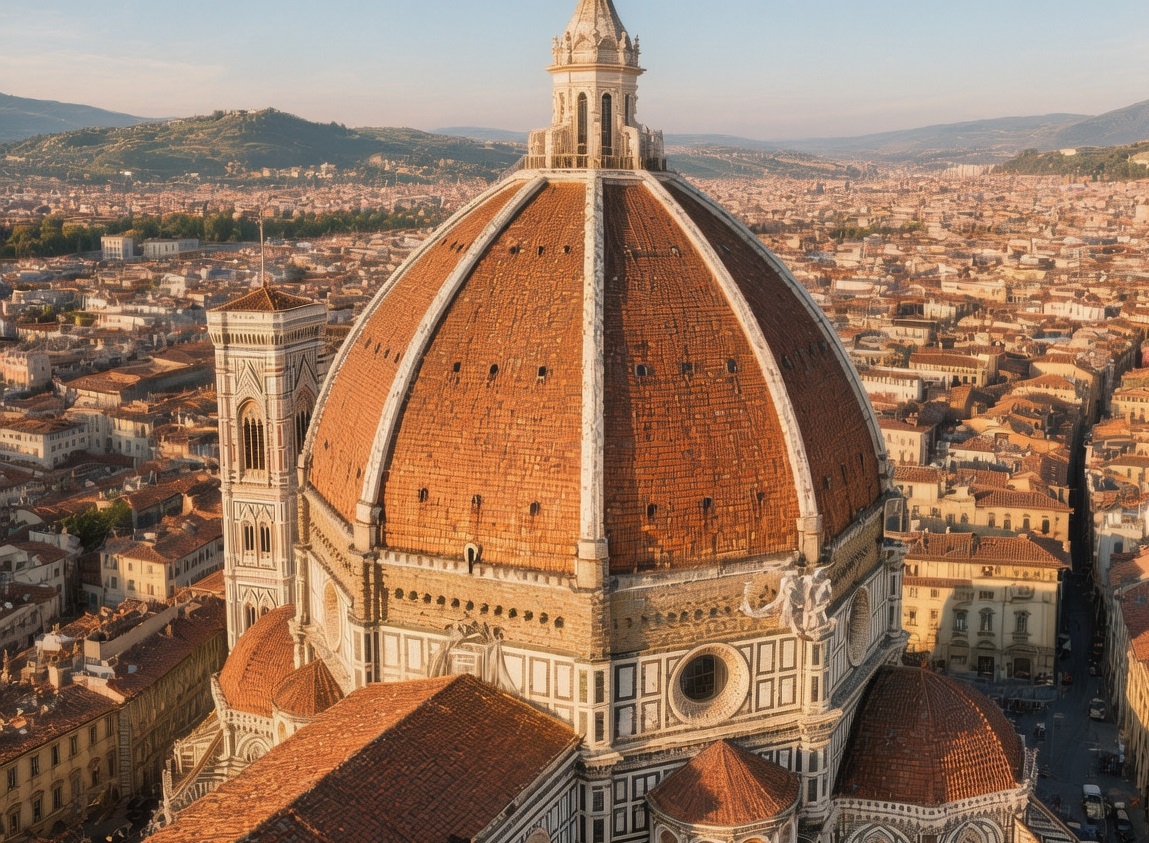
Florence Duomo Renaissance Genius Meets the Tuscan Sky
The city stirs awake in a symphony of clattering shutters and Vespa engines—yet above it all, silent and immense, stands Florence Duomo – Brunelleschi's dome. Its red-tiled cupola, ribbed with eight bands of white Carrara marble, catches the first amber light of dawn, a celestial crown for a city that birthed the Renaissance. You can almost feel the ghost of Filippo Brunelleschi’s frustration as he wrestled with an engineering problem deemed impossible: how to span the cathedral’s 42-meter-wide crossing without scaffolding, a feat no one had achieved since antiquity. Completed in 1436 after sixteen years of relentless innovation, his double-shelled masterpiece of brick and sandstone not only solved that puzzle—it redefined the limits of human ambition. Today, standing in the Piazza del Duomo, you are at the epicenter of a revolution that began nearly six centuries ago, a place where every cobblestone whispers of art, faith, and audacious intellect.
Why Florence Duomo Embodies Human Ingenuity
Florence Duomo – Brunelleschi's dome is more than an architectural triumph; it is the physical manifestation of a city’s soul. In the early 15th century, Florence was a wealthy, competitive republic desperate to outshine its rivals. The cathedral’s gaping hole, left unfinished for over a century, was a civic embarrassment. The challenge was clear: construct a dome larger than the Pantheon’s without using the Roman method of wooden centering, which was prohibitively expensive and logistically unfeasible for such a scale. Brunelleschi’s solution was nothing short of genius—a self-supporting double shell constructed with a herringbone brick pattern that distributed weight inward, allowing the structure to build itself as it rose. Standing 116 meters tall with an inner diameter of 45.5 meters, it remains the largest masonry dome ever built. This wasn't just a roof; it was a declaration that Florence, through reason and creativity, could rival even the ancients. Its very existence fueled the Renaissance, inspiring generations of artists and engineers who saw in its curves the perfect marriage of science and beauty.
The Best Time to Experience Florence Duomo
To witness Florence Duomo – Brunelleschi's dome in its full glory while avoiding the oppressive crowds, target the specific window of October 7–21, 2026. During this period, daytime temperatures are a comfortable 15–22°C (60–72°F), offering crisp air ideal for the climb and soft, golden-hour light that makes the marble facade glow [[21], [23]]. Mornings between 8:00–9:30 AM are particularly magical, as the piazza is still relatively quiet and the low sun casts dramatic shadows across the intricate green, pink, and white marble patterns. This timeframe avoids the intense heat and density of July and August, when queues for the dome can stretch for hours. Crucially, avoid visiting during major holidays like Easter week or the first two weeks of May, which see a significant surge in tourist numbers [[25]]. For the most serene experience, book your timed entry for a Tuesday or Wednesday morning. Always verify current opening hours on the official Opera di Santa Maria del Fiore website before your trip, as maintenance closures do occur—such as the scheduled closure from February 9–13, 2026 [[7]].
Approximate Budget for a 7-Day Trip (2026)
This budget is based on mid-range 2025 pricing adjusted for Italy’s projected 2026 inflation rate of 1.5% [[37]], providing a realistic estimate for a solo traveler staying in the historic center.
- Accommodation: €840–€1,120 total (€140–€185 per night) for a 3-star hotel or private apartment in the San Giovanni or Santa Croce neighborhoods.
- Food: €420 total (€60 per day). Breakfast at a local bar (€3 for a cappuccino and cornetto); lunch at a trattoria (€15 for a primo like pappardelle al cinghiale); dinner at a mid-range restaurant (€35 for a secondo like bistecca alla fiorentina with a side and house wine).
- Transportation: €25 total. Florence is best explored on foot, but this covers a few bus rides (€1.70 per ticket) or a taxi from the Santa Maria Novella station to your hotel.
- Attractions: €95 total. Brunelleschi Pass for full Duomo complex access (€30) [[12]]; Uffizi Gallery (€28); Accademia Gallery to see Michelangelo’s David (€22); Bargello Museum (€15).
- Miscellaneous: €100 total. This includes a gelato from Perché No! (€4), a Chianti wine tasting in a local enoteca (€25), and a hand-tooled leather bookmark from the San Lorenzo market (€20).
Total Estimated Budget: €1,480–€1,870
5 Essential Florence Duomo Experiences
- Climb Brunelleschi’s Dome: Ascend the 463 narrow, steep steps inside the double shell. The journey is intimate and physical—you’ll run your hand along the same bricks laid in the 1400s. At the top, the panoramic view of Florence’s terracotta sea, with the Arno snaking through, is a reward that feels earned.
- Explore the Museo dell’Opera del Duomo: This museum houses the original sculptures from the cathedral’s exterior, including Donatello’s haunting “Penitent Magdalene” and Michelangelo’s unfinished “Pietà.” Seeing these masterpieces up close provides essential context for the architecture outside.
- Marvel at Ghiberti’s “Gates of Paradise”: Stand before the east doors of the Baptistery, whose ten gilded bronze panels depict scenes from the Old Testament. Michelangelo’s famous praise—that they were worthy of being the “Gates of Paradise”—is immediately understandable in their breathtaking detail and perspective.
- Ascend Giotto’s Bell Tower: For a different perspective, climb the 414 steps of the Campanile. Its polychrome marble matches the cathedral, and the view from its summit frames the dome perfectly against the Tuscan hills, a composition that has inspired artists for centuries.
- Visit the Crypt of Santa Reparata: Descend beneath the cathedral floor to the excavated ruins of the 4th-century basilica that once stood here. Walking among its ancient mosaics and foundations offers a profound sense of the site’s layered history, spanning from Roman times to the Renaissance.
3 Hidden Gems Most Travelers Miss
- La Loggia del Pesce: Tucked away on Via de’ Lamberteschi, just north of the Duomo, this small, elegant loggia was designed by Giorgio Vasari in 1560 and relocated here in the 19th century. It’s a quiet, shaded spot often used by locals for a quick coffee, completely overlooked by the tourist throngs.
- Giardino delle Rose (The Rose Garden): Located on Viale Giuseppe Poggi, just below Piazzale Michelangelo, this tranquil garden offers the single most iconic postcard view of Florence, with the Duomo perfectly centered in the distance. Visit at sunset for a truly magical, crowd-free experience.
- Officina Profumo-Farmaceutica di Santa Maria Novella: A short walk from the Duomo at Via della Scala, 16, this historic pharmacy—founded in 1221—is the world’s oldest. Its rooms are filled with antique apothecary jars, frescoed ceilings, and beautifully scented soaps and perfumes, offering a unique sensory journey into Florence’s medieval past.
Cultural & Practical Tips
- Book timed tickets far in advance: The climb up the dome requires a specific time slot booked online via the official Opera di Santa Maria del Fiore website. Do this at least 2–3 weeks ahead, especially for morning slots [[12]].
- Dress respectfully: Shoulders and knees must be covered to enter the cathedral. This is a place of worship, not just a tourist site.
- Learn a few key phrases: “Buongiorno” (bwohn-JOHR-noh) for hello, “Dov’è la biglietteria?” (doh-VEH lah bee-lyet-TEH-ree-ah?) for “Where is the ticket office?”, and “Grazie mille” (GRAHT-see-eh MEE-leh) for “Thank you very much.”
- Be vigilant for pickpockets: The Piazza del Duomo is a prime spot for petty theft. Keep your bag zipped and in front of you, and avoid flashing valuables.
- Photography is allowed, but be mindful: No flash photography inside the cathedral or museum. Be respectful of other visitors and religious services, which often take place on Sunday mornings when the cathedral is closed to tourists [[5]].
Conclusion: Travel with Intention, Not Just Itineraries
Your visit to Florence Duomo – Brunelleschi's dome is part of a living legacy. The euros you spend on your ticket directly fund the painstaking conservation of this UNESCO World Heritage site—a perpetual effort to preserve its fragile frescoes, marble, and structural integrity against the ravages of time and tourism. To travel with intention here means to move beyond the checklist. It means choosing to linger in the Museo dell’Opera to truly understand the hands that carved its statues, or to savor a simple espresso at a bar where the barista has been working for decades. It means supporting the local artisans in the Oltrarno district whose crafts have been passed down through generations, rather than buying mass-produced souvenirs. By slowing down and engaging deeply, you ensure that Florence’s heart—the city that dared to build an impossible dome—remains not just a monument to the past, but a vibrant, authentic home for the future.