
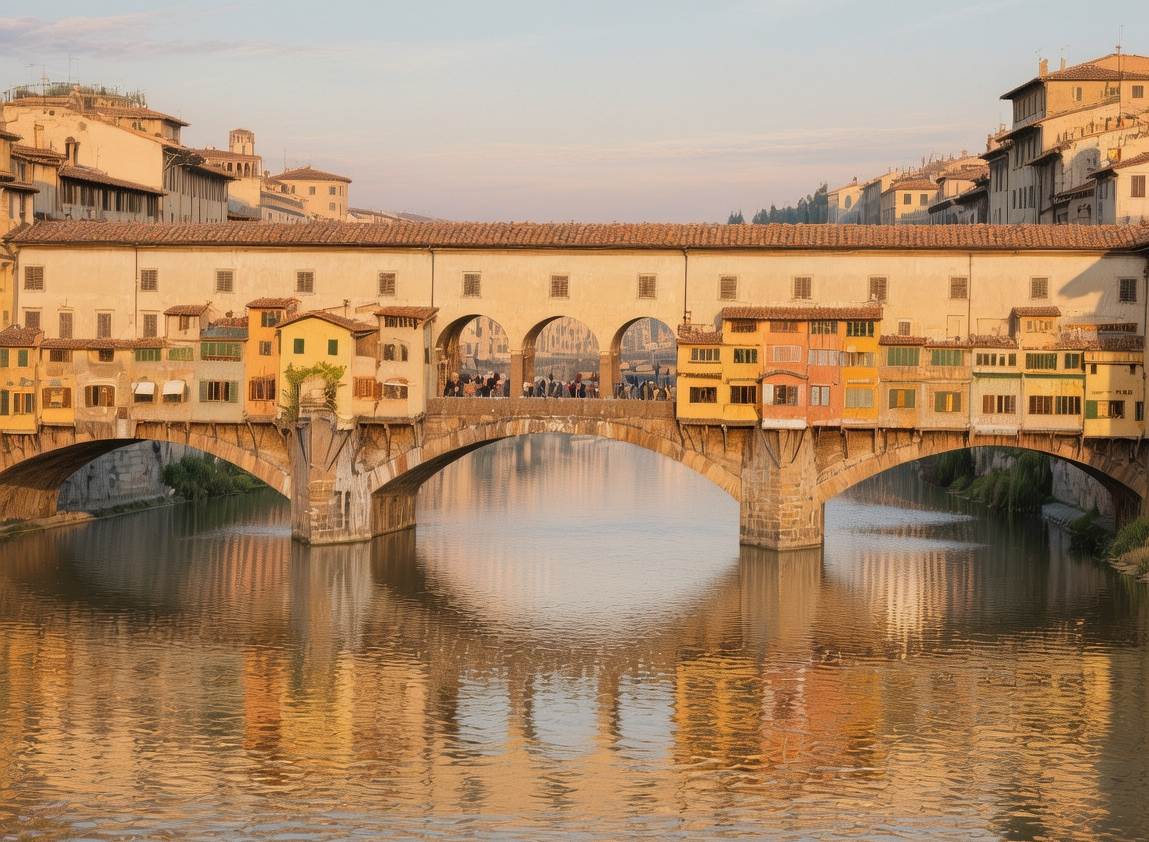
Ponte Vecchio Medieval Stone Meets Golden Light
The day’s last sun gilds the Arno River—turning its surface into a sheet of liquid amber that laps gently against ancient stone. On the Ponte Vecchio, Florence’s only surviving medieval bridge, the air hums with a quiet commerce that has echoed here for over six centuries. You can hear the soft clink of gold being weighed in tiny trays, the murmur of artisans behind glass windows displaying rings and necklaces, and the distant chime of a church bell from the Oltrarno district. Built in 1345 after two earlier bridges were swept away by floods, this 84-meter-long (276-foot) structure is an engineering marvel of its time—its three segmental arches distributing weight with elegant efficiency across the river’s unpredictable flow. Unlike other European bridges lined with houses that vanished long ago, the Ponte Vecchio endures, its upper corridor—the Vasari Corridor—once a private passage for the Medici family, now a silent witness to history. In 2026, as overtourism strains Florence’s historic core, this bridge stands not just as a postcard icon, but as a living artery connecting past resilience with present responsibility.
Why Ponte Vecchio Embodies Enduring Resilience
The Ponte Vecchio is more than Florence’s most photographed bridge—it is a testament to urban survival. After catastrophic floods in 1117 and 1333 destroyed its wooden predecessors, city planners demanded a structure that could withstand the Arno’s fury. The solution was revolutionary: a stone bridge with three unequal arches (spanning 30, 27, and 30 meters), built on piers reinforced with pointed cutwaters to deflect floodwaters. Completed in 1345, it became the first Florentine bridge to support buildings—originally butchers and tanners whose waste flowed directly into the river. In 1565, Grand Duke Cosimo I commissioned Giorgio Vasari to construct the enclosed Corridoio Vasariano, a 1-kilometer elevated passageway linking the Palazzo Vecchio to the Pitti Palace, allowing the Medici to cross the city unseen. During World War II, it was the only bridge in Florence spared by retreating German forces—a decision attributed to Hitler’s personal admiration. Today, its shops house goldsmiths and jewelers, a legacy mandated by Ferdinand I in 1593 to replace the “stench of meat” with the “glitter of gold.” This bridge isn’t just stone and mortar; it’s a layered chronicle of power, pragmatism, and preservation.
The Best Time to Experience Ponte Vecchio
To witness the Ponte Vecchio bathed in its most magical light while avoiding suffocating crowds, plan your visit for the precise window of September 22–October 6, 2026. During these weeks, daytime temperatures range from a comfortable 16–23°C (61–73°F)—ideal for lingering without summer’s oppressive heat [[21], [24]]. The golden hour between 6:30–7:30 PM transforms the bridge into a scene from a Renaissance painting, as low-angle sunlight sets the gold-shop windows ablaze and casts long reflections on the Arno. Mornings before 8:00 AM offer near solitude, perfect for photography without human clutter. Crucially, avoid visiting during peak periods: the entire month of May, all of July and August, and major holidays like Easter week or Christmas markets, when the narrow span becomes dangerously congested [[26]]. For the clearest views, position yourself on the downstream side near the statue of Benvenuto Cellini. Always check current access conditions via the official Florence tourism portal (visitflorence.com), as restoration work on adjacent buildings occasionally restricts viewpoints.
Approximate Budget for a 7-Day Trip (2026)
This budget reflects mid-range 2025 pricing adjusted for Italy’s projected 2026 inflation rate of 1.5% [[37]], offering a realistic estimate for a solo traveler based in central Florence.
- Accommodation: €870–€1,155 total (€145–€190 per night) for a 3-star hotel or private apartment in the Santa Croce or San Niccolò neighborhoods—close enough to walk to the bridge yet slightly removed from the densest tourist zones.
- Food: €455 total (€65 per day). Breakfast at a local bar (€3 for espresso and cornetto); lunch at a trattoria near Piazza Santo Spirito (€18 for ribollita and a glass of Chianti); dinner at a mid-range restaurant (€38 for bistecca alla fiorentina with contorno and house wine).
- Transportation: €25 total. Florence is eminently walkable; this covers a few bus rides (€1.70 per ticket on ATAF lines) or a taxi from Santa Maria Novella station.
- Attractions: €110 total. Uffizi Gallery (€28); Accademia Gallery (€22); Bargello Museum (€15); Boboli Gardens (€12); and a guided walking tour of Oltrarno artisans (€33).
- Miscellaneous: €110 total. A handcrafted silver ring from a Ponte Vecchio goldsmith (€60+); gelato from Gelateria dei Neri (€4); a bottle of local olive oil from Mercato di Sant’Ambrogio (€15); and a leather journal from Scuola del Cuoio (€30).
Total Estimated Budget: €1,570–€1,950
5 Essential Ponte Vecchio Experiences
- Witness the Sunset from Lungarno degli Archibusieri: Stand on the downstream embankment just east of the bridge as the sun dips behind the Boboli Hills. The golden light will ignite the bridge’s façade, turning every jewelry display into a constellation of reflected fire.
- Walk the Oltrarno Artisan Trail: Cross the bridge and explore the San Frediano district. Visit historic workshops like Antico Setificio Fiorentino (Via Bartolini, 4) to see silk being woven on 18th-century looms—a craft nearly lost to industrialization.
- View the Bridge from Boboli Gardens: Climb to the Belvedere Fort within the gardens for a sweeping, elevated panorama of the entire city, with the Ponte Vecchio perfectly centered over the Arno’s curve—a perspective favored by Grand Dukes.
- Photograph the Vasari Corridor Windows: Look up as you cross to spot the small, arched windows of the private corridor. Though closed to the public since 2022 for safety renovations, they remain a haunting reminder of Medici secrecy and power.
- Visit at Dawn for Solitude: Arrive by 7:00 AM to experience the bridge almost entirely alone. Watch shopkeepers unlock their doors, unroll velvet displays, and polish glass cases in the soft morning light—a ritual unchanged for generations.
3 Hidden Gems Most Travelers Miss
- Casa Serristori Courtyard: Just steps from the bridge’s south end at Via de’ Bardi, 12, this 16th-century palace hides a serene internal courtyard with frescoed loggias. It’s unmarked and rarely entered by tourists—simply walk through the open archway during daylight hours.
- Giardino di Rose (Rose Garden): Located on Viale Giuseppe Poggi below Piazzale Michelangelo, this fragrant garden offers the most iconic, unobstructed view of the Ponte Vecchio framed by cypress trees and blooming roses. Visit at sunrise for complete tranquility.
- Officina Profumo-Farmaceutica di Santa Maria Novella: A ten-minute walk north at Via della Scala, 16, this 1221-founded apothecary is the world’s oldest. Its antique vials, frescoed ceilings, and artisanal perfumes offer a sensory journey into Florence’s mercantile soul—far removed from the bridge’s glitter.
Cultural & Practical Tips
- Never block the walkway: The bridge is only 8 meters wide—stand to the side if stopping to admire or photograph. Congestion here is a serious safety concern.
- Respect the artisans: Do not press your face against shop windows or tap on glass. These are working studios, not museum displays.
- Learn key phrases: “Buongiorno” (bwohn-JOHR-noh) for hello; “Posso vedere questo?” (POH-soh veh-DEH-reh KWEHS-toh?) for “Can I see this?”; and “Grazie, arrivederci” (GRAHT-see-eh ah-ree-veh-der-CHEE) for a polite goodbye.
- Be vigilant for pickpockets: The bridge is a hotspot for petty theft. Use a cross-body bag with zippers facing inward, and avoid carrying your phone in your back pocket.
- Photography is permitted, but be discreet: Avoid using tripods or drones without a permit. Early morning or late evening offers the best natural light without flash interference.
Conclusion: Travel with Reverence, Not Just Reflections
Your presence on the Ponte Vecchio is part of a continuum that stretches back to the 14th century. Every step you take echoes those of merchants, dukes, and refugees who crossed this same stone. In 2026, as Florence grapples with the impacts of mass tourism, your choices matter deeply. Buying a €5 trinket from a stall undermines the centuries-old goldsmithing tradition that defines this bridge; commissioning a piece from a master artisan sustains it. Lingering to understand the history behind the Vasari Corridor honors its legacy more than a hurried selfie ever could. True travel here means slowing down—listening to the river’s whisper, watching the light shift on ancient stone, and recognizing that you are not just a spectator, but a temporary steward of a place that has survived floods, war, and time itself. Carry that reverence with you, and the Ponte Vecchio will reveal its soul, not just its sparkle.