
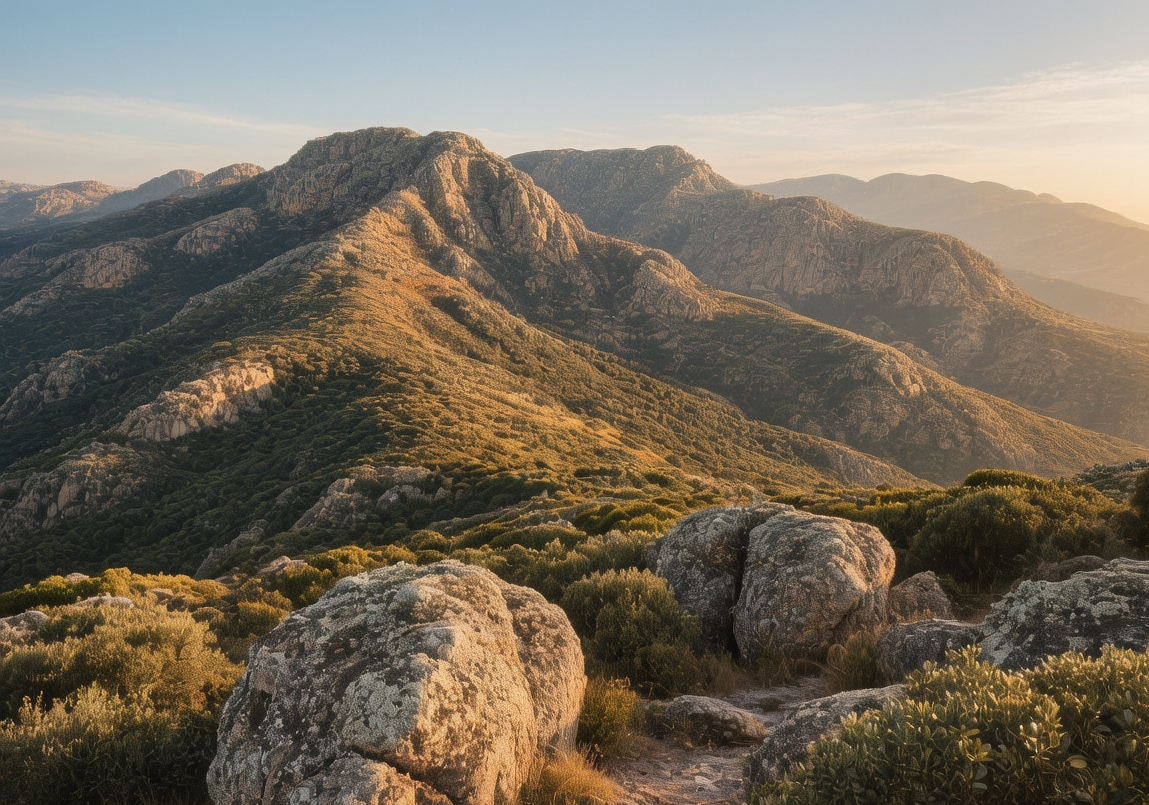
Gennargentu Mountains Alpine Silence Meets Nuragic Echoes
The first light of dawn spills over Punta La Marmora—Sardinia’s highest peak at 1,834 meters (6,017 feet)—painting the Supramonte limestone in hues of apricot and rose quartz. You stand on the Sentiero Italia trail near Fonni, breath visible in the crisp 8°C (46°F) air, as the only sounds are the distant bleat of a pecora sarda sheep and the rustle of wild thyme underfoot. Below, mist clings to glacial valleys carved during the Pleistocene epoch, while above, the skeletal silhouette of a 3,000-year-old Nuragic tower emerges from the fog—a silent sentinel overlooking Europe’s southernmost alpine ecosystem. This mountain range, covering 72,000 hectares across central-eastern Sardinia, has served as refuge for millennia: Bronze Age shepherds built dry-stone huts here to evade Phoenician traders; medieval bandits hid in its labyrinthine canyons; and during Mussolini’s fascist regime, anti-fascist partisans used its remoteness as sanctuary. In 2026, as climate change accelerates Mediterranean aridification, Gennargentu matters more than ever—not just as a biodiversity hotspot harboring 30 endemic plant species like the Moricandia moricandioides, but as a living archive of human resilience where ancient pastoral traditions still shape the landscape through transhumance routes unchanged since Roman times.
Why Gennargentu Mountains Embodies Timeless Refuge
Gennargentu solves a fundamental ecological paradox: how to sustain life in a Mediterranean island increasingly threatened by desertification. Formed 300 million years ago during the Variscan orogeny, its granite and limestone massifs capture moisture from Tyrrhenian storms that bypass lower elevations—creating microclimates where snow persists until June and rare species like the Sardinian deer (Cervus elaphus corsicanus) thrive. The mountains’ cultural significance crystallized during the Nuragic civilization (1800–238 BCE), when builders constructed over 7,000 domus de janas (fairy houses) and 300 stone towers across these slopes—not as defensive structures, but as astronomical observatories aligned with solstices. Later, during Spanish rule (1479–1718), the impenetrable terrain became a haven for banditi d’onore (honorable outlaws) who resisted feudal oppression; their legacy lives in place names like “Sa Barbaia” (The Bearded One’s Canyon). Modern conservation began in 1998 with the establishment of Parco Nazionale del Golfo di Orosei e del Gennargentu, though full national park status remains pending due to local opposition fearing restrictions on pastoralism. Today, the mountains fulfill dual roles: as a critical water reservoir supplying 40% of Sardinia’s freshwater via aquifers recharged by 1,200 mm annual rainfall, and as a cultural bulwark where 120 shepherd families still practice transhumance—moving flocks along 15 designated tratturi (drove roads) up to 80 kilometers long each spring. The engineering is precise: stone pinnettas (shepherd huts) use corbelled roofs that withstand 100 km/h winds, while irrigation channels follow gradients of exactly 0.8% to maximize water distribution without erosion.
The Best Time to Experience Gennargentu Mountains
For optimal hiking conditions and wildlife viewing, visit between May 28–June 25 or September 5–October 10, 2026—when daytime temperatures average 18–24°C (64–75°F) with minimal precipitation and wildflowers in full bloom [[14]]. Begin high-altitude hikes (above 1,500m) by 8:00 AM to avoid afternoon thunderstorms common in summer; the window between 7:30–10:30 AM offers clearest visibility for spotting mouflon sheep on Punta La Marmora’s eastern slopes. Avoid July 20–August 20 when temperatures exceed 28°C (82°F) at base elevations and wildfire risk peaks—regional authorities often close trails during this period following the 2021 fire that burned 12,000 hectares [[15]]. Winter visits (December–February) offer solitude but require preparation: snow closes roads above 1,200m, and temperatures drop to -5°C (23°F) at night; however, cross-country skiing is possible on the Bruncu Spina plateau with proper gear. For real-time trail conditions and fire alerts, verify with Ente Foreste Sardegna’s portal at foreste.sardegna.it 72 hours before departure, as mountain weather shifts rapidly.
Approximate Budget for a 7-Day Trip (2026)
This budget reflects mid-range adventure travel based in Fonni with day excursions into Gennargentu National Park, using 2026 projected pricing with 3.8% inflation adjustment from 2024 baseline figures per ISTAT regional data. All costs in euros (€).
- Accommodation: €80–€120 per night for agriturismo or mountain lodge in Fonni (e.g., Agriturismo Sa Perda Pinta or Rifugio Armungia); includes traditional breakfast with pecorino cheese and homemade bread
- Food: €40 per day average—breakfast €8 (local honey and pane carasau), lunch €14 (panino with roast lamb at trailside kiosk), dinner €18 (primo of malloreddus pasta with sausage, secondo of grilled goat at family-run trattoria)
- Transportation: €230 total—Cagliari Elmas Airport to Fonni via ARST bus line 502 (€14.50, 3h 40m); daily 4x4 rental from Fonni €65 including fuel for mountain tracks; parking free at trailheads
- Attractions: Guided hike with Ente Foreste ranger €35; Museo della Montagna in Fonni €6; cave tour of Grotta di Su Bentu €22
- Miscellaneous: €70—handwoven wool scarf €35, Sardinian wine tasting €20, donation to mouflon conservation program €15
Total estimated cost: €980–€1,180 for seven days
6 Essential Gennargentu Mountain Experiences
- Summit Punta La Marmora at Dawn: Begin your 8-kilometer ascent from Bruncu Spina at 5:30 AM to reach Sardinia’s highest point (1,834m) by sunrise. The final 400 meters traverse scree slopes where mouflon tracks are visible in morning dew; bring crampons if snow lingers (common until early June). At the summit, touch the bronze plaque honoring geologist Alberto La Marmora who mapped Sardinia in 1829.
- Trace Transhumance Routes with Shepherds: Join a working pastore on the Tratturo di Monte Spada between 7:00–10:00 AM in late May when flocks move to summer pastures. Carry a walking stick to navigate rocky sections; the shepherd will demonstrate how to identify medicinal herbs like erba meda (wild mint) used in traditional remedies.
- Explore Grotta di Su Bentu’s Labyrinth: Descend into Sardinia’s deepest cave system (150m vertical drop) with certified guides from Gruppo Grotte Nuorese. Wear thermal layers—the constant 12°C (54°F) temperature and 98% humidity create otherworldly calcite formations; the 3-hour tour includes rappelling through the “Sala delle Meraviglie” chamber.
- Photograph Wildflower Meadows at Bruncu Spina: Visit the high plateau between 9:00–11:00 AM in early June when endemic Limonium gennargentense blooms in violet carpets against limestone outcrops. Use a macro lens to capture dewdrops on the rare Armeria morisii flowers found only above 1,600m elevation.
- Attend a Traditional Cheese-Making Demonstration: At Agriturismo Sa Perda Pinta (open Tuesday/Thursday 16:00–18:00), watch shepherds transform sheep’s milk into casu axedu using 3,000-year-old techniques. The curd is pressed in woven reed baskets that imprint geometric patterns—a Nuragic design still used today.
- Hike the Canyon of Gorropu: Traverse Europe’s deepest canyon (500m walls) via the 12-kilometer Sentiero Selvaggio Blu route. Start at 7:00 AM from Urzulei to avoid midday heat; the narrowest section (“Sa Ucca”) requires sideways passage between walls just 3 meters apart. Bring 3 liters of water—no sources exist in the canyon.
3 Hidden Gems Most Travelers Miss
- Santuario di San Basilio Hermitage: Nestled at 1,100m near Desulo, this 12th-century Byzantine chapel contains frescoes depicting Sardinian saints rarely seen elsewhere. Access requires a 45-minute hike from SP15 road; the caretaker unlocks the gate at 11:00 on Sundays—leave a €3 donation in the wooden box.
- Lago di Gusana Bird Observatory: Located 15km northeast of Fonni, this artificial lake hosts 120 bird species including the endangered griffon vulture. Visit at dawn (6:00–8:00 AM) with binoculars; the unmarked observation blind is reached via a dirt track off SS388—look for the faded blue arrow on the oak tree.
- Nuraghe Arvu Archaeological Site: Hidden in the Taccu di Seui plateau, this well-preserved nuraghe complex features intact staircases leading to a tholos chamber. Requires 4x4 access via unpaved Strada Forestale 12; contact Ente Foreste (+39 0784 230011) 48 hours ahead for gate code—most tourists never venture beyond roadside ruins.
Cultural & Practical Tips
- Wear layered clothing even in summer—the temperature drops 6°C (11°F) per 1,000m elevation gain, and sudden storms can reduce visibility to zero within minutes.
- Greet shepherds with "Sa buna orta" (SAH BOO-nah OR-tah)—Sardinian for "good harvest"—a traditional blessing acknowledging their pastoral livelihood.
- Carry a detailed topographic map (IGM 1:25,000 series) and GPS; mobile signal disappears above 1,000m, and trails are marked only with occasional red-white paint blazes.
- Never disturb stone structures—even loose rocks may be part of active archaeological sites; report new finds to Ente Foreste rangers immediately.
- Respect wildlife corridors—mouflon sightings increase at dawn/dusk, so maintain 50-meter distance and avoid flash photography which startles herds.
- Support conservation by purchasing products from the Cooperativa Gennargentu (e.g., organic honey €12/jar); proceeds fund anti-poaching patrols protecting endemic species.
- Ask permission before photographing shepherds or their flocks; many still view cameras as intrusive, but will often share stories if approached respectfully with a small gift of bread.
Conclusion: Travel with Presence, Not Just Pace
To journey through Gennargentu Mountains is to step into a dialogue between rock and resilience—a place where every limestone ridge holds memories of Nuragic astronomers, every alpine meadow echoes with shepherd songs unchanged for centuries. In 2026, as overtourism flattens destinations into consumable experiences, Gennargentu demands something different: presence over pace, listening over looking. Your footprints on these trails carry consequence—the €35 guided hike fee funds mouflon conservation, yet your haste could disturb nesting griffon vultures; your curiosity about transhumance sustains cultural memory, but your intrusion might break the quiet concentration of a cheesemaker perfecting a 3,000-year-old craft. Slow down to feel the grit of volcanic soil beneath your boots; pause to learn the Sardinian name for the wild thyme scenting the air (sa santoreja). True connection here means recognizing that you walk not through scenery, but through sanctuary—a living landscape where human and natural histories intertwine with such intimacy that to protect one is to preserve the other. Depart not with checklists completed, but with questions carried forward: How do we honor places that refuse to be merely visited?