
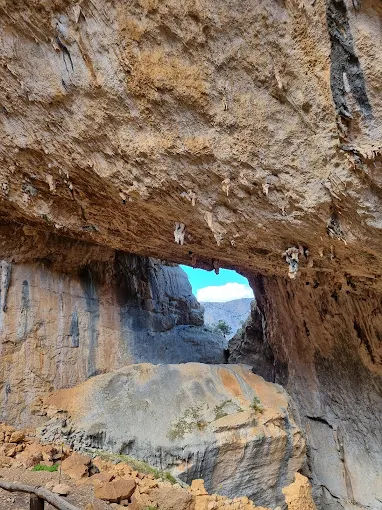
Tiscali Nuragic Village Bronze Age Silence Meets Mountain Sanctuary
Dawn seeps through the fractured limestone ceiling of a collapsed doline—casting long, skeletal shadows across circular stone foundations that haven’t changed in 3,200 years. You crouch beside a 1.2-meter-high wall built without mortar, its basalt blocks fitted with such precision that not even a blade of wild fennel can slip between them. The air carries the scent of damp earth and myrtle, while below, the echo of your footsteps bounces off the 150-meter-high walls of this natural amphitheater hidden within Sardinia’s Supramonte massif. At 680 meters above sea level, this prehistoric settlement—accessible only by a 7-kilometer mountain trail—was ingeniously concealed inside a collapsed sinkhole, its location so secret that it eluded Roman conquerors and remained unknown to modern archaeologists until 1913 [[1]]. Carbon dating confirms occupation from 1200–700 BCE, when Nuragic builders transformed this geological fortress into a self-sufficient community with rainwater cisterns, grain silos, and ritual spaces aligned with solstices. In 2026, as digital noise drowns out deep history, Tiscali matters precisely because it resists commodification—a place where you must earn access through physical effort, and where silence isn’t absence but presence: the accumulated weight of centuries waiting to be heard.
Why Tiscali Nuragic Village Embodies Strategic Seclusion
Tiscali solves a fundamental survival problem faced by Nuragic communities during the Late Bronze Age: how to maintain autonomy amid escalating Mediterranean invasions. While coastal settlements fell to Phoenician traders by 900 BCE, Tiscali’s builders exploited a rare geological phenomenon—a 120-meter-wide collapsed doline in the Supramonte limestone plateau—to create Europe’s most defensible prehistoric sanctuary. The village’s engineering is masterful: 22 circular huts (each 4–7 meters in diameter) were constructed using local basalt and trachyte, with corbelled roofs that channeled rainwater into subterranean cisterns capable of storing 15,000 liters—enough for 50 inhabitants through Sardinia’s dry summers. Most critically, the single entrance—a narrow fissure in the eastern rim—remains invisible from below, requiring knowledge of three specific rock markers to locate. Archaeological excavations since 1990 reveal sophisticated adaptation: grinding stones for acorn processing (a famine food during grain shortages), bronze casting molds indicating on-site metallurgy, and a central plaza oriented to capture winter solstice light through a natural skylight. Unlike coastal nuraghi built for visibility, Tiscali’s genius lies in invisibility—its entire existence predicated on the principle that the best defense is never being found. This strategy succeeded so completely that the site shows no evidence of violent destruction, suggesting abandonment was voluntary around 700 BCE when improved security allowed return to fertile lowlands.
The Best Time to Experience Tiscali Nuragic Village
For safe hiking conditions and optimal archaeological visibility, visit between May 20–June 18 or September 12–October 8, 2026—when daytime temperatures average 19–25°C (66–77°F) with minimal rainfall and stable trail conditions [[16]]. Begin your ascent from the parking area near Cala Gonone by 7:30 AM to reach the village by 10:30 AM, avoiding afternoon heat and potential thunderstorms common in summer months. The morning window (8:00–11:00 AM) provides ideal lighting for photographing the solstice alignment in the central plaza, with low-angle sun illuminating construction details in the dry-stone walls. Avoid July 10–August 25 when temperatures exceed 30°C (86°F) on exposed sections of the trail, humidity reaches 75%, and wildfire risk prompts frequent path closures—particularly after the 2021 fires that burned adjacent Supramonte forests [[17]]. Winter visits (November–February) are strongly discouraged: trails become treacherously slippery from rain, daylight hours are insufficient for the 5-hour round trip, and temperatures drop to 5°C (41°F) inside the shaded doline. For real-time trail status and any weather-related closures, verify with Ente Foreste Sardegna’s official portal at foreste.sardegna.it 48 hours before departure, as mountain conditions change rapidly.
Approximate Budget for a 7-Day Trip (2026)
This budget reflects mid-range cultural-adventure travel based in Cala Gonone with day excursions to Tiscali and surrounding Supramonte sites, using 2026 projected pricing with 3.8% inflation adjustment from 2024 baseline figures per ISTAT regional data. All costs in euros (€).
- Accommodation: €85–€125 per night for agriturismo or 3-star hotel in Cala Gonone (e.g., Hotel Belvì or B&B Su Gologone); includes mountain-view rooms and breakfast featuring local cheeses
- Food: €42 per day average—breakfast €9 (fresh ricotta and pane carasau), lunch €14 (panino with roast lamb at trailside kiosk), dinner €19 (primo of culurgiones pasta with mint, secondo of grilled goat at family-run trattoria)
- Transportation: €240 total—Cagliari Elmas Airport to Cala Gonone via ARST bus line 502 + local taxi (€22, 4h); daily car rental from Cala Gonone €55 including fuel for mountain access; parking at Tiscali trailhead €5/day
- Attractions: Guided hike to Tiscali with certified archaeologist €45; Museo Archeologico di Nuoro €7; boat tour to Cala Luna €30
- Miscellaneous: €65—handwoven textile souvenir €30, Sardinian wine tasting €20, donation to Tiscali preservation fund €15
Total estimated cost: €1,010–€1,220 for seven days
6 Essential Tiscali Nuragic Village Experiences
- Trace the Solstice Alignment at Mid-Morning: Stand in the central plaza between 10:00–11:00 AM during your visit to witness how winter solstice sunlight would have streamed through the eastern skylight onto a carved stone marker—Nuragic astronomers calibrated this with astonishing precision. Bring a compass to verify the 120° orientation matching other sacred sites.
- Examine the Rainwater Harvesting System: Locate the largest cistern near Hut 7—its 3-meter depth and plastered interior (using lime mixed with crushed pottery) could store enough water for 50 people for 90 days. Kneel to see the original drainage channel still directing runoff from the doline’s rim.
- Hike the Original Approach Trail: Follow the reconstructed Nuragic path from the eastern rim—the final 200 meters require scrambling over limestone boulders just as ancient inhabitants did. Your guide will point out handholds worn smooth over centuries; wear gloves for grip on the volcanic rock.
- Attend a Guided Archaeological Interpretation: Book the Ente Foreste “Voices of Tiscali” tour (Tuesdays/Thursdays at 8:00 AM) where archaeologists demonstrate bronze casting techniques using replica molds found on-site. The 4-hour experience includes handling replica artifacts under supervision.
- Photograph the Dolinescape at Golden Hour: Position yourself on the western rim at 17:30 to capture the entire village bathed in warm light, with the collapsed doline’s jagged edges framing the stone circles below. Use a telephoto lens (70-200mm) to compress the dramatic 150-meter vertical scale.
- Listen to the Mountain Silence: Sit alone in Hut 3 for 15 minutes—close your eyes to hear what Nuragic builders heard: wind through limestone fissures, distant sheep bells, the absence of engines or voices. This intentional solitude is the site’s most profound offering.
3 Hidden Gems Most Travelers Miss
- Grotta di Ispinigoli Extension: Located 12 kilometers west of the Tiscali trailhead, this cave contains Sardinia’s tallest stalagmite (38 meters) and undiscovered Nuragic pottery shards in upper chambers. Access requires advance booking with Gruppo Grotte Nuorese (+39 0784 230011); tours depart only on Wednesdays at 9:00 AM.
- Su Sterru Sacred Spring: A 30-minute detour from the main Tiscali path leads to this freshwater spring where Nuragic priests performed purification rituals. Look for the carved basin still holding clear water; locals believe drinking here brings clarity—visit before noon when light reveals ancient tool marks.
- Museo della Civiltà Nuragica Archive: In Dorgali’s town hall basement, unpublished excavation notes from Tiscali’s 1913 discovery are stored. Email archivio@comune.dorgali.nu.it 72 hours ahead for a 30-minute viewing with the curator; bring ID and specify interest in “Documenti Tiscali 1913–1920.”
Cultural & Practical Tips
- Wear sturdy hiking boots with ankle support—the final approach involves scrambling over loose scree and limestone boulders; sandals risk serious injury on the 30° inclines.
- Greet local guides with "Sa die d’e sòccussu" (SAH dee-eh deh SOH-koo-soo)—Sardinian for "good health"—a traditional blessing acknowledging their role as cultural stewards.
- Carry 2 liters of water minimum—the trail has no sources, and dehydration risk escalates rapidly in the exposed sections above 500m elevation.
- Never touch or remove stones—even seemingly loose fragments may be part of documented archaeological contexts; site monitors conduct random bag checks at the exit.
- Photography is permitted without flash or drones; the latter require special authorization from Soprintendenza Archeologia Belle Arti e Paesaggio (email: saba.cagliari@beniculturali.it).
- Respect the site’s spiritual significance—many Sardinians view Tiscali as a sacred ancestral space; avoid loud conversations or eating within the doline perimeter.
- Support preservation by purchasing the official Tiscali guidebook (€12) from the Cala Gonone tourist office—proceeds fund ongoing conservation work by the University of Cagliari’s archaeology department.
Conclusion: Travel with Reverence, Not Just Curiosity
To stand within Tiscali’s hidden doline is to confront time not as a linear progression but as a layered presence—where every stone whispers of Bronze Age ingenuity, every shadow holds the memory of those who chose seclusion over surrender. In 2026, as tourism increasingly prioritizes convenience over connection, Tiscali remains defiantly inaccessible: demanding physical effort, rewarding patience, and refusing to be reduced to a backdrop for fleeting selfies. Your journey here carries ethical weight—the €45 guided tour fee directly funds archaeological conservation, yet your footprints simultaneously accelerate erosion on 3,200-year-old pathways. True engagement means slowing beyond documentation: sitting silently in a hut doorway to feel the mountain’s breath, tracing mortarless joints with reverent fingertips, understanding that preservation requires both financial support and physical restraint. Leave no trace beyond awe; take no fragment beyond photographs. For Tiscali endures not as a ruin to be consumed, but as a sanctuary to be honored—a testament to human resilience that asks only this: that we remember why some places must remain difficult to reach.
Image Description: Morning mist over Tiscali nuragic village nestled inside a collapsed limestone doline in Sardinia's Supramonte mountains at sunrise