
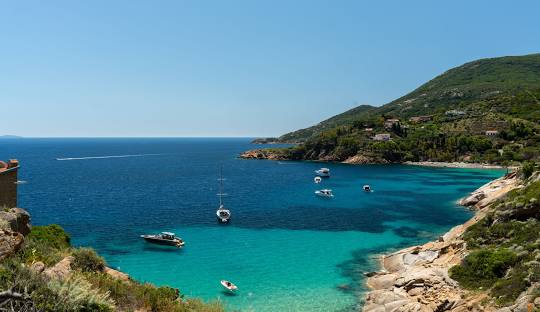
Giglio Island Medieval Silence Meets Tyrrhenian Blue
The morning sun warms the ancient stone walls of Giglio Castello, its narrow, cobbled streets empty save for the soft clatter of a shutter being opened and the distant cry of a gull. From this hilltop perch, 300 meters (984 feet) above the sea, you gaze out over a panorama of staggering beauty: the deep blue Tyrrhenian Sea, dotted with sailboats, laps against a coastline of hidden coves and rugged cliffs. You smell wild rosemary and myrtle carried on a gentle breeze, hear the faint chime of goat bells from the hillsides, and feel a profound sense of stillness that seems to have settled here centuries ago. This is Giglio, the second-largest island of the Tuscan Archipelago, a place fortified by the Pisans in the 12th century to fend off Saracen pirates—a legacy that lives on in its three distinct settlements: the castle town, the port, and the seaside hamlet [[6]]. With just 700 year-round residents and no airport or bridge to the mainland, Giglio has fiercely guarded its authenticity. In an age of hyper-connectivity and overtourism, this island matters now more than ever—it is a sanctuary of slow time, where the rhythm of life is dictated by the tides and the seasons, not by the digital clock.
Why Giglio Island Embodies Timeless Seclusion
Giglio’s enduring magic lies in its deliberate isolation and layered history, which together create a powerful antidote to the modern world’s frenetic pace. Its strategic importance was recognized as early as the Roman era, but it was the Pisans who, in the 12th century, transformed it into a formidable stronghold, building the walled citadel of Giglio Castello whose concentric rings of stone still dominate the island’s center [[6]]. This fortress solved a critical problem of its time: defense against maritime raiders. Today, that same geography solves a modern need—the desire for a genuine escape. The island’s lack of an airport and its reliance on a single ferry route from Porto Santo Stefano (a 50-minute crossing) act as a natural filter, preserving its unspoiled character. Giglio’s three villages each fulfill a distinct role: Giglio Porto is the lively, colorful harbor; Giglio Campese offers a long, sandy beach on the island’s west coast; and Giglio Castello remains a silent, almost spiritual refuge. This tripartite structure, combined with its status as part of the Tuscan Archipelago National Park, ensures that development is strictly controlled. The “need” it fulfills is profound: it offers a space to disconnect, to wander without a map, and to rediscover the simple pleasure of a conversation over a glass of local Ansonica wine as the sun sets over the sea.
The Best Time to Experience Giglio Island
To experience Giglio in its most peaceful and pleasant state, plan your visit for the specific windows of May 15–June 10 or September 15–October 5, 2026. During these periods, the island is lush and green from spring rains, the sea has warmed to a swimmable 20–22°C (68–72°F), and air temperatures are a comfortable 22–26°C (72–79°F) [[11]]. The best time of day to explore the island is in the early morning, between 8:00 AM and 10:30 AM, when the light is golden, the trails are quiet, and you can have the beaches nearly to yourself before the day-trippers arrive on the mid-morning ferry. It is essential to avoid the peak summer period of July 20–August 25, when the island’s small port becomes congested, accommodation is fully booked months in advance, and the serene atmosphere gives way to a more bustling, albeit still charming, summer energy [[30]]. For the most up-to-date ferry schedules, weather conditions, and local event calendars, always consult the official tourism website: islandofgiglio.com.
Approximate Budget for a 7-Day Trip (2026)
This budget is calculated for a solo traveler seeking a comfortable, immersive experience focused on nature, history, and local culture in 2026, based on current inflation trends and average costs for the Tuscan islands.
- Accommodation: €85–€150 per night. Staying in Giglio Porto offers the most amenities and ferry access. A room in the historic Castello provides a unique, quieter experience.
- Food: €45 per day. Breakfast (€5): a cappuccino and cornetto at Bar Centrale. Lunch (€15): a plate of seafood pasta at a family-run trattoria. Dinner (€25): a main course like grilled fish with a glass of local Ansonica wine.
- Transportation: €140 total. Round-trip ferry from Porto Santo Stefano to Giglio Porto (€38 via Toremar). A weekly bus pass to travel between the island’s three villages (€20). Occasional taxi rides (€10–€15).
- Attractions: Entry to the historic Forte Mediceo in Giglio Castello (€5). Guided hiking tour of the island’s coastal paths (€40). Access to the protected beaches of the National Park is free.
- Miscellaneous: €90. This covers a bottle of local wine (€15), several gelato stops (€3 each), a snorkeling set rental (€20), and souvenirs like handmade ceramics.
Total Estimated Cost: €910–€1,020
6 Essential Giglio Island Experiences
- Wander the Silent Streets of Giglio Castello: Arrive in the morning to explore the island’s medieval heart. Walk the concentric ring roads within the ancient walls, visit the 12th-century church of San Pietro, and climb to the highest point for a panoramic view that stretches to Monte Argentario on the mainland.
- Swim at Cala dell’Allume: This secluded cove on the island’s east coast is accessible only by foot or boat. The hike down is steep but rewarding, leading to a small, pebbly beach with water so clear it feels like liquid glass. Go early to secure your private slice of paradise.
- Stroll the Harbor of Giglio Porto: The colorful, horseshoe-shaped port is the island’s social hub. Enjoy an evening passeggiata along the waterfront, browse the small boutiques, and watch the fishing boats unload their daily catch.
- Hike the Coastal Path to Campese: Take the scenic trail from Giglio Castello down to the western coast. The 90-minute walk offers breathtaking views of the sea and ends at Campese’s long, sandy beach and its distinctive Spanish tower.
- Taste Local Wines and Seafood: Dine at a family trattoria like Ristorante La Lanterna in Giglio Porto. Order the local specialty, cacciucco (a rich fish stew), paired with a crisp white Ansonica, the island’s signature wine made from grapes grown on its sun-drenched slopes.
- Snorkel Around the Scoglietto Islet: Just a short swim or kayak trip from Giglio Porto, this tiny rocky islet is a marine sanctuary teeming with life. The underwater visibility is exceptional, revealing starfish, octopuses, and schools of sardines.
3 Hidden Gems Most Travelers Miss
- Cala delle Cannelle: A stunning, crescent-shaped beach of fine sand on the southeast coast, often missed because it requires a 30-minute hike from the nearest road. The effort is rewarded with turquoise water and a backdrop of dramatic cliffs. Go on a weekday for solitude.
- The Abandoned Mine Trails near Cala Minella: On the island’s remote northern tip, old mining paths from the 19th century lead to hidden coves. These trails are unmarked and rugged—best explored with a local guide from the Giglio Hiking Association (+39 0564 XXXXX).
- The Hermitage of San Mamiliano: High in the hills above Giglio Castello, the ruins of this 5th-century hermitage mark the spot where the saint is said to have lived as a hermit. The site is peaceful and offers a profound sense of the island’s spiritual history. A small, unmarked path leads there—ask a local for directions.
Cultural & Practical Tips
- Book your ferry and accommodation early: While less crowded than Elba, Giglio’s limited infrastructure means rooms and ferry tickets sell out quickly, especially for the shoulder seasons. Book by March 2026 for a summer trip.
- Bring sturdy walking shoes: The island’s terrain is hilly and the paths are often rocky. Good footwear is essential for exploring its many trails and villages.
- Learn a few key phrases: “Dov’è il sentiero per…?” (DOH-veh eel sen-TYEH-roh pehr…) for “Where is the path to…?”, and “Un bicchiere di Ansonica, per favore” (oon bee-KYEH-reh dee ahn-SOH-nee-kah).
- Respect the siesta: Many small shops and restaurants close between 1:00 PM and 4:00 PM. Plan your hikes or beach time during these hours.
- Carry cash: While cards are accepted in larger establishments, many small cafes, bus drivers, and souvenir stalls operate on a cash-only basis.
- Protect the environment: As part of a National Park, Giglio has strict rules against littering and disturbing wildlife. Use reef-safe sunscreen and take all your trash with you.
Conclusion: Travel with Presence, Not Just Itinerary
Giglio Island is not a destination to be ticked off a list; it is a place to be absorbed. Its power lies in its quiet insistence on slowness—in the unhurried pace of its villagers, the patient rhythm of the waves, and the silent watch of its ancient stone walls. In 2026, as the world grows louder and faster, Giglio offers a vital counterpoint: a space to simply be. Your journey here should be one of presence, not performance. Sit on a wall in Giglio Castello and watch the light change on the sea. Share a meal with locals who have lived here for generations. Let the island’s silence seep into your bones. By traveling with this mindful attention, you honor its fragile ecosystem and its resilient spirit. Slow down. Breathe in the scent of wild herbs on the wind. In that quiet communion with Giglio’s timeless landscape, you don’t just find a vacation—you find a deeper sense of self.
Image Description: Sun-drenched medieval village of Giglio Castello on a hilltop, with terracotta roofs, stone walls, and Tyrrhenian Sea in the distance at mid-morning