
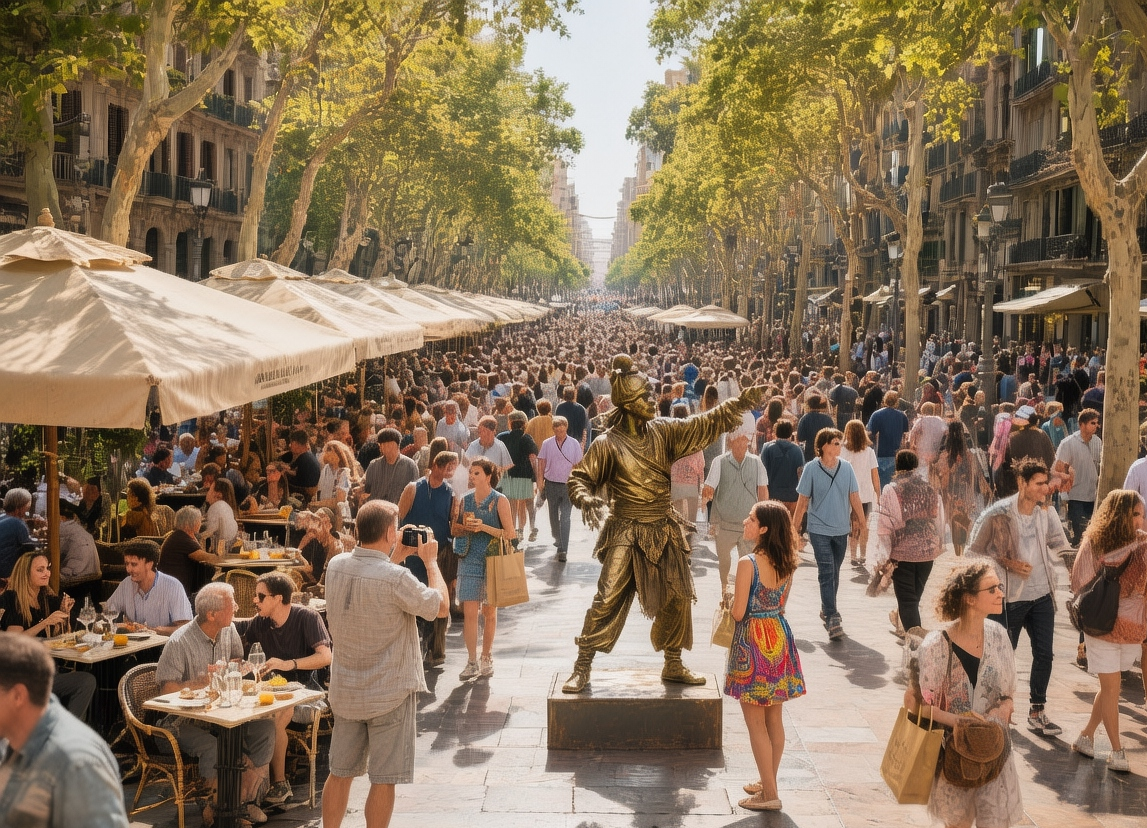
La Rambla Urban Pulse Meets Mediterranean Soul
Golden hour strikes La Rambla at precisely 6:28 p.m., gilding the canopy of 280 plane trees that line this 1.2-kilometer (0.75-mile) artery—sunlight filters through leaves to illuminate the iconic mosaic pavement designed by Joan Miró in 1976, while the scent of jasmine from hidden courtyards mingles with fresh-baked ensaimadas from century-old pastry shops; you weave through a living tapestry of human theater—flamenco dancers stamping rhythms near Plaça de Catalunya, living statues frozen in bronze-like poses, and elderly locals playing chess under wrought-iron lampposts installed during Barcelona’s 1888 Universal Exposition; once a 15th-century dried riverbed (ramla means "sandy riverbed" in Arabic), this promenade evolved into Europe’s most celebrated pedestrian boulevard after architect Ildefons Cerdà integrated it into his revolutionary Eixample grid in 1859. Today, as overtourism strains its fragile ecosystem with 100,000 daily visitors, La Rambla matters profoundly—not as mere thoroughfare but as Barcelona’s beating heart where Catalan resilience meets global curiosity, demanding mindful engagement in this pivotal 2026 moment.
Why La Rambla Embodies Catalan Resilience
La Rambla isn’t just a street—it’s a palimpsest of Barcelona’s defiant spirit, layered across seven centuries of transformation. Originating as a seasonal stream outside medieval city walls, it became a formal promenade in 1703 when aristocrats planted its first plane trees to escape plague-ridden quarters. The 1888 Universal Exposition catalyzed its golden age: architect Josep Fontserè designed the Gran Teatre del Liceu opera house (rebuilt after 1893 and 1994 fires), while Antoni Gaudí contributed ironwork for streetlights. The 1976 addition of Joan Miró’s 8,000-square-meter mosaic pavement transformed the central walkway into an open-air gallery—a bold statement of cultural rebirth after Franco’s dictatorship. Structurally, La Rambla solves urban challenges through ingenious zoning: five distinct sections flow seamlessly—Rambla de Canaletes (fountain of gossip), Rambla dels Estudis (bird market), Rambla de les Flors (flower stalls), Rambla dels Caputxins (theater district), and Rambla de Santa Mònica (art galleries)—each separated by historic plazas that act as social lungs. The 30-meter-wide (98-foot) design accommodates 12,000 pedestrians hourly through staggered pedestrian zones flanked by protected building façades featuring Modernista ironwork and Gothic arches. After the 2017 terrorist attack, Barcelona fortified its resilience—replacing vulnerable kiosks with reinforced planters while preserving historic character through the €18 million "Rambla 2024" restoration project. Today, this boulevard stands as testament to how cities can honor heritage while adapting to contemporary challenges.
The Best Time to Experience La Rambla
Stroll between 7:00 and 9:00 a.m. during April 12–May 18 or September 20–October 25, when temperatures range 16–22°C (61–72°F) and humidity stays below 65%, allowing comfortable exploration before tourist crowds peak. Morning light through plane tree canopies creates dramatic dappled patterns on Miró’s mosaic pavement between 7:30–9:30 a.m., while evening ambiance intensifies after 8:00 p.m. when street performers activate and café terraces glow under vintage lamps. Avoid June 20–August 25 entirely—temperatures exceed 30°C (86°F) with heat indices reaching 36°C (97°F), and pedestrian density surpasses 8,000 people per hour between 11:00 a.m. and 4:00 p.m., creating dangerous compression in narrow sections; July 15–August 10 is particularly problematic during Spanish national holidays. Winter visits (November–February) offer shortest lines but limited daylight for mosaic photography and frequent rain; many flower stalls close by 6:00 p.m. in January. Crucially, experience the "Blue Hour" between 8:30–9:30 p.m. when streetlights activate but daylight lingers—this magical transition reveals La Rambla’s theatrical essence without midday chaos. Always verify current event schedules and security protocols at Barcelona’s official tourism portal (barcelonaturisme.com) minimum 48 hours before visiting.
Approximate Budget for a 7-Day Barcelona Trip with La Rambla Focus (2026)
These estimates reflect projected 2026 pricing with 4.1% annual inflation applied to 2024 baselines per Spain’s National Statistics Institute (INE) tourism indices and Barcelona’s municipal fiscal reports. Budget assumes moderate comfort with Ciutat Vella lodging, authentic Catalan dining, and comprehensive cultural access.
- Accommodation: €160–€240 per night in El Raval (2-minute walk to La Rambla); €120–€180 in Gothic Quarter (5-minute walk). Specific options: Hotel España (€220/night with Modernista courtyard), Casa Camper (€235/night with rooftop terrace), or budget alternative Hostal Grau (€85/night private room). SUBTOTAL: €1,120–€1,680 for 7 nights.
- Food: €70 per person daily average—breakfast €9 (churros con chocolate €4.50 at Granja M. Viader, café solo €2.50), lunch €25 (bocadillo de calamares €14 at Bar Pinotxo, vermouth €4/glass), dinner €36 (arroz negro €26 at Can Majó, Priorat wine €9/glass). Includes daily pastry budget (€5 at Pastisseria Hofmann). SUBTOTAL: €490 per person for 7 days.
- Transportation: €48 total—€12 for 48-hour Hola BCN! card (unlimited metro/bus), €8 metro line L1 roundtrip from El Prat Airport, €28 taxi supplement for late-night returns via official black cabs (fixed €35 airport rate). SUBTOTAL: €48.
- Attractions: €95 per person—€18 Gran Teatre del Liceu tour, €16 Palau Güell, €22 Museu Picasso, €14 MACBA contemporary art museum, €12 Boqueria Market guided tasting, €13 Montjuïc Castle cable car. SUBTOTAL: €95 per person.
- Miscellaneous: €130 per person—€50 flamenco show at Tablao Cordobés, €35 guided Gothic Quarter walking tour, €25 official La Rambla ceramic tile replica, €20 emergency horchata refuels at Sirvent. SUBTOTAL: €130 per person.
Total estimated cost: €1,883–€2,443 per person
7 Essential La Rambla Experiences
- Dawn Mosaic Meditation: Arrive at 6:45 a.m. when custodians finish cleaning Miró’s mosaic pavement. Walk barefoot (if permitted) or in socks along the central path—feel the cool terrazzo beneath your feet as morning light ignites cobalt blues and sunflower yellows in the 8,000-square-meter artwork. Duration: 30 minutes. Essential because this solitude reveals Miró’s chromatic dialogue with Mediterranean light before crowds obscure details.
- Canaletes Fountain Ritual: Visit the Art Deco fountain at Carrer de Còrsega 12 at 7:30 a.m.—drink from its spout as tradition dictates: "Who drinks from Canaletes will return to Barcelona." Observe how the 1892 hydraulic system still functions, delivering spring water from Collserola hills. Duration: 15 minutes. Essential because this ritual connects you to generations of Barcelonans who’ve sought the city’s blessing here.
- Boqueria Market Sensory Immersion: Enter Mercat de Sant Josep (La Boqueria) at 8:00 a.m. when vendors arrange pyramids of blood oranges and jamón ibérico. Sample fresh-squeezed sugarcane juice (€3) at El Quim while watching chefs prepare breakfast tapas. Duration: 50 minutes. Essential because this 1840 market embodies La Rambla’s culinary soul—where local traditions thrive amid global tourism.
- Liceu Opera House Acoustics: Book the 10:00 a.m. backstage tour of Gran Teatre del Liceu (€18). Stand in the royal box where velvet drapes muffle sound, then descend to the orchestra pit where acoustics engineered in 1847 still carry whispers across 2,292 seats. Duration: 75 minutes. Essential because this survivor of two fires represents Catalan cultural resilience in architectural form.
- Florist’s Alley Fragrance Journey: Stroll Rambla de les Flors between 9:00–10:00 a.m. when 40+ flower stalls burst with color. Inhale the layered scents: tuberose from Mallorca, lavender from Provence, and local roses arranged in traditional Catalan bouquets. Purchase a single stem (€2) to place at the Monument a Colom base. Duration: 25 minutes. Essential because this fragrant corridor preserves a 19th-century tradition threatened by souvenir kiosks.
- Street Performer Dialogue: Return at 8:30 p.m. during "Blue Hour" when living statues activate. Engage respectfully—ask performers about their craft (many are trained actors). Tip €2–€5 in designated boxes; never photograph without permission. Duration: 40 minutes. Essential because these artists transform pavement into stage, continuing La Rambla’s legacy as Europe’s greatest open-air theater.
- Midnight Literary Pilgrimage: Visit La Central bookstore at Rambla 117 after 11:00 p.m. when crowds thin. Browse Catalan literature in this 1929 Modernista space where Orwell once sourced maps for Homage to Catalonia. Duration: 30 minutes. Essential because this sanctuary of words offers intellectual counterpoint to La Rambla’s sensory spectacle.
3 Hidden Gems Most Travelers Miss
- Plaça Reial Secret Courtyard: Overlooked because tourists focus on surface-level nightlife—enter through the eastern arcade at Rambla 103. This neoclassical square designed by Gaudí (1878) features his original cast-iron streetlamps with bat motifs. Visit Tuesday mornings when antique dealers set up ephemeral stalls revealing hidden artifacts. Free access; photography permitted. Special because this oasis demonstrates how Gaudí’s genius permeated even minor commissions.
- Carrer de l’Hospital Backstreet Passage: Located 50 meters east of La Rambla—follow the unmarked alley beside El Indio restaurant. This medieval lane features original 14th-century stone arches and hidden courtyards where laundry still hangs between buildings. Open 24/7; best explored 7:00–9:00 a.m. Special because this passage reveals Barcelona’s pre-Rambla urban fabric—narrow streets designed for shade and community.
- Palau Moja Historic Archive: Accessible via guided tour only—book the €15 "Hidden Palaces" experience through barcelonaturisme.com. This 18th-century palace houses Catalonia’s oldest library (1772) with Goya engravings and original Rambla development plans. Tours run Saturdays at 11:00 a.m.; requires advance reservation 30 days ahead. Special because these documents reveal how Enlightenment ideals shaped La Rambla’s evolution from riverbed to cultural artery.
Cultural & Practical Tips
- Pickpocket prevention protocol: Highest risk occurs 11:00 a.m.–4:00 p.m. near Boqueria Market and Plaça Catalunya—use cross-body bags with zippers facing inward. Never place phones/wallets in back pockets; municipal police maintain visible presence but cannot monitor all threats.
- Street performer etiquette: Always ask permission before photographing living statues; tip €2–€5 if they pose for you. Never touch performers—they break character only for safety reasons.
- Essential Catalan phrases: “Bon dia” (bone DEE-uh) for good morning; “Gràcies” (GRAH-see-es) for thank you; “On és el mercat?” (ohn ES el mer-KAHT) for market location.
- Photography guidelines: No tripods on mosaic pavement (€100 fines); drone use prohibited citywide. Best shots occur 7:30–9:00 a.m. when east-facing light illuminates Miró’s blues without harsh shadows.
- Market shopping protocol: At Boqueria, sample only when offered—never touch produce without vendor permission. Bargaining is considered rude; prices are fixed except at flower stalls (gentle negotiation acceptable).
- Weather considerations: Summer humidity (70–80%) intensifies heat on exposed pavement; winter rains create slippery conditions on mosaic tiles. Always carry water—free refill stations available at Plaça Reial.
- Historic preservation awareness: Do not sit on Miró’s mosaic—body oils accelerate tile deterioration. Report damaged sections to municipal staff immediately; each fragment represents irreplaceable public art.
Conclusion: Travel with Presence, Not Just Passivity
To walk La Rambla is to traverse layers of Barcelona’s defiant soul—a place where every mosaic tile, plane tree, and street performance echoes centuries of resilience. Your mindful presence directly supports local artisans and florists whose livelihoods sustain this cultural artery against homogenizing tourism pressures; each respectful interaction honors the 2026 vision of a Rambla that balances global curiosity with Catalan identity. In an age of digital distraction, this boulevard demands embodied attention: feel the mosaic’s texture beneath your feet rather than viewing it through a screen; listen to flamenco rhythms instead of curated playlists; taste market flavors beyond Instagram aesthetics. The 2017 tragedy taught Barcelona that public spaces require vigilant care—your awareness becomes part of its healing. Choose presence over passivity—linger at Canaletes Fountain to understand its ritual significance; observe how light shifts on Miró’s blues across hours. Let La Rambla recalibrate your urban senses; understand that true travel here measures not distance covered, but depths of human connection forged along this sacred mile of Mediterranean earth.