
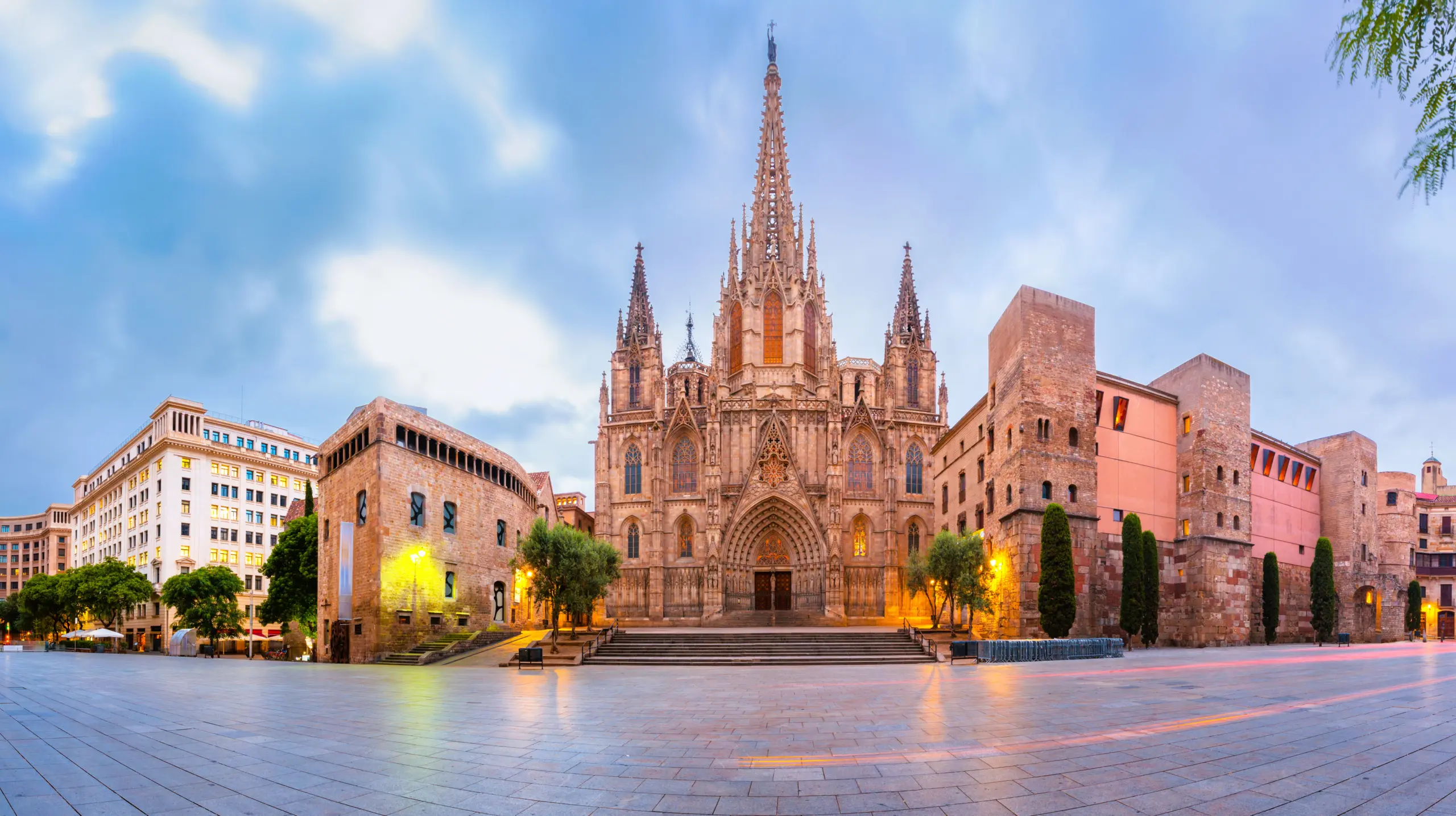
Gothic Quarter Medieval Stone Meets Mediterranean Light
Twilight descends on Barcelona’s Gothic Quarter at precisely 7:14 p.m., igniting 2,000-year-old Roman walls in amber light while wrought-iron lanterns flicker to life along Carrer del Bisbe—your footsteps echo on cobblestones worn smooth by Roman legionnaires, medieval merchants, and Modernista artists as the scent of saffron from hidden tapas bars mingles with jasmine spilling from wrought-iron balconies; you pause beneath the 14th-century bridge connecting Palau de la Generalitat’s towers, its arch reflected perfectly in rain-slicked stones, then trace your fingers along the Temple of Augustus’ four surviving columns—erected in 15 BCE when Barcino was a mere 10-hectare Roman colony of 1,000 souls; this labyrinth of alleys spanning just 0.4 square kilometers (0.15 square miles) evolved through layers: Roman foundations, Visigothic churches, Catalan Gothic cathedrals, and Gaudí’s subtle interventions. Today, as overtourism strains its fragile infrastructure with 35,000 daily visitors, the Gothic Quarter matters profoundly—not as open-air museum but as living palimpsest where every stone whispers resilience, demanding mindful engagement in this pivotal 2026 moment of cultural preservation.
Why Gothic Quarter Embodies Layered History
The Gothic Quarter isn’t merely old—it’s a geological stratum of civilizations stacked like parchment pages. Founded as Roman Barcino in 15 BCE under Emperor Augustus, its original 1.2-kilometer defensive wall (parts still visible near Plaça Ramon Berenguer) enclosed a grid-pattern city centered on today’s Plaça Sant Jaume. When Visigoths conquered Hispania in 418 CE, they repurposed Roman temples into churches—most notably converting the Temple of Augustus into a cathedral site. The true Gothic transformation began in 1298 with construction of Barcelona Cathedral, whose 53-meter-high nave and forest of 28 octagonal columns exemplify Catalan Gothic’s verticality without flying buttresses—a structural innovation using thick walls and internal buttressing to support 14th-century vaults. The quarter solved medieval urban challenges through ingenious density: buildings shared party walls to conserve space within the Roman perimeter, while courtyards like Plaça Sant Felip Neri provided communal oases. After centuries of neglect, 19th-century architects like Josep Puig i Cadafalch initiated controversial "Gothicizations"—adding neo-Gothic elements to medieval structures during Barcelona’s Renaixença cultural revival. Today, beneath surface-level tourism, archaeologists continue uncovering Roman mosaics and Jewish Quarter remnants through projects like the MUHBA (Museum of the History of Barcelona), revealing how this 0.4-square-kilometer zone embodies Europe’s complex narrative—from imperial outpost to mercantile powerhouse to modern cultural sanctuary.
The Best Time to Experience Gothic Quarter
Wander between 7:00 and 9:00 a.m. during April 10–May 15 or September 20–October 25, when temperatures range 16–22°C (61–72°F) and humidity stays below 65%, allowing comfortable exploration before tourist crowds peak. Morning light through narrow alleys creates dramatic chiaroscuro effects on Gothic façades between 7:30–9:30 a.m., while evening ambiance intensifies after 8:00 p.m. when streetlights activate and café terraces glow under vintage lamps. Avoid June 15–August 25 entirely—temperatures exceed 30°C (86°F) with heat indices reaching 36°C (97°F), and pedestrian density surpasses 5,000 people per hour in narrow sections like Carrer del Call, creating dangerous compression; July 20–August 10 is particularly problematic during Spanish national holidays. Winter visits (November–February) offer shortest lines but limited daylight for photography and frequent rain; many small museums close by 5:00 p.m. in January. Crucially, experience the "Blue Hour" between 8:30–9:30 p.m. when lanterns illuminate Roman walls without midday glare—this magical transition reveals the quarter’s theatrical essence. Always verify current event schedules and excavation access at Barcelona’s official history portal (barcelona.cat/museuhistoria) minimum 48 hours before visiting.
Approximate Budget for a 7-Day Barcelona Trip with Gothic Quarter Focus (2026)
These estimates reflect projected 2026 pricing with 4.1% annual inflation applied to 2024 baselines per Spain’s National Statistics Institute (INE) tourism indices and Barcelona’s municipal fiscal reports. Budget assumes moderate comfort with Ciutat Vella lodging, authentic Catalan dining, and comprehensive historical access.
- Accommodation: €170–€250 per night in Gothic Quarter (central location); €130–€190 in El Born (10-minute walk). Specific options: Hotel Neri (€240/night with Roman wall views), Mercer Hotel (€250/night with rooftop terrace), or budget alternative Hostal Grau (€90/night private room). SUBTOTAL: €1,190–€1,750 for 7 nights.
- Food: €75 per person daily average—breakfast €10 (pa amb tomàquet €4, café con leche €3 at Federal Café), lunch €28 (fideuà €18 at Can Solé, vermouth €4/glass), dinner €37 (suquet de peix €26 at Els Pescadors, Priorat wine €10/glass). Includes daily pastry budget (€5 at Forn de Sant Jaume). SUBTOTAL: €525 per person for 7 days.
- Transportation: €48 total—€12 for 48-hour Hola BCN! card (unlimited metro/bus), €8 metro line L4 roundtrip from El Prat Airport, €28 taxi supplement for late-night returns via official black cabs (fixed €35 airport rate). SUBTOTAL: €48.
- Attractions: €105 per person—€14 Barcelona Cathedral + roof access, €12 MUHBA Roman ruins, €18 Palau de la Música Catalana tour, €16 Museu Picasso, €15 Santa Maria del Mar church, €18 Gothic Quarter guided walking tour, €12 Plaça Reial flamenco show. SUBTOTAL: €105 per person.
- Miscellaneous: €140 per person—€50 traditional Catalan cooking class, €35 artisanal leather journal from El Born workshop, €25 official MUHBA ceramic replica, €30 emergency horchata refuels at Sirvent. SUBTOTAL: €140 per person.
Total estimated cost: €2,008–€2,568 per person
7 Essential Gothic Quarter Experiences
- Dawn Roman Wall Meditation: Arrive at 6:45 a.m. at Plaça del Rei when custodians finish cleaning. Trace your fingers along the original Roman wall (built 15 BCE)—feel the tufa stone blocks held by iron clamps stolen during Middle Ages. Duration: 30 minutes. Essential because this solitude reveals Barcino’s foundational layer before crowds obscure archaeological details.
- Cathedral Roof Panorama: Book the 8:00 a.m. "Early Access" ticket via catedralbcn.org. Climb 214 steps to the roof where gargoyles overlook Plaça Sant Jaume—observe how 14th-century builders used Montjuïc sandstone that hardens with age. Duration: 50 minutes. Essential because this aerial perspective reveals the quarter’s organic growth pattern impossible to grasp at street level.
- Temple of Augustus Contemplation: Visit Carrer del Paradís at 7:30 a.m. when sunlight filters through the four surviving Corinthian columns (15 BCE). Stand precisely 5 meters back—the optimal distance to see how later buildings incorporated Roman fragments into their foundations. Duration: 20 minutes. Essential because these columns represent Barcelona’s birth certificate, connecting modern city to imperial origins.
- Plaça Sant Felip Neri Silence: Enter this hidden square at 8:00 a.m. before café shutters rise. Observe shrapnel scars on the church façade from 1938 Francoist bombings—contrast with children’s laughter from the adjacent school. Duration: 25 minutes. Essential because this poignant duality embodies Barcelona’s resilience through trauma and joy.
- Jewish Quarter Archaeology: Book the 10:00 a.m. MUHBA "Call" tour (€12). Descend into excavated mikveh (ritual bath) and synagogue foundations beneath Carrer de Sant Domènec del Call. Duration: 75 minutes. Essential because these fragile remnants reveal medieval Barcelona’s multicultural fabric erased during 1492 expulsion.
- Twilight Bridge Reflection: Return to Carrer del Bisbe at 8:30 p.m. during "Blue Hour." Position yourself where the 1928 neo-Gothic bridge reflects perfectly in rain-slicked cobblestones—capture the illusion of medieval authenticity. Duration: 30 minutes. Essential because this engineered perspective demonstrates how 20th-century romanticism shaped our Gothic imagination.
- Midnight Flamenco Intimacy: Attend the 11:00 p.m. show at Tarantos (Plaça Reial). Feel floor vibrations from stomping feet in this 1950s tablao where Carmen Amaya once performed. Duration: 90 minutes. Essential because this raw art form channels centuries of Catalan-Roma cultural fusion in visceral sound and movement.
3 Hidden Gems Most Travelers Miss
- Capella de l’Àngel Custodi Secret Chapel: Overlooked because it’s accessible only through Barcelona Cathedral’s cloister—request entry at the sacristy desk by mentioning “capella anglesa.” This 14th-century chapel features original alabaster reliefs depicting guardian angels protecting sailors. Open 10:00 a.m.–1:00 p.m. Tuesday–Thursday; free with cathedral ticket. Special because its maritime iconography reveals Barcelona’s identity as Mediterranean port city.
- Carrer de la Palla Underground Passage: Located between Plaça Sant Jaume and Plaça del Rei—follow the unmarked alley beside Casa Padellàs. This Roman-era drainage channel runs beneath medieval buildings, visible through protective grates. Best explored 7:00–9:00 a.m. when ambient noise is minimal. Free access; photography permitted. Special because this subterranean artery demonstrates Roman engineering that still functions after 2,000 years.
- Archives of the Crown of Aragon Reading Room: Accessible via guided tour only—book the €20 "Medieval Manuscripts" experience through barcelona.cat/museuhistoria. View original 13th-century trade documents that built Barcelona’s maritime empire. Tours run Saturdays at 11:00 a.m.; requires advance reservation 30 days ahead. Special because these parchments reveal how legal frameworks enabled Catalonia’s golden age of commerce.
Cultural & Practical Tips
- Pickpocket prevention protocol: Highest risk occurs 11:00 a.m.–4:00 p.m. near Barcelona Cathedral and Plaça Sant Jaume—use cross-body bags with zippers facing inward. Never place phones/wallets in back pockets; municipal police maintain visible presence but cannot monitor all threats.
- Church etiquette: Shoulders and knees covered for all genders when entering religious sites—carry a lightweight scarf (€10 at gift shops) if needed. Maintain silence in chapels; photography without flash permitted except during services.
- Essential Catalan phrases: “Bon dia” (bone DEE-uh) for good morning; “Gràcies” (GRAH-see-es) for thank you; “On és el bany?” (ohn ES el BAH-ny) for restroom location.
- Photography guidelines: No tripods in narrow alleys (€100 fines); drone use prohibited citywide. Best shots occur 7:30–9:00 a.m. when east-facing light illuminates Roman walls without harsh shadows.
- Market shopping protocol: At Plaça Sant Josep market, sample only when offered—never touch produce without vendor permission. Bargaining is considered rude; prices are fixed except at flower stalls (gentle negotiation acceptable).
- Weather considerations: Summer humidity (70–80%) intensifies heat in enclosed alleys; winter rains create slippery conditions on cobblestones. Always carry water—free refill stations available at Plaça Sant Felip Neri.
- Historic preservation awareness: Do not lean on ancient walls—body oils accelerate stone deterioration. Report damaged sections to MUHBA staff immediately; each fragment represents irreplaceable heritage.
Conclusion: Travel with Reverence, Not Just Routes
To wander the Gothic Quarter is to traverse time itself—a place where Roman stones breathe beneath Gothic arches and Modernista flourishes. Your mindful presence directly supports local artisans and historians preserving this fragile ecosystem against homogenizing tourism pressures; each respectful step honors the 2026 vision of a quarter that balances global curiosity with Catalan identity. In an age of digital distraction, these alleys demand embodied attention: feel cobblestone textures beneath your feet rather than viewing them through screens; listen to flamenco rhythms instead of curated playlists; taste saffron-infused flavors beyond Instagram aesthetics. The 1938 bombing scars on Plaça Sant Felip Neri teach us that beauty persists through trauma—your awareness becomes part of its healing. Choose reverence over routes—linger at Temple of Augustus columns to understand their imperial significance; observe how light shifts on Roman walls across hours. Let the Gothic Quarter recalibrate your historical senses; understand that true travel here measures not distance covered, but depths of human connection forged along these sacred Mediterranean stones.