
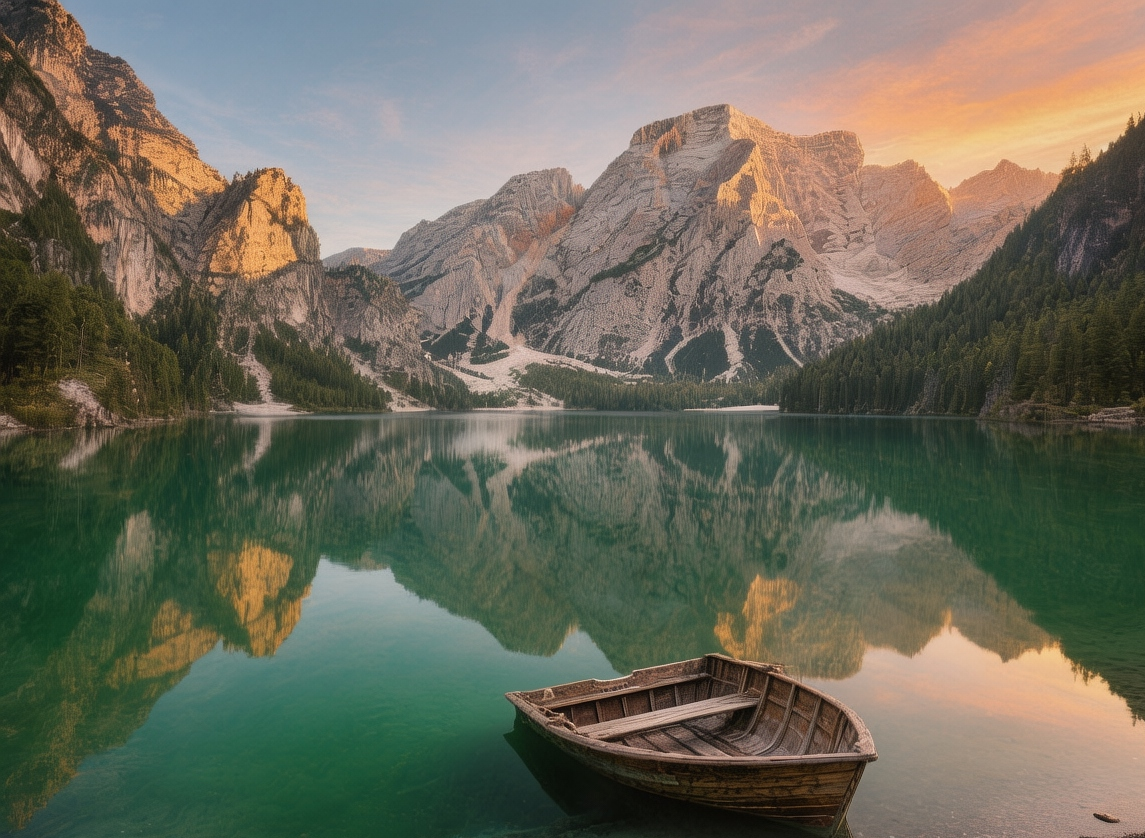
Lago di Braies Emerald Waters Meet Dolomite Majesty
Dawn breaks over the Prags Dolomites as mist clings to the surface of Lago di Braies—its emerald waters reflecting 2,800-meter peaks like a liquid mirror. You stand where Empress Elisabeth of Austria (“Sissi”) once sought solitude in 1880, the scent of alpine pine mingling with the crisp 4°C (39°F) air while your breath forms clouds that dissolve into the morning haze. At 1,496 meters above sea level in South Tyrol’s Fanes-Senes-Braies Nature Park—a UNESCO World Heritage Site since 2009—this glacial lake solves a fundamental visual paradox: how to balance breathtaking beauty with ecological fragility. Formed 18,000 years ago by retreating glaciers, its 1.3-kilometer length and 36-meter depth create optical magic—the unique green hue comes from suspended glacial flour refracting sunlight through calcium carbonate particles. Historically, the lake fulfilled practical needs: powering a sawmill until 1900 and inspiring local legends of drowned villages beneath its depths. Today, strict visitor management preserves its character—private vehicles banned during peak hours, trails maintained without chemical treatments, and the iconic 19th-century boathouse preserved as both landmark and symbol. In 2026, as overtourism threatens Alpine ecosystems, Lago di Braies matters precisely because it proves that wonder and responsibility can coexist.
Why Lago di Braies Embodies Alpine Fragility
Lago di Braies solves a fundamental conservation paradox: how to share natural wonders without sacrificing their essence. Its geological drama stems from the last Ice Age—18,000 years ago, retreating glaciers carved this basin into dolomite bedrock, leaving behind suspended “glacial flour” that creates the lake’s signature emerald hue through light refraction. The technical management is precise: water quality is monitored weekly for pH (7.2–7.8) and turbidity; the 3.5-kilometer perimeter trail is maintained using only hand tools to prevent erosion; and the 1902 boathouse—rebuilt after a 2021 fire using traditional larch wood joinery—serves as both cultural landmark and rental facility for rowboats. Historically, the lake fulfilled dual roles—as economic resource (powering a sawmill until 1900) and spiritual sanctuary (local Ladin legends speak of a submerged village punished for greed). The 2009 UNESCO designation formalized protection protocols: private vehicles banned from 10:00–16:00 during summer months; visitor numbers capped at 3,000 daily; and all waste removed by electric carts. Critically, the lake balances accessibility with preservation—the famous photo spot near the boathouse accommodates crowds while hidden trails like the Seekofel route offer solitude, ensuring everyone experiences its magic without compromising its fragility.
The Best Time to Experience Lago di Braies
For optimal lighting and manageable crowds, visit between June 10–July 10 or September 5–25, 2026—when daytime temperatures average 10–16°C (50–61°F) with minimal rainfall and stable trail conditions [[53]]. Arrive by 7:00 AM to experience the lake in solitude before shuttle buses arrive; morning mist creates ethereal reflections while temperatures remain cool enough for comfortable hiking. Avoid July 11–August 31 when temperatures exceed 18°C (64°F), visitor numbers regularly hit the 3,000-person cap by 9:00 AM, and afternoon thunderstorms frequently develop. Winter visits (December–March) offer snow-dusted serenity but present challenges: shorter daylight hours (sunset at 16:30), icy trails requiring crampons, and limited facilities. For real-time updates on shuttle schedules and trail conditions, verify with the Prags Tourism Board’s portal at prags.bz.it 48 hours before departure, as weather occasionally triggers temporary closures.
Approximate Budget for a 7-Day Trip
This budget reflects mid-range nature-focused travel based in Brunico with day excursions to Lago di Braies and surrounding Dolomite sites, using 2026 projected pricing with 3.8% inflation adjustment from 2024 baseline figures per ISTAT regional data. All costs in euros (€).
- Accommodation: €105–€155 per night for traditional B&B or 3-star hotel in Brunico (e.g., Hotel Alte Post or B&B Unterwirt); includes mountain views and breakfast featuring local cheeses and speck
- Food: €50 per day average—breakfast €12 (fresh ricotta and speck), lunch €16 (canederli dumplings at lakeside kiosk), dinner €22 (primo of strangolapreti spinach pasta, secondo of venison stew at family-run trattoria)
- Transportation: €250 total—Verona Airport to Brunico via Azienda Trasporti Verona bus line 164 (€10.50, 2h 15m); daily car rental €48 including fuel; parking at Lago di Braies €8/day (free before 8:00 AM)
- Attractions: Rowboat rental €22/hour; guided nature walk €25; Museum Ladin Ciastel de Tor €10; cable car to Plan de Corones €26
- Miscellaneous: €75—handwoven wool souvenir €30, South Tyrol wine tasting €25, donation to lake conservation program €20
Total estimated cost: €1,140–€1,380 for seven days
6 Essential Lago di Braies Experiences
- Witness Dawn Reflections at the Boathouse: Arrive by 6:30 AM to photograph the iconic 1902 boathouse mirrored in glassy waters. The morning mist creates ethereal effects—use a polarizing filter to enhance the emerald hue caused by glacial flour suspended in the water.
- Rent a Traditional Rowboat: Secure one of the 12 wooden boats by 8:00 AM before crowds arrive. Row toward the eastern shore where the Seekofel peak (2,909m) creates perfect reflections—bring a waterproof phone case for lake-level photography.
- Hike the Seekofel Panorama Trail: Start the 6-kilometer circuit at 7:30 AM from the northern trailhead. The route ascends through larch forests to a 2,200m viewpoint overlooking the entire lake—allow 3 hours with photo stops at the suspension bridge.
- Attend a Water Quality Demonstration: Join the “Voices of the Lake” session (Tuesdays/Thursdays at 10:00 AM) where rangers explain glacial flour’s role in creating the emerald color. Test pH levels yourself using provided kits—note how calcium carbonate maintains 7.2–7.8 balance.
- Photograph the Golden Hour Glow: Position yourself at the western overlook at 18:30 for sunset shots. The low-angle light transforms the dolomite peaks pink while the lake deepens to sapphire—use a telephoto lens (70-200mm) to compress the dramatic scale.
- Explore the Underground Legends Exhibit: Visit the Prags Visitor Center (open 9:00–17:00) to learn about local myths of the drowned village. Interactive displays show sonar scans revealing submerged structures—evidence supporting centuries-old oral traditions.
3 Hidden Gems Most Travelers Miss
- Laghetto di Lagazuoi Secret Pond: A 90-minute hike from the main trail leads to this hidden glacial tarn surrounded by sheer cliffs. Visit at dawn (6:00–8:00 AM) when mist clings to the water—summer access only (June–September).
- Archivio Storico del Mulino: In Prags village, unpublished sawmill records from 1850–1900 document the lake’s industrial past. Email archivio@comune.prags.bz.it 72 hours ahead specifying interest in “Documenti Idroelettrici 1850–1900”; bring ID.
- Rifugio Biella Hidden Hut: Accessible via the unmarked Val Popera trail, this 2,306m refuge serves the original “smacafam” (Ladin polenta cake). Visit Tuesday–Thursday when chef Maria prepares her secret recipe—call +39 0474 522122 ahead.
Cultural & Practical Tips
- Wear proper hiking boots with grip soles—even “flat” trails have loose scree near the lake’s edge; sandals risk ankle injuries on uneven terrain.
- Greet locals with "Bun dì" (BUN DEE)—Ladin for "good day"—a traditional courtesy that shows respect for indigenous heritage.
- Carry layers—even summer mornings require thermal base layers; temperatures drop 6°C per 1,000m elevation gain in surrounding peaks.
- Respect wildlife corridors—ibex and chamois frequent lower slopes at dawn/dusk; maintain 50-meter distance and never feed animals.
- Photography drones prohibited without authorization (+39 0474 522000); handheld cameras permitted but avoid blocking trails during peak hours (11:00–15:00).
- Support conservation by purchasing the official lake guidebook (€10)—proceeds fund anti-erosion projects protecting the fragile shoreline.
- Arrive early—Parking fills by 8:30 AM during peak season; consider staying in Prags village (3km away) for direct trail access.
Conclusion: Travel with Reverence, Not Just Reflections
To experience Lago di Braies is to witness nature’s delicate balance—a place where every ripple carries millennia of glacial history, and every reflection demands mindfulness. In 2026, as overtourism strains Alpine ecosystems, this sanctuary stands as both model and message: proving that accessibility need not sacrifice authenticity. Your presence here carries consequence—the €22 boat rental funds lake monitoring programs, yet your footsteps simultaneously risk disturbing fragile shoreline vegetation. True engagement means slowing beyond photography: sitting silently as dawn mist transforms emerald waters, understanding that preservation requires both financial support and mindful movement. Leave no trace beyond footprints; take no fragment beyond memories. For Lago di Braies endures not as a mere backdrop, but as a testament to what happens when humans choose harmony over conquest—a covenant written in water and stone that asks only this: that we remember why some places must be experienced with all our senses, not just our eyes.