
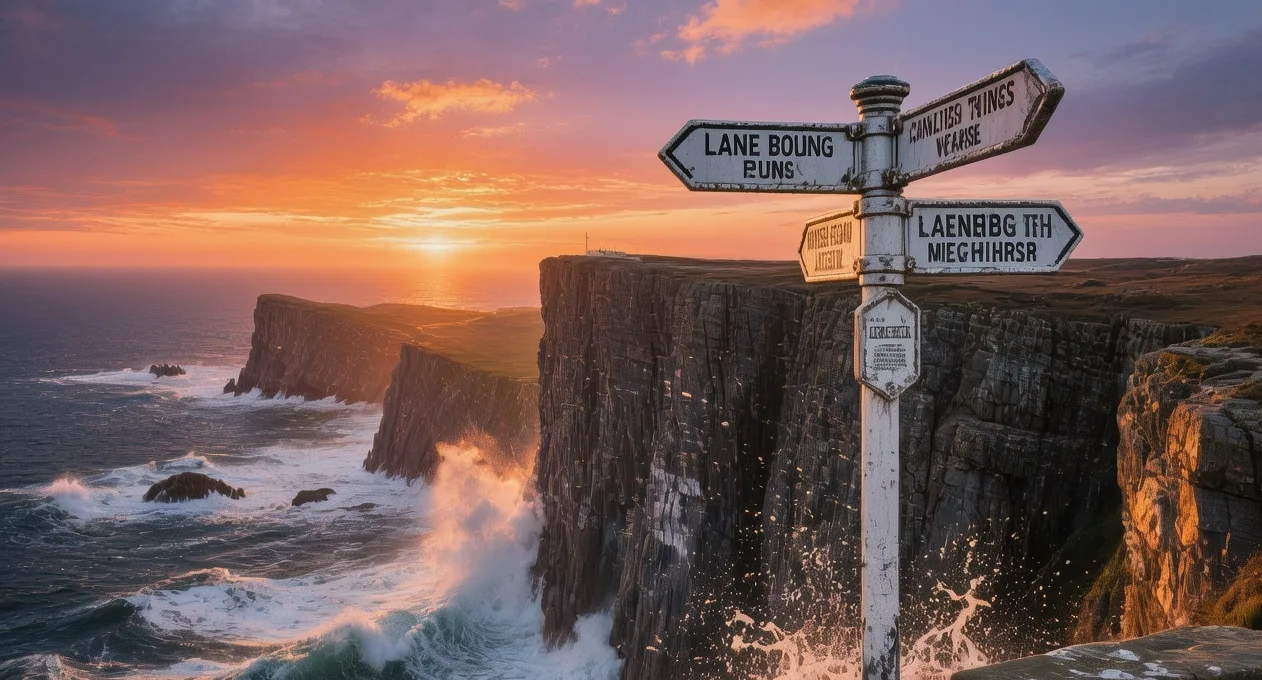
Land's End Granite Cliffs Meet Atlantic Fury
Wind screams across the headland as dusk settles over the Celtic Sea—carrying salt spray 60 meters (197 feet) up from the churning waves to the iconic signpost that has marked the edge of England since 1837. You stand on the weathered granite of Land's End, the westernmost point of mainland Britain, while the rhythmic crash of the Atlantic echoes against cliffs carved by 300 million years of geological violence. The famous distance marker reads 874 miles to John o' Groats, a testament to the sheer scale of the island you stand upon. As you watch the sun dip below the horizon, illuminating the Longships Lighthouse 2 kilometers offshore, you realize this place matters now more than ever: in an era of digital boundaries, Land's End remains a physical terminus, a raw reminder of where the land simply stops and the ocean begins, demanding respect from all who venture to the edge in 2026.
Why Land's End Embodies Coastal Resilience
The Land's End peninsula is not merely a tourist destination; it is a geological fortress composed of Land's End Granite, one of the hardest rock formations in Britain. This igneous intrusion, cooled from magma approximately 280 million years ago, solves a structural problem: resisting the relentless erosion of the Atlantic Ocean that has claimed softer surrounding rock. The headland stands as a bastion against the sea, though it retreats an average of 2-3 centimeters per year due to hydraulic action and freeze-thaw weathering. The iconic signpost, erected by the Lands End Hotel in 1837, fulfilled a Victorian need for quantification, turning a remote wilderness into a measurable destination for travelers.
Today, it fulfills a cultural need for connection to the elemental forces of nature. Managed by the National Trust since 1986, the site protects 10 square kilometers of cliff top habitat from over-development, hosting over 500,000 annual visitors. The architecture of the peninsula includes ancient standing stones like the Men Scryfa, dating to the Bronze Age, proving human presence long before tourism. When you walk the South West Coast Path here, you traverse a space where Neolithic farmers grazed livestock and Victorian engineers built lighthouses. The Land's End represents a continuous narrative of survival against the elements, preserved by the very organization that now maintains the footpaths against the encroaching bracken and erosion of the Cornwall coastline.
The Best Time to Experience Land's End
To witness Land's End in optimal atmospheric conditions, plan your visit between May 15 and June 25. During this window, temperatures average 12-17°C (54-63°F), and daylight extends until 9:15 PM, providing ample time for sunset viewing. The best light for photography occurs between 7:30-9:30 AM when morning mist lifts off the sea, and 6:00-8:00 PM for golden hour illumination on the granite cliffs. Visiting early also allows you to photograph the signpost before tour coaches arrive from Penzance, typically between 11:00 AM and 3:00 PM.
Autumn offers a secondary window—specifically September 10 to October 15—when summer crowds dissipate and storm watching becomes dramatic. Temperatures remain mild at 11-16°C (52-61°F), though daylight hours shorten rapidly. Avoid July 25 to August 25 when school holidays push visitor numbers above 4,000 daily, creating congestion at the signpost and limited parking at the terminal. Winter months (November-February) offer solitude but challenging conditions; high winds often close coastal paths for safety, and sunset occurs as early as 4:05 PM in December. For current path conditions and closure notices, verify information at www.nationaltrust.org.uk/lands-end or contact the visitor center at +44 (0)1736 871503.
Approximate Budget for a 7-Day Trip (2026)
Exploring Land's End and the wider West Cornwall coast requires moderate budgeting, as the region commands premium prices during peak season. The following budget reflects mid-range travel for one person in 2026, accounting for approximately 4.5% UK inflation (ONS data, January 2026). Prices assume a base in Penzance or Sennen for optimal access to the headland and coastal paths.
- Accommodation: £90-£150 per night for a B&B or guesthouse in Sennen Cove (6 nights = £540-£900). Budget options: £50-£70 for hostels in Penzance or camping at Trewellard.
- Food: £50-70 per day total • Breakfast: £10-15 (Full English at The Old Success Inn) • Lunch: £15-20 (Cornish pasty at The Land's End Bakery) • Dinner: £25-35 (Seafood platter at The Sennen Cove Hotel or Reef)
- Transportation: • Train London Paddington to Penzance: £80-140 return (advance booking) • Local bus (Route 1): £4.50 day pass • Car rental (recommended): £65/day plus fuel £1.58/liter • Parking at Land's End: £9/day (March-October)
- Attractions: • Land's End Attraction Pass: £29.50 • Boat Trip to Longships: £35 • Minack Theatre Entry: £18 • Free: Coastal path, signpost, cliff views
- Miscellaneous: • Ordnance Survey Explorer Map 102: £10.99 • Local artisan souvenirs: £25 • Travel insurance: £40-60 for week • Waterproof gear rental: £20
Total estimated cost: £1,400-£1,750 for 7 days (excluding international flights)
5 Essential Land's End Experiences
- Photograph the Signpost at Sunrise: Arrive at the terminal by 7:00 AM during May-August. The iconic distance marker faces west; morning light illuminates the text without glare. Spend 20 minutes capturing the shot before crowds arrive. Bring a windbreaker; exposure at the cliff edge creates wind chill 5°C below shelter temperatures. This experience connects you to the Victorian tradition of documenting the journey's end.
- Walk the South West Coast Path: Dedicate 90 minutes to the section north toward Carn Les Boel. The path climbs 50 meters to clifftops offering panoramic views of the Atlantic. The scent of gorse and thrift fills the air. Wear sturdy shoes; paths are uneven and exposed. This experience connects the headland to the wider geological landscape of the Penwith Heritage Coast.
- View the Longships Lighthouse: Walk to the westernmost cliff edge (grid reference SV375255). The lighthouse stands 2 kilometers offshore, automated since 1988. Visit during clear weather to see the white tower against the horizon. Binoculars are essential for detail. The sound of the foghorn (if active) carries for miles. This experience demonstrates the maritime safety network protecting vessels from the hazardous rocks.
- Explore Sennen Cove Beach: Walk down the slope from the headland to this sandy bay. The beach is 1 kilometer long and backed by dunes. Spend 60 minutes walking the shoreline. The sound of waves crashing on sand contrasts with the cliff roar. Best visited at low tide. This experience provides a softer counterpoint to the rugged granite cliffs above.
- Watch Sunset at Carn Les Boel: Reserve a spot on the grassy headland north of the terminal by 7:00 PM. The light illuminates the sea stacks as dusk falls. The sound of wind through the grass provides a rhythmic backdrop. This experience connects you to the Neolithic history of the area, offering a panoramic view of the sunset over the Celtic Sea.
3 Hidden Gems Most Travelers Miss
- Pedn-men-an-mere: While crowds cluster at the signpost, this rocky cove 1 kilometer south remains surprisingly quiet. Access via the coastal path from Land's End (grid reference SV370245). The site features natural rock pools filled at high tide. Visit between 3:00-5:00 PM when tide is receding. No facilities exist—bring water and a headlamp for the return. The National Trust notes this area has high geological interest due to exposed granite formations.
- The Men Scryfa Standing Stone: Located 2 kilometers east, grid reference SV385275, lies a Bronze Age inscribed stone dating to 500 AD. Access via a public footpath from the B3315 road. The stone marks an ancient burial site. Visit during weekday mornings when the site is empty. No facilities exist—bring snacks. This spot demonstrates the deep history of human occupation in the area, offering a raw view of the landscape before tourism took hold.
- Nanjizal Beach (Song of the Sea): Contact the National Trust (+44 (0)1736 871503) for access updates to this secluded beach. The site features a natural sea cave where waves create a musical sound. Access is restricted to footpath only; no vehicles. The space offers a tangible connection to the wilder side of the coast. This site reveals the acoustic properties of the geology, showing how the ocean interacts with the rock.
Cultural & Practical Tips
- Respect cliff edges: Granite edges are unstable—rockfalls occur regularly. Stay on marked paths; red warning flags indicate dangerous conditions. Keep children supervised at all times. The National Trust reports 5-10 incidents annually due to visitors straying too close.
- Understand weather warnings: The headland is exposed; wind speeds exceed 100 km/h (62 mph) in storms. Check www.metoffice.gov.uk before visiting. Never stand on wet rocks near the sea. If paths are closed, respect the barriers. The coastguard monitors the area closely.
- Leave no trace: Remove all litter, including biodegradable items. The site collects 12 tonnes of waste annually from the headland. Do not remove stones or plants—this violates the Wildlife and Countryside Act 1981. Photograph specimens in situ instead.
- Learn local terminology: "Cove" (small bay); "Headland" (promontory); "Granite" (local rock). Using these terms shows respect for geological heritage and helps guides assist you better during tours.
- Photography guidelines: Tripods are permitted on the grass but restricted on the main terrace during busy periods. Drone use requires written permission from the National Trust and Civil Aviation Authority—apply 6 weeks in advance. Respect other visitors; do not block pathways for extended shoots during peak hours (11:00 AM-3:00 PM).
- Weather preparedness: The peninsula is exposed; wind chill is common even in summer. Pack waterproof layers; Cornwall showers are sudden. Wear sturdy shoes with grippy soles—granite becomes slippery when wet. Sun protection is essential; reflection from sea increases UV exposure by 25%.
- Accessibility considerations: The terminal area is wheelchair accessible. The coastal path is not accessible due to uneven terrain. Alternative viewing exists from the terrace. Request an accessibility map at the ticket office upon arrival.
Conclusion: Travel with Reverence, Not Just Sightseeing
The Land's End does not exist merely to be photographed—it exists to be felt as the edge of the world. When you stand on this headland in 2026, you are not observing a static monument; you are entering a space where geology and ocean converge in a perpetual battle. The Victorians who built the signpost are gone, but their marker remains embedded in the granite. The fishermen who sailed these waters are gone, but their lighthouse still flashes. This is not heritage frozen in amber—it is heritage living, breathing, enduring.
So slow down. Sit on the grassy banks for ten minutes without your phone. Listen to the wind that once carried the sounds of sailing ships and now carries the cries of choughs. Buy your lunch from a café whose owners pay rates that support the local community. Donate to the National Trust rather than purchasing plastic souvenirs. Leave only footprints on ancient grass, take only memories of granite against sky, carry home only the profound understanding that some things—oceans, cliffs, natural beauty—cannot be rushed, cannot be owned, can only be honored. The end of the land will still meet the sea in 2126 if we choose stewardship over exploitation today.