
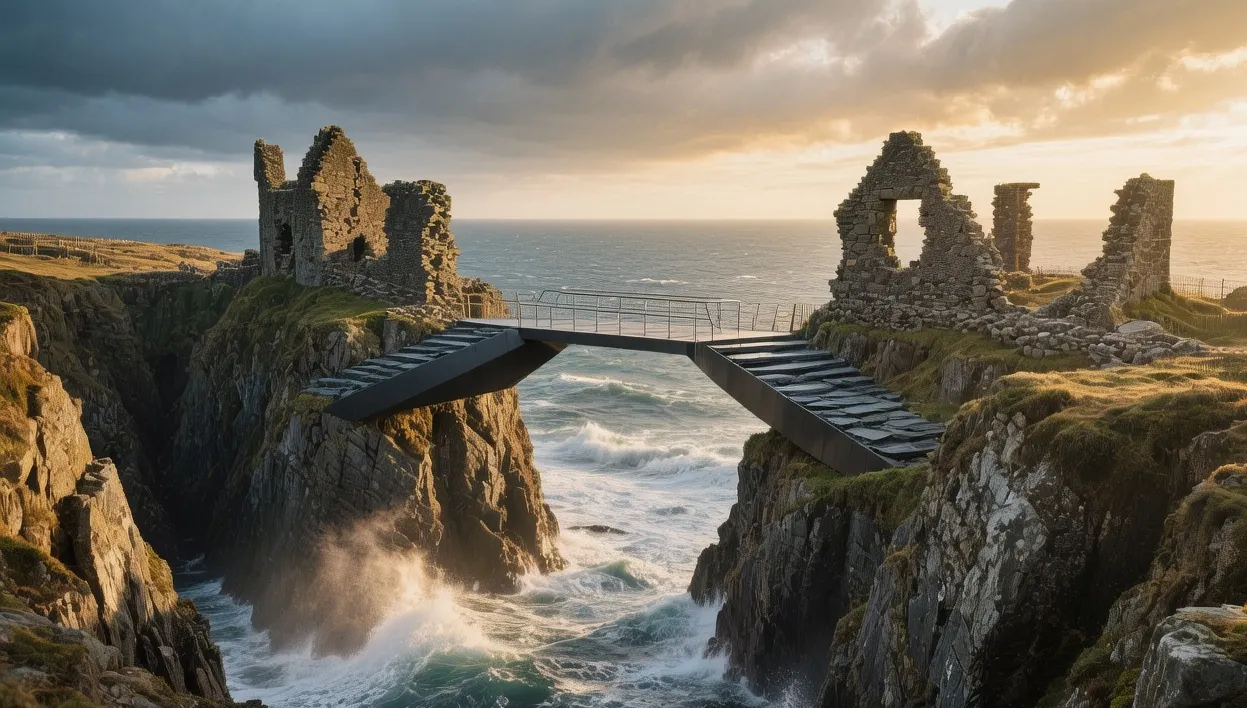
Tintagel Castle Arthurian Legend Meets Atlantic Stone
Wind whips across the slate ruins as dawn breaks over the Atlantic—carrying the salt spray 70 meters (230 feet) up from the crashing waves below to the crumbling walls of the Great Hall. You stand on the edge of the Tintagel Castle headland, tracing the cold stone of a 13th-century fortification built upon a much older Dark Age settlement, while the new footbridge sways gently in the breeze connecting the island to the mainland. Construction of the castle began in 1233 under Richard, Earl of Cornwall, deliberately invoking the myths of King Arthur popularized by Geoffrey of Monmouth a century earlier. As you look out over the grey water where Merlin's Cave lies hidden at the cliff base, you realize this place matters now more than ever: in an age of digital fabrication, the Tintagel Castle offers a tangible connection to the origins of British identity, a physical anchor for legends that continue to shape cultural imagination in 2026.
Why Tintagel Castle Embodies Mythic History
The Tintagel Castle is not merely a ruin; it is a deliberate construction of nationalism wrapped in medieval masonry. While the visible structures date to the 13th century, excavations by English Heritage reveal a prosperous post-Roman settlement from the 5th to 7th centuries, suggesting this was a royal stronghold of the Kingdom of Dumnonia. The site solves a historical problem: providing a physical location for the legendary conception of King Arthur, bridging the gap between oral tradition and archaeological evidence. Technical analysis of the slate walls shows they were built using local Devonian slate bonded with lime mortar, designed to withstand the corrosive sea air that erodes softer limestone.
Today, it fulfills a cultural need for connection to a heroic past. Managed by English Heritage since 1984, the site hosts over 250,000 annual visitors who walk the paths worn smooth by centuries of pilgrims and tourists. The 2019 installation of the 70-meter (229-foot) footbridge engineered by Neyland Architects reconnected the split headland, symbolizing the union of myth and reality. When you walk the bridge, you traverse a space where Dark Age merchants traded Mediterranean wine and Victorian poets sought inspiration. The Tintagel Castle represents a continuous narrative of power and belief, preserved by the very organization that now maintains the grass against the encroaching bracken of the Cornwall countryside.
The Best Time to Experience Tintagel Castle
To witness the Tintagel Castle in optimal atmospheric conditions, plan your visit between May 15 and June 25. During this window, temperatures average 13-18°C (55-64°F), and daylight extends until 9:15 PM, providing ample time for exploring the cliffs. The best light for photography occurs between 7:30-9:30 AM when morning mist lifts off the sea, and 6:00-8:00 PM for golden hour illumination on the slate walls. Visiting early also allows you to cross the footbridge before tour buses arrive from Newquay, typically between 11:00 AM and 3:00 PM.
Autumn offers a secondary window—specifically September 10 to October 15—when summer crowds dissipate and the heathland turns russet and gold. Temperatures remain mild at 11-16°C (52-61°F), though daylight hours shorten rapidly. Avoid July 25 to August 25 when school holidays push visitor numbers above 3,000 daily, creating congestion on the narrow bridge and limited parking in the village. Winter months (November-February) offer solitude but challenging conditions; high winds often close the footbridge for safety, and sunset occurs as early as 4:05 PM in December. For current opening hours and bridge closure notices, verify information at www.english-heritage.org.uk/tintagel or contact the visitor center at +44 (0)1840 770328.
Approximate Budget for a 7-Day Trip (2026)
Exploring the Tintagel Castle and the wider North Cornwall coast requires moderate budgeting, as the region commands premium prices during peak season. The following budget reflects mid-range travel for one person in 2026, accounting for approximately 4.5% UK inflation (ONS data, January 2026). Prices assume a base in Tintagel village or Boscastle for optimal access to the castle and coastal paths.
- Accommodation: £95-£160 per night for a B&B or boutique inn in Tintagel village (6 nights = £570-£960). Budget options: £55-£75 for hostels in Boscastle or camping at Widemouth Bay.
- Food: £50-70 per day total • Breakfast: £10-15 (Full English at The Camelot Castle Hotel) • Lunch: £15-20 (Cornish pasty at The Blue Pig Company) • Dinner: £25-35 (Seafood platter at The Beach or The Old Post Office)
- Transportation: • Train London Paddington to Bodmin Parkway + Bus 594: £75-130 return • Local bus (Route 594): £4.50 day pass • Car rental (recommended): £65/day plus fuel £1.58/liter • Parking at Tintagel Castle: £9/day (March-October)
- Attractions: • Tintagel Castle Entry: £22.50 • Merlin's Cave Access: Free (tide dependent) • Boscastle Museum of Witchcraft: £10 • Free: South West Coast Path, village exploration
- Miscellaneous: • Ordnance Survey Explorer Map 113: £10.99 • Local Arthurian souvenirs: £25 • Travel insurance: £40-60 for week • Waterproof gear rental: £20
Total estimated cost: £1,450-£1,800 for 7 days (excluding international flights)
5 Essential Tintagel Castle Experiences
- Cross the Footbridge at Sunrise: Arrive at the ticket office by 8:00 AM to be among the first across the 70-meter (229-foot) span. The view encompasses the entire ruin complex and the Atlantic horizon. Bring a windbreaker; exposure at this height creates wind chill 5°C below valley temperatures. Spend 20 minutes photographing the slate ruins before crowds arrive. This experience connects you to the engineering feat that reunited the split headland in 2019.
- Explore Merlin's Cave at Low Tide: Check the UK Tide Tables for times below 2.5 meters. Access the beach via the steep path from the castle grounds. Walk into the cavern mouth where the sea rushes in during high tide. The sound of water echoing off the rock walls is deafening. Wear sturdy boots with ankle support; rocks are slippery with seaweed. Return before the tide turns—water can advance 100 meters in 30 minutes.
- Visit the Great Hall Foundations: Walk to the highest point of the island to see the remains of the 13th-century Great Hall. The stone foundations outline the room where Richard of Cornwall held court. Spend 30 minutes examining the interpretive panels explaining the layout. The view from here offers the best perspective of the mainland connection. This context enriches your visit, linking the physical ruins to the historical figures who built them.
- Walk the South West Coast Path: Dedicate 90 minutes to the section north of the castle toward Bossiney Haven. The path climbs 100 meters to clifftops offering panoramic views. The scent of gorse and thrift fills the air. Wear sturdy shoes; paths are uneven and exposed. This experience connects the castle to the wider geological landscape of the North Cornwall Heritage Coast.
- Explore Tintagel Village: Dedicate 60 minutes to walking the main street after your castle visit. Visit the King Arthur's Great Halls museum (£8.50). The village retains a medieval street plan despite Victorian redevelopment. Stop for cream tea at The Tea Garden. This experience provides context for the tourism industry that has sustained the village since the 19th century.
3 Hidden Gems Most Travelers Miss
- Rocky Valley Waterfalls: While crowds cluster at the castle, this inland gorge 2 kilometers south remains surprisingly quiet. Access via the footpath from Tintagel village (parking at SX045895). The site features two waterfalls and ancient rock carvings of unknown origin. Visit between 3:00-5:00 PM when light filters through the trees. No facilities exist—bring water and a headlamp for the return. The National Trust notes this area has high archaeological interest due to the mysterious labyrinth carvings.
- St Nectan's Glen: Contact the site office (+44 (0)1840 770328) for access to this spiritual woodland walk near Trethevy. The 20-meter (65-foot) waterfall flows into a sacred pool used for baptisms. Access is restricted to paid entry (£9.50); open 10:00 AM-5:00 PM. The space offers a tangible connection to Celtic Christianity predating the castle. This site reveals the spiritual landscape that surrounded the fortress before Richard of Cornwall arrived.
- Trethevy Quoit: Located 3 kilometers east, grid reference SX255885, lies a Neolithic burial chamber dating to 3000 BC. Access via a public footpath from the road. The stone structure predates the castle by 4,000 years. Visit during weekday mornings when the site is empty. No facilities exist—bring snacks. This spot demonstrates the deep history of human occupation in the area, offering a raw view of the landscape before Arthurian legend took hold.
Cultural & Practical Tips
- Respect the ruins: Do not climb on loose masonry or venture beyond barrier ropes. English Heritage employs conservation masons who repair damage caused by visitors. Removing stones or graffiti is a criminal offense under the Ancient Monuments Act 1979. Stay on marked paths to protect archaeological deposits beneath the grass.
- Understand tide schedules: The tidal range at Tintagel averages 6-7 meters. Check www.uktides.co.uk before visiting Merlin's Cave. Never turn your back on the sea—rogue waves occur. If trapped by incoming tide, call HM Coastguard immediately at 999.
- Leave no trace: Remove all litter, including biodegradable items. The site collects 10 tonnes of waste annually from the headland. Do not remove stones or plants—this violates the Wildlife and Countryside Act 1981. Photograph fossils in situ instead.
- Learn local terminology: "Quoit" (burial chamber); "Headland" (promontory); "Slate" (local rock). Using these terms shows respect for geological heritage and helps guides assist you better during tours.
- Photography guidelines: Tripods are permitted on the grounds but restricted on the footbridge during busy periods. Drone use requires written permission from English Heritage and Civil Aviation Authority—apply 6 weeks in advance. Respect other visitors; do not block pathways for extended shoots during peak hours (11:00 AM-3:00 PM).
- Weather preparedness: The headland is exposed; wind chill is common even in summer. Pack waterproof layers; Cornwall showers are sudden. Wear sturdy shoes with grippy soles—slate becomes slippery when wet. Sun protection is essential; reflection from sea increases UV exposure by 25%.
- Accessibility considerations: The footbridge is accessible but steep. The island path involves uneven ground. Alternative viewing exists from the mainland path. Request an accessibility map at the ticket office upon arrival.
Conclusion: Travel with Reverence, Not Just Sightseeing
The Tintagel Castle does not exist merely to be photographed—it exists to be understood as a bridge between history and myth. When you walk this headland in 2026, you are not observing a static monument; you are entering a space where legend was manufactured to serve power, and where archaeology continues to rewrite the narrative. The masons who laid the slate are gone, but their work remains embedded in the cliff. The poets who sang of Arthur are gone, but their words still echo in the wind. This is not heritage frozen in amber—it is heritage living, breathing, enduring.
So slow down. Sit on the grassy banks for ten minutes without your phone. Listen to the wind that once carried the sounds of Dark Age trade and now carries the cries of choughs. Buy your lunch from a café whose owners pay rates that support the local community. Donate to English Heritage rather than purchasing plastic souvenirs. Leave only footprints on ancient grass, take only memories of slate against sky, carry home only the profound understanding that some things—history, legend, natural beauty—cannot be rushed, cannot be owned, can only be honored. The ruins will still stand in 2126 if we choose stewardship over exploitation today.