
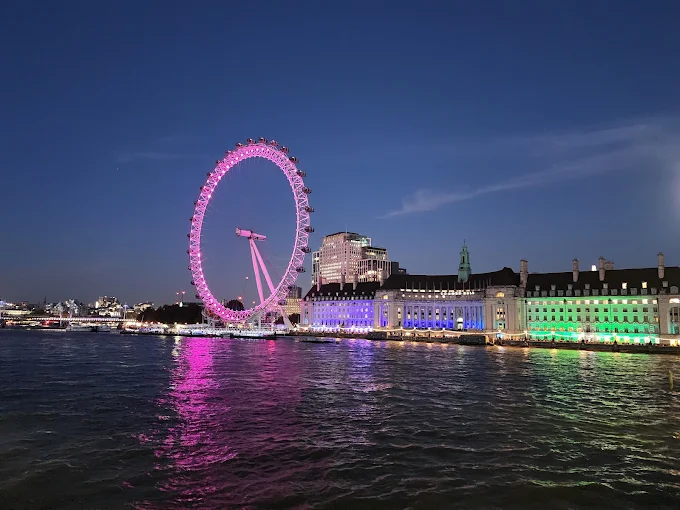
London Eye Cantilevered Engineering Meets Thames River Panorama
The motor hums—a barely perceptible vibration beneath your feet—as the capsule begins its slow ascent, rising 0.26 meters per second into the London sky. You stand inside the climate-controlled glass pod at 6:15 PM, watching the sun dip below the horizon while the Thames River transforms into a ribbon of liquid gold beneath you. Built for the millennium celebrations in 1999, this 135-meter observation wheel was intended to stand for only five years; instead, it became the defining silhouette of modern London, carrying over 85 million visitors since opening. The 32 capsules represent the city's boroughs, rotating once every 30 minutes to offer a 360-degree view stretching 40 kilometers on clear days. From this height, the jagged skyline of the City blends with the historic spires of Westminster, creating a panorama that bridges centuries of urban development. In 2026, as cities worldwide struggle with vertical congestion, visiting the London Eye means experiencing a masterpiece of temporary architecture that became permanent proof that engineering can evoke emotion. This structure matters now because it offers a rare moment of stillness above the rush, allowing you to see the metropolis not as a maze of streets, but as a living, breathing organism.
Why London Eye Embodies Modern Observation Engineering
The London Eye solves the architectural challenge of providing panoramic views without the visual obstruction of traditional support structures—a feat achieved through its unique cantilevered design. Designed by architects David Marks and Julia Barfield of Marks Barfield Architects, the wheel was constructed in 1999 using steel supplied by British Steel, weighing in at 2,100 tons for the rim alone. Unlike traditional Ferris wheels, the Eye is supported on one side only, resembling a giant bicycle wheel lying on its side, with tensioned steel cables acting as spokes to maintain structural integrity. The capsules, each weighing 10 tons and holding up to 25 people, are mounted on the external rim rather than hanging beneath, ensuring unobstructed views through the 25-millimeter-thick curved glass. Engineering-wise, the wheel rotates continuously at a slow pace, allowing passengers to step on and off without the mechanism stopping, though it halts for accessibility needs. Originally permitted as a temporary structure, the London Eye received permanent status in 2002 due to its overwhelming popularity and cultural significance. Today, the structure undergoes regular maintenance, including capsule refurbishments and LED lighting upgrades installed in 2015, ensuring the London Eye remains not merely a tourist attraction but a symbol of Millennium Bridge-era innovation that continues to define the South Bank skyline.
The Best Time to Experience London Eye
For optimal visibility and manageable queues, plan your visit between May 15–June 20 or September 10–October 15, when London's temperatures range from 15–22°C (59–72°F) and daylight extends until 9:00 PM. Arrive precisely at 8:00 AM when tickets open for the first rotation; this allows you to ascend before the tour groups converge by 10:30 AM, ensuring clearer glass and shorter security lines. For photography, the golden hour between 7:30–9:00 PM in summer bathes the Thames in warm light, while blue hour offers dramatic city illumination against a deep blue sky. Avoid July 25–August 31 when school holidays bring peak crowds, pushing wait times beyond 60 minutes despite fast-track tickets. Winter months (December–February) offer shorter lines but temperatures drop to 2–8°C (36–46°F), and high winds may close the attraction for safety. For special events like New Year's Eve, verify schedules at londoneye.com before booking, as the wheel often closes for private functions. Tuesday and Wednesday mornings typically see the lowest visitor volume, allowing for a more contemplative experience above the city.
Approximate Budget for a 7-Day Trip (2026)
London remains a premium destination, but staying in Zone 1 near Waterloo or South Bank provides immediate access to the London Eye without excessive transport costs. These 2026 estimates assume a moderate travel style, accounting for approximately 3-4% annual inflation in UK hospitality and attraction pricing.
- Accommodation: £140–£290 per night for a double room in Waterloo, South Bank, or Covent Garden; budget hostels from £50/night in nearby Elephant and Castle
- Food: £55–85 per day—breakfast £10–14 (full English or café pastry), lunch £15–22 (South Bank market food or pub meal), dinner £30–49 (mid-range restaurant with wine); traditional fish and chips £18
- Transportation: £8.10 daily cap for Zones 1-2 using contactless/Oyster; Heathrow Express £25 one-way or Elizabeth Line £12.80; Thames Clippers river bus £9.40 single Eye to Greenwich
- Attractions: London Eye £35.00 adult, London Eye 4D Experience included, SEA LIFE London £38.00, Westminster Abbey £33.00, Thames cruise £20.00
- Miscellaneous: Souvenir guidebook £15, London Eye keyring £10, rain jacket (essential) £35, travel insurance £50 for week
Total for 7 days: £1,400–1,950 per person (excluding international flights)
7 Essential London Eye Experiences
- Standard Rotation Flight: Board the capsule for a 30-minute rotation reaching 135 meters at the apex. The glass is cleaned daily for clarity; stand near the bench in the center to stabilize yourself during the slight sway caused by wind loads at maximum height.
- Sunset Champagne Experience: Upgrade to the Champagne Ticket for a private capsule with a glass of Pommery Brut. Available for evening slots from 5:00 PM; the bubbles pair perfectly with the view of Big Ben illuminating as dusk falls over the Thames.
- Fast Track Entry: Purchase Fast Track tickets online to bypass the general admission queue. This saves approximately 45 minutes during peak season; proceed directly to the security checkpoint on the riverside terrace rather than the main ticket hall line.
- London Eye 4D Experience: Watch the short 4D film before boarding, featuring sensory effects like wind and rain. Located in the ticket hall; the 8-minute film provides historical context about the wheel's construction and the landmarks you are about to see from above.
- Thames Riverside Walk: After descending, walk the Queen's Walk along the south bank toward Tower Bridge. This 3-kilometer path offers ground-level perspectives of the wheel's structure; stop at the undercroft to see the street art beneath the festival hall.
- Jubilee Gardens Photo Stop: Position yourself in the park directly behind the wheel for the perfect frontal shot. Best light occurs at 7:00 AM when the sun rises behind the structure; use the green space to frame the wheel against the sky without foreground clutter.
- County Hall Crypt Visit: Explore the historic vaults beneath the London Eye ticket office. Open during operating hours; the stone archways date to the 19th century and house exhibitions about the building's history as a local government headquarters.
3 Hidden Gems Most Travelers Miss
- South Bank Undercroft: This skate space beneath the Queen Elizabeth Hall offers gritty street art and urban culture contrasting the polished wheel. Access via the stairs near the Royal Festival Hall; open 24 hours, it features concrete bowls used by skaters since the 1970s—a raw counterpoint to the tourist attraction above.
- Golden Jubilee Bridges: These pedestrian bridges flank the Hungerford Bridge, offering unique angles of the London Eye from river level. Walk across at night when the wheel's LED lights change color; the view from the bridge deck allows you to see the capsule mechanics rotating overhead without obstruction.
- St. Thomas' Hospital Garden: Located across the road from the Eye, this quiet garden offers a secluded bench view of the wheel's rear structure. Access via Lambeth Palace Road; open during daylight hours, it provides a peaceful spot to read while watching the capsules glide silently against the sky—a perspective most visitors miss while queueing.
Cultural & Practical Tips
- Security screening: All visitors pass through airport-style security; prohibited items include large bags (nothing over 45×35×25cm), sharp objects, and tripods. Allow 20–30 minutes for security checks during peak summer hours (11:00 AM–2:00 PM).
- Photography rules: Interior photography is permitted for personal use without flash; tripods are prohibited due to space constraints. Phones must be silenced during the ride; professional cameras require prior written permission from the Merlin Entertainments media team.
- Weather closures: The London Eye closes during high winds (exceeding 50 mph/80 kph) or lightning storms. Check the website on the morning of your visit; tickets are valid for another day if cancelled due to weather.
- Local phrases: Learn "Mind the gap" (watch the step), "Cheers" (thanks), and "Queue here" (wait in line); Londoners appreciate visitors who respect pedestrian flow on the narrow boarding platform.
- Accessibility: The attraction offers step-free access via ramps; wheelchair users remain in their chairs during the rotation. Contact access@londoneye.com 48 hours ahead to arrange assistance and ensure the capsule slows sufficiently for boarding.
- Queue etiquette: Stand behind the marked lines on the terrace; do not cut across the boarding zone while others are disembarking. The rotation slows but does not stop for general admission, so be ready to step on promptly when instructed by staff.
- Respectful behavior: Keep voices lowered inside the capsule; sound carries in the enclosed space. Do not tap on the glass or lean heavily against the panels; the structure is sensitive to weight distribution during rotation.
Conclusion: Travel with Perspective, Not Just Checklists
The London Eye demands more than a selfie at 135 meters—it invites you to contemplate the city sprawl unfolding beneath your feet like a living map. When you rotate above the Thames in 2026, tracing the river's curve through the heart of the capital, you're not just ticking a sightseeing box; you're gaining a rare vantage point that reveals connections between historic landmarks and modern skyscrapers. As overtourism pressures London's landmarks, visiting mindfully means respecting the shared space within the capsule, understanding that this slow revolution offers a moment of pause in a frantic city. Watch silently as the capsules glide, noticing how the light shifts on the water below; listen to the hum of the motor not as mechanical noise but as the heartbeat of observation. Leave only footprints on the capsule floor, take only memories of the horizon, and carry forward the understanding that structures like this endure because they offer us the gift of perspective—reminding us that sometimes, to truly see the world, we must rise above it.