
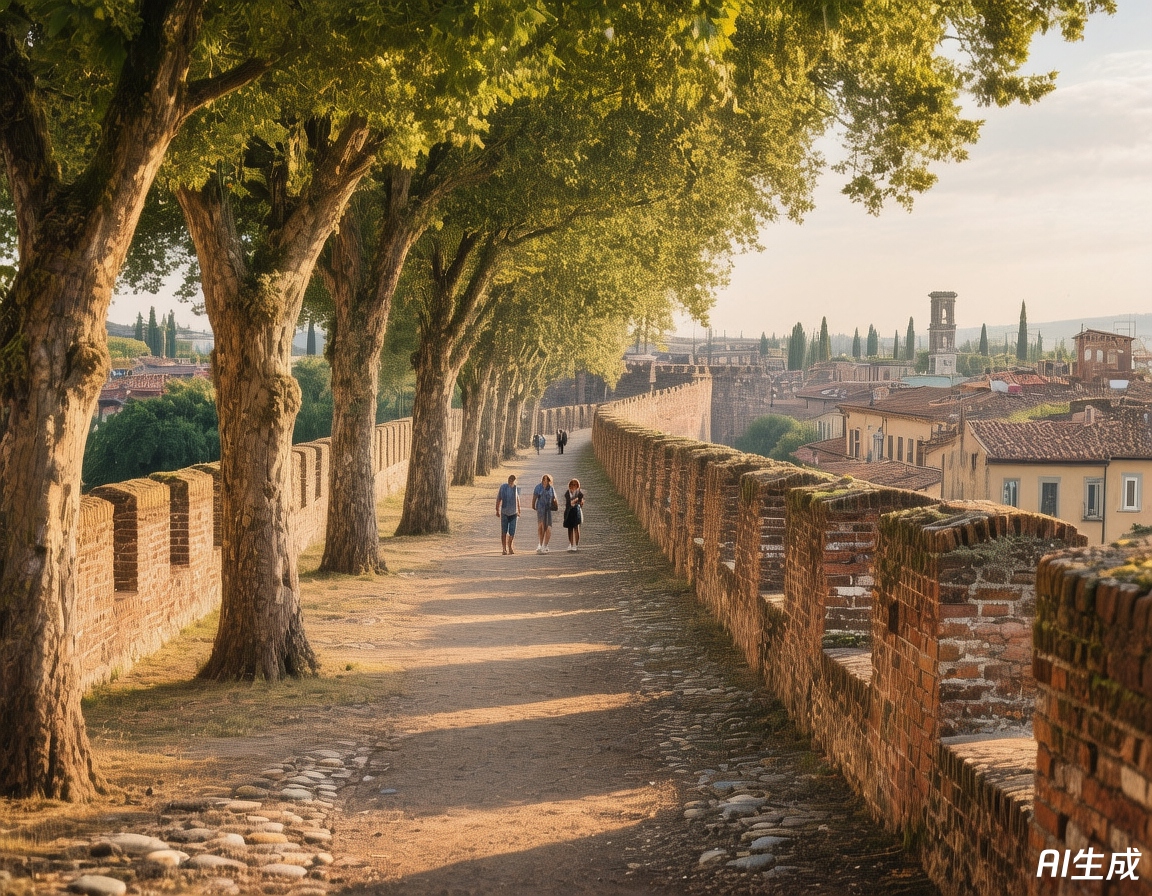
Lucca City Walls Renaissance Stone Meets Living Green
The late sun gilds the treetops of Lucca’s ramparts—casting long shadows across the 4-kilometer loop where locals pedal bicycles, joggers pass beneath chestnut canopies, and children chase kites above ancient stone. You hear the distant chime of San Michele’s bell, the rustle of leaves in the breeze, and the murmur of Italian families gathering on grassy terraces that once bristled with cannons. Built between 1616 and 1650 as Europe’s last great Renaissance fortification, these walls were never fired upon—instead, they evolved into one of the world’s most unique urban parks. Rising 12 meters high and spanning 4.2 kilometers, they encircle Lucca’s medieval heart like a green embrace, offering panoramic views of red rooftops, the Apuan Alps, and the serene Serchio River. In 2026, as cities grapple with car congestion and lost public space, Lucca stands as a model of human-centered design—where defense has become delight, and history breathes through every leaf.
Why Lucca City Walls Embodies Peaceful Innovation
Lucca’s walls aren’t just scenic—they’re a revolutionary act of urban transformation. Constructed between 1616 and 1650 under the Republic of Lucca, they replaced earlier medieval fortifications to counter emerging artillery threats. Designed by architect Alessandro Pieroni, the bastioned walls stretch 4.2 kilometers, stand 12 meters high, and feature 11 massive bastions shaped like arrowheads to deflect cannon fire. Yet their genius lies not in war, but in peace: unlike other Italian cities that demolished their walls for development, Lucca chose preservation. In the 1820s, under Duchess Elisa Baciocchi (Napoleon’s sister), the ramparts were converted into a public promenade planted with over 1,000 trees—cypress, plane, and horse chestnut—that now form a shaded canopy. This 19th-century decision created Europe’s only intact Renaissance wall circuit open entirely to pedestrians and cyclists. The walls solved a profound need: to maintain civic identity while embracing modernity. Today, they function as Lucca’s “green lung,” hosting daily life, festivals, and quiet contemplation—a living monument to choosing harmony over destruction.
The Best Time to Experience Lucca City Walls
To enjoy the walls in comfortable weather and soft light, target the precise window of May 15–29, 2026. During these weeks, daytime temperatures range from a pleasant 18–24°C (64–75°F)—ideal for walking or cycling the full loop [[24], [27]]. Mornings between 8:00–9:30 AM offer crisp air, empty paths, and golden light filtering through the chestnut canopy—perfect for photography. Alternatively, September 12–26, 2026 provides similar conditions with amber autumn hues and fewer tourists. Avoid visiting during peak periods: all of July and August, when heat exceeds 32°C (90°F) and afternoon thunderstorms are common, and major events like the Lucca Summer Festival (July) or Comics & Games (October), when hotels fill months ahead [[29]]. For the most magical experience, walk the walls at sunset—when the Alpine peaks glow pink and the city lights begin to twinkle below. Always verify opening hours via the official Comune di Lucca website (comune.lucca.it).
Approximate Budget for a 7-Day Trip (2026)
This budget reflects mid-range 2025 pricing adjusted for Italy’s projected 2026 inflation rate of 1.5% [[37]], offering a realistic estimate for a solo traveler based in Lucca’s historic center.
- Accommodation: €770–€1,050 total (€110–€150 per night) for a boutique guesthouse or private apartment within the walls—many with rooftop views of the ramparts.
- Food: €490 total (€70 per day). Breakfast at Caffè di Simo (€4 for cappuccino and cornetto); lunch of farro salad with pecorino (€12); dinner at a family-run osteria (€45 for tordelli lucchesi pasta, roasted rabbit, and house Montecarlo wine).
- Transportation: €65 total. Includes train from Florence or Pisa (€20 round-trip); bike rental for 3 days (€30); and occasional taxi for luggage (€15).
- Attractions: €65 total. Guinigi Tower climb (€5); San Martino Cathedral visit (€3); guided walls history walk (€20); bike tour of the ramparts (€25); and gelato from Gelateria Veneta (€4).
- Miscellaneous: €90 total. A high-quality print of the walls (€25); locally made olive oil (€20); leather journal from Libreria Feltrinelli (€30); and espresso at historic Caffè di Simo (€4).
Total Estimated Budget: €1,480–€1,770
6 Essential Lucca City Walls Experiences
- Walk the Full 4.2-Kilometer Loop at Dawn: Start at Porta Santa Maria by 7:30 AM to experience the entire circuit in solitude. The morning light through the trees creates dappled patterns on the brick path—a meditative start to your day.
- Rent a Bike and Circle the Ramparts: At Cicli Raddi near Porta San Donato, rent a classic city bike (€10/day) and pedal the flat, traffic-free path. Stop at Bastion San Colombano for panoramic views of the Apuan Alps.
- Watch Sunset from Bastion San Salvatore: This western bastion offers unobstructed views of the sun dipping behind the mountains. Bring a blanket and local wine for an unforgettable evening.
- Attend a Summer Concert on the Walls: In July–August, free classical and jazz performances are held on Bastion San Pietro. Arrive early to secure a spot on the grassy terrace.
- Climb the Guinigi Tower for Wall-to-Wall Views: Scale 230 steps to the rooftop garden with ancient holm oaks. From here, you’ll see how the walls cradle the city like a protective arm.
- Join the Daily Passeggiata: At 6:00 PM, locals stroll the walls in a centuries-old tradition. Follow their lead—it’s the best way to feel Lucca’s living rhythm.
3 Hidden Gems Most Travelers Miss
- Bastion San Regolo Secret Garden: Tucked near Porta San Jacopo, this lesser-known bastion features a wildflower meadow and century-old magnolia tree—often empty even in high season.
- Libreria Feltrinelli Lucca: This independent bookstore near Piazza San Michele specializes in Tuscan history and art. Its reading nook overlooks a hidden courtyard—perfect for post-walk reflection.
- Orto Botanico di Lucca: Just outside Porta San Donato, this 1820 botanical garden was designed by Elisa Baciocchi herself. Entry is €3, and you’ll likely have it to yourself.
Cultural & Practical Tips
- Wear comfortable shoes or rent a bike: The path is flat and paved, but walking the full 4.2 km takes 1.5 hours. Bikes are faster and more fun for families.
- Respect residential zones: Many homes back onto the walls. Keep noise down after 10:00 PM, especially near Bastion San Colombano.
- Carry water and sunscreen: While trees provide shade, summer sun can be intense. Public fountains at Porta San Donato offer free drinking water.
- Learn key phrases: “Dov’è il giro delle mura?” (doh-VEH eel JEE-roh DEH-leh MOO-reh?) for directions; “Grazie mille” (GRAHT-see-eh MEE-leh) for sincere thanks.
- Photograph responsibly: Drones require permits in historic zones. Early morning offers the best natural light without harsh midday glare.
Conclusion: Travel with Presence, Not Just Pedals
In 2026, Lucca’s walls invite more than exercise—they call for mindful presence. Your choice to walk instead of drive honors a 400-year-old vision of peace; renting a local bike supports family businesses; sitting quietly on a bastion connects you to generations who’ve watched the same sun set over the Alps. Slow down: taste wine pressed from local grapes, listen to the rustle of leaves that once muffled cannon fire, let the rhythm of the ramparts guide your pace. By traveling with presence—prioritizing connection over conquest—you help ensure Lucca remains not just a fortress, but a living model of how cities can grow without losing their soul. Let your journey be a quiet promise—and these walls will remember your respect long after you’ve left their green embrace.