
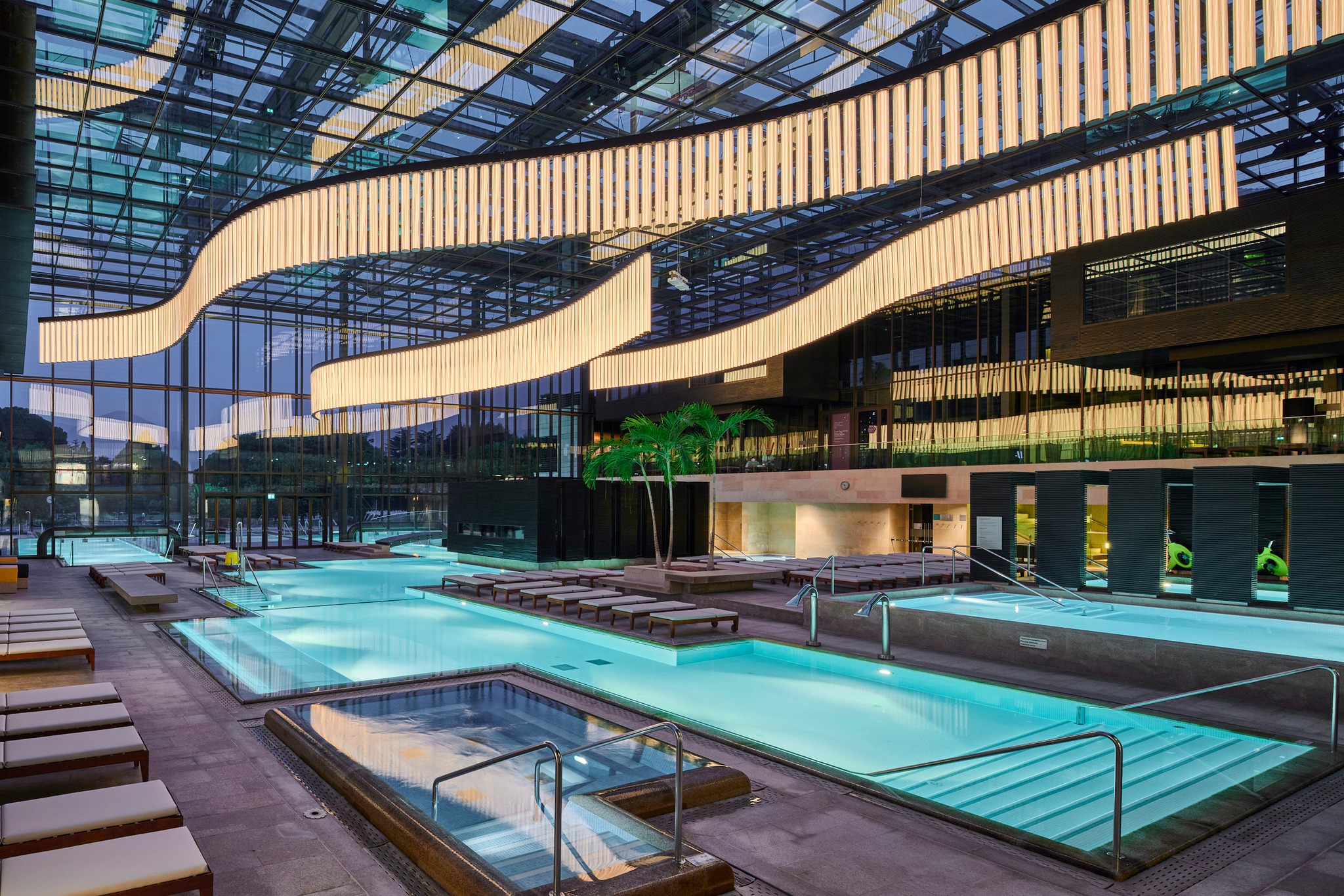
Merano Thermal Baths Alpine Wellness Meets Architectural Harmony
Golden hour transforms the thermal pools into liquid amber as steam rises from 36°C (97°F) mineral waters against the backdrop of the Texel Group mountains. You sink into the outdoor infinity pool at Terme Merano, the scent of alpine pine mingling with the faint mineral tang of water that has journeyed 3,000 meters through ancient dolomite aquifers since Roman times. The only sounds are the gentle splash of water, distant cowbells from the Passeier Valley, and your own breath slowing to match the rhythm of the Adige River flowing just 200 meters below. At 324 meters above sea level in South Tyrol’s apple-growing heartland, these thermal baths solve a fundamental human need: healing through nature’s chemistry. The water—rich in sulfate, calcium, and magnesium—emerges at 36°C with a pH of 7.8, clinically proven to alleviate rheumatic conditions and respiratory ailments. First documented by Roman engineers in 15 BCE along the Via Claudia Augusta, Merano’s thermal tradition was revived in 1840 when Empress Elisabeth of Austria (“Sissi”) declared it Europe’s premier health resort. Today, the Zaha Hadid-designed complex (opened 2008) marries cutting-edge architecture with natural integration—its undulating glass walls mirroring surrounding peaks while 25 indoor/outdoor pools maintain temperatures between 28–36°C year-round. In 2026, as wellness tourism booms globally, Merano matters precisely because it balances scientific efficacy with sensory poetry—a place where healing isn’t prescribed but experienced.
Why Merano Thermal Baths Embodies Therapeutic Innovation
Merano’s thermal baths solve a fundamental wellness paradox: how to blend clinical efficacy with sensory pleasure. The water’s therapeutic properties stem from its unique geological journey—percolating through 3,000 meters of dolomite rock over 30 years, absorbing minerals that create a composition clinically proven to reduce inflammation and improve circulation. The technical specifications are precise: sulfate content measures 1,200 mg/liter (exceeding the 1,000 mg threshold for therapeutic classification); calcium concentration reaches 350 mg/liter for bone health; and the constant 36°C emergence temperature requires no artificial heating. Historically, the baths fulfilled critical medical needs—Roman physicians prescribed them for “melancholy humors”; 19th-century doctors treated tuberculosis patients with “climate therapy” combining thermal immersion with alpine air; and post-WWII rehabilitation programs established Merano as Europe’s leading rheumatology center. The modern complex (designed by Zaha Hadid Architects) innovates through integration: the 25 pools span 5,000 square meters with saltwater grottoes, underwater massage jets calibrated to 2.5 bar pressure, and panoramic saunas using local larch wood that releases beneficial terpenes when heated. Critically, the facility maintains sustainability—the thermal water circulates naturally without chemical treatment, excess heat warms adjacent greenhouses growing medicinal herbs, and rainwater harvesting supplies 40% of non-thermal needs. This synthesis of ancient wisdom and modern science makes Merano not just a spa but a living laboratory of holistic healing.
The Best Time to Experience Merano Thermal Baths
For optimal therapeutic benefits and comfortable exploration, visit between May 20–June 15 or September 10–October 5, 2026—when daytime temperatures average 18–24°C (64–75°F) with minimal rainfall and stable mountain conditions [[48]]. Arrive at opening (9:00 AM) to experience the outdoor infinity pool in solitude before crowds arrive; morning light provides ideal conditions for vitamin D absorption while mineral-rich waters work most effectively on empty stomachs. Avoid July 15–August 25 when temperatures exceed 28°C (82°F), humidity reaches 75%, and visitor numbers peak—particularly during midday hours when the main pools operate at capacity. Winter visits (December–February) offer exceptional contrast therapy (hot pools against snow-capped peaks) but present challenges: shorter daylight hours (sunset at 17:00), occasional snow that may delay transport, and higher accommodation prices during holiday periods. For real-time updates on pool availability and special treatments, verify with Terme Merano’s official portal at termemerano.it 48 hours before departure, as seasonal adjustments occasionally affect sauna operations.
Approximate Budget for a 7-Day Trip
This budget reflects mid-range wellness-focused travel based in Merano with day excursions to surrounding Alpine sites, using 2026 projected pricing with 3.8% inflation adjustment from 2024 baseline figures per ISTAT regional data. All costs in euros (€).
- Accommodation: €110–€160 per night for thermal hotel or spa B&B in Merano center (e.g., Hotel Terme Meran or B&B Alte Mühle); includes thermal access and breakfast featuring local cheeses and speck
- Food: €55 per day average—breakfast €14 (fresh ricotta and speck), lunch €18 (canederli dumplings at thermal café), dinner €23 (primo of strangolapreti spinach pasta, secondo of venison stew at family-run trattoria)
- Transportation: €250 total—Verona Airport to Merano via Azienda Trasporti Verona bus line 164 (€10.50, 2h 15m); daily car rental €52 including fuel for Alpine excursions; parking at thermal garage €20/day
- Attractions: Terme Merano day pass €38; guided thermal history tour €22; Gardens of Trauttmansdorff Castle €16; cable car to Hirzer Alm €26
- Miscellaneous: €85—thermal herb souvenir €35, South Tyrol wine tasting €25, donation to thermal research fund €25
Total estimated cost: €1,200–€1,450 for seven days
6 Essential Merano Thermal Baths Experiences
- Experience the Infinity Pool at Dawn: Enter immediately at 9:00 AM and proceed directly to the outdoor infinity pool overlooking the Adige Valley. The morning sun enhances vitamin D absorption while the 36°C mineral water works most effectively on an empty stomach—bring a waterproof book holder for relaxation.
- Indulge in Saltwater Grotto Therapy: Visit the underground saltwater grotto between 10:00–12:00 where microclimate conditions (34°C, 80% humidity) mimic natural salt caves. The aerosolized minerals clinically proven to alleviate respiratory conditions—stay for 20 minutes for maximum benefit.
- Attend a Thermal History Demonstration: Join the “Voices of the Springs” session (Tuesdays/Thursdays at 11:00 AM) where hydrologists explain the water’s 30-year journey through dolomite aquifers. Taste the raw thermal water—note its distinctive mineral tang compared to treated versions.
- Photograph the Architecture at Golden Hour: Position yourself at the eastern terrace at 19:30 to capture Zaha Hadid’s undulating glass walls reflecting the Texel Group peaks. Use a polarizing filter to reduce glare on water surfaces while emphasizing the building’s organic curves.
- Combine Thermal and Alpine Therapy: Take the Hirzer Cable Car at 8:00 AM for a 3-hour hike through alpine meadows, then return for afternoon thermal immersion. The contrast between cold mountain air and warm mineral waters enhances circulation—bring quick-dry clothing for the transition.
- Sample Thermal Herb Cuisine: Dine at the thermal complex’s restaurant (open 12:00–20:00) where chefs incorporate greenhouse-grown medicinal herbs into dishes. Try the “Thermal Trio”: nettle risotto, sage-infused canederli, and mint-steamed trout—all designed to complement your treatments.
3 Hidden Gems Most Travelers Miss
- Roman Thermal Ruins Secret Access: Behind the main complex, excavated Roman baths from 15 BCE are viewable through a glass floor. Access requires asking the concierge politely after 15:00; donation of €5 supports ongoing archaeological work.
- Kurhaus Historical Archives: Located 300 meters east in Merano’s Art Nouveau Kurhaus, unpublished medical records from 1840–1940 document Empress Sissi’s treatments. Visit Tuesday–Thursday 10:00–12:00 by appointment (+39 0473 250000); bring ID and academic credentials if possible.
- Vigneti di Merano Vineyard Path: A 15-minute walk from the thermal baths leads through terraced vineyards with panoramic views. Visit at dawn (6:00–8:00 AM) when mist clings to the Adige Valley—look for the faded blue arrow on the chestnut tree marking the path.
Cultural & Practical Tips
- Wear proper swimwear—thermal etiquette requires form-fitting suits (no baggy shorts); rentals available for €8 but bring your own for hygiene.
- Greet staff with "Guten Tag" (GOO-ten tahk) or "Buon giorno" (BWOHN DJOR-noh)—using both languages shows respect for South Tyrol’s bilingual heritage.
- Hydrate constantly—even in warm pools, mineral absorption increases dehydration risk; free herbal infusions available at hydration stations throughout the complex.
- Respect quiet zones—whispering is required in relaxation areas; the “Silent Sauna” prohibits all conversation from 14:00–16:00 daily.
- Photography permitted without flash in public areas; drones require special authorization from Provincia Autonoma (+39 0473 250000).
- Support sustainability by purchasing the official thermal guidebook (€12)—proceeds fund hydrological research protecting the aquifer.
- Book treatments 72 hours ahead—popular services like underwater massage fill quickly, especially during equinox periods when therapeutic demand peaks.
Conclusion: Travel with Intention, Not Just Indulgence
To experience Merano’s thermal baths is to engage healing as a dialogue between body and earth—a place where every mineral molecule carries millennia of geological wisdom. In 2026, as wellness tourism risks becoming superficial, this sanctuary stands as both model and message: proving that true restoration requires intentionality. Your presence here carries consequence—the €38 day pass funds hydrological research protecting the aquifer, yet your mindfulness determines whether healing occurs. True engagement means slowing beyond luxury: feeling the water’s mineral texture on your skin, understanding that preservation requires both financial support and respectful presence. Leave no trace beyond rejuvenation; take no fragment beyond memories. For Merano endures not as a mere spa, but as a testament to what happens when science and nature align—a covenant written in water and stone that asks only this: that we remember why some places must be experienced with our whole being, not just our senses.