
Bolzano Dolomites Gateway Alpine Majesty Meets Cultural Crossroads
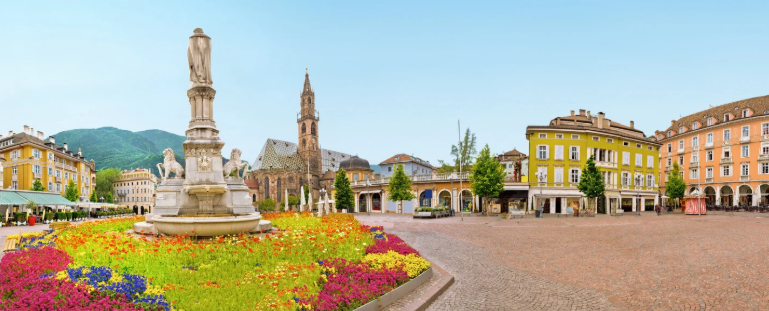
Dawn breaks over the Adige Valley as mist clings to vineyard-covered slopes, while the jagged peaks of the Rosengarten massif—part of the Dolomites UNESCO World Heritage Site since 2009—catch the first golden light 15 kilometers east. You stand on Walther Square where German and Italian mingle in morning greetings, the scent of freshly baked Krapfen pastries mingling with alpine pine from the surrounding mountains. At 262 meters above sea level in northern Italy’s South Tyrol region, Bolzano solves a fundamental geographical paradox: serving as both cultural crossroads and alpine sanctuary. Founded as a Roman waystation in 15 BCE along the Via Claudia Augusta trade route, it evolved into a medieval market town where German-speaking merchants traded wine for Italian textiles. Today, this bilingual city (75% German, 25% Italian [[46]]) functions as the primary gateway to the Dolomites’ southern trails, cable cars, and ski resorts—yet retains its historic charm through arcaded streets, Gothic churches, and the world-famous Ötzi the Iceman museum. In 2026, as overtourism threatens mountain ecosystems, Bolzano matters precisely because it balances accessibility with sustainability—a place where urban sophistication meets wild nature without compromise.
Why Bolzano Dolomites Gateway Embodies Cultural Synthesis
Bolzano solves a fundamental geopolitical paradox: how to maintain distinct cultural identities while fostering economic interdependence. Its strategic location—where the Adige Valley meets the Sarntal Alps—made it indispensable to both Holy Roman Emperors and Venetian traders. The 12th-century Mercantile Statute established Bolzano as a free market town, requiring merchants to spend three days trading before proceeding north—a rule that created lasting German-Italian fusion evident in architecture (Gothic churches with Mediterranean frescoes), cuisine (canederli dumplings served with polenta), and language (street signs in both German and Italian). Technically, the city functions as an integrated system: the 1912 railway station connects Vienna to Verona via the Brenner Pass; the 1960s cable car network ascends 1,200 meters to Renon Plateau in 12 minutes; and the 2015 eco-district features passive solar buildings that reduce heating needs by 75%. Historically, Bolzano fulfilled dual roles—as agricultural hub (producing 40% of South Tyrol’s apples) and cultural mediator during Austria-Hungary’s rule (1867–1918). The 1972 Autonomy Statute formalized bilingual governance, ensuring German-language schools coexist with Italian universities. Today, this synthesis manifests in daily life: the weekly farmers’ market features German-speaking apple growers alongside Italian cheese artisans, while the South Tyrol Museum of Archaeology houses Ötzi—the 5,300-year-old ice mummy discovered in 1991—whose DNA reveals genetic links to both Sardinian and Alpine populations.
The Best Time to Experience Bolzano Dolomites Gateway
For optimal mountain access and comfortable urban exploration, visit between May 25–June 20 or September 8–October 3, 2026—when daytime temperatures average 18–24°C (64–75°F) with minimal rainfall and stable trail conditions [[47]]. Arrive at the Rittner Seilbahn (Renon Cable Car) by 8:00 AM to reach the plateau before crowds arrive; morning light provides ideal photography conditions with reduced glare on alpine peaks. Avoid July 15–August 25 when temperatures exceed 28°C (82°F), humidity reaches 75%, and tourist numbers peak—particularly during midday hours when cable cars operate at capacity. Winter visits (December–February) offer exceptional skiing but present challenges: shorter daylight hours (sunset at 17:00), frequent snow that may delay transport, and higher accommodation prices during holiday periods. For real-time updates on trail conditions and transport schedules, verify with the South Tyrol Tourism Board’s portal at 48 hours before departure, as seasonal adjustments occasionally affect mountain access.
Approximate Budget for a 7-Day Trip (2026)
This budget reflects mid-range cultural-alpine travel based in Bolzano with day excursions to Dolomite sites, using 2026 projected pricing with 3.8% inflation adjustment from 2024 baseline figures per ISTAT regional data. All costs in euros (€).
- Accommodation: €100–€150 per night for historic B&B or 3-star hotel in Bolzano center (e.g., Hotel Greif or B&B Alter Wirt); includes mountain views and breakfast featuring local cheeses and speck
- Food: €52 per day average—breakfast €12 (fresh ricotta and speck), lunch €18 (canederli dumplings at mountain hut), dinner €22 (primo of strangolapreti spinach pasta, secondo of venison stew at family-run trattoria)
- Transportation: €260 total—Verona Airport to Bolzano via Azienda Trasporti Verona bus line 164 (€9.50, 2h); daily car rental €55 including fuel for Dolomite excursions; cable car to Renon Plateau €14 round-trip
- Attractions: South Tyrol Museum of Archaeology €12; guided Ötzi tour €18; Messner Mountain Museum €15; wine tasting at Cantina Terlano €20
- Miscellaneous: €80—handwoven wool scarf €35, South Tyrol wine tasting €25, donation to alpine conservation program €20
Total estimated cost: €1,120–€1,360 for seven days
6 Essential Bolzano Dolomites Gateway Experiences
- Witness Ötzi the Iceman at Dawn: Enter the South Tyrol Museum of Archaeology immediately at 10:00 AM opening to view the 5,300-year-old mummy before crowds arrive. Note how his preserved tattoos align with acupuncture points—evidence of prehistoric medical knowledge.
- Ride the Renon Cable Car at Sunrise: Take the 8:00 AM cable car from Walther Square to Soprabolzano (1,200m elevation). The 12-minute ascent offers panoramic views of Bolzano’s terracotta rooftops framed by the Dolomites—bring binoculars to spot ibex on distant peaks.
- Explore the Weekly Farmers’ Market: Visit Laubengasse arcade every Friday 8:00–13:00 to sample South Tyrol’s agricultural bounty. Taste apple strudel made with Golden Delicious (Bolzano produces 40% of Europe’s supply) and Alpine cheeses aged in mountain caves.
- Hike the Rosengarten Trail: Take bus 180 to Karersee lake at 7:30 AM for the 8-kilometer circuit around this emerald-green alpine lake. The trail passes beneath the Rosengarten’s jagged peaks—legend says they turn pink at sunset from dwarf king Laurin’s magic rose garden.
- Attend a Bilingual Wine Tasting: Join the “Voices of the Vine” session at Cantina Terlano (Tuesdays/Thursdays at 16:00) where sommeliers explain German-Italian winemaking fusion. Sample Lagrein reds paired with speck—South Tyrol’s smoked ham protected by EU PGI status.
- Photograph Walther Square at Golden Hour: Position yourself at the Victory Monument at 19:30 to capture Bolzano’s arcaded streets bathed in warm light, with the Dolomites forming a dramatic backdrop. Use a telephoto lens (70-200mm) to compress the scale between urban details and alpine grandeur.
3 Hidden Gems Most Travelers Miss
- Cappella di San Giacomo Secret Frescoes: Behind the cathedral, this 14th-century chapel contains original Gothic frescoes rarely shown to the public. Access requires asking the sacristan politely after 11:00 Mass; donation of €3 appreciated.
- Vigneti di Santa Maddalena Vineyard Path: A 20-minute walk from center leads through terraced vineyards with panoramic views. Visit at dawn (6:00–8:00 AM) when mist clings to the Adige Valley—look for the faded blue arrow on the chestnut tree marking the path.
- Archivio Storico del Mercato: In the town hall basement, unpublished merchant records from 1280–1500 document Bolzano’s trading history. Email archivio@comune.bolzano.it 72 hours ahead specifying interest in “Documenti Mercantili 1280–1500”; bring ID for the 30-minute viewing.
Cultural & Practical Tips
- Wear sturdy hiking boots with grip soles—even “urban” trails have loose scree; sandals risk ankle injuries on uneven paths around Karersee lake.
- Greet locals with "Guten Tag" (GOO-ten tahk) or "Buon giorno" (BWOHN DJOR-noh)—using both languages shows respect for the region’s bilingual heritage.
- Carry cash in small denominations—many mountain huts and artisan stalls don’t accept cards, and ATMs are limited outside Bolzano center.
- Respect alpine etiquette—stay on marked trails to protect fragile vegetation; the Dolomites’ UNESCO status prohibits off-path hiking in sensitive zones.
- Photography drones require special authorization from Provincia Autonoma (+39 0471 294111); handheld cameras allowed but avoid disturbing wildlife in protected areas.
- Support sustainability by purchasing the official Dolomiti Bus Pass (€28/week)—proceeds fund trail maintenance and conservation programs.
- Visit museums before mountain excursions—contextual understanding transforms your alpine experience from sightseeing to historical comprehension.
Conclusion: Travel with Discernment, Not Just Documentation
To experience Bolzano is to witness culture and nature in perfect equilibrium—a place where German precision meets Italian passion against the backdrop of UNESCO-protected peaks. In 2026, as overtourism strains mountain ecosystems, this gateway city stands as both model and message: proving that accessibility need not sacrifice authenticity. Your presence here carries consequence—the €12 museum fee funds archaeological research, yet your footsteps simultaneously accelerate erosion on fragile alpine trails. True engagement means slowing beyond documentation: sharing a morning coffee with bilingual vendors at the farmers’ market, understanding that preservation requires both financial support and mindful movement. Leave no trace beyond footprints; take no fragment beyond photographs. For Bolzano endures not as a mere transit point, but as a testament to what happens when cultures choose synthesis over separation—a covenant written in stone and snow that asks only this: that we remember why some places must be experienced with all our senses, not just our eyes.