
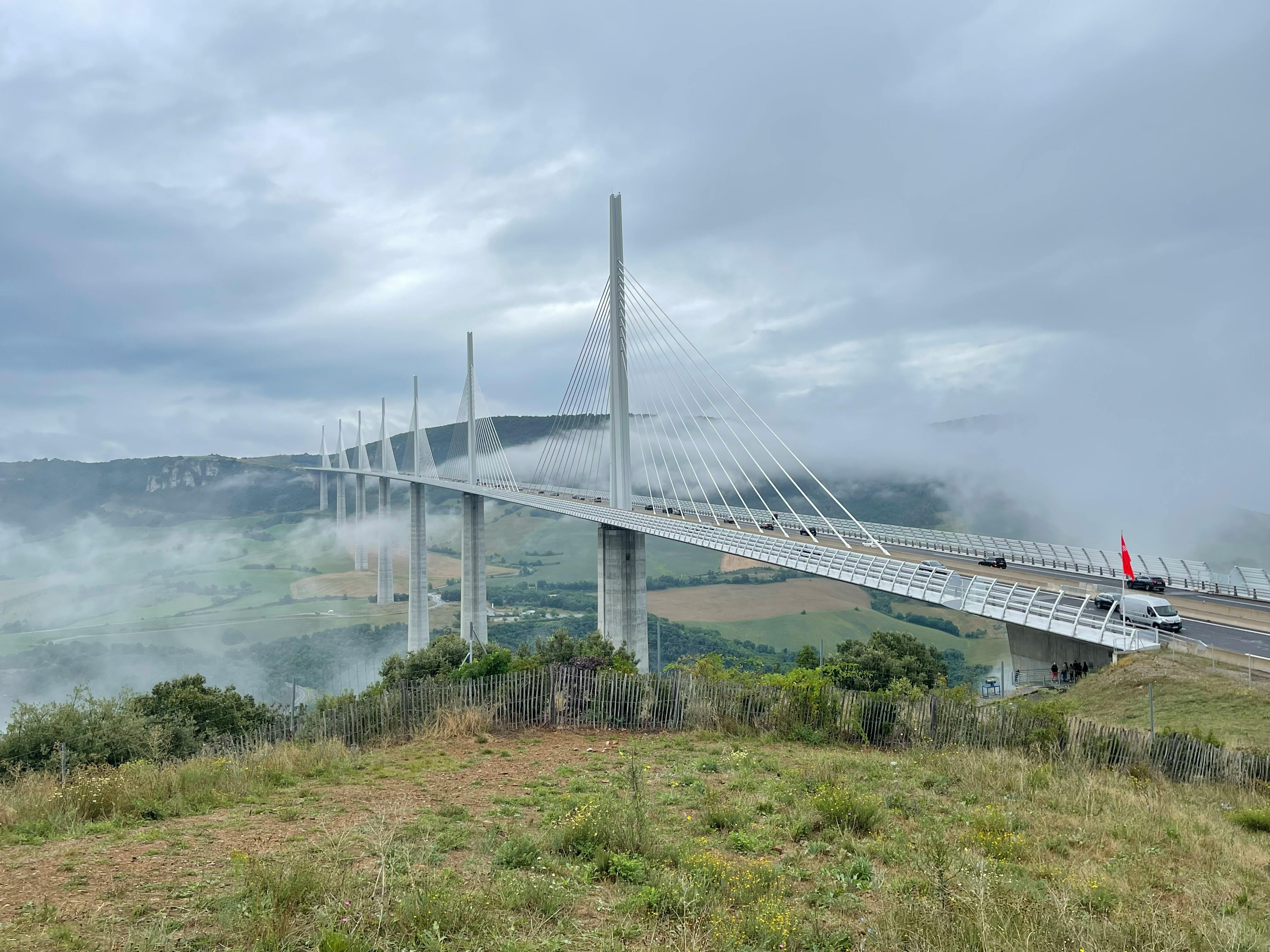
Millau Viaduct : Engineering Grace Meets the Tarn Valley
The first encounter arrives not as spectacle, but as revelation. Driving south from the Massif Central, the landscape opens to reveal the Tarn River valley—a deep green scar winding between limestone plateaus. Then, impossibly, it appears: a silver thread suspended between earth and sky, so slender it seems woven from light rather than steel. As you approach, the scale defies comprehension—the deck floats 270 meters above the valley floor, its seven needle-like pylons rising like sequoias from the forest canopy. Crossing takes precisely three minutes, but the memory lingers: the hum of tires on deck, the whisper of wind through cables, the sudden vertigo of seeing treetops far below your windows. This is not infrastructure as intrusion, but engineering as poetry—a structure that honors landscape rather than dominating it. In 2026, the Millau Viaduct remains Europe's most elegant solution to a practical problem: how to cross a valley without scarring it.
Why the Millau Viaduct Represents Engineering Poetry
The Millau Viaduct embodies more than technical achievement—it represents a philosophical shift in how humanity interfaces with nature. Conceived to alleviate Christmas traffic jams that paralyzed the town of Millau for days, this 2.46-kilometer cable-stayed bridge required audacious vision: Norman Foster's architectural grace married to Michel Virlogeux's structural genius, with deck sections assembled like a Meccano set before being launched across the void. Completed in 2004 after three years of construction, it holds multiple records—the world's tallest bridge (pylon P2 reaches 343m), the highest road bridge deck (270m), and an unprecedented slenderness ratio that makes it appear weightless despite carrying 15,000 vehicles daily. Crucially, its design minimized environmental impact: foundations occupy less than 1% of the valley floor, migratory bird paths were studied to position pylons, and the deck's aerodynamic profile reduces wind resistance without visual bulk. Unlike brute-force infrastructure elsewhere, the viaduct demonstrates that elegance and utility need not compete—a lesson increasingly vital in our era of climate-conscious design.
The Best Time to Experience the Millau Viaduct
For optimal conditions—dramatic cloud inversions, manageable traffic, and photography-friendly light—visit between May 20 and June 10 or September 25–October 15. These windows deliver daytime temperatures of 18–24°C (64–75°F) with frequent morning cloud inversions that pool in the valley, making the viaduct appear to float above a sea of mist—a phenomenon locals call "la mer de nuages." Arrive at the official Espace Eiffel viewpoint by 6:30 AM to witness this spectacle as the sun burns through clouds, illuminating the deck's cables with ethereal clarity. September offers a second excellent opportunity: stable high-pressure systems create crystal-clear air ideal for long-lens photography, with golden hour light gilding the limestone plateaus. Avoid July 15–August 15 when holiday traffic creates congestion (though the viaduct itself rarely jams), and winter months when dense fog frequently obscures views entirely. Note that the viaduct remains open year-round except during extreme weather—real-time conditions available at viaduc-de-millau.fr.
Approximate Budget for a 7-Day Trip (2026)
Based on 2025 benchmarks adjusted for 4% inflation (per INSEE and Occitanie Tourism Board projections), here's a realistic mid-range budget for a southern Massif Central itinerary:
- Accommodation: €85–€125 per night for a family-run guesthouse in Millau's historic center or a rural gîte in the Causse Rouge—essential for early viaduct access.
- Food: €80–€95 per day—breakfast at lodging, lunch of aligot (cheese-potato purée) at village café (€18–€22), dinner featuring Roquefort cheese and local wine (€40–€50).
- Transportation: €52 for a 7-day car rental (€48/day with insurance). Fuel costs: ~€70/week. Viaduct toll: €9.40 southbound (northbound free). No viable public transport to viewpoints.
- Attractions: Espace Eiffel visitor center: free. Guided engineering tour (Saturdays only): €18. Kayak descent of Tarn River: €38. Roquefort cheese cave tour: €15. Allocate €110 total.
- Miscellaneous: €50 for local Laguiole knives, Roquefort cheese direct from affineurs, or contributions to the Conservatoire des Sites Naturels.
Total Estimated Cost: €1,050–€1,450 for seven days, excluding international flights.
5 Essential Millau Viaduct Viewpoints and Experiences
- Espace Eiffel Official Viewpoint: The purpose-built terrace 400m from the viaduct's base—arrive by 7:00 AM for unobstructed photography before tour buses arrive. Interpretive panels explain engineering in accessible terms.
- Corniche de Millau Road: The D992 mountain road winding below the viaduct—stop at Belvédère du Pas de l'Escalette for the classic postcard view where the entire structure arcs across the valley.
- Tarn River Kayak Perspective: Paddle beneath the central span at dawn when mist rises from the water—rentals from Base de Loisirs de Soulages (book ahead for 8:00 AM departure).
- A75 Motorway Crossing: Experience the engineering firsthand—drive across at sunrise when light streams through cables creating dramatic shadows on the deck (southbound direction offers best views).
- Plateau du Causse Viewpoint: Hike the GR6 trail to the limestone plateau above the viaduct for the only perspective looking downward onto the deck—a humbling reminder of human scale.
3 Hidden Gems Most Travelers Miss
- Belvédère de la Cascade du Saut: A 15-minute drive south to this unmarked pullout (between km markers 42–43 on D992) offers the only perspective where the viaduct frames the Tarn River's waterfall—locals photograph here at 6:45 AM when mist rises from the cascade.
- Village of La Cavalerie: Perched on the causse above the viaduct, this medieval village's church tower provides an elevated vantage point rarely visited—climb the bell tower (ask permission at mairie) for sunrise views.
- Atelier du Viaduc: A workshop in Millau town center where retired construction engineers build 1:200 scale models using original blueprints—open Tuesday afternoons by appointment (+33 5 65 60 12 34).
Cultural & Practical Tips
- Driving Protocol: Speed limit on viaduct is strictly 110 km/h—radar enforced. Never stop on emergency lanes for photos; use designated viewpoints only. Southbound toll collected electronically (Liber-t system)—ensure rental car has transponder.
- Photography Safety: Never attempt drone flights—the viaduct sits beneath military flight paths and within protected airspace. Tripods permitted only at official viewpoints, never on roadsides.
- Learn Key Phrases: "Bonjour," "Merci," and "Où est le meilleur point de vue?" (Where is the best viewpoint?) show respect in this proudly Aveyronnais region.
- Weather Awareness: Valley microclimates shift rapidly—carry layers even in summer. Fog can reduce visibility to zero within minutes; check Météo-France app before driving.
- Support Local Stewardship: Purchase Roquefort directly from affineurs in Combalou caves rather than supermarkets—revenue sustains traditional pastoralism that maintains the landscape the viaduct crosses.
Conclusion: Travel with Engineering Reverence, Not Just a Camera
The Millau Viaduct endures not as monument to human dominance, but as testament to thoughtful coexistence with landscape. As a conscious traveler, your presence should honor this philosophy: cross the deck slowly to appreciate its grace rather than rushing toward destinations, support the farmers whose sheep still graze beneath the pylons as they did before construction, and understand that this structure's true success lies not in records broken, but in problems solved without sacrifice. Sit quietly at the Espace Eiffel viewpoint at dusk and watch the deck lights ignite like a constellation strung between mountains—the same stars that guided shepherds through this valley for millennia. By approaching the viaduct not as backdrop for achievement, but as teacher of balance, you help ensure such projects continue prioritizing harmony over hubris—for those who recognize that the most advanced engineering doesn't conquer nature, but converses with it.