
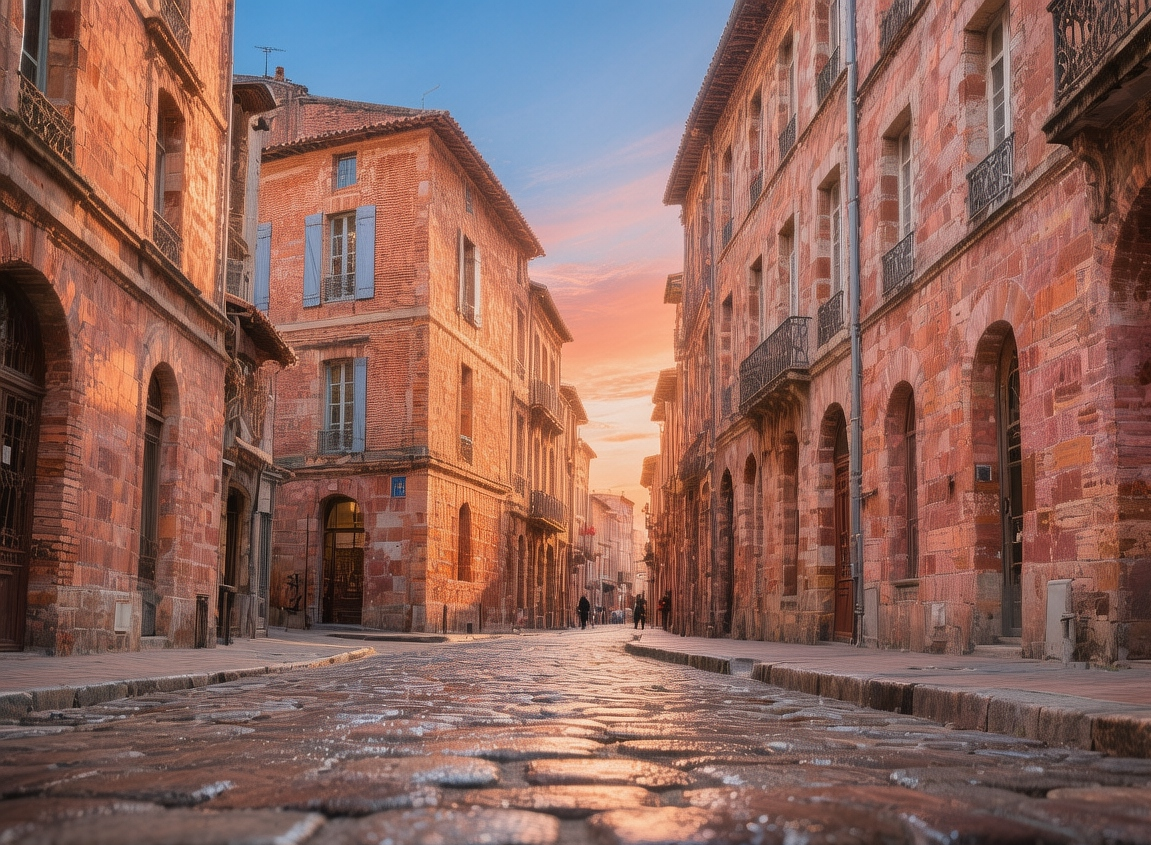
Toulouse Pink City : Terracotta Light Meets Occitan Soul
The color arrives before comprehension. Walking from the Métro toward Capitole Square, the world shifts from gray concrete to a warm, luminous rose—not painted on surfaces, but baked into them. Every façade, every archway, every cobblestone seems to radiate a soft terracotta glow, intensified by the particular quality of southern light that filters through plane trees lining the Garonne River. This is not cosmetic prettiness but geological truth: for eight centuries, Toulouse builders quarried local clay rich in iron oxide, firing it into bricks that absorb daylight and release it as gentle radiance. The effect deepens at dusk when streetlamps ignite and the entire city appears to blush from within. In 2026, Toulouse pink city remains Europe's most authentically hued urban landscape—not a marketing gimmick, but a testament to place-based architecture where geology, history, and daily life converge in every sun-warmed wall.
Why Toulouse Pink City Embodies Authentic Southern Character
Toulouse pink city represents more than chromatic charm—it embodies Occitan identity forged through resilience. The city's distinctive hue stems from practical necessity: after devastating fires in the 14th century destroyed timber-framed structures, builders turned to abundant local clay, creating fire-resistant brick architecture that evolved into an aesthetic signature. Unlike cities that adopted color for tourism, Toulouse's pink emerged organically and persisted through centuries of change—from its zenith as Europe's "Violet Capital" (cultivating 7,000 hectares of flowers for perfume) to its modern role as Europe's aerospace hub hosting Airbus headquarters. This duality defines contemporary Toulouse: medieval pink brick houses neighbor aerospace engineering firms, student bicycles weave past 17th-century mansions, and the Occitan language still echoes in market squares despite centuries of French linguistic dominance. As France's fourth-largest city yet retaining village-scale intimacy, Toulouse succeeds not through preservation behind glass, but by allowing its pink heart to beat within a living, working metropolis.
The Best Time to Experience Toulouse Pink City
For optimal conditions—intense brick radiance, comfortable temperatures, and authentic local rhythm—visit between April 25 and May 20 or September 18–October 8. These windows deliver daytime temperatures of 18–25°C (64–77°F), when the angle of southern sun maximizes the iron oxide's reflective properties without harsh glare. Mornings between 8:00–10:00 AM offer the most dramatic illumination: low-angle light transforms Place du Capitole's arcades into corridors of rose-gold while casting long shadows that accentuate architectural details. September provides a second excellent opportunity: warm days, departing summer crowds, and autumn light that intensifies the terracotta tones as vines begin to redden on ancient walls. Avoid July 15–August 15 when temperatures exceed 34°C (93°F), making brick surfaces radiate uncomfortable heat and narrow streets feel stifling. Note that winter months (November–February) offer stark beauty with empty squares ideal for photography, though many outdoor cafés reduce hours and mistral winds can create biting chill.
Approximate Budget for a 7-Day Trip (2026)
Based on 2025 benchmarks adjusted for 4% inflation (per INSEE and Occitanie Tourism Board projections), here's a realistic mid-range budget for a Toulouse-focused itinerary:
- Accommodation: €90–€135 per night for a family-run guesthouse in Carmes district or boutique hotel near Place Wilson—essential for experiencing neighborhood life beyond tourist zones.
- Food: €85–€100 per day—breakfast at bakery (€6), lunch of cassoulet or duck confit at market hall (€18–€24), dinner featuring violet-infused dishes with Fronton wine (€42–€52).
- Transportation: €22 for a 7-day Pastel Pass (covers all Métro, buses, and VélôToulouse bike rentals). Train from Paris Montparnasse: €55–€85 one-way (4h45 via SNCF Connect).
- Attractions: Capitole guided tour: €12. Saint-Sernin Basilica tower climb: €8. Musée des Augustins: €9. Canal du Midi boat tour: €26. Allocate €100 total.
- Miscellaneous: €55 for violet candies from Nougat de Toulouse, artisanal cassoulet kits, or hand-painted ceramics from Rue des Arts.
Total Estimated Cost: €1,000–€1,450 for seven days, excluding international flights.
5 Essential Toulouse Pink City Experiences
- Place du Capitole: The city's political and social heart—arrive by 8:30 AM to witness the square empty of crowds, with morning light igniting the pink brick façade of the Capitole building and its celebrated 1883 frescoed ceiling.
- Saint-Sernin Basilica: Europe's largest remaining Romanesque structure built from distinctive pink brick—climb the tower at 10:00 AM for panoramic views where the entire city glows terracotta beneath your feet.
- Canal du Midi: The 17th-century UNESCO waterway lined with plane trees—rent a véloToulouse bike (€3/day) and cycle the shaded towpath at dawn when mist rises from the water and brick bridges glow rose-gold.
- Marché Victor Hugo: The covered market beneath Place Victor Hugo—descend at 9:00 AM to witness vendors arranging regional specialties beneath vaulted pink brick arches, with natural light filtering through skylights.
- Rue du Taur: The ancient pilgrim route ascending to Saint-Sernin—walk slowly between 4:00–5:30 PM when afternoon light streams through narrow passages, setting centuries-old brickwork ablaze.
3 Hidden Gems Most Travelers Miss
- Cour de la Patte d'Oie: Behind No. 35 Rue des Lois, an unmarked archway leads to a hidden 17th-century courtyard where pink brick arcades frame a central fountain—locals call it "la cour des roses" for its climbing Rosa gallica.
- Jardin Raymond VI Secret Bench: In this riverside park, a solitary wrought-iron bench positioned beneath a centuries-old plane tree (coordinates: 43.6045° N, 1.4442° E) offers the only perspective where the Garonne's curve frames the entire pink city skyline at sunset.
- Atelier de la Brique: A working brickmaker's studio hidden in a vaulted cellar at 12 Rue du Languedoc—observe artisans using traditional molds and local clay to repair historic façades (open Wednesday mornings by appointment: +33 5 61 22 88 41).
Cultural & Practical Tips
- Respect Residential Rhythm: Many pink brick buildings house multi-generational families. Never block narrow passages with luggage—streets like Rue du Taur are essential thoroughfares, not photo backdrops.
- Market Etiquette: At Marché Victor Hugo, greet vendors with "Adishatz" (hello in Occitan) before browsing. Never touch produce—vendors select items as sign of quality assurance.
- Learn Key Phrases: "Merci," "Adishatz," and "Un cassoulet toulousain, si possible" show respect in this proudly Occitan region where southern French dialects remain vibrant.
- Photography Protocol: Tripods prohibited on narrow streets before 10:00 AM—they obstruct passage. Best architectural shots captured between 8:30–9:30 AM when eastern light illuminates brick textures without crowds.
- Support Authentic Commerce: Purchase violets directly from L'Occitane en Provence's Toulouse flagship (not airport shops) or cassoulet kits from Maison Dénat rather than souvenir stalls selling imported goods.
Conclusion: Travel with Terracotta Consciousness, Not Just a Lens
Toulouse pink city endures not as attraction to be consumed, but as living testament to place-based identity—where geology literally shapes culture. As a conscious traveler, your presence should honor this continuity: dine at family-run estaminets where recipes pass through generations, support artisans preserving brickmaking techniques threatened by modern construction, and understand that your footsteps tread ground where Occitan troubadours once sang of courtly love beneath these same rose-hued walls. Sit quietly on the Garonne riverbank at dusk and watch the city blush as daylight fades—the same transformation witnessed by Raymond IV before the First Crusade and by Airbus engineers today. By approaching Toulouse not as backdrop for social media, but as sanctuary demanding quiet respect, you help ensure these bricks continue to shelter not just history, but humanity—for those who recognize that true color resides not in pigment, but in the dignified persistence of place.